


Right then, let's get into what a virtual receptionist in Australia actually is. At its core, it’s a service that handles your incoming calls remotely, giving you a professional front desk without the overheads of an in-house employee. This is a game-changer for busy SMEs, tradies, and real estate agents who simply can't afford to miss a single client enquiry.
What Exactly Is a Virtual Receptionist in Australia?
Picture this: a plumber is on a noisy job site, or a real estate agent is in the middle of a property viewing. That ringing phone is almost always a missed opportunity. A virtual receptionist steps in to solve this exact problem, providing a dedicated professional—either a real person or a sophisticated AI—to manage your calls, book appointments, and even qualify leads on your behalf.
It's like having a full-time receptionist on the payroll, but you only pay for the time they're actually working for you.
This is worlds away from a clunky old answering machine. It's a dynamic, scalable extension of your business that ensures every single caller is greeted professionally, their needs are understood, and their details are captured perfectly.
The Modern Front Desk, Reimagined
Think about a traditional receptionist sitting at a desk in an office. They greet people, answer the main phone line, and direct calls. A virtual receptionist does all of that, just from a different location. They can:
- Answer and screen calls: They'll filter out the tyre-kickers and spam calls, making sure only genuine customer enquiries get through to you.
- Take detailed messages: You'll get all the crucial information you need to follow up properly. No more half-baked messages.
- Schedule appointments: They can book meetings or consultations directly into your calendar, saving you the back-and-forth.
- Provide basic information: They can handle common questions about your business, like your opening hours or services.
Before we go on, let's break down the core functions that make this service so valuable for a small or medium-sized business.
Core Functions of a Virtual Receptionist
Here’s a quick look at the primary tasks a virtual receptionist can take off your plate, freeing you up to focus on what you do best.
| Function | Description | Key Benefit for SMEs |
|---|---|---|
| Live Call Answering | A professional answers every call in your business name, ensuring no call goes to voicemail. | Never miss a lead again. Captures every opportunity, boosting potential revenue. |
| Appointment Booking | Integrates with your calendar (e.g., Google Calendar, Calendly) to schedule appointments in real time. | Saves you hours of admin time and eliminates double bookings. |
| Message Taking & Forwarding | Takes detailed, accurate messages and forwards them to you instantly via SMS or email. | You get the right info, fast, so you can prioritise and respond effectively. |
| Lead Qualification | Asks pre-set questions to determine if a caller is a potential customer, a time-waster, or a current client. | Your sales team only deals with warm, qualified leads, improving conversion rates. |
| Customer Service FAQs | Answers common questions about your services, pricing, or business hours based on a provided script. | Improves customer experience and reduces the number of simple queries you have to handle yourself. |
As you can see, it's not just about answering the phone. It's about actively managing your customer interactions and streamlining your operations.
This remote setup offers incredible flexibility. For an Aussie business, it means you can have a local presence, complete with a local phone number, without being chained to a physical office. It builds a seamless customer experience that projects trust and a professional image, no matter how big or small your operation is.
A virtual receptionist bridges the gap between being a one-person show and running a fully staffed office. It lets small businesses punch well above their weight, offering the same level of customer service as the big players.
The market for these services is well-established right across the country. You'll find a heap of top providers in hubs like Melbourne, Sydney, and Brisbane, all geared towards helping Australian SMEs. Many of these companies focus squarely on virtual receptionist duties, offering a really specialised skill set for local businesses. You can get a sense of the top players by checking out Clutch.co's Australian rankings.
Ultimately, it’s a powerful tool that helps you capture every lead, get your operations in order, and focus on your actual work, all while knowing your phone lines are in expert hands.
AI Assistants Versus Human Receptionists
So, you're looking for a virtual receptionist in Australia. One of the first big decisions you'll face is whether to go with the empathetic touch of a real person or the non-stop efficiency of an AI assistant. This isn't just about choosing tech over tradition; it’s about figuring out what your business actually needs. An agent in real estate has very different needs from a tradie trying to answer every single call that comes through.
A human receptionist is brilliant at navigating those tricky, unexpected, or emotional conversations. They can pick up on tone, show genuine empathy, and think on their feet when a problem isn't covered by a script. For any business where building that personal connection is gold, this human touch is hard to beat.
But let's be realistic, human receptionists have their limits. They work set hours, need to take breaks, and can only handle one call at a time. If you're dealing with a high volume of calls or need someone on deck after hours, you're going to miss opportunities. It’s a classic bottleneck.
The Rise of AI-Powered Service
This is exactly where AI assistants are changing the game. An AI-powered virtual receptionist is on the clock 24/7, 365 days a year. You'll never miss a call again, whether it rings at 3 PM or 3 AM. It can juggle hundreds of calls at once, which means your callers will never hear a busy signal.
And forget those clunky, robotic voice systems from years ago. Modern AI has come a long way. Today's assistants can understand natural language, book appointments straight into your calendar, ask smart questions to qualify leads, and even log all the call details directly into your CRM. For a busy mortgage broker, this is a lifesaver—every online enquiry can trigger an immediate, intelligent callback from the AI.
The real power of AI is its ability to handle repetitive, data-driven tasks with perfect speed and accuracy. It frees up your team to focus on the high-value conversations that really do need a personal touch.
A Head-to-Head Comparison
To make the choice a bit clearer, let's break down the key differences between these two powerful options. The table below shows you how each one stacks up in different situations, helping you see which is a better fit for your Australian business.
AI vs Human Virtual Receptionist: A Head-to-Head Comparison
| Feature | AI Virtual Receptionist | Human Virtual Receptionist |
|---|---|---|
| Availability | 24/7/365, including public holidays, without fail. | Typically standard business hours, with potential for limited after-hours support at a higher cost. |
| Call Capacity | Can handle hundreds of calls simultaneously, ensuring no caller ever gets a busy signal. | Manages one call at a time, which can lead to missed calls during peak periods. |
| Cost-Effectiveness | Generally lower cost, often based on usage or a flat monthly fee. Highly scalable without a linear price increase. | Higher cost due to wages and service fees. Scaling up means adding more receptionists, increasing costs significantly. |
| Consistency | Provides a perfectly consistent brand experience on every call, following the script and process exactly every time. | Performance can vary based on the individual's mood, training, and workload. |
| Emotional Nuance | Limited ability to understand complex emotions, sarcasm, or highly nuanced problems. Best for structured tasks. | Excels at empathy, building rapport, and de-escalating difficult situations with a human touch. |
| Data Integration | Seamlessly integrates with CRMs and calendars, logging data instantly and accurately without manual entry. | Requires manual data entry, which can sometimes lead to errors or delays. |
At the end of the day, the right choice really hinges on what your business needs most.
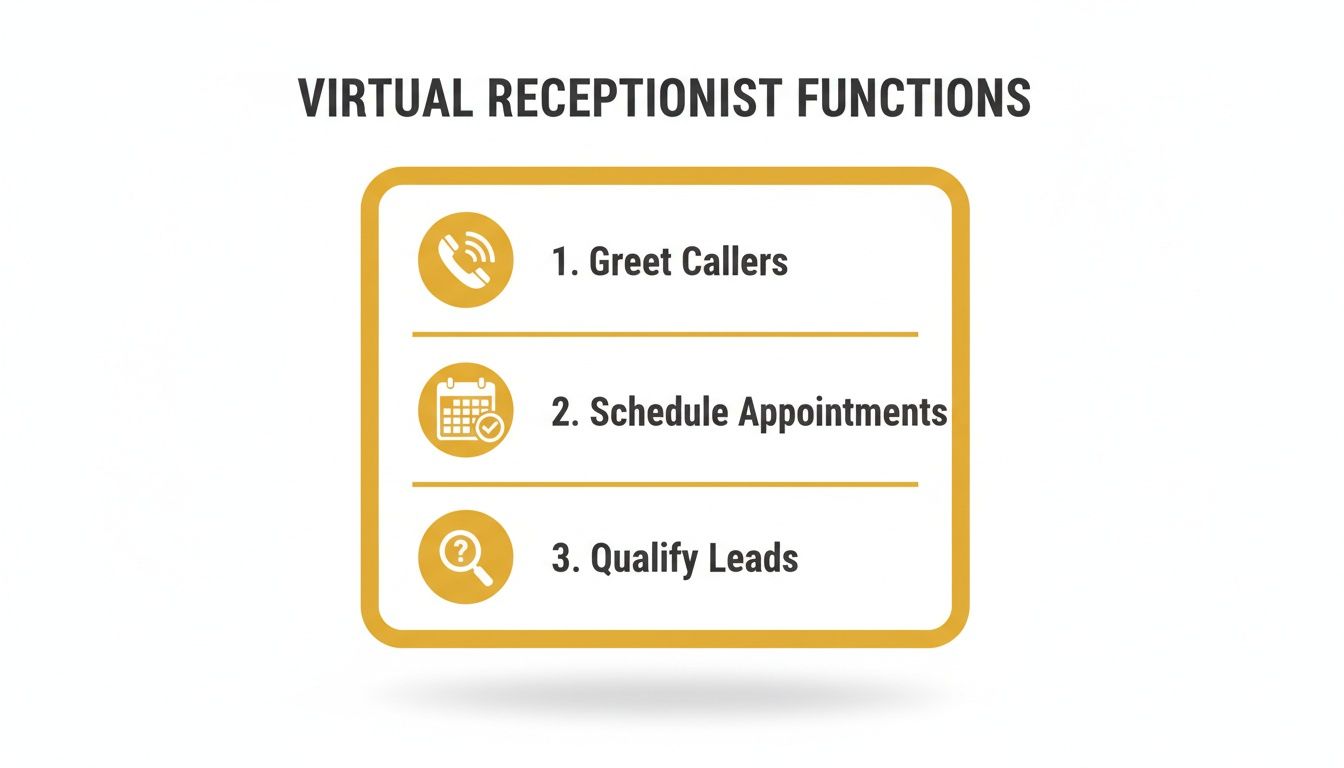
As you can see, core tasks like greeting callers, scheduling appointments, and qualifying leads can be handled by either one. The big difference is how they get the job done.
What many businesses are doing now is getting the best of both worlds with a hybrid approach. They let an AI handle all the initial calls, filter out the spam, and manage routine bookings. Then, any complex or high-value calls get routed straight to a human team member. This model gives you unbeatable efficiency backed by a personal touch right where it counts. You can dig deeper into how this works by exploring our complete guide to the modern AI answering service.
Essential Features for Australian Businesses
A quality virtual receptionist service does far more than just answer the phone. For a busy Australian business, the right features can be the difference between treading water and properly scaling up. It's all about having a system that actively generates leads, smooths out your workflow, and projects the image of a highly organised, professional operation—even if you're a sole trader working from a ute.
These services aren't just about taking messages anymore; they've evolved to become a core part of your business engine. They give you the practical tools that drive real growth, turning missed calls into booked jobs and casual enquiries into genuinely qualified leads.
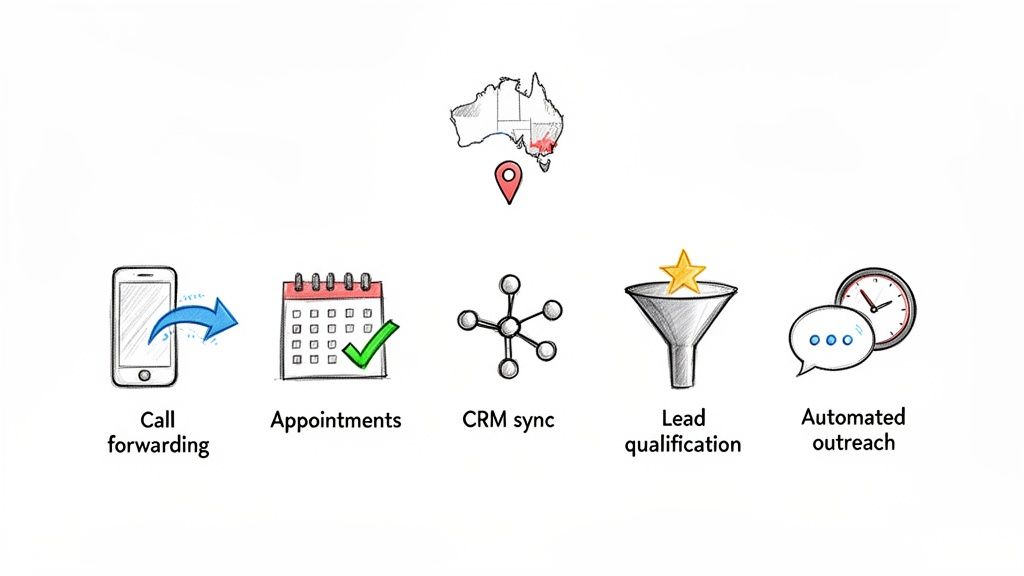
Let's break down the essential features that deliver the most value, starting with the fundamentals and then moving into the more advanced capabilities that give you a serious competitive edge.
Core Functionalities Every Business Needs
Before you get wowed by fancy features, it’s vital to make sure any potential provider absolutely nails the basics. These are the non-negotiables that form the foundation of a reliable virtual receptionist service here in Australia.
- Customised Call Answering: Your receptionist should answer every single call with a personalised greeting, using your business name. It's a simple touch, but it immediately establishes professionalism and brand consistency from the first second.
- Appointment Scheduling: The ability to book appointments directly into your calendar is a massive time-saver. A good service will integrate seamlessly with platforms like Google Calendar or Calendly, which stops double-bookings and kills the endless back-and-forth emails.
- Intelligent Call Forwarding: Not every call needs to end in a message. You need the flexibility to have urgent or high-value calls transferred straight to your mobile or a specific team member. This ensures you're always available for those critical conversations.
These core functions are just the starting line. The real power comes when you add features that automate and fine-tune your lead management process.
The goal isn’t just to stop missing calls. It's to build a system where every single incoming call is handled perfectly, maximising its potential value to your business without you lifting a finger.
Advanced Capabilities That Drive Growth
Once the basics are locked in, advanced features can transform your receptionist from a simple answering service into a proactive business development tool. This is where you really start to see a significant return on your investment.
Intelligent Lead Qualification
Picture this: a property manager's phone is ringing off the hook with tenant enquiries, maintenance requests, and new landlord leads. Intelligent lead qualification lets your virtual receptionist ask specific, pre-determined questions to sort these callers out automatically.
This means an urgent maintenance issue can be flagged immediately, while a hot new landlord lead is captured with all the right details and prioritised for a prompt callback. For a mortgage broker, this feature could filter out applicants who don't meet basic lending criteria, making sure you only spend your valuable time on viable leads. You can get a better idea of how this works by exploring how providers deliver intelligent call routing.
Seamless CRM Integration
Let's be honest, manually entering caller details into your Customer Relationship Management (CRM) system is a tedious and error-prone job. Seamless CRM integration is a must-have for any serious business.
When a call comes in, the virtual receptionist can automatically:
- Create new contacts for anyone calling for the first time.
- Log call details under existing client profiles.
- Update lead statuses based on what was discussed.
This keeps your client database perfectly up-to-date, providing a single source of truth for your entire team and eliminating those costly data entry mistakes.
Automated Outreach Campaigns
Some of the most powerful virtual receptionist platforms can also make outbound calls on your behalf. This is a complete game-changer for businesses that need to follow up on leads at scale.
For instance, a real estate agent could upload a list of contacts from a weekend home open, and the system will call each one to gather feedback or schedule a follow-up chat. A tradesperson can have the system automatically call back every missed call from the day, ensuring no potential job is ever lost. This automated outreach saves countless hours and guarantees a level of follow-up that’s nearly impossible to manage by hand, directly boosting your bottom line.
Getting it Right: Compliance and Carrier Integration in Australia
Choosing a virtual receptionist in Australia isn't just about finding a service that sounds good. You've got to peel back the layers and look at the technical and legal stuff, too. A great service is one that not only answers your calls professionally but also plays by Australian rules and works hand-in-glove with our local phone networks.
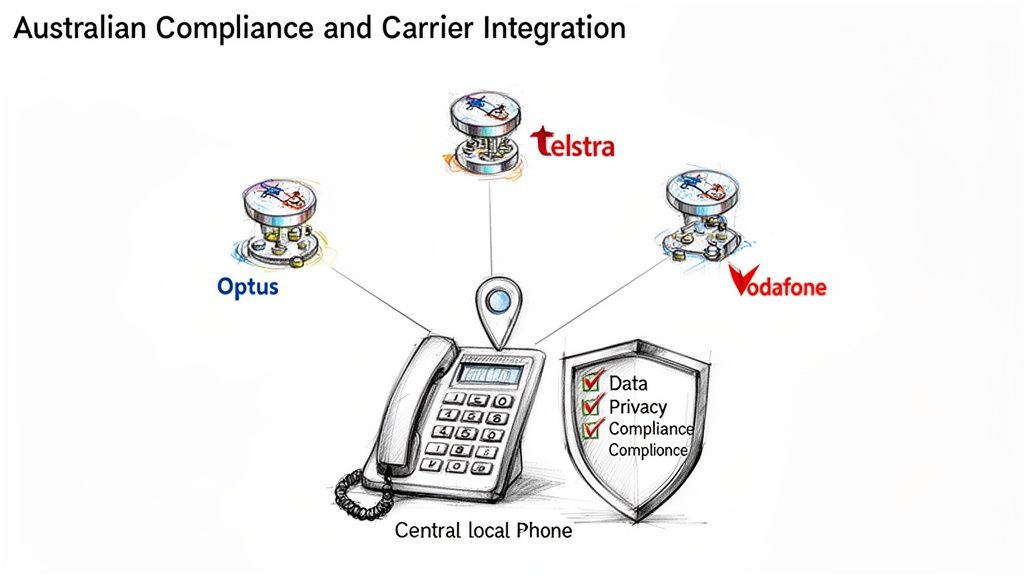
Think about it – your virtual receptionist will be handling sensitive client details. They need to be managed according to Australia's strict privacy standards. On top of that, the whole system needs to work seamlessly with major carriers like Telstra and Optus to give your callers a smooth, reliable experience.
Upholding Australian Privacy Principles
Here in Australia, we have the Privacy Act 1988, which includes the Australian Privacy Principles (APPs). These aren't just suggestions; they are firm rules about how businesses collect, handle, and store personal data. Every time your virtual receptionist jots down a name and number or qualifies a new lead, they're dealing with exactly this kind of information.
Any decent virtual receptionist provider operating here must be fully compliant with the APPs. It’s non-negotiable. This is what guarantees your clients' details are kept safe from being misused or falling into the wrong hands.
Before you even think about signing on the dotted line, you need to grill a potential provider on their data security:
- Data Storage: Ask them flat out: where is my client data being stored? You want to hear that it's on secure servers right here in Australia.
- Access Controls: Who can see the call notes and customer info? They need to have rock-solid access protocols in place.
- Privacy Policy: Have a look at their policy. Does it clearly explain how they stick to the APPs?
A provider's approach to data privacy says everything about their professionalism. Getting this wrong isn't just a tech headache; it's a massive business risk that can wreck your reputation and land you in hot water.
Seamless Integration with Aussie Carriers
For this whole thing to work, your virtual receptionist service has to plug into the Australian telco network without a single glitch. That means it must integrate perfectly with the big players – Telstra, Optus, and Vodafone. The aim is a completely seamless experience, where your customers have no idea their call is being handled by a service off-site.
This usually works through a simple process called call diversion or forwarding. Your provider gives you a unique local phone number (like an 02, 03, or 07 number). You then tell your existing business mobile or landline to divert calls to that new number whenever you're busy, can't answer, or after hours.
Setting Up Your Local Number and Call Flow
Getting set up is almost always a piece of cake and won't mess with your current phone plan. Here's how it generally works:
- Get Your Local Number: Your provider issues you a dedicated local number. This is great for business, as it immediately gives you a local presence in that city.
- Configure Call Forwarding: On your existing mobile, you'll activate 'conditional call forwarding'. It's a standard feature that Telstra, Optus, and Vodafone all offer.
- Define Your Rules: You get to decide when calls are forwarded. You might set it to only divert when your line is busy, or if a call rings out for more than 15 seconds.
This simple setup means you keep full control of your main business number while ensuring no call ever goes unanswered again. It’s a straightforward but incredibly effective way to make sure your virtual receptionist in Australia acts as a reliable, compliant, and technically sound extension of your business.
Understanding Pricing and Calculating Your ROI
Thinking about investing in a virtual receptionist? It’s easy to get bogged down in the monthly cost, but that’s the wrong way to look at it. A good virtual receptionist isn't just another business expense; it's a strategic move to actually boost your revenue and efficiency.
Let's shift the mindset from "how much does it cost?" to "how much value will it generate?". Once you see it that way, the decision becomes a whole lot clearer. The good news is that pricing models are flexible, so you can find a structure that fits your specific call volume and business needs, which is a massive plus for Aussie SMEs managing tight cash flow.
Common Pricing Structures Explained
When you start shopping around, you'll typically find a few different ways providers charge for their services. Each has its pros and cons, depending on how many calls you get and how predictable your workflow is.
- Pay-Per-Call or Pay-Per-Minute: This one’s as straightforward as it gets—you only pay for what you actually use. It’s perfect for businesses with a lower or unpredictable number of calls. You're not locked into a hefty monthly fee for something you barely use.
- Monthly Subscription Tiers: This is the most common setup. Providers offer different plans that include a set number of calls or minutes each month. If your call traffic is pretty consistent, these plans usually offer better value per call and make budgeting a breeze.
- All-Inclusive Packages: Some services, especially the more advanced AI assistants, offer all-inclusive plans. Think of it like an all-you-can-eat buffet for your phone calls. You get unlimited calls and a full suite of features for one flat monthly fee, which is brilliant for high-growth businesses that don't want to worry about hitting a cap.
To get a feel for the different options out there, it's a good idea to explore their pricing structures from various providers. And if you're weighing up your options, our detailed breakdown of virtual receptionist costs is a great resource for a direct comparison.
Calculating Your True Return on Investment
Here’s the thing: the monthly fee is almost irrelevant if the service is bringing in more money than it costs. A virtual receptionist pays for itself, often many times over, simply by capturing leads that you would have otherwise missed.
Think about it like this:
What’s the real value of one new client? For a plumber, a single captured job from a missed call could easily be worth $500. For a real estate agent, that one new seller lead could turn into a $15,000 commission cheque. If your virtual receptionist snags just one of those leads a month, it’s already paid for itself.
This is why we see the service as a powerful revenue-generating tool, not a cost centre. The shift to virtual receptionists in Australia really took off after COVID, as businesses hunted for ways to trim overheads without sacrificing customer service. Adopting these solutions can slash administrative workloads by up to 35%, freeing up thousands of dollars and countless hours every single month.
A Simple ROI Framework
Want to figure out your potential ROI? It’s not as complicated as it sounds. Just ask yourself a few honest questions:
- How many calls do you miss each week? Don’t just guess. Even a couple of missed calls a day really add up over a month.
- What’s your lead-to-client conversion rate? Out of every ten genuine enquiries, how many turn into paying customers?
- What’s the average lifetime value of a single client?
Let’s run the numbers for a mortgage broker who misses five calls a week. If a virtual assistant captures all five of those calls, and just one converts into a client with a lifetime value of $5,000, the ROI is enormous. Suddenly, the monthly cost of the service looks trivial compared to the revenue it just secured.
That’s the simple but powerful maths that makes a virtual receptionist in Australia one of the smartest financial decisions any growing SME can make.
How to Choose the Right Provider
Picking the right virtual receptionist service in Australia can feel like you're staring at a wall of options. But it doesn't have to be overwhelming. The trick is to break it down with a simple, practical checklist so you can find a partner that actually fits how you work and helps your business grow. It’s all about looking past the slick marketing and focusing on what will genuinely make a difference to your day.
The first big question to tackle is whether you want an AI-powered assistant or a real human on the other end of the line. As we've touched on, AI is brilliant for 24/7 efficiency and handling massive volumes, while human receptionists bring that irreplaceable empathy and knack for solving tricky, nuanced problems. Think about your typical caller—are they after a quick, straight answer, or do they need a reassuring, personal touch to feel looked after?
Your Essential Provider Checklist
To cut through the noise, just work your way through these questions. Your answers will pretty quickly show you which providers are worth a look and which ones you can bin straight away. It’s a structured way to make sure you’ve covered all your bases before you sign anything.
- Does it integrate with my existing tools? You need it to talk to your CRM, calendar, and whatever else you use day-to-day. Automatic data entry is a massive time-saver and stops costly stuff-ups.
- Can it provide a local Australian number? Having a local number (like an 02, 03, or 07) just feels more legit to Aussie clients. It builds instant trust and makes you look like a proper local professional.
- What are the contract terms and setup fees? Hunt for providers with flexible, clear pricing. You don't want to get locked into a long, rigid contract or get stung by hidden setup fees.
- Is the service scalable? Hopefully, your business is going to grow. You need a provider that can handle more calls without the price shooting through the roof or the service quality taking a dive.
While you're doing your homework, it’s worth checking out lists of leading BPO companies in Australia, as many of them offer really solid virtual assistant and receptionist services that might be just what you need.
The Importance of a Test Drive
Reading reviews and scrolling through feature lists is one thing, but it’s nothing like seeing it work in the real world. Any provider worth their salt will be confident enough to let you try before you buy.
A free trial or a proof-of-concept (POC) isn't just a nice-to-have, it's a must. This is your chance to test the call quality, see how professional the receptionists are (human or AI), and check if the platform is actually easy to use.
During the trial, get picky about the little things. How fast are calls answered? Are messages taken down accurately? Does the appointment booking actually sync up with your calendar without any glitches? This hands-on experience is the single best way to know for sure if the service is right for your business.
Ultimately, making a smart choice for a virtual receptionist in Australia is all about matching what a provider can do with what you actually need. By using this checklist and insisting on a proper trial, you can find a partner who doesn't just answer your calls, but actively helps make your business more efficient and profitable.
Got Questions? We've Got Answers
Stepping into the world of virtual receptionists can bring up a few queries. It's only natural. Here are some clear, no-nonsense answers to the questions we hear most from Australian business owners, helping you get the full picture.
Can I Keep My Existing Business Number?
Yes, you absolutely can. A professional virtual receptionist service is built to slot right into your current setup without any fuss. You won't have to change the business number your clients already know and trust.
The whole thing works with a simple call diversion from your number to the one we provide. You're in the driver's seat, deciding when calls get forwarded—maybe only when your line's busy, after a few rings, or just for your after-hours. This way, you keep total control and never miss a call.
How Do You Handle Tricky or Upset Callers?
This is where having a real person on the line makes all the difference. A human virtual receptionist is a pro in customer service and knows how to navigate tough conversations. They use empathy and actually listen to what's going on, helping to calm frustrated clients and get the details needed to sort things out.
An AI assistant, on the other hand, is great but sticks to a script. It can pick up on keywords that signal frustration and can be programmed to pass the call straight over to a human team member. The best setups blend the two, using AI for the straightforward stuff and seamlessly handing over the more emotional situations to a person.
What's the Difference Between a Virtual Receptionist and a Virtual Assistant?
It's a common point of confusion, but they really are two different roles. Think of it like this:
A virtual receptionist is your communications expert, focused squarely on managing calls and being the professional, friendly voice of your business. They're your virtual front desk.
A virtual assistant (VA) usually takes on a much wider range of admin, tech, or even creative tasks. They could be doing anything from managing your social media and sending out invoices to data entry and booking your travel. While a VA might answer the odd call, a virtual receptionist specialises in it.
Is My Business Too Small for This?
Not a chance. In fact, it's often the sole traders and small businesses who get the most out of a virtual receptionist. When you’re trying to do the actual work, chase new leads, and handle the books, the phone ringing off the hook is a massive headache.
A virtual receptionist service grows with you. You can kick things off with a simple pay-per-call plan and scale up as your business takes off. It lets a one-person show project the polished, responsive image of a much larger company, helping you compete with the big dogs and snag every single lead.
Ready to see how an AI assistant can completely change your business communications and give you your time back? OnSilent has a powerful, easy-to-use solution made for busy Aussie professionals just like you.