

Let's be honest, the term 'AI assistant' gets thrown around a lot. You've got Siri in your pocket and Alexa on your kitchen counter. But when we talk about a strata-specific AI assistant, we're in a completely different league. This isn't your average chatbot; it's a purpose-built tool designed from the ground up to understand the unique chaos of strata management.
So, What Exactly Is a Strata-Specific AI Assistant?

Picture a team member who never sleeps, never takes a holiday, and has perfect recall of every bylaw for every single building you manage. That’s the essence of a strata-specific AI assistant. It’s an intelligent system that does more than just answer questions—it understands the context of strata.
While a general AI can tell you the weather, a strata-focused AI can explain to an owner why their levy has increased, pulling up the exact line items from the budget and referencing the minutes from the last AGM. It’s built to handle the repetitive, administrative grind that eats up so much of a strata manager's day.
Think of it as a fundamental shift away from putting out fires reactively. Instead, it allows for proactive, automated management, acting as a genuine extension of your team.
How Is It Different From General AI?
The real magic is in the training data. A strata-specific AI assistant has been "educated" on a very specific curriculum that a general AI knows nothing about.
This includes:
- Building-Specific Bylaws: It knows the pet policy for one building and the parking rules for another.
- Strata Legislation: It stays current with the relevant state and territory laws that govern your portfolio.
- Financial Records: It can instantly access levy details, budgets, and payment histories for any lot.
- Maintenance Schedules: It knows the lift is being serviced on Tuesday and can inform residents automatically.
This deep, specialised knowledge means it can handle tasks with an accuracy that general-purpose AI just can't touch. We’re seeing platforms that can automate up to 70% of day-to-day admin, from triaging inboxes to chasing compliance documents.
To get a better sense of how this works under the hood, you can explore our guide on what an AI answering service is and see the principles applied to our industry.
In simple terms, a strata-specific AI acts as an intelligent filter. It fields the flood of incoming queries, resolves the common ones on the spot, and passes the complex issues to a human manager—but with all the necessary background information already attached.
General AI vs Strata-Specific AI
To make the distinction crystal clear, here’s a quick comparison of what a general AI can do versus a purpose-built strata assistant.
| Feature | General AI Assistant (e.g., Alexa, Siri) | Strata-Specific AI Assistant |
|---|---|---|
| Knowledge Base | General world knowledge, web searches | Strata legislation, specific building bylaws, financial records |
| Query Handling | Answers factual questions ("What's the capital of Australia?") | Resolves contextual queries ("Why is my levy higher this quarter?") |
| Task Automation | Sets reminders, plays music, makes calls | Manages work orders, issues levy notices, triages owner emails |
| Integration | Connects to smart home devices, music apps | Integrates with strata management software (e.g., MRI StrataMaster) |
| Communication | General conversational ability | Uses strata-specific terminology, understands industry jargon |
| Proactivity | Responds to direct commands | Proactively sends maintenance reminders or overdue levy notices |
As you can see, while both use AI, their capabilities are worlds apart. One is a helpful gadget; the other is a professional tool designed for a specific, complex job.
It's a Booming Market in Australia
This isn't just a niche idea; it's part of a much bigger movement. The Australian AI market is growing at a staggering pace, and digital assistants are leading the charge. This segment, which includes specialised tools like strata AI, hit USD $2,072.7 million in 2024.
Even more telling? It's projected to skyrocket to USD $7,761.0 million by 2033. This massive growth shows a clear demand for smart automation in professional fields like ours, where efficiency and accuracy are everything.
How AI Can Seriously Upgrade Your Strata Management Operations
Bringing a strata-specific AI assistant into your business is a lot more than just a software update—it completely changes the game for your day-to-day operations. This isn't just theory; it’s about getting real, tangible results that shift your team from constantly putting out fires to thinking strategically and proactively.
The impact really hits home in four key areas: getting time back, making communication smoother, locking down compliance, and making smarter decisions with data.
The first and most obvious win is waving goodbye to those soul-crushing admin tasks. So much of a strata manager’s day gets eaten up by repetitive work that, while necessary, is a massive drain on time and energy.
Get Your Valuable Time Back with Automation
Just imagine having an assistant that chases up levy reminders, books in routine jobs with your go-to contractors, and follows up on outstanding compliance docs—all on its own. A strata-specific AI does exactly that, tirelessly ticking off the to-do list so your managers can focus on solving complex problems and actually talking to clients.
This is a huge deal. Studies have shown that similar AI tools can automate up to 70% of day-to-day admin. For a busy agency, that translates to hundreds of hours back in your pocket every year. This is where you can find out more about how this tech is reshaping the industry by checking out the benefits of strata management automation tools.
By taking over the monotonous but critical tasks, a strata AI assistant lets your managers use their expertise where it truly counts: managing relationships, giving strategic advice, and growing the business.
AI assistants can also take the pain out of other admin jobs, like whipping up efficient meeting minutes with action items, making sure every decision is properly documented and tracked without someone having to do it all manually.
Take Resident Communication to the Next Level
Let’s be honest, a common frustration for owners is waiting around for an answer to a simple question. A strata AI provides an instant, 24/7 channel for communication, which makes a world of difference to the resident experience.
It can instantly answer common queries like:
- “What are the rules for moving in?”
- “When is the next bin collection day?”
- “How do I submit a maintenance request?”
This isn't just about keeping residents happy; it also acts as a brilliant filter for a manager's inbox. Instead of answering the same five questions a dozen times a day, managers only have to deal with the complex, high-priority issues that actually need their attention.
Lock Down Your Compliance and Record-Keeping
Compliance is the bedrock of good strata management, and keeping a flawless, auditable trail is non-negotiable. A strata AI assistant acts as a powerful safety net by meticulously logging every single interaction.
Every question, every response, and every action is automatically recorded and organised. This builds a searchable, chronological history that’s worth its weight in gold for resolving disputes or proving you’ve done the right thing. Better yet, the AI can be trained to ensure its advice always lines up with current legislation and the specific bylaws of each building, cutting down the risk of human error.
This is a massive part of why the Australian AI market is booming, with more and more businesses adopting specialised digital assistants. The chart below shows just how fast the demand for AI agents—the tech powering these assistants—is growing.
This sharp upward trend makes one thing clear: businesses are seriously investing in AI to handle complex, rule-based work like strata management, where getting compliance and accuracy right is everything.
Start Making Data-Driven Decisions
Beyond just handling daily tasks, a strata-specific AI becomes an incredibly powerful analytical tool. By crunching huge amounts of data, it can spot patterns and trends that would be completely invisible to the human eye.
For example, the AI could analyse maintenance requests across your whole portfolio and flag recurring issues with a specific lift model or water pump. That kind of insight allows you to get ahead of the problem with preventative maintenance, saving the owners corporation a small fortune in the long run.
It can also analyse financial data to forecast potential budget shortfalls or pinpoint opportunities for cost savings, helping committees make smarter, more informed decisions for the future of their building.
Putting Your Strata AI Assistant to Work
Alright, let's move past the theory and see what a strata-specific AI assistant actually looks like in action. This is where the rubber meets the road, turning abstract ideas into real, tangible wins that make your day-to-day life easier and keep your clients happy.
These aren't just hypotheticals. These are practical scenarios showing how this technology slots right into your existing workflows, not to replace your expertise, but to act as a powerful force multiplier for you and your team.
Scenario One: Handling After-Hours Emergencies
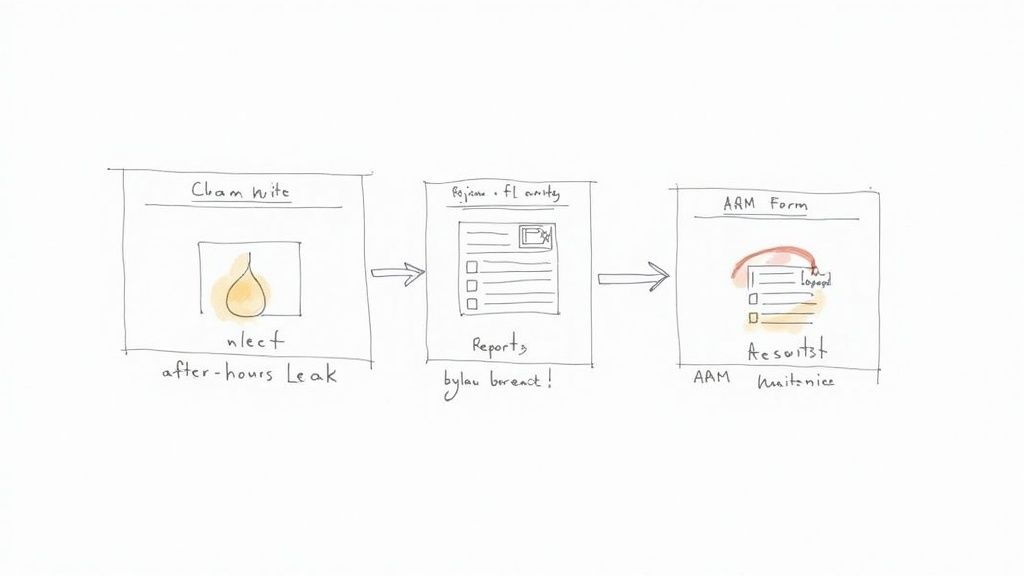
Picture this: it’s 2 AM on a Saturday. A panicked owner from one of your buildings sends a message through the portal about a massive water leak. Without an AI assistant, that message sits in an inbox until Monday morning while thousands of dollars in damage piles up.
With a strata AI, the response is instant and automatic:
- Log and Acknowledge: The AI immediately grabs the report, flags it as a high-priority emergency, and fires off an automated reply to the owner. They get instant confirmation that their message has been received and know what's happening next.
- Verify and Dispatch: It instantly pulls up the building's details, confirms the issue is a plumbing emergency, and checks the pre-approved list of after-hours plumbers.
- Action and Document: The system sends a work order straight to the first available plumber, complete with the owner's contact info, address, and a summary of the problem. Every single step is logged in your management software, creating a perfect audit trail.
This hands-off process means emergencies get tackled immediately, minimising property damage and giving residents incredible service, even while your office is dark.
Scenario Two: Managing Bylaw Breaches
Dealing with bylaw complaints is a delicate dance. You need to be firm but diplomatic, and everything has to follow procedure to the letter. A strata-specific AI assistant can handle this entire process with precision and impartiality, making sure you stay compliant every step of the way.
Take a common complaint, like an unauthorised car in a visitor's spot. The AI assistant can run the whole play:
- Initial Intake: An owner submits a complaint with a photo through the resident portal. The AI logs it against the right lot number.
- Drafting Communication: Using your agency’s templates, the AI drafts a formal notice to the resident who’s breached the bylaw. It pulls in the specific bylaw number and clearly states what they need to do.
- Review and Send: The draft pops up in the strata manager's queue for a quick look. With one click of approval, the notice is sent, and a copy is saved to the property file.
Automating this ensures every breach is handled the same way, cuts down the admin headache for managers, and builds an impeccable communication record if things ever escalate.
A strata-specific AI assistant is brilliant at handling these kinds of rule-based, process-driven jobs. It frees you up to focus on the human side of strata management—things like mediating tricky disputes or giving strategic advice to the owners corporation.
The rapid uptake of this tech is part of a much bigger trend. By June 2025, an impressive 33% of Australians were already using AI assistants for various tasks, showing just how much we're starting to trust AI with important parts of our day. You can discover more insights about this AI evolution in Australia to get the bigger picture.
Scenario Three: Streamlining Annual General Meetings
Prepping for an Annual General Meeting (AGM) is one of the most time-consuming tasks on any strata manager’s plate. A strata AI can automate a huge chunk of this work, making the whole process smoother and more organised from start to finish.
The assistant can take charge of several key stages:
- Notice Distribution: It automatically sends the AGM notice, agenda, and financial statements to every registered owner, making sure it complies with the legally required notice period.
- Proxy Collection: It handles the collection of electronic proxy forms, keeping track of who has submitted what and tallying them correctly before the meeting kicks off.
- Minute Drafting: Once the meeting is done, you can feed the AI a recording or transcript. It will then generate a comprehensive draft of the minutes, highlighting motions, votes, and action items for you to review and finalise.
By automating these admin-heavy parts of the AGM, the strata-specific AI assistant lets managers concentrate on running a productive meeting instead of drowning in paperwork. It’s a perfect example of how targeted automation leads to better governance and more efficient community management.
What to Look For in a Powerful Strata AI
Not all AI assistants are built the same, and when you’re picking one for your strata agency, you need to know what’s under the bonnet. A generic chatbot just won't cut it; you need a tool that's been specifically built for the unique world of strata management.
Think of it like hiring a new strata manager. You wouldn’t hire someone who doesn’t understand Australian strata legislation, right? The same goes for your tech. A strata-specific AI assistant needs to speak fluent 'strata' from day one. Let's break down the non-negotiables that separate a genuinely useful AI from a basic one.
Must-Have Features in a Strata AI Assistant
When you're evaluating different AI options, it can feel a bit overwhelming. This table is your checklist – a quick guide to the essential features and integrations you should be asking about to make sure you're getting a tool that will actually make a difference to your agency.
| Feature Category | Specific Functionality | Why It Matters |
|---|---|---|
| Language & Knowledge | Trained on Australian strata legislation, terminology, and common owner queries. | Ensures the AI understands and responds accurately to industry-specific terms like "special levy" or "by-law breach," preventing confusion and providing compliant answers. |
| Core Integrations | Seamless connection with platforms like StrataMax, MRI Strata Master, Microsoft 365, and Google Workspace. | Creates a single source of truth by pulling real-time data from your existing systems, eliminating data silos and manual double-entry. |
| Workflow Automation | Ability to build and customise "if-this-then-that" rules and logic. | Lets you adapt the AI to your agency's specific processes, like automatically escalating high-cost maintenance requests or flagging overdue levies. |
| Security & Compliance | Enterprise-grade security, end-to-end encryption, and adherence to Australian data privacy laws. | Protects sensitive owner and financial data, maintains client trust, and ensures your agency remains compliant with the Privacy Act. |
Think of these features as the foundations. Without them, you'll end up with a tool that creates more work than it saves. A great strata AI should feel like a natural extension of your team, not another piece of software you have to fight with.
It Needs to Speak Your Language
The absolute cornerstone of a decent strata AI is its ability to understand our industry’s unique lingo. It needs a natural language processing (NLP) engine that has been properly trained on strata terminology, legislation, and common scenarios we deal with every day.
This means when an owner asks, "What's that special levy for the roof replacement being used for?" the AI doesn't get stumped. It instantly gets what a "special levy" is, connects it to the right motion from the last AGM, and gives a clear answer based on the official minutes.
Without that specialised training, an AI is basically a glorified search bar. A purpose-built one can tell the difference between a by-law, a motion, and a special resolution, making sure every response is spot-on and compliant.
Plugs Straight Into Your Existing Software
An AI assistant that works in its own little bubble is more trouble than it's worth. To actually be helpful, it has to integrate perfectly with the core software you already use day in, day out. This stops you from having to jump between systems and keeps all your data in one place.
You'll want to look for key integrations with:
- Strata Management Platforms: A direct line into software like StrataMax or MRI Strata Master is a must-have for pulling up property, owner, and financial details in real time.
- Email and Calendars: Linking up with Microsoft 365 or Google Workspace lets the AI take over managing inboxes, scheduling meetings, and firing off communications automatically.
- Accounting Systems: The ability to chat with your accounting software means the AI can handle levy questions, process payments, and give accurate financial updates without bothering you.
To get the most out of an AI, it really helps to know what your core platforms can do. Understanding the key property management software features shows you where an AI can plug in to make things even more efficient.
Workflows That Fit Your Agency
Every strata agency has its own way of doing things, from how you handle maintenance requests to the way you chase up arrears. A powerful strata AI shouldn't try to cram you into a rigid, one-size-fits-all process.
Instead, it needs to offer customisable workflows. This feature is what lets you mould the AI's behaviour to match your agency's established procedures. You get to set the rules.
For example, you could set up a rule so the AI automatically sends any maintenance request estimated over $1,000 to a senior manager for approval, while it handles all the smaller jobs from start to finish on its own. That's the kind of control you need—tech that adapts to your business, not the other way around.
Bulletproof Security and Data Privacy
Last but certainly not least: security. You're holding onto a massive amount of sensitive information, from people's personal contact details to detailed financial records. A data breach is simply not an option.
Any strata AI you consider must have enterprise-grade security baked in from the very beginning. We're talking end-to-end encryption, secure data storage, and strict controls over who can access what.
Crucially, the provider has to be fully compliant with Australian data privacy laws, like the Privacy Act. Your data needs to be handled responsibly, stored securely (ideally within Australia), and shielded from anyone who shouldn't see it. This isn't just a nice-to-have feature; it's fundamental to keeping your clients' trust and protecting your agency's reputation.
A Roadmap for Successful AI Implementation
Bringing any new tech into the business is less about the software itself and more about the game plan. A strata-specific AI assistant has incredible potential, but tapping into it all comes down to a well-planned rollout. Without a clear roadmap, you’re just setting yourself up for poor adoption, frustrated staff, and a shiny new tool that never quite lives up to the hype.
The key is to treat this like a strategic project, not just another IT setup. You need to define what a win looks like right from the start, get your data in order, guide your team through the shift, and test everything in a controlled way before you go all-in. This measured approach is what makes for a smooth transition and delivers real value from day one.
Start With Clear Goals and Pain Points
Before you even think about demos or software features, ask your team one simple question: "What's the biggest time-waster in our day?" The best AI implementations always start by targeting specific, high-impact problems. Don't just get AI for the sake of it; set clear, measurable goals.
Your objectives might be something like:
- Cut email response times for common owner queries by 50%.
- Slash the admin time spent on AGM prep by 10 hours per meeting.
- Automate the first-response workflow for all after-hours maintenance requests.
By nailing down these pain points first, you give your AI a clear mission. This focus doesn’t just help you pick the right tool—it makes it a whole lot easier to prove the return on investment down the track.
Prepare Your Data for Success
An AI assistant is only as smart as the information you feed it. Think of it like a new hire who needs to learn the ropes of your agency and the specific rules for every single building you manage. For the AI to do its job, your information has to be organised, accessible, and accurate. This is the most crucial step, and honestly, it's the one most people skip.
The old saying "garbage in, garbage out" has never been more true. A successful AI implementation runs on clean, structured data—from building bylaws and owner contact lists to preferred contractor details and financial records.
This data prep phase is all about cleaning up your records and making sure your core systems are up to date. It’s the essential groundwork that ensures the AI can find the right information instantly, giving accurate and reliable answers from its very first day on the job.
This diagram shows how the core processes work together, highlighting how seamless integration, smart language processing, and solid security are all linked.
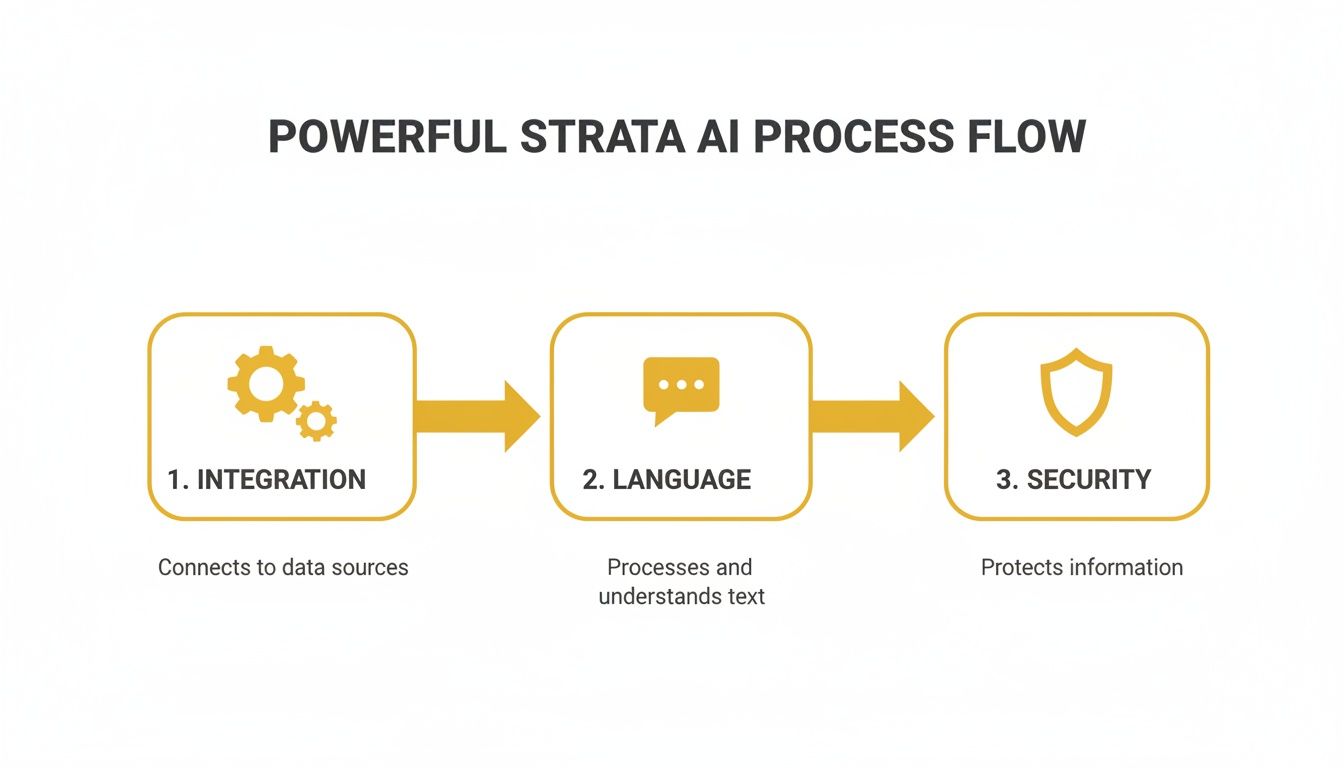
As you can see, the AI first needs to connect to your existing data, then understand the unique lingo of strata, and finally operate within a secure bubble to be truly effective.
Guide Your Team Through the Change
The technology is the easy part; getting people on board is the real challenge. Your team might be a bit anxious about AI, worrying that it’s here to take their jobs. It’s vital to communicate that the AI is a tool to support them, not replace them.
Frame the strata-specific AI assistant as a digital teammate—one that’s built to handle the repetitive, boring tasks they hate. This frees them up for more valuable, strategic work. Make sure you provide proper training that goes beyond just "here's how to use the software" and focuses on "here's how this makes your job better." To get a feel for what’s out there, have a look at our guide on the top software for strata managers.
Launch a Pilot Program First
Finally, whatever you do, don't try to roll out the new system across your entire portfolio at once. Start small with a pilot program. Pick one or two buildings and a small, enthusiastic group of managers to test it out.
This approach gives you a low-risk space to test and tweak your workflows. You can iron out any kinks on a small scale, gather real feedback, and build a success story that gets the rest of the team excited to get on board.
What's Next for AI in Australian Strata?
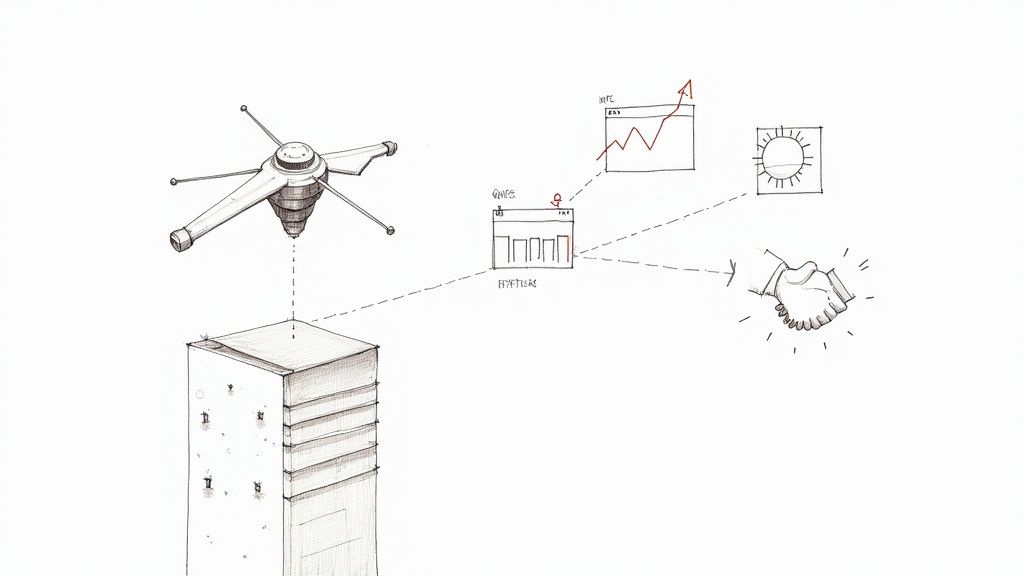
The current strata-specific AI assistant is already a powerful bit of kit, but what’s coming down the pipeline is where things get really interesting. We’re on the cusp of a shift from AI that helps us out to AI that genuinely acts on our behalf. The next evolution will bring autonomous ‘AI agents’ that can manage complex, multi-step jobs with very little hand-holding.
Think about it. Instead of an AI just logging a maintenance request, imagine it actively sourcing three quotes from your pre-approved contractor list. It could then check them against the budget, negotiate the terms based on rules you’ve set, and pop the best option in front of the committee for a final tick of approval. That leap from assistant to agent is a game-changer for day-to-day operations.
This isn't just wishful thinking; it's part of a much bigger trend. In 2024, the Australian AI agents market pulled in USD 76.9 million in revenue, and that number is tipped to skyrocket to a massive USD 893.5 million by 2030. That’s driven by a huge compound annual growth rate of 51.2%, which shows just how much faith businesses are putting into this kind of autonomous tech. You can read the full research about Australia’s growing AI agent market to see the detailed forecast for yourself.
From Reactive Fixes to Predictive Planning
Beyond just getting tasks done, the real future is in predictive analytics. A truly smart strata AI will be able to chew through years of maintenance logs, financial reports, and building condition data to forecast major capital works with scary accuracy.
So, instead of scrambling when a lift suddenly gives up the ghost or a roof springs a leak, the AI will give the owners corporation a heads-up years in advance. It could even model different financial scenarios for the sinking fund, helping committees plan for special levies or adjust contributions without any last-minute panic. This kind of data-driven foresight helps build far more resilient and financially sound communities.
By forecasting future needs, a strata-specific AI assistant transforms capital works planning from a reactive expense into a strategic, long-term investment, preventing financial shocks for owners.
Creating a Hyper-Personalised Experience for Residents
Finally, the future of strata AI gets personal. Really personal. As the technology gets smarter, it’ll allow for a hyper-personalised experience for every resident. The AI could learn individual communication styles, sending an urgent notice via SMS to one owner while sending a detailed weekly email summary to another.
It might even start offering tailored services, like automatically booking the lift for a resident who has just scheduled a furniture delivery. This level of personal attention is what builds a genuinely strong community and sends resident satisfaction through the roof. Getting on board with a strata-specific AI assistant today is about getting ready for this smarter, more proactive, and data-driven future.
Got Questions? We’ve Got Answers
Deciding to bring a new piece of tech into your agency always comes with questions. When that tech is a strata-specific AI assistant designed to be a core part of your operations, you absolutely need clear, straightforward answers.
We've pulled together the most common queries we hear from strata managers just like you. Let's get into the specifics so you can make a properly informed choice.
Is Our Strata Data Secure with an AI Assistant?
This is usually the first question on everyone's mind, and for good reason. The short answer is yes, absolutely. Security isn't just a feature; it's built into the very foundation of these systems.
Reputable strata AI providers use enterprise-grade security, including end-to-end encryption for all data, whether it's being sent or just sitting on a server. Plus, these platforms are designed from the ground up to comply with Australian data privacy laws, like the Privacy Act. This means all that sensitive owner, committee, and financial information is handled with the highest level of care, protecting your clients and your agency's good name.
What Happens When the AI Doesn’t Know the Answer?
Look, no AI is all-knowing, and a smart one knows its own limits. A strata-specific AI assistant is trained to spot when a question is too complex, too vague, or just needs a human touch.
When it hits that wall, it doesn't just error out. The system is designed to seamlessly pass the entire conversation over to the right strata manager. You get the full context—who the owner is, what they've asked, and the chat history so far. This means you can jump in and solve the problem without making the owner repeat everything they’ve just said.
Think of the AI less as a replacement and more as a super-intelligent filter. It takes care of the constant stream of routine questions, freeing up your time for the issues that actually need your expertise.
What’s the Typical Return on Investment?
This is where the rubber really meets the road. Measuring the return on investment (ROI) for a strata AI is surprisingly direct, and most agencies see the benefits in three key areas pretty quickly.
Here’s where you’ll see the biggest wins:
- Lower Admin Costs: Imagine automating the hours your team spends stuck in their inboxes, chasing levies, or booking routine jobs. This alone can slash admin workloads by up to 70%, freeing up staff for more valuable work.
- Better Client Retention: When residents get instant, 24/7 answers, they’re happier. Happy clients stick around, which cuts down on churn and the constant, costly hunt for new business.
- Fewer Compliance Headaches: The AI automates rule-based compliance tasks and keeps a perfect digital paper trail of every interaction. This dramatically reduces the risk of expensive human errors and potential legal dramas down the track.
Ready to see how an AI assistant can give your agency back its time and transform your client service? OnSilent provides a purpose-built solution that fits right into your workflow, saving you time and headaches. Learn more about how OnSilent can help your strata agency.