

Strata management AI is simply about using smart software to automate and streamline how strata-titled properties are run. Think of it as a digital assistant that handles the repetitive, time-consuming jobs—things like resident communications, maintenance scheduling, and financial admin—so managers can focus on the bigger picture.
For Australian strata communities, this isn't just a fancy tech trend; it's a practical way to deal with skyrocketing operational costs and the ever-growing demand from residents for instant service.
The New Era of Australian Strata Management
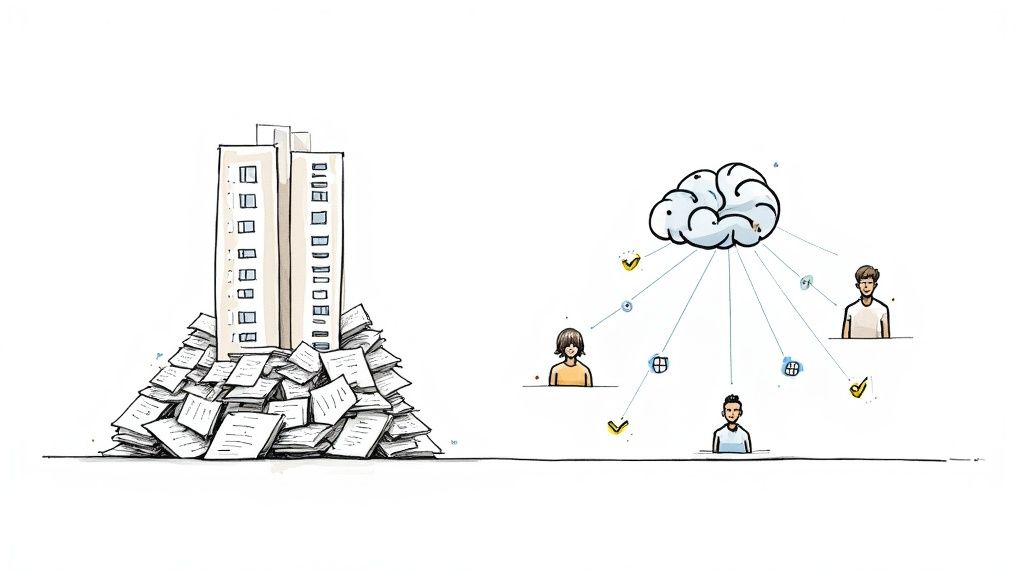
If your desk looks like a mountain range made of paperwork, resident requests, and maintenance follow-ups, you're definitely not alone. The old-school way of managing strata properties is buckling under the pressure of modern life, where every single issue seems to demand personal attention, right now.
It’s a bit like upgrading from a manual telephone switchboard to a smart, automated network. In the old days, a human operator had to plug in every single call, which often meant delays and missed connections. The new way uses intelligent systems to route information, figure out what's needed, and provide instant automated responses. This is exactly the kind of shift that strata management AI is bringing to the property game.
Facing Today's Strata Challenges
Strata managers and committees across Australia are caught in a tough spot. The pressure is coming from all sides, creating a perfect storm of operational headaches that can’t be solved by simply working harder.
Here are the key pain points we see every day:
- Rising Operational Costs: Everything from insurance premiums to lift maintenance is getting more expensive. These climbing costs are squeezing budgets and putting serious pressure on levies.
- Heightened Resident Expectations: We live in an on-demand world. Residents now expect instant communication and super-fast resolutions, 24/7. Waiting until Monday morning for a response is no longer good enough.
- Administrative Overload: The sheer volume of emails, invoices, compliance checks, and by-law questions can easily swallow a manager's entire day, leaving zero time for proactive community building or strategic planning.
This guide is here to cut through the hype and show you how artificial intelligence offers real, practical solutions to these exact problems. We’re moving beyond the buzzwords to give you a clear roadmap for Australian properties.
We’ll break down everything you need to know, starting with what strata management AI actually is in simple terms. From there, we’ll get into the specifics of how it can be used, weigh up the benefits and the risks, and lay out a step-by-step plan for bringing it into your own operations.
By the end, you'll see how tools like OnSilent can fit perfectly into an AI-driven workflow to build a far more efficient and responsive strata community.
So, What on Earth is Strata Management AI?
Let's cut through the buzzwords and get real. At its heart, strata management AI is about giving your building a ‘digital brain’. It’s smart software designed to chew through repetitive tasks, make sense of complex information, and even flag problems before they blow up. We’re not talking about sci-fi robots taking over, but practical tools that make life genuinely easier for managers and residents.
Think about it for a second. Your building is constantly generating a mountain of information. You’ve got maintenance logs from the lift guy, emails from residents about a leaky pipe in the garage, financial data from levy payments, and hundreds of other little data points flying around every single day.
Right now, a human manager is responsible for connecting all those dots. With strata management AI, the system itself starts to ‘sense’ these inputs, ‘learn’ from the patterns it spots, and ‘act’ on what it finds. This is what turns a building from a static block of concrete into a responsive, intelligent environment.
The Tech That Makes It All Tick
You don't need a degree in computer science to get what’s going on under the hood. The two big ideas you’ll hear about are Machine Learning and Natural Language Processing. They sound complicated, but what they do is actually pretty straightforward.
Machine Learning (ML) is basically teaching a computer by showing it examples, not by writing rigid rules. You feed it a heap of historical data—like years of maintenance records—and it learns to spot patterns on its own.
- Here’s a real-world example: You give an ML model five years of data on your building’s air conditioning system. It can then analyse patterns tied to weather, usage, and past breakdowns to predict when a unit is most likely to fail. This means you can schedule preventative maintenance before residents are left sweating through a summer scorcher.
Natural Language Processing (NLP) gives software the magic ability to understand and respond to normal human language. It’s the same tech that powers chatbots and smart assistants, letting them figure out what you actually mean when you send an email or a message.
- Picture this: A resident emails, “The garage door on level B2 is stuck again.” An NLP-powered system can instantly pick out the key info—garage door, B2, stuck—and automatically create a work order, shoot it off to the right contractor, and let the resident know it's being handled. All without anyone lifting a finger.
At the end of the day, strata management AI isn't one single thing. It's a toolbox of smart assistants working together. The whole point is to automate the predictable, admin-heavy parts of the job. This frees up your managers to focus on what really matters: building a community and making strategic decisions. It’s all about empowering your team, not replacing it.
How AI Is Getting Used in Modern Strata Communities
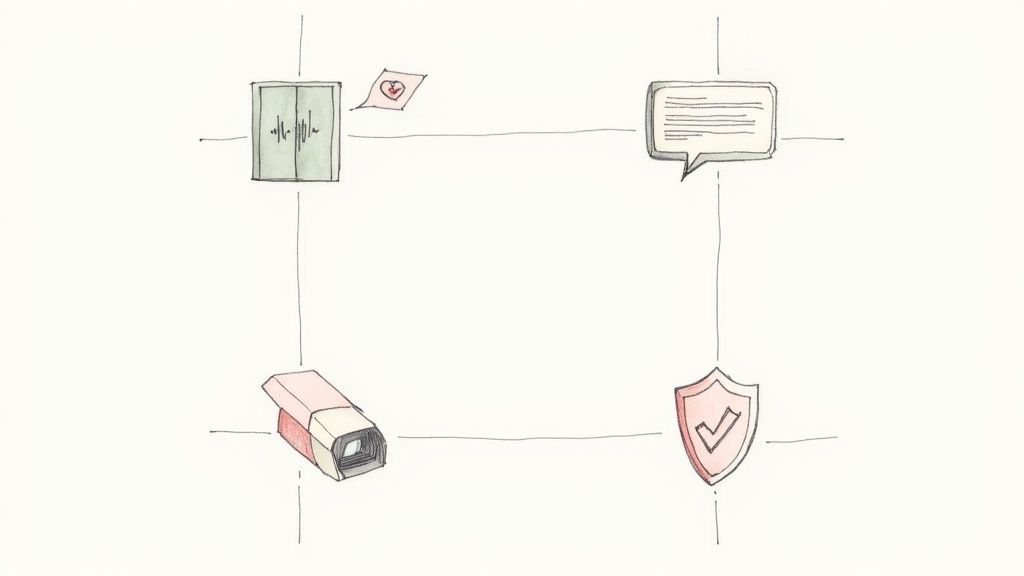
This is where the idea of strata management AI stops being a buzzword and starts solving the real-world headaches that eat up your time and money. Forget the abstract stuff for a minute. Let’s look at the practical, day-to-day things AI is doing right now in strata communities across Australia.
These aren't futuristic pipe dreams. They are real tools tackling some of the most stubborn challenges in property management. From preventing expensive breakdowns before they happen to making sure residents get instant answers, AI is changing what's possible.
Predictive Maintenance for Critical Assets
Imagine if your building’s lift could send you a message saying it's going to break down next week. That’s the simple idea behind predictive maintenance. AI systems plug into sensors on vital assets like lifts, HVAC units, and water pumps, and they just watch the data, 24/7.
The AI quickly learns the unique operational rhythm of each piece of equipment. When it spots tiny changes in vibration, temperature, or energy use that point to a future failure, it flags it immediately. It can even go ahead and schedule a technician for you.
This proactive approach means no more expensive emergency repairs and less disruption for residents. It turns maintenance from a panicked, reactive scramble into a predictable, scheduled task. Simple as that.
Streamlining Resident Communications
Let's be honest, one of the biggest time-sinks is the never-ending stream of questions from residents. An AI-powered chatbot or virtual assistant can take a huge chunk of this off your plate, essentially acting as a front desk that never sleeps.
These bots can instantly answer all the usual questions:
- "When is my next levy payment due?"
- "What are the rules for booking the common area BBQ?"
- "How do I report a leaky tap?"
By hooking into your existing strata software, the AI gives accurate, immediate answers. This frees up your team to handle the more complex issues that actually need a human touch. It’s also a big win for residents, who no longer have to wait for office hours to get a simple question answered. For more advanced needs, solutions like OnSilent's smart AI voicemail system can even manage calls and route enquiries without you lifting a finger.

Automating Financial and Administrative Tasks
Processing invoices, chasing payments, and pulling together financial reports are essential but incredibly tedious. AI is brilliant at automating these repetitive, rule-based jobs with pinpoint accuracy.
An AI system can scan an incoming invoice, pull out the key details like the vendor, amount, and due date, and check it against an approved work order. If it all matches up, it flags it for payment. This massively reduces manual data entry and pretty much eliminates the risk of human error.
This level of automation doesn't just save time; it gives the committee cleaner, more reliable financial data to work with, leading to better budgets and smarter decisions.
This isn't just a niche trend. With over 3.5 million strata properties in Australia, communities are jumping on AI to improve how they run things. For example, AI-driven waste management with smart bins that signal when they're full is becoming common, helping to optimise collection schedules and improve sustainability.
To help you see how these tools fit into a real-world setting, here’s a quick breakdown of common AI applications in strata management.
Real-World AI Use Cases in Strata Management
This table summarises how different AI tools address specific, everyday problems within a strata community, highlighting the direct benefits for everyone involved.
| Application Area | Common Problem It Solves | Key Benefit for Your Community |
|---|---|---|
| Predictive Maintenance | Unexpected equipment breakdowns (lifts, pumps) causing disruption and high emergency repair costs. | Fewer disruptions for residents, lower maintenance costs, and longer asset lifespan. |
| Resident Communications | Strata managers being overwhelmed by repetitive resident questions, leading to slow response times. | Instant, 24/7 answers for residents and more time for managers to focus on complex issues. |
| Financial Automation | Time-consuming manual data entry for invoices and payments, which can lead to errors. | Faster processing, reduced human error, and more accurate financial reporting for the committee. |
| Compliance & By-Laws | Difficulty tracking critical dates for safety inspections, insurance, and by-law enforcement. | Reduced risk of non-compliance, automated reminders for key dates, and easier by-law management. |
| Intelligent Security | Passive security cameras that only record incidents after they've happened. | Proactive security that can detect and alert on suspicious activity in real-time. |
As you can see, the focus isn't on flashy tech for its own sake. It’s about applying smart solutions to make the day-to-day running of a community smoother, safer, and more efficient for everyone.
Enhancing Compliance and Security
Keeping on top of fire safety rules, insurance renewals, and by-law enforcement is a massive compliance headache. An AI platform can serve as your digital compliance officer, tracking all those critical dates and automatically sending reminders when inspections or certifications are due.
For instance, AI can be a huge help in sifting through and managing complex by-laws, contracts, and other formal paperwork. You can learn more about the practical side of AI for legal documents.
When it comes to security, AI-powered surveillance systems can do a lot more than just record footage. They can analyse video feeds as they happen to spot unusual activity—like a strange car entering the car park late at night or someone loitering in a restricted area—and send an instant alert to security. This turns your security system from a passive recording device into an active, intelligent watchdog.
Weighing the Benefits and Risks of AI
Bringing in any new tech, especially something as big as strata management AI, is a major decision. You need a clear-eyed view of both the game-changing rewards and the real-world challenges. Making a smart choice means looking past the hype to see the whole picture.
On one hand, the potential upside is huge. AI promises to tackle some of the most stubborn headaches in strata management, turning reactive, time-sucking processes into proactive, automated workflows. This shift can lead to serious gains in efficiency and satisfaction for everyone involved.
The Clear Advantages of Adopting AI
Integrating AI into your strata operations can unlock a heap of tangible benefits. We're not just talking about saving a few minutes here and there; this is about fundamentally improving how the entire community functions.
The most talked-about benefits include:
- Significant Cost Savings: AI-powered predictive maintenance can spot equipment issues before they become catastrophic failures, saving thousands on emergency repairs for assets like lifts and water pumps. Automating admin tasks also cuts down on manual labour, which hits your bottom line directly.
- Streamlined and Efficient Operations: Picture a system that automatically triages maintenance requests, answers common resident queries 24/7, and processes invoices without a human touching it. This level of automation frees up strata managers from the repetitive grind, letting them focus on high-value work like community engagement and financial planning.
- Happier and More Engaged Residents: Quick, consistent communication is the bedrock of a good resident experience. AI chatbots give instant answers to common questions, while automated systems keep residents in the loop about maintenance schedules and community notices. This boosts satisfaction and cuts down on complaints.
At its heart, strata management AI is about turning data into action. It moves a community from being run on gut feelings and spreadsheets to being optimised by intelligent, data-driven insights.
These advantages are especially relevant in Australia right now. The strata sector is under intense pressure from rising costs, operational bottlenecks, and crushing workloads—all of which threaten service quality. Pioneering research into AI systems powered by Large Language Models is aiming to tackle these challenges head-on across the nation's 3.5 million strata properties, a sector that's often been slow on the uptake with new tech. You can discover more about how this research seeks to revolutionise Australian strata management.
Navigating the Potential Risks and Challenges
But let's be real—adopting AI isn't a walk in the park. Knowing the potential downsides is crucial for a successful rollout and helps you build a strategy to sidestep these risks from the get-go.
Here’s what you need to keep in mind:
- Data Privacy and Security: AI systems need a lot of data, including sensitive resident information. You absolutely must ensure this data is stored securely and handled in line with Australian privacy laws. A data breach could have serious legal and reputational consequences.
- Initial Investment and Integration Costs: While many AI solutions offer a solid return on investment, there are upfront costs for software, setup, and training. Getting a new AI platform to play nicely with your existing systems, like accounting or property management software, can also be complex and might need specialist help.
- Over-Reliance on Imperfect Algorithms: AI is a tool, not a crystal ball. If you feed it rubbish data, you'll get rubbish results. Relying solely on an algorithm without a human sanity check can lead to blunders, like setting incorrect levy amounts based on flawed data or mishandling a sensitive resident dispute.
- Shifting Team Roles and Skillsets: Automation will change what a strata manager's job looks like. It won't get rid of the need for human expertise, but it will require teams to adapt. Managers will need to get comfortable with strategy, data analysis, and overseeing the AI systems themselves, which might mean some targeted training and support.
Your Roadmap to Implementing Strata AI
Alright, so you're sold on the idea. But moving from theory to action can feel like the biggest hurdle. The good news?## Your Roadmap to Implementing Strata AI
Alright, so you're sold on the idea. But moving from theory to action can feel like the biggest hurdle. The good news? Implementing strata management AI doesn't have to be some overwhelming, all-or-nothing leap.
Think of it as a clear, phased journey. A solid roadmap takes the mystery out of the process, letting you build momentum, prove the value, and make sure it’s a smooth ride for your entire community. Let's break it down into four manageable stages.
The journey starts not with flashy tech, but with the simple information you already have. It's all about organising your assets before you start building.
Phase 1: Get Your Data Ready
Before you even think about looking at AI vendors, you need to get your house in order. AI systems run on data. If yours is messy, incomplete, or scattered across a dozen different spreadsheets, the AI won't be able to do its job. It's the classic "garbage in, garbage out" principle.
Start by pulling together your key information sources:
- Maintenance Logs: Get all your past repairs, service calls, and inspection records into one place. This historical data is gold for training a predictive maintenance model.
- Financial Records: Make sure your levy payments, invoices, and budget reports are clean and categorised properly. This is crucial for automating any financial processing.
- Communications History: Organise resident emails and messages. This helps an AI chatbot get a handle on the most common questions your community asks.
A huge part of this first step is getting your head around the technical side, particularly overcoming data integration challenges. Nailing this sets the stage for everything that follows.
Phase 2: Choose the Right Partner
With your data sorted, you're ready to find a technology partner. This decision is about more than just software features; it's about finding a vendor who actually gets the unique demands of the Australian strata sector. Not all AI providers are created equal, so asking the right questions is vital.
When you're vetting potential vendors, go beyond the sales pitch. Dig into the details. You should be asking about their approach to data security, the level of local support they offer, and how their system will play with the software you already use.
This is how a successful AI rollout should look—the initial cost leads to smoother operations and, ultimately, happier residents.
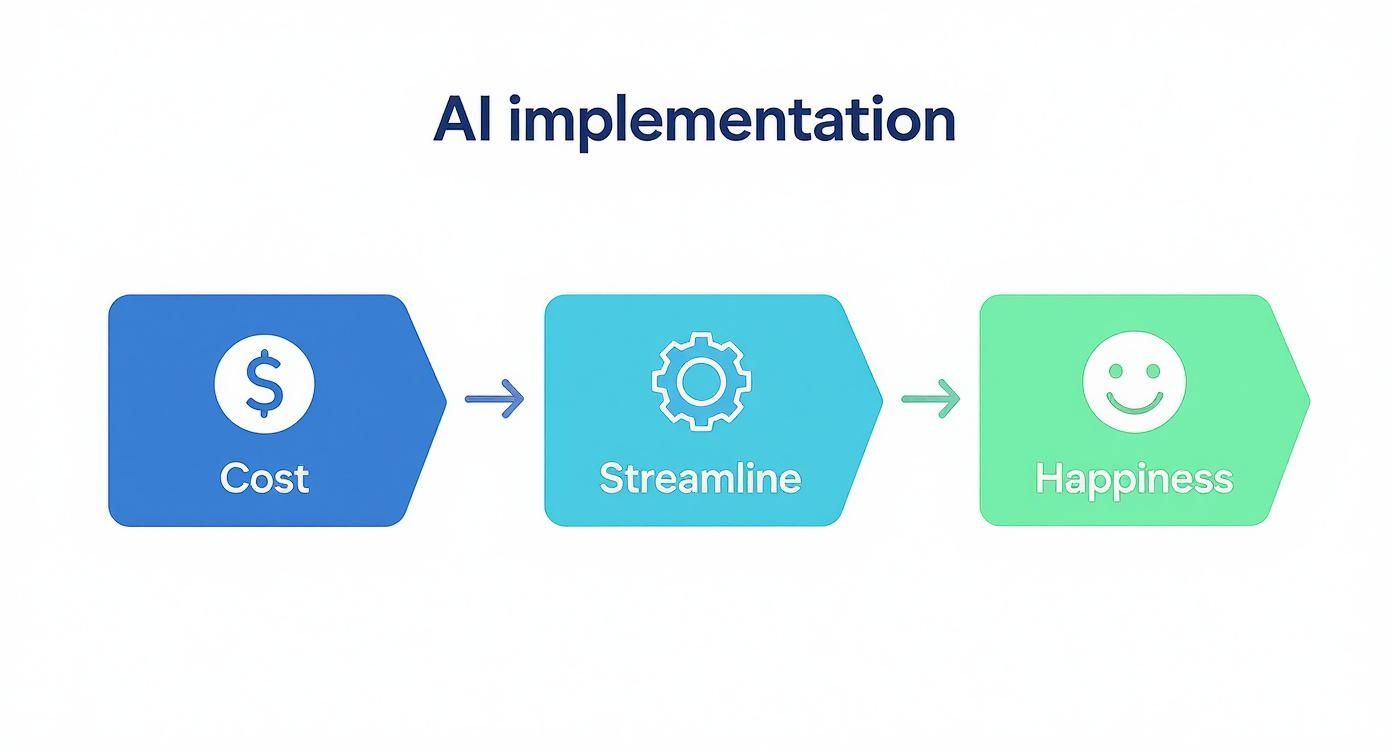
As you can see, that initial investment is what kicks off the efficiency gains that drive a better community experience.
Phase 3: Launch a Pilot Program
Don't try to boil the ocean. Instead of a massive, building-wide rollout, start with a small, focused pilot program. This lets you test the tech in a low-risk environment, show its value to stakeholders, and iron out any kinks before you go big.
A great place to start is with a common, high-volume pain point. For instance, you could launch an AI communications bot to handle after-hours resident enquiries. This gives your management team immediate relief and delivers a quick, visible win for residents.
It's important to keep expectations realistic, though. Many Australian businesses struggle to get a clear return from their AI projects. Despite an average annual investment of $28 million in AI, roughly 72% of Australian enterprises fail to see a significant ROI. A big reason for this is that only 24% have data architectures that are truly AI-ready. Success really depends on getting those foundations right.
Phase 4: Scale and Measure Success
Once your pilot program has proven its worth, it's time to expand. Use the lessons you learned from the trial to guide a wider rollout. This could mean applying the AI to new areas, like predictive maintenance for your HVAC system or automated invoice processing for all your contractors.
As you scale, measuring success is non-negotiable. You need to track key performance indicators (KPIs) that connect directly to your original goals.
Define what success looks like from the get-go. Are you aiming for a 20% reduction in admin emails? A 15% decrease in emergency maintenance costs? By tracking these concrete numbers, you can clearly show the committee and the whole community the real value of your AI investment.
To help you stay on track, we've put together a simple checklist that breaks down each phase. Think of it as your cheat sheet for a successful AI implementation.
Your AI Implementation Roadmap
| Phase | Key Actions You Should Take | What Success Looks Like |
|---|---|---|
| 1: Data Readiness | Consolidate maintenance, financial, and communication records. Clean up and standardise all your data. | All key data is organised, accessible, and ready for the AI to analyse without errors. |
| 2: Partner Selection | Vet vendors who understand the Australian strata sector. Ask about data security, integrations, and local support. | You've selected a partner whose tech fits your needs and who you can trust to support you long-term. |
| 3: Pilot Program | Choose a single, high-impact problem to solve first. Launch a small-scale trial and gather feedback. | Your pilot delivers a measurable win (e.g., fewer after-hours calls) and builds confidence for a wider rollout. |
| 4: Scale & Measure | Expand the AI to other areas based on your pilot's success. Track KPIs like cost savings and response times. | The AI is integrated across multiple functions, and you have clear data showing its positive impact on the community. |
Following these steps will help demystify the process and put you on a clear path to not just adopting new technology, but truly making it work for your strata community.
The Future of AI in Australian Strata
The conversation around strata management AI isn't about replacing skilled strata managers. Far from it. It's about arming them with smarter, more capable tools to get the job done better. As we look ahead, AI is shaping up to be an indispensable partner, helping to create Australian strata communities that are better-run, more sustainable, and ultimately, more liveable for everyone.
This shift goes well beyond simple automation. We're moving into an era where AI doesn't just react to problems as they pop up; it actively anticipates what a community needs. The focus is shifting from just fixing things to creating a seamless, tailored living experience for every single resident.
Emerging Trends on the Horizon
The next wave of AI in strata will feel less like a process running in the background and more like a core part of the building's identity. Three key trends are leading this charge, promising to redefine what residents can expect and what managers can deliver.
These exciting developments include:
- Hyper-Personalised Resident Services: Imagine an AI that knows a resident prefers email notifications, learns their schedule for maintenance access, and even suggests community events based on their interests. This level of personalisation builds real community bonds and makes residents feel genuinely looked after.
- AI-Driven Sustainability Goals: AI can chew through real-time data from utilities, waste management, and building systems to pinpoint opportunities for massive efficiency gains. It could optimise HVAC schedules to slash energy bills or adjust watering cycles for gardens, helping the strata scheme hit its sustainability targets and cut running costs.
- Digital Twin Technology: This is a game-changer. It involves creating a complete virtual model of your property. A digital twin lets managers simulate the impact of upgrades, predict wear and tear on assets, and plan long-term capital works with incredible accuracy—all without touching a single brick.
The key takeaway is simple: the journey into strata management AI isn't something you can put on the back burner. The tools are here now, and the advantages they offer are becoming too big to ignore.
Your Next Steps in a Changing Industry
Staying ahead of the curve means starting the exploration today. Just beginning to understand these tools is the first step toward delivering exceptional value and future-proofing your operations. Initiatives across the country, supported by organisations like Australia's
, are pushing for responsible AI adoption.
By getting on board with these advancements, you position your community not just to keep up, but to thrive. You'll be setting a new standard for what modern strata living can and should be.
Common Questions About Strata Management AI
As strata committees and managers start looking into artificial intelligence, a bunch of practical questions always pop up. It’s one thing to talk about AI as a concept, but putting it to work in the real world is another story. This section tackles the most common queries we hear, cutting through the noise to give you clear, straightforward answers.
These questions get right into the everyday realities of bringing AI on board—from budget worries in smaller schemes to the critical issue of data security and how the strata manager's role will change.
Is Strata AI Too Expensive for a Small Scheme?
Not at all. The old idea that AI is only for massive corporations with bottomless budgets is well and truly outdated. Many modern strata management AI tools are offered as Software-as-a-Service (SaaS), meaning you pay a scalable monthly subscription instead of a huge upfront cost.
This approach makes advanced tech accessible even for smaller schemes. You can start with a single, affordable tool that targets your biggest headache—like an AI chatbot to handle the constant flow of by-law questions—and see a real return on your investment before you even think about expanding.
The key is to focus on value, not just cost. If a tool saves your manager five hours of admin work a week, it often pays for itself in no time.
Will AI Replace Our Strata Manager?
This is a big one, but the goal here is to supercharge your manager's skills, not replace them. AI is brilliant at handling the repetitive, data-heavy tasks that bog down a manager's day, like sifting through invoices or answering the same questions over and over.
Think of AI as the ultimate assistant. Its job is to free up your strata manager to focus on the high-value work that needs a human touch: navigating complex owner disputes, building a genuine sense of community, and smart financial planning for the future.
By taking the administrative grind off their plate, AI empowers your manager to be more proactive and effective where it really counts. They can shift from reactive paperwork to proactive community leadership—a change that benefits everyone.
How Do We Ensure Our Residents' Data Is Kept Safe?
Data security is non-negotiable, simple as that. When you’re dealing with sensitive resident information, privacy has to be the top priority. Choosing the right AI partner is critical, and you should demand complete transparency about their security measures.
Before you sign anything, make sure you ask these questions:
- Where is the data stored? It’s vital the data is hosted in a way that complies with Australian privacy laws, like the Privacy Act 1988.
- What encryption standards are used? Data should be locked down with encryption both when it’s moving (in transit) and when it’s stored (at rest).
- Who has access to our data? There must be strict access controls to limit who can see or handle your community’s information.
Any reputable provider will have proper security certifications (like ISO 27001) and solid policies to keep your data safe. Never cut corners on security; it’s the foundation of trust between you, your residents, and your tech provider.
Ready to see how an AI assistant can free up your time and streamline your communications? OnSilent acts as your dedicated AI call assistant, managing enquiries and qualifying leads 24/7 so you never miss an opportunity. Discover a smarter way to work by visiting https://onsilent.com.