

Right, let's get this sorted. Strata and body corporate management software – what is it, and why should you care?
Think of it as a specialised digital toolkit designed to bring order to the chaos of managing multi-unit properties. It takes all the scattered spreadsheets, endless email chains, and piles of paperwork and wrangles them into one single, organised hub for strata managers, committees, and owners alike.
The Digital Heart of Your Strata Community
Picture a typical strata manager. They're juggling dozens of properties, constantly fielding calls about leaky pipes, chasing up late levy payments, prepping for the next AGM, and trying to keep up with ever-changing regulations.
Without a central system, their whole operation is a fragile dance of memory, manual spreadsheets, and an overflowing inbox. It’s stressful, time-consuming, and a recipe for things to fall through the cracks.
This is exactly the problem strata and body corporate management software solves. Think of it as a digital building manager that works 24/7, never takes a sick day, and keeps a perfect record of every single interaction. It’s the central nervous system for a property, connecting everyone and streamlining all those critical jobs into one cohesive place. Instead of digging through an old email thread for an invoice, it’s right there in the financial portal, ready to go.
Moving From Chaos to Control
The real game-changer here is the shift from reactive, manual work to proactive, automated management. By getting those complex workflows organised, the software creates a far more transparent and efficient community for everyone involved.
And this isn't just a 'nice-to-have' anymore. The way we live in Australia is changing, with more and more people choosing strata properties.
As of 2025, about one in ten Australians now live in strata properties, which adds up to over three million individual lots across the country. With our cities getting denser, that number is only going up, pushing the need for more professional and buttoned-up management.
This boom, combined with major regulatory reforms aimed at boosting transparency and accountability, is putting serious pressure on strata managers. The legal landscape is getting trickier, demanding tools that can handle proper compliance and reporting. Suddenly, sophisticated management software isn't a luxury; it's a necessity. You can get the full rundown on these trends in the latest strata market report.
Core Functions of Strata Software
At its core, this software is all about bringing order to the four key pillars of property management. It gives you dedicated tools to tackle the unique challenges of each area, so nothing gets missed.
- Financial Administration: This is about automating levy collection, managing budgets, paying supplier invoices, and pulling together detailed financial reports without the headache.
- Compliance and Governance: Think secure storage for meeting minutes, a clear system for tracking by-law enforcement, and automated reminders for those critical deadlines.
- Maintenance and Operations: It’s about creating, assigning, and tracking maintenance jobs from the moment a resident spots an issue right through to paying the final invoice.
- Communication and Engagement: This means a central portal where owners can grab documents, see announcements, and get in touch with the strata committee or manager easily.
By bringing all these functions under one roof, strata and body corporate management software gives managers a crystal-clear view of their portfolios. It swaps out fragmented, confusing systems for a single source of truth, building trust and collaboration between managers, committees, and owners. The end result? A better-run, more harmonious community for everyone.
Diving Into the Core Software Modules
Think of strata or body corporate management software as the digital brain of a building. It’s not a single, clunky program but a suite of specialised tools that all talk to each other, each designed to nail a specific part of property administration. By breaking down the massive job of strata management into these key pieces, the software brings some much-needed order to what can often feel like organised chaos.
Each module is like having a dedicated expert on your team. You’ve got a finance guru, a compliance watchdog, a maintenance coordinator, and a communications pro, all working together in one system. This is what lets you finally ditch the messy spreadsheets and overflowing inboxes, creating a single source of truth for everything happening in the property.
This diagram gives you a quick visual of how a central strata system connects the dots between finances, owner messages, and crucial documents.
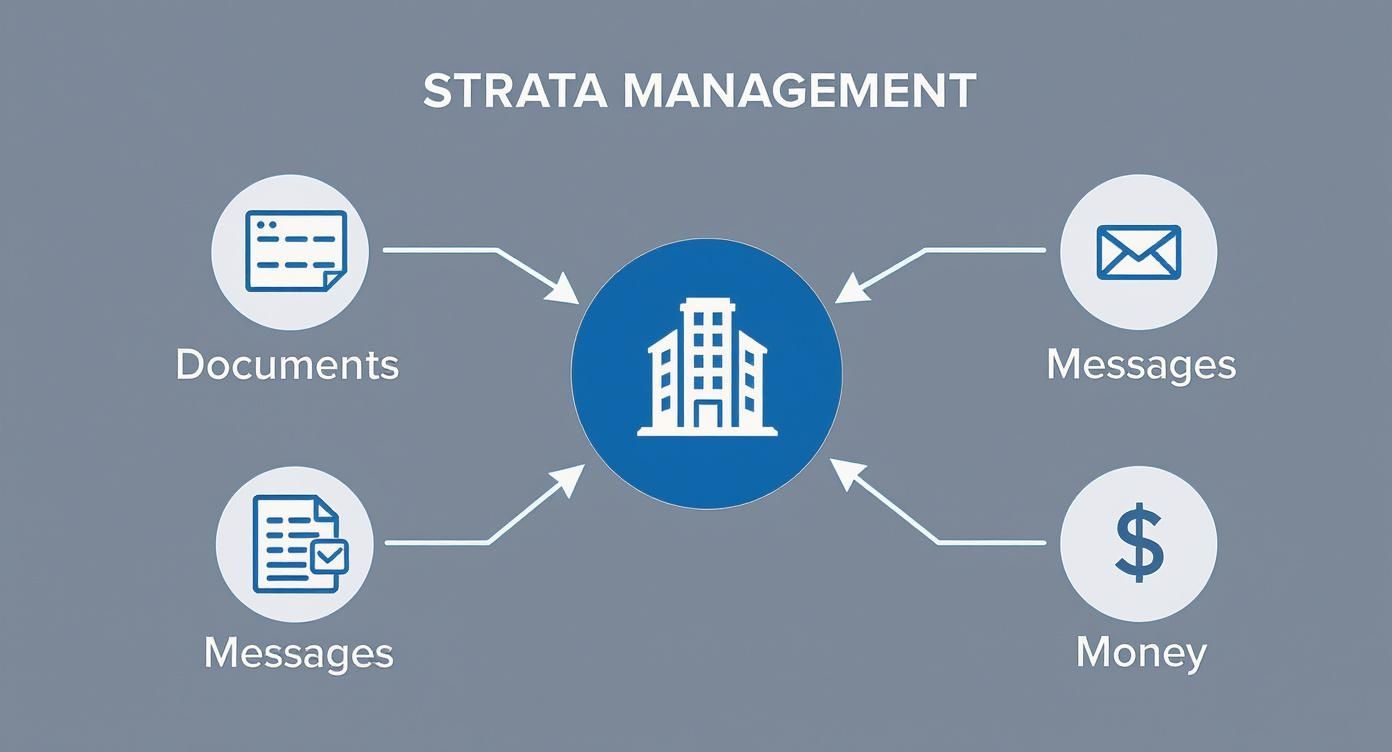
You can see how interconnected it all is. An action in one area, like processing an invoice, automatically updates the financial records, keeping everything consistent without you having to lift a finger.
So, what are these core modules? Let’s take a look under the hood at the essential features you'll find in most quality strata management platforms.
Key Software Modules and Their Functions
| Software Module | Primary Function | Key Benefit |
|---|---|---|
| Financial Management | Automates levy collection, budgeting, and supplier payments. | Creates financial transparency and drastically reduces admin time. |
| Compliance & Governance | Tracks key legal dates and stores important documents securely. | Minimises legal risks and ensures the scheme operates by the book. |
| Maintenance Management | Logs, assigns, and tracks maintenance requests from start to finish. | Keeps residents informed and ensures repairs are handled efficiently. |
| Owner Communications | Provides a central portal for announcements, documents, and owner self-service. | Empowers owners and cuts down on repetitive phone calls and emails. |
These modules work in harmony to streamline the day-to-day grind, freeing up strata managers to focus on the things that really matter—like building a better community.
Financial Management and Accounting
Let’s be honest, a strata scheme’s health lives and dies by its finances. This makes the financial module the absolute engine room of the software. It takes the entire financial workflow off your plate, from pumping out levy notices to chasing up payments and managing arrears. Manual invoicing becomes a distant memory as the system sends out scheduled reminders automatically, which makes a huge difference in cutting down late payments.
It also handles all the supplier invoices and payments, making sure your contractors get paid on time while logging every expense against the right budget line. This gives you an accurate, real-time picture of the scheme's finances, allowing managers and committees to generate detailed reports for the AGM with just a few clicks. It’s this kind of transparency that really builds trust with owners.
Compliance and Governance
Trying to keep up with the maze of state-specific legislation—like the Strata Schemes Management Act in NSW or the Body Corporate and Community Management Act in Queensland—can feel like a full-time job. The compliance module is your digital paralegal, helping you stay on top of all those legal hoops.
It provides a secure, central spot to store all the essential documents you can’t afford to lose, like meeting minutes, by-laws, and insurance certificates. Everything is organised and searchable.
This digital archive means critical records are never misplaced and can be pulled up in an instant. Even better, the software tracks key dates for compliance reporting, insurance renewals, and safety checks, firing off automatic alerts so nothing slips through the cracks.
By turning governance into a system, this module slashes administrative risk and makes sure the scheme is always running by the book.
Maintenance and Work Order Management
The moment a resident reports a leaking pipe or a busted garage door, the maintenance module kicks into gear. It turns a simple service request into a fully trackable work order, making the whole process transparent from the first call to the final invoice.
It usually works something like this:
- Request Submitted: An owner logs a maintenance request through their online portal, maybe even attaching a few photos of the problem.
- Job Dispatched: The strata manager reviews the request and assigns it to an approved contractor right there in the system.
- Status Monitored: Everyone involved—the owner, the committee—can see the real-time status of the job. No more "what's happening with…?" calls.
- Job Closed Out: Once the work is done, the contractor marks it as complete, and the invoice gets processed through the financial module.
This slick workflow cuts out a massive amount of back-and-forth phone calls and emails, keeping everyone in the loop and getting issues sorted out much faster.
Communication and Owner Portals
Good communication is the glue that holds a strata community together. A dedicated communication portal acts as a digital noticeboard, message centre, and self-service hub for every resident. Owners can log in whenever they want to pay levies, check financial statements, download meeting minutes, or see building announcements.
This level of transparency empowers owners and dramatically reduces the number of routine questions a manager has to field every day. It also creates a formal channel for important notifications, ensuring every owner gets the message. And for those urgent after-hours problems, integrating with a smart voicemail system can ensure no critical call is ever missed. You can check out options like the OnSilent app for your smartphone to see how it can help manage incoming calls without the headache.

Benefits for Managers, Committees, and Owners
Bringing in proper strata and body corporate management software isn't just a tick-box exercise for getting organised. It’s about completely overhauling the day-to-day experience for every single person involved in a strata scheme. It takes all those disconnected, manual tasks and pulls them into one collaborative space where managers, committees, and owners finally feel like they're on the same page.
This shift brings real, tangible wins for each group, turning common frustrations into new efficiencies.
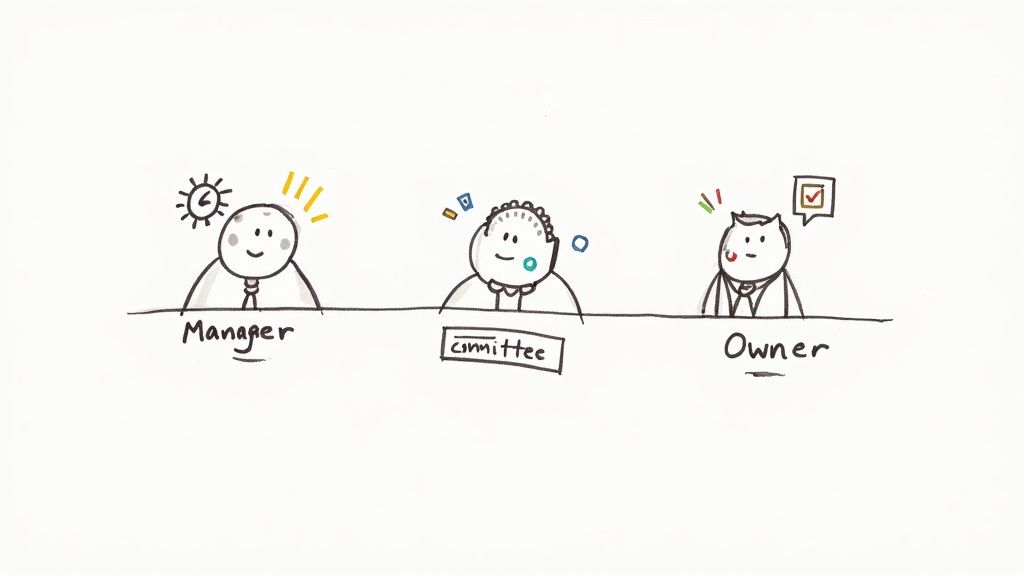
Let’s have a look at the 'before and after' for everyone involved.
For Strata Managers: A Return to Proactive Management
Before a solid platform is in place, a strata manager’s day is often a mad dash. They’re swamped with repetitive admin—manually chasing up levies, trying to make sense of different spreadsheets, and answering the same questions from owners over and over. It's a constant cycle of putting out fires, leaving almost no time for actual strategic work.
With good strata software, the manager's role is transformed.
- Automation Buys Back Time: Things like sending levy notices and meeting reminders happen automatically, freeing up hours every week. One report even found that digital maintenance systems can slash repair response times by as much as 40%.
- A Clear View of Everything: A single dashboard gives them a real-time snapshot of every property. They can instantly see a scheme's financial health, track a maintenance job, or check compliance deadlines without digging through piles of paperwork.
- Less Admin Overload: When owners can help themselves to documents and make payments through a portal, the flood of routine calls and emails slows to a trickle. This lets managers focus on the tricky stuff and build a better community.
Keeping skilled people in the job is a huge deal for the Australian strata industry. MRI Software's 'Voice of the Strata Manager' report found that around 85% of strata managers want to stay in the industry long-term, which means they're holding onto a ton of valuable experience. This trend is pushing software developers to build platforms that can handle complex communications and training, meeting the needs of these dedicated pros. You can discover more about these future trends in the strata management industry to get a sense of where things are heading.
For Committee Members: Confidence Through Clarity
Committee members, who are usually volunteers, have the weighty job of making smart decisions for all the owners. Without a single source of truth, that’s incredibly tough. They might be working off old reports or tangled email chains, which leads to uncertainty and long, drawn-out debates in meetings.
Strata management software gives them the clear, data-backed information they need to make decisions with confidence. With real-time financial reports and maintenance histories at their fingertips, committees can approve budgets and plan for future works with genuine precision.
This clarity doesn't just lead to better governance; it builds trust. When decisions are backed by clear data that any owner can look at, everyone feels more secure.
For Owners and Residents: An Empowered Experience
For most owners and residents, the old way of doing strata can feel like a black box. You send a maintenance request and wonder if it just disappeared into the ether. Getting a copy of a key document often means a whole series of phone calls and emails.
A dedicated owner portal changes all that.
- 24/7 Self-Service: Owners can log in whenever they want to pay their levies, download the by-laws, look at financial statements, or check on a repair. No waiting around.
- Transparent Communication: Centralised announcements mean everyone gets important news at the same time, whether it's a planned water outage or the date for the next AGM.
- Faster Resolutions: When a resident logs an issue through the portal, it creates an instant, trackable ticket. This transparency ensures things get sorted out quickly and efficiently, keeping everyone happier.
At the end of the day, effective strata and body corporate management software creates a positive cycle. Managers work smarter, committees are better equipped, and owners feel more included and heard. It all adds up to a stronger, better-run community for everyone.
How to Choose the Right Strata Software
Picking the right strata and body corporate management software is one of those big decisions that will echo through your business for years to come. With a sea of options out there, it’s easy to get overwhelmed. But diving in without a plan is a recipe for disaster.
Think of it like buying a new work vehicle. You wouldn't just grab the first ute you see. You’d check under the bonnet, look at the running costs, and make sure it’s tough enough for the jobs you handle. The same logic applies here. Your software needs to match your portfolio size, your team’s comfort level with tech, and where you see your business heading. Getting this right from the start means investing in a platform that actually makes your job easier, not harder.
First Things First: What Do You Actually Need?
Before you even think about watching a flashy sales demo, take a step back and look at your own operations. Where are the bottlenecks? What tasks suck up most of your team’s time? Is it chasing down overdue levies, juggling a mountain of maintenance requests, or the endless prep for AGMs?
Get it all down on paper. Make a list of your absolute must-haves versus the nice-to-haves. This simple exercise is your secret weapon—it gives you a rock-solid benchmark to measure every potential platform against. Without it, you’ll get distracted by bells and whistles you'll never actually use.
- For managers with big portfolios: You need a workhorse. Can the software handle thousands of lots without grinding to a halt? Scalability is your number one priority.
- For smaller schemes: It’s all about simplicity and value. Is the system intuitive enough for volunteer committee members to use without a three-day training course? Ease of use is king.
- For everyone: Airtight data security and support you can actually get on the phone are completely non-negotiable.
The Technical Nitty-Gritty: What to Look For Under the Hood
Once you’ve got your needs mapped out, it’s time to start kicking the tyres on a few systems. Don't just look at the feature list. Focus on these four critical areas that will determine if the software is a long-term asset or a short-term headache.
Software Selection Checklist
Choosing the right software can feel like a massive task, but breaking it down makes it manageable. This checklist is designed to help you methodically compare your options and ensure you're asking the right questions.
| Evaluation Criteria | What to Look For | Why It Matters |
|---|---|---|
| Performance & Scalability | Can it handle your current lot numbers and grow with you? Ask for case studies or performance data for portfolios similar to yours. | A system that slows down as you grow becomes a liability. You need a platform that can keep up with your success. |
| Security & Compliance | Where are the servers located (should be in Australia)? Do they have bank-grade encryption and conduct regular security audits? | You're the custodian of sensitive owner and financial data. A breach is a disaster for trust and your bottom line. |
| Key Integrations | Does it connect with your accounting software (Xero, MYOB)? What about communication tools for calls or emails? | A lack of integration means tedious double-handling of data, which is a breeding ground for human error. |
| Mobile Experience (UX) | Is there a functional, easy-to-use mobile app for managers, committees, and owners? Is the interface clean and intuitive? | Work doesn't just happen at a desk. A clunky or non-existent mobile app cripples your team's on-the-go efficiency. |
By working through this checklist, you can move beyond the sales pitch and get a real feel for how each platform will perform in the real world, ensuring you make a choice that truly fits your business.
1. Scalability and Performance
The software you choose today has to work for the business you’ll be tomorrow. It’s a simple question, but one you must ask any vendor: how does your platform perform when you triple the number of lots and users? A system that’s zippy with 100 lots can become a slow, frustrating mess at 1,000.
2. Security and Compliance
Let’s be blunt: you’re holding the keys to people’s financial and personal information. Protecting that data isn't just a "nice to have," it's your legal and ethical duty. Make sure any provider you consider uses top-shelf encryption, undergoes regular security audits, and—critically—hosts their servers in Australia to stay on the right side of our privacy laws.
A data breach can absolutely destroy a strata community’s trust in its management. The fallout can be financially and reputationally catastrophic. Treating bank-grade security as a non-negotiable is just smart, responsible management.
3. Integrations and Ecosystem
Your strata software doesn't live on an island. To be truly effective, it needs to play nicely with the other tools you rely on every day. Think about seamless connections to accounting platforms like Xero or MYOB, which kills the soul-destroying task of double data entry and slashes the risk of errors.
Communication tools are just as vital. Good software should help you manage the constant flow of calls, even after hours, without adding to your workload. For instance, tools that can manage your phone line are a game-changer. You can find out how a

can automate follow-ups and make sure genuinely urgent messages are never missed.
4. User Experience (UX) and Mobile Access
The most feature-packed platform in the world is completely useless if your team can’t figure out how to use it. Look for a clean, logical layout that feels intuitive from the get-go. And remember, it’s not just for your managers—committee members and residents need to be able to navigate it easily too.
These days, a solid mobile app isn’t a bonus feature; it’s an absolute necessity for managing tasks, approving invoices, and accessing key documents while out on site.
To get a broader view of the market, checking out detailed property management software comparison guides can be incredibly helpful. They often break down features, pricing, and real-user feedback, giving you a head start on shortlisting the contenders that best suit your needs.
The Future of Strata Technology
Strata and body corporate management software is evolving. Fast. It's no longer just a fancy tool for admin tasks; it’s becoming the central command centre for entire smart buildings. Forget about better spreadsheets. The future is about creating an intelligent, connected property ecosystem that spots needs before they turn into full-blown problems. We're moving from a reactive "fix it when it breaks" model to one that's predictive and driven by real data.

This whole shift is powered by new tech being snapped up across the Australian strata industry. AI-driven platforms are quickly becoming the norm, improving everything from how we talk to tenants to making day-to-day operations run smoother. Smart building tech is a huge part of this, enabling real-time maintenance logging and much faster response times. It’s a pretty exciting time for anyone in property management.
Predictive Maintenance with Artificial Intelligence
Picture this: your building’s lift flags itself for a service before it breaks down. That’s the real-world power of predictive maintenance, and it's all driven by Artificial Intelligence (AI). By crunching historical data from sensors in equipment—think HVAC systems, lifts, and water pumps—AI can spot the subtle little patterns that scream "I'm about to fail!"
So, instead of waiting for a frustrated resident to call you, the management software automatically pings a work order to a technician. Problem solved before it even happened. This doesn't just prevent annoying breakdowns; it lets you plan maintenance strategically, saving the body corporate a fortune on those painful emergency call-out fees. The potential here is massive, and it’s something being explored by initiatives from Australia's
.
Seamless Building System Integrations
The real magic of next-gen strata software is its ability to talk directly to the building’s physical hardware. This is what turns your platform from a simple database into a proper digital hub, giving you a level of control and insight that was unthinkable a few years ago.
- Smart Access Control: Need to grant a contractor temporary access? You can issue or cancel digital keys from your dashboard, check who’s been in the common areas, and manage it all remotely.
- Energy Monitoring: By connecting with smart meters, you get a live feed of energy and water usage. This makes it dead simple for committees to spot wastage and roll out sustainability initiatives that actually work.
- Automated Resident Support: Let’s be honest, managers spend a lot of time answering the same questions. AI chatbots built into owner portals can handle the common queries—"When is bin day?" or "Where can I find the by-laws?"—24/7, freeing you up for the important stuff.
And it’s not just about core management. The wider property tech space is booming with things like AI virtual staging already changing how properties are sold and marketed.
A Use Case for Advanced Communication
One of the biggest headaches for any strata scheme is dealing with urgent, after-hours calls. A burst pipe at 2 AM simply can’t wait until the office opens. The next wave of strata tech solves this by linking up with smart communication services that can handle these calls intelligently.
Think about an urgent call coming in after hours. Instead of going to voicemail, it’s routed through an AI-powered system. The system figures out what the issue is, how serious it is, and if it's critical, it automatically forwards the call and all the property details straight to the on-call plumber. An immediate response, with zero human intervention needed from the manager.
This approach ensures urgent issues are never missed. Better yet, it creates a complete digital record of the whole interaction, logged right there in the strata management platform. It’s a perfect example of how strata and body corporate management software is becoming the heart of a truly connected and intelligent building.
Avoiding Common Implementation Mistakes
Picking the right strata and body corporate management software is a massive step forward, but its success really comes down to how well you roll it out. Let's be honest, even the world's best platform will fall flat if the implementation is a clumsy mess. Dodging a few common pitfalls can be the difference between a smooth transition and a complete headache for everyone involved—managers, committees, and owners alike.
Switching from your old, clunky system to a new, shiny one isn't as simple as flicking a switch and hoping for the best. That’s a recipe for chaos. From my experience, the three biggest tripwires are almost always the same: messy data, poor training, and confusing communication.
The Challenge of Messy Data Migration
Your existing data is the heart and soul of your operation—all those owner details, financial records, and maintenance logs. Shovelling it all into a new system without a serious clean-up first is the number one cause of implementation nightmares. You'll end up with duplicated records and inaccurate info, which immediately throws a spanner in the works for everything from levy notices to owner portal access.
Before you even think about migrating, you need to:
- Conduct a Data Audit: Seriously, get in there and clean house. Go through your records to find and fix errors, get rid of duplicate entries, and make sure the formatting is consistent across the board.
- Create a Migration Checklist: You need a game plan. Map out exactly what data you’re moving, where it’s going in the new system, and who is double-checking it once it's there.
A clean data migration is the bedrock of a successful software launch. The old saying ‘garbage in, garbage out’ is brutally true here. Taking the time to get your data organised beforehand will save you from countless problems down the track and build trust in the new system from day one.
Insufficient User Training and Onboarding
Just handing over new software without any training is like giving someone the keys to a brand-new car but not teaching them how to drive. It's bound to end in a crash. And a one-size-fits-all training session just won't cut it, because different people need different things. Your strata managers need the deep-dive, technical stuff, while committee members and owners just need a simple tour of their portals.
To get everyone on board and actually using the software, a phased training plan is your best bet.
- Manager and Admin Training: Start with an intensive session for your core team. Focus on the back-end workflows they’ll be living in every single day.
- Committee Onboarding: Hold a separate, more focused session for committee members. Show them the tools that matter to them, like reporting, approvals, and communication features.
- Owner and Resident Rollout: Keep it simple for owners. Think short video tutorials, a straightforward FAQ page, and maybe a few drop-in Q&A sessions to help them get comfortable.
A Lack of Clear Communication
Finally, and this is a big one, don't ever underestimate how important it is to keep everyone in the loop. If a new system suddenly appears out of nowhere, you’re going to get confusion and pushback from residents. A solid communication plan lets everyone know what’s changing, why it’s changing, and how it’s going to make their lives better.
Use plain, simple language and give people a clear timeline. Send out an announcement to kick things off, follow up with a few reminders, and then send a final "welcome" email with login details. When you give people the heads-up and guide them through it, they feel included and prepared. It paves the way for a much smoother, more successful rollout of your new strata management software.
Frequently Asked Questions
Jumping into the world of strata and body corporate management software can throw up a few questions, especially when you're trying to figure out if it’s the right move for your properties. Let's get straight into some of the most common queries we hear.
How Much Does Strata Management Software Typically Cost?
There's no single price tag on this one. The cost really depends on the size of your portfolio and the specific bells and whistles you need. Most vendors run on a Software-as-a-Service (SaaS) model, which means you'll pay a monthly or annual fee for each lot you manage. This can be anything from a few dollars to over ten dollars per lot.
But here’s a tip: don't just look at the base subscription fee. Make sure you ask about any one-off costs for things like setup, getting your data moved over, or premium support. That way, you get the full picture of what you’re really investing.
Is This Software Difficult for Committee Members to Use?
Not at all. The last thing you want is a system that only a tech whiz can figure out. Modern platforms are built with everyone in mind, from seasoned managers to volunteer committee members who might not be super comfortable with new technology.
The best strata and body corporate management software providers focus on simple owner portals, clean mobile apps, and plenty of support. Look for vendors who offer solid training resources like video tutorials and have a dedicated support line, so everyone feels confident using the system from day one.
Can Strata Software Integrate with Our Existing Accounting System?
Absolutely—and this is a big one. Solid integration is the hallmark of any high-quality strata software. Many of the top platforms connect directly and smoothly with popular accounting packages like Xero, MYOB, and QuickBooks.
This connection means all your financial data, like levy payments and invoices, gets synced up automatically. It completely gets rid of the soul-destroying (and error-prone) task of manual data entry, keeping your books accurate and up-to-date. Just be sure to double-check which specific accounting systems are supported before you sign on the dotted line.
Ready to reclaim your time and streamline your communications? OnSilent acts as your AI personal assistant, ensuring no urgent call is ever missed and every enquiry is handled professionally. Discover how our smart voicemail and call management can transform your strata operations by visiting https://onsilent.com for a free trial.