

Let's be honest, the best sparkies know their most valuable tools aren't just rattling around in the back of the van anymore. Software for electricians has become the essential upgrade for running the business side of things—quoting, scheduling, and invoicing—while your physical tools get the actual job done.
Why Your Toolbox Isn’t Cutting It Anymore
The days of successfully running an electrical business from a dog-eared clipboard and a messy van are fading fast. Modern electricians are juggling complex safety regs, clients who want everything yesterday, and a mountain of paperwork that can quickly bury even the most organised operator.
This admin burden is where good money gets lost and stress levels go through the roof.
Think of it this way: your screwdrivers and testers are for fixing electrical problems, but what tools are you using to fix your business problems? Relying on paper-based systems is like using dodgy, old wiring; it’s inefficient, bound to fail, and a serious risk to your business's health. Lost quotes, missed appointments, and late invoices are just symptoms of a system that can’t keep up.
The Move to a Digital Toolkit
The answer is to switch to a "digital toolkit." This isn't about replacing your hands-on skills, but beefing them up with powerful software that automates the tedious bits of your job. By grabbing onto digital solutions, you can start to:
- Punch out accurate quotes in minutes: Forget manual calculations or notes scribbled on a napkin. You can send off professional, detailed quotes from your phone before you even leave the job site.
- Get your job scheduling sorted: Get a crystal-clear view of your team's availability, send techs out to jobs efficiently, and give clients accurate arrival times they'll appreciate.
- Speed up your invoicing and payments: Instantly create and fire off invoices the moment a job is finished, which dramatically improves your cash flow.
Making this leap from manual chaos to organised digital systems is a game-changer for growth. And it’s not just about job management; other digital tools are making waves too. For example, dedicated workplace safety apps are replacing old paper forms to make compliance and on-site safety a whole lot easier and more efficient.
The Growing Demand for Smarter Tools
This shift isn't just a fleeting trend; it’s a massive market change. The wider Australian software market, which includes the kind of crucial application software sparkies need, generated USD 15,737.1 million in 2024 and is expected to nearly triple by 2030.
At the end of the day, creating business systems is what separates a struggling sole trader from a thriving, profitable business. This digital transformation is your chance to build a stronger, more efficient operation, freeing you up to focus on the work you actually enjoy.
Your Digital Toolkit Explained
To really get a handle on your business, you need to think of your software like a perfectly organised work van. Every tool has its purpose, and when they all work together, you become incredibly efficient. This digital toolkit is what separates a busy sparkie from a profitable electrical business owner.
Let's break down the essential software categories every electrician should have, exploring how each one tackles a specific headache and pushes your business forward.
The modern sparkie's business is now split right down the middle: there's the hands-on work, and then there are the digital tools that manage it all.

This image highlights a simple but powerful truth: your success now depends just as much on your digital systems as it does on your trade skills.
Before we dive into the details of each tool, here’s a quick overview of the key software types that can transform your operations.
Essential Software Types for Electrical Businesses
| Software Category | Primary Function | Key Benefit |
|---|---|---|
| Quoting & Estimating | Creates fast, accurate, and professional-looking quotes. | Wins more jobs by eliminating guesswork and speeding up response times. |
| Job Management & Scheduling | Organises team schedules, tracks job progress, and centralises communication. | Tames daily chaos, reduces admin, and improves team efficiency. |
| Invoicing & Accounting | Automates invoice creation, sending, and payment tracking. | Improves cash flow, simplifies bookkeeping, and makes getting paid faster. |
| Design & Compliance | Plans complex electrical systems and ensures they meet legal standards. | Ensures safety, quality, and regulatory compliance for complex installations. |
This table lays out the core functions, but let's get into the nitty-gritty of how these tools actually work in the real world.
Quoting and Estimating Software
Remember scrambling to price a job on the back of a napkin, hoping you didn’t forget a crucial material cost? Quoting software puts an end to that guesswork for good. It’s built to help you create accurate, professional quotes in minutes, not hours.
These platforms often come loaded with price books for common materials and standard labour rates, letting you quickly build a detailed estimate. That speed is a massive advantage—you can often send a quote to a potential client from your phone before you've even left their property.
A fast, professional quote doesn't just look good; it shows the client you’re organised and serious about winning their business.
Job Management and Scheduling Software
This is the central nervous system of your operation. Job management software is designed to tame the daily chaos of dispatching technicians, tracking job progress, and keeping everyone in the loop. Think of it as your digital whiteboard, but way smarter.
You can see your entire team’s schedule at a glance, assign jobs based on location and skill, and give clients accurate arrival windows. Better yet, technicians in the field can update job statuses, upload photos of their work, and pull up all the job details they need right from their phone.
This real-time visibility is a game-changer. It means fewer frantic phone calls between the office and the field, fewer missed appointments, and a much smoother workflow from start to finish.
There's a good reason sparkies are ditching the old manual methods. The software development market in Australia, which builds these essential tools, is booming. It hit USD 3.86 billion in 2024 and is projected to skyrocket to USD 17.33 billion by 2034. This growth is driven by businesses swapping clipboards for cloud-synced platforms that can slash quoting and invoicing errors by up to 30%, according to industry data. You can read more about this huge market expansion and its impact on the trades.
Invoicing and Accounting Software
Getting paid on time is the lifeblood of any trade business. Invoicing and accounting software automates this critical process, making sure your cash flow stays healthy. Instead of waiting until the end of the week to create and send invoices, you can fire one off the moment a job is done.
Many of these tools make it dead simple for clients to pay you, with features like online payment portals. They also sync up with popular accounting platforms, which simplifies your bookkeeping and makes tax time a whole lot less painful. This automation frees you from chasing late payments and gives you a clear financial picture of your business anytime you need it.
Design and Compliance Software
For more complex jobs, especially on commercial sites or new builds, design and compliance software is non-negotiable. This is a more specialised tool that helps you plan and map out intricate electrical systems before you start.
With these tools, you can create detailed wiring diagrams, calculate load balancing, and ensure your plans meet all the necessary safety standards and regulations, like the crucial AS/NZS 3000. Using this software not only improves the quality and safety of your work but also provides professional documentation you can share with clients, builders, and inspectors. It’s all about getting the job right on paper before you ever touch a wire.
Must-Have Features in Top Electrical Software
Knowing the different types of software is a good start, but the real game-changer is the features inside. This is what turns a decent program into the most valuable tool in your van. Let's be honest, not all software for electricians is built the same. The best ones all share a core set of features designed to tackle the real-world headaches you deal with every single day.
Think about it like buying a new multimeter. You wouldn't just grab the first one off the shelf. You’d look for specific functions like True RMS, auto-ranging, and a solid safety rating. The same logic applies here. Let's break down the non-negotiables that make a software platform a genuine asset for your business.
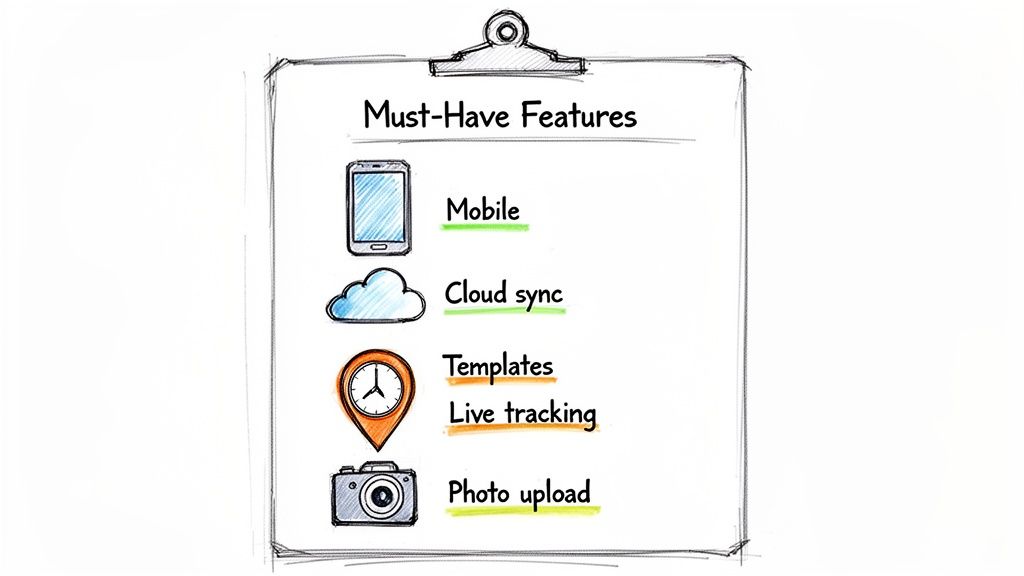
Uncompromising Mobile Accessibility
For a sparkie, the office is usually the front seat of the ute. That means any software you rely on has to work flawlessly on a mobile phone, no questions asked. And I don't just mean being able to check your calendar. Proper mobile access lets your team get critical tasks done from anywhere, without ever needing to crack open a laptop.
This means being able to:
- Whip up and send a quote right after walking through a job.
- Fire off an invoice the second the tools are packed away.
- Pull up a client's history and job notes while you're standing on their property.
- Get a client's signature for an approval directly on a phone or tablet.
Without this, your software is just a ball and chain, tying you back to a desk and slowing everything down.
Cloud Syncing for a Connected Team
Picture this: your apprentice wraps up a job, and the invoice is instantly ready for the office to email out. That's the magic of cloud syncing. It makes sure any update made in the field—a note, a photo, a completed task—is immediately visible back at the office, and vice versa.
This real-time connection gets rid of the communication breakdowns that burn time and money. No more frantic calls checking if a job's finished or confusion over what was actually said on-site. Everyone on the team is working from the same, always-current information.
For an electrical business, this creates a single source of truth. It stops vital information from getting trapped on one person's phone or a stray bit of paper, ensuring your entire operation runs like a well-oiled machine.
The growth in this space is massive. Australia's electric automation market, which relies heavily on this kind of software for electricians, hit USD 523.64 million in 2023. It's projected to climb to an incredible USD 1,425.84 million by 2033. This software now lets sparkies simulate entire electrical layouts before installation, which can slash material waste by 15-20% per project. You can discover more insights about this rapidly expanding automation market and its impact.
Powerful Quoting and Invoicing Templates
Speed and professionalism win jobs, simple as that. The best software comes loaded with customisable templates that let you build slick, professional quotes in minutes. Instead of starting from scratch every single time, you can pull in pre-set labour rates, common materials from your price book, and your company branding with a few taps.
This isn't just about saving time; it's about consistency. It ensures every quote and invoice that goes out looks professional and is free from costly mistakes. A good template automatically drops in your terms and conditions, payment details, and business info, protecting you legally while making it dead simple for clients to pay you. It's a small feature that gives your business's image a huge lift.
Real-Time Job Tracking and Photo Uploads
You need a bird's-eye view of everything that's happening. Real-time tracking lets you see the status of every job at a glance—from "scheduled" and "in progress" to "completed" and "invoiced." This level of visibility helps you manage your team more effectively and give clients proactive updates before they even think to call you.
One of the most valuable features tied to this is on-site photo and video uploads. When a technician can snap a photo of a tidy switchboard installation or a quick video explaining a complex problem, it does a few things. It provides undeniable proof of work, helps with troubleshooting from afar, and can shut down potential client disputes before they even start. A simple timestamped photo can be the difference between a happy customer and a frustrating, costly callback.
Choosing the Right Software for Your Business
Picking the right software for your electrical business isn't about finding the shiniest new tool with a million features. It's about finding the one that actually fixes what's broken in your day-to-day operations. Get this wrong, and you’re just swapping one set of headaches for another. A clear game plan is non-negotiable.
Before you even think about browsing websites, you need to get brutally honest about your biggest pain point. Is it the mind-numbing hours you sink into quoting from scratch? Or maybe it’s the constant phone tag trying to get your team to the right place at the right time? Whatever that major bottleneck is, let it be your guide.
Start With Your Business Needs
The software a sole trader needs is a world away from what a growing business with five vans on the road requires. If you're a one-person show, you're probably looking for something simple and affordable—a rock-solid mobile app that lets you fire off quotes and invoices from site is likely your top priority.
But for a bigger business, the game changes. You need more grunt under the hood. We're talking about advanced scheduling to juggle multiple crews, detailed job tracking to see who's doing what, and different user permissions so your apprentices can’t accidentally see the company's financials.
A massive part of getting your operations in order is using dedicated software for quotes and invoices. This isn't just about looking professional; it's about making sure cash flows back into your business quickly, which is critical whether you're working solo or running a team.
To really spell it out, let's look at how software needs change as a business grows.
Software Needs Based on Business Size
The "best" software is completely different depending on whether you're a lone wolf or leading a pack. This table breaks down the key differences.
| Consideration | Sole Trader Focus | Multi-Person Team Focus |
|---|---|---|
| Primary Goal | Speed and simplicity for quoting and invoicing. | Efficiency, communication, and team oversight. |
| Key Features | Excellent mobile app, simple job tracking, online payments. | Multi-user access, advanced scheduling, timesheets, reporting. |
| Budget | Lower-cost, subscription-based plans. | Higher investment for a comprehensive, scalable platform. |
| Integration | Basic integration with accounting software (e.g., Xero). | Deeper integrations with CRM, supplier catalogues, and payroll. |
As you can see, what works for you now might not be what you need in a few years. It's all about matching the tool to your current scale and where you plan to take the business.
Evaluate Your Top Options
Once you've nailed down what you actually need, it's time to create a shortlist. My advice? Look for software providers that specifically build tools for Aussie tradies. They're far more likely to get the local compliance stuff right and build features that make sense for how we work here.
When you're comparing your top contenders, keep these things in mind:
- Ease of Use: Is the app actually easy to navigate? There's no point investing in a complicated system if your team finds it too hard and refuses to use it. The software should feel like it was built for a sparkie, not a software engineer.
- Customer Support: What happens when something goes wrong at 7 am on a Monday morning? Look for companies with responsive, Australian-based support. Dig into their reviews and see what real users are saying about getting help when they need it.
- Scalability: Will this software grow with you, or will you outgrow it in a year? Make sure the platform has bigger plans or extra features you can add on as you hire more people and take on larger projects. For example, as businesses expand, they often realise job management isn't enough; they need a proper system to manage client relationships. You can find out more about how a CRM for the construction industry can help with that.
Always Use the Free Trial
Honestly, this is the most important step of the whole process. Watching slick demo videos and reading reviews is one thing, but nothing beats getting your hands dirty with a real-world test drive. A free trial is your chance to see if the software truly fits how you work.
Don’t just click around in the settings. Use the trial to run a real job from quote to invoice. Create a quote for a fictional client, schedule the job, assign it to yourself, track your time on it, and then generate the final invoice.
This hands-on approach is the only way you'll know for sure if the platform is going to solve your problems or just create a whole new set of them. It puts the software to the test in the messy reality of a typical workday, which is where it really matters. Investing a few hours here can save you months of frustration and thousands of dollars down the track.
Integrating Your Tools for a Seamless Workflow
The real magic happens when your different software tools start talking to each other. Think of it like a perfectly wired circuit—when every component is connected correctly, the whole system just works, smoothly and reliably. Standalone tools are handy, sure, but an integrated system is a massive step up for your business.
This is where you go beyond just speeding up one-off tasks and start building a genuinely seamless operation. When you connect your job management, quoting, and accounting software, you can finally kill off that mind-numbing double entry for good. It creates an unbroken flow of information, from the second a potential customer calls to the moment their final payment lands in your bank account.
The Power of a Connected System
Let’s play it out. A new job enquiry comes in. With an integrated system, the details you punch into your job management platform automatically populate in your quoting tool.
Once the quote gets the green light, it instantly becomes a scheduled job. When the work is done and dusted, that same data is used to fire off an invoice from your accounting software. No re-typing, no mistakes.
This seamless handover of information between platforms gives you some huge wins:
- Drastically Reduced Admin Time: No more manually copying customer details, job notes, and costs from one program to another. This alone can save you hours every single week.
- Fewer Costly Errors: Let’s be honest, manual data entry is a recipe for stuff-ups. Automation keeps things accurate, preventing you from under-billing a client or sending a tech to the wrong address.
- A Clear View of Your Business: When all your data lives in one connected ecosystem, you get a much clearer, real-time picture of your profitability, job statuses, and cash flow.
A truly connected workflow doesn't just make you faster; it makes your entire business smarter and more resilient. For a deeper dive into how this all works, you can learn more about the principles of workflow automation and how it applies directly to a trade business like yours.
Plugging the Biggest Leak in Your Business
Even with the best operational software, most electrical businesses have a massive weak spot: missed phone calls.
Every time your phone rings while you're on the tools, up a ladder, or driving between jobs, you’re risking a valuable lead. It’s the most common and costly leak in any service business, period.
This is where a specialised tool like an AI call assistant completes the picture. While your core software manages the work you’ve already won, an intelligent front desk makes sure you never miss the chance to win more.
Think of it as the perfect front door for your entire system. It acts as an always-on receptionist, capturing every single inquiry, 24/7, and ensuring no potential job ever slips through the cracks.
A tool like OnSilent slots right into your workflow by acting as that first point of contact. It doesn’t just take a message; it intelligently captures lead details and can feed new jobs directly into your system.
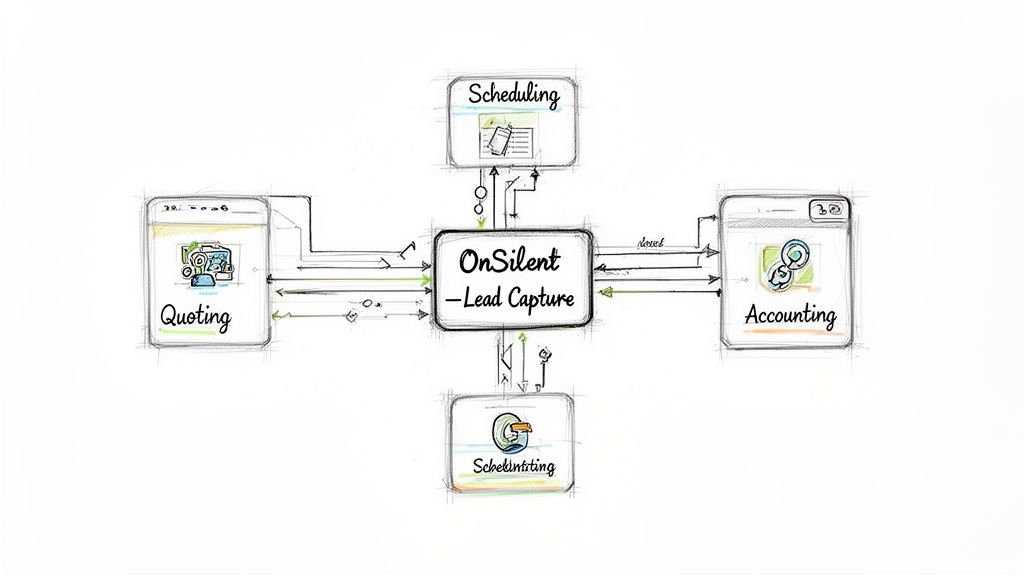
This effectively plugs that leaky hole at the very start of your customer journey, turning every missed call into a captured opportunity. By connecting this front-end lead capture to your back-end management software, you create a powerful, end-to-end system that drives growth and stops you from leaving money on the table.
Right, let's turn all this talk into action. Bringing the right software into your business isn't just another monthly bill to pay—it’s a proper investment in your future. It's what gets you your evenings back and makes the job more profitable and a hell of a lot less stressful.
You don't need some complex, jargon-filled strategy to get started. All you need is a simple, clear plan. Think of it like ripping out old, faulty wiring and installing a modern, efficient system that just works. This is about making a deliberate choice to build a stronger, leaner operation, and you can start today.
Your Simple Get-Started Checklist
Don't let yourself get overwhelmed. If you break it down into a few manageable steps, the whole process feels a lot less daunting. Here’s how you can start moving to a smarter way of working:
-
Pinpoint Your Biggest Time-Waster: First up, be brutally honest with yourself. Are you sinking endless hours building quotes from scratch? Or is it the sheer chaos of trying to juggle job scheduling over the phone? Nail down the single biggest bottleneck that's costing you time and money.
-
Research with a Clear Goal: Once you know the problem, start looking for software for electricians that is built to solve that specific headache. It’s easy to get distracted by flashy features you'll never touch. Stay focused on platforms that directly tackle your main pain point.
-
Commit to Free Trials: This step is a non-negotiable. Pick two or three promising options and really put them through their paces with a free trial. Don't just click around—run a real job through each system, from quote to final invoice, and see how it actually feels to use in the real world.
Secure Your Lead Flow
While you're sorting out your internal operations, don't take your eye off the most critical part of the business: getting new customers. The most efficient system in the world is useless if you don't have a steady stream of job enquiries coming in. And this is where you need to plug the single biggest leak in any trade business—missed phone calls.
Upgrading your operational software is a massive step forward, but if your phone rings out while you're on a job, you're still leaving money on the table. A solid lead flow is the foundation of a truly efficient business.
This is where a tool like an always-on AI assistant can slot perfectly into your new digital toolkit. Something like OnSilent works 24/7 to capture every single one of those valuable phone leads, making sure no opportunity ever slips through the cracks. When you pair this kind of front-end protection with your back-end management software, you create a powerful, end-to-end system built for real, sustainable growth.
Of course. Here is the rewritten section, designed to sound like it was written by an experienced human expert, following all your specified requirements.
Common Questions Sparkies Ask About Software
Jumping into new software can feel like a big step, and you probably have a few questions rattling around. It's a major decision for your business, so you want to get it right. Let's tackle some of the most common queries we hear from sparkies looking to upgrade their tech.
Getting these last few details sorted will help you pull the trigger with confidence, knowing you're picking something that'll genuinely make your work life easier and your business healthier.
How Much Should I Expect to Fork Out for Good Electrician Software?
The price tag on software for electricians can be all over the place, really depending on what you need. A simple app for a one-man band might only cost you $30 to $60 a month. But for bigger crews that need all the bells and whistles, you could be looking at anywhere from $100 to over $300 monthly.
The key is to stop thinking of it as just another bill and start seeing it as an investment. If a $150-a-month platform saves you five billable hours stuck doing admin, it’s already paid for itself a few times over. Always hunt for clear, upfront pricing and be a bit wary of hefty setup fees unless they include some solid training to get you and the team comfortable.
Is This Stuff a Headache to Learn and Set Up?
Not anymore. Most modern software for electricians is built for tradies on the tools, not tech heads in an office. The whole point is to have a simple, mobile-friendly design you can get the hang of between jobs.
Sure, the first setup might take an hour or two to chuck your client list and price book in, but the good providers have your back. They’ll usually have how-to videos, help docs, and actual people you can chat to, making the whole thing as smooth as possible.
The acid test? A free trial. It’s your chance to see if you and the team actually find the platform easy to use in the real world before you spend a single cent.
Taking the time to give it a proper go ensures you end up with a tool your team will actually use, not one that just collects digital dust.
Will This Software Help Me Stay Compliant with Aussie Electrical Standards?
You bet. Heaps of platforms are built specifically for the Australian market with compliance features baked right in. They’re designed to help you pump out Certificates of Electrical Safety, manage your JSA checklists on-site, and make sure all your paperwork lines up with local regs.
Some of the more powerful design tools even help you map out complex jobs according to essential standards like AS/NZS 3000. As you’re weighing up your options, always check that the provider specifically mentions compliance with Australian standards. Honestly, this feature alone can save you a mountain of time and massively slash your business risk. It’s a non-negotiable for any sparkie working down under.
Ready to stop missing valuable leads while you're on the tools? OnSilent acts as your 24/7 AI assistant, capturing every call and ensuring no opportunity slips through the cracks. Discover how OnSilent can secure your lead flow today.