


Let's be honest, in the world of sales, the terms 'lead' and 'prospect' get thrown around so much they almost seem interchangeable. But they’re not. Getting this distinction right is the foundation of a sales process that actually works, instead of one that just keeps your team busy.
So, what’s the real difference? It all boils down to two things: qualification and communication.
A lead is essentially just a name and some contact details. They’ve shown a flicker of interest – maybe they downloaded a guide from your website or signed up for a newsletter. They're on your radar, but that's about it.
A prospect, on the other hand, is a qualified lead. This is someone you’ve actually vetted. You know they fit your ideal customer profile, and crucially, you've started a real, two-way conversation with them. They're not just a name on a list; they're a potential buyer.
Defining the Critical Difference Between a Lead and a Prospect
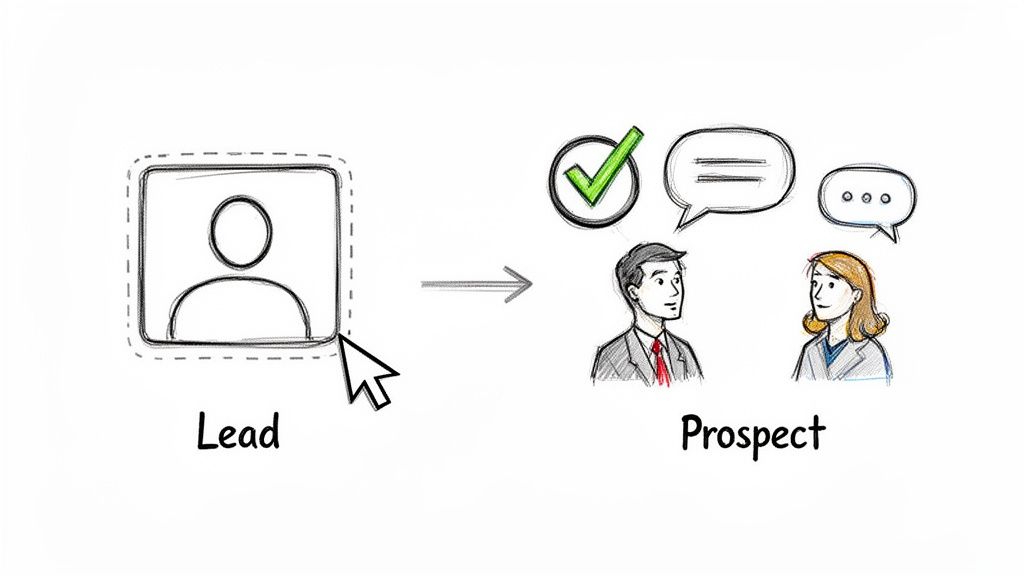
Nailing the difference between a lead and a prospect is what separates a clunky sales machine from a smooth-running one. Think of it this way: every single prospect starts out as a lead, but only a fraction of your leads will ever earn the title of 'prospect'.
Why does this matter so much? Because it stops your sales team from wasting precious hours chasing down people who were never going to buy in the first place. It’s all about focusing your energy where it’ll actually make a difference and drive revenue.
Where a lead comes from often gives you a clue about their initial intent. Checking out the top marketing lead sources can shed some light on this. At the end of the day, a lead is just someone who’s handed over their contact info. Their genuine interest and whether they're a good fit for your business are still big question marks.
A prospect, however, has been properly checked out. They’ve moved past that initial curiosity stage because you've qualified them against a set of real-world criteria. This process confirms they have a problem you can solve, the power to make a purchasing decision, and a budget that makes sense for what you offer.
The real magic happens when one-way marketing chatter turns into a two-way sales conversation. That’s the moment a lead truly becomes a prospect. It’s the shift from collecting contact details to actually building a relationship.
This progression is absolutely vital for a healthy sales funnel. If you treat every name in your CRM like they're ready to sign on the dotted line, you're setting yourself up for failure. By clearly defining each stage, you can build smart nurturing campaigns for your leads and save the high-touch, personal sales efforts for your genuinely qualified prospects.
Lead vs Prospect At a Glance
To cut through the noise, here's a quick side-by-side look at what separates a lead from a prospect. This table breaks down the key attributes so you can see the difference in an instant.
| Attribute | Lead | Prospect |
|---|---|---|
| Qualification Status | Unqualified or maybe lightly vetted. | Qualified against specific criteria (like BANT). |
| Communication | Usually one-way; you talking at them. | Two-way; an actual sales conversation is underway. |
| Stage in Funnel | Top of the Funnel (TOFU) – just looking. | Middle of the Funnel (MOFU) – seriously considering. |
| Identified Need | A potential or assumed problem. | A confirmed need and interest in finding a solution. |
| Next Step | Nurturing and the first qualification chat. | Deep-dive discovery call, a demo, or a proposal. |
As you can see, the journey from lead to prospect is a significant one. It’s a process of filtering and focusing that ensures your sales team is always talking to the right people at the right time.
Mapping the Journey: From First Contact to a Done Deal
The easiest way to get your head around the difference between a prospect and a lead is to picture your sales process as a funnel. It maps out every single step, from that first flicker of interest right through to a closed deal, with each stage having a very specific job to do.
It all kicks off at the Top of the Funnel (TOFU), which is where you cast your widest net. This is your marketing playground, where you generate a high volume of raw leads. These are the people clicking an ad, downloading a free guide, or dropping their email in a form. At this point, they're basically strangers who’ve shown a brief flash of curiosity. The goal here isn't to make a sale; it's to grab their attention and get some basic contact details.
From Vague Interest to Real Intent
This is where things get interesting. As a lead trickles down into the Middle of the Funnel (MOFU), the real transformation happens. This is the crucial qualification and nurturing phase where a lead gets a chance to become a prospect. You start engaging with them in a more meaningful way—maybe through a targeted email sequence, an informative webinar, or an initial phone call.
Your mission is to find out if they actually fit your ideal customer profile and have a genuine problem you can solve. For example, someone who downloaded your real estate guide is just a lead. They only become a prospect after you follow up, they confirm they're actively looking to buy, and they've already had a chat with a mortgage broker. That two-way conversation is the defining moment. Tools like chatbots for lead generation are brilliant at turning these initial chats into qualified conversations without you lifting a finger.
Closing the Deal with Genuine Prospects
Finally, you get to the Bottom of the Funnel (BOFU), where your focus narrows right down to sales-ready prospects. These are the people who’ve been properly qualified, they get what you offer, and they’re seriously thinking about buying. This is where your sales team should be spending all its time—running demos, sending out proposals, and negotiating the final details.
The real magic of the funnel is its filtering power. It makes sure your most valuable sales activities are spent on high-intent prospects, not wasted on tyre-kickers at the top.
This whole process is crystal clear in the Australian real estate game. Industry data shows that only a tiny fraction—around 5-10%—of initial enquiries ever become Marketing Qualified Leads (prospects who are genuinely interested). Even fewer make it to the sales stage, which shows why agents can't afford to waste a second. A fast, organised follow-up is the only way to guide those few golden opportunities through the funnel. For anyone in property, a solid system is non-negotiable. You can learn more about building a powerful real estate follow-up system that actually converts.
How to Spot a Genuine Prospect from a Tyre-Kicker
Turning a lead into an actual prospect all comes down to one thing: qualification. Without a solid process for this, your team will waste hours on dead-end conversations. You need a simple way to filter out the time-wasters so you’re only talking to people with real intent to buy. This is where the whole prospect vs lead difference really matters.
One of the best-known frameworks for this is BANT, which stands for Budget, Authority, Need, and Timeline. It’s been around for ages in corporate sales, but the principles are a perfect fit for Aussie service-based businesses. Think of it as a quick checklist to see if a lead has what it takes to become a serious prospect.
This diagram shows you exactly where this qualification step fits in. It’s the critical filter that moves people from being a random lead to a qualified prospect, and eventually, a paying customer.
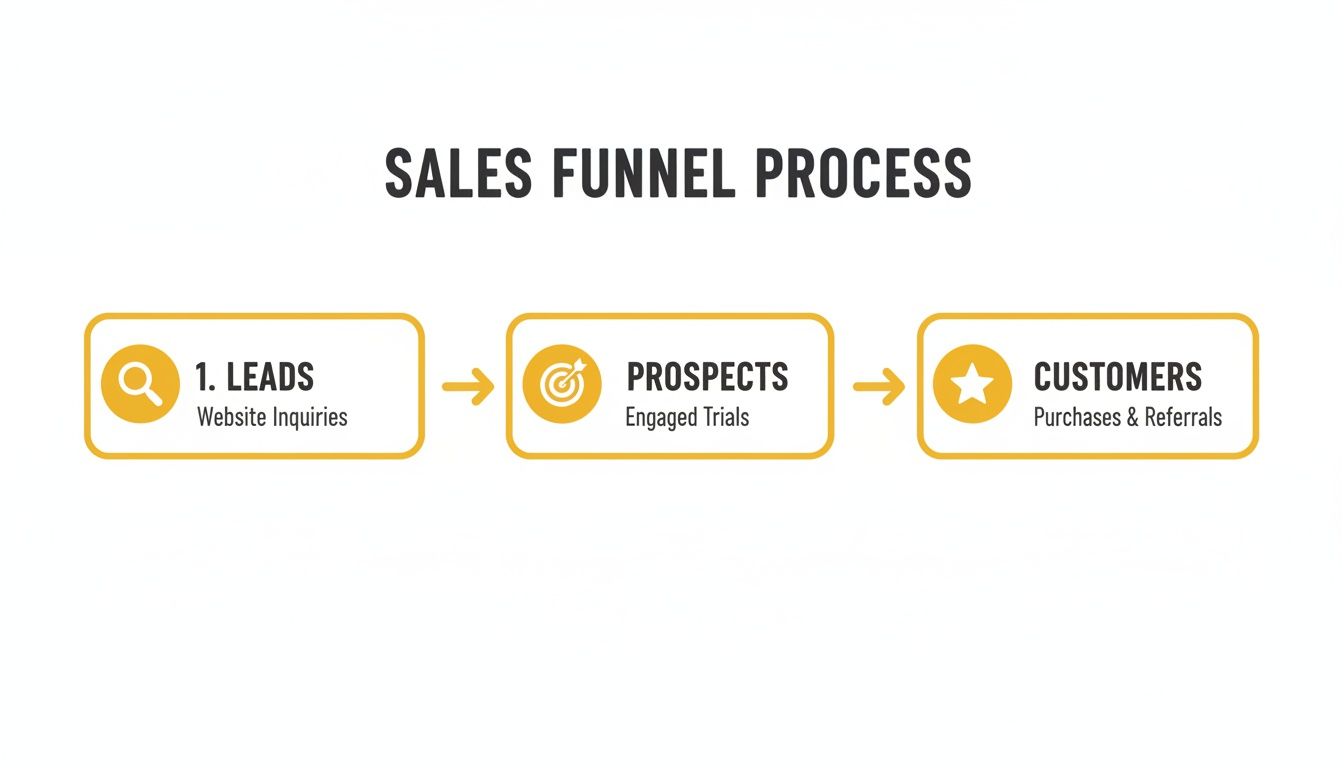
Seeing it laid out like this really drives home how important that middle step is for cleaning up your pipeline.
Putting BANT to Work in the Real World
So, how does this actually work day-to-day for an Australian business? Let's break down BANT with some practical examples.
-
Budget: Can they actually afford what you're selling? A real estate agent needs to ask if a buyer has their finance pre-approved. A tradie might just need to confirm the client is okay with the call-out fee or the ballpark quote. It’s about making sure the money conversation happens early.
-
Authority: Are you talking to the person who can actually say "yes"? A plumber needs to know if they're dealing with the homeowner or a tenant who has to get the landlord's okay. A mortgage broker has to be sure all the decision-makers are in the room.
-
Need: Do they have a real problem that you can solve? A vague "just looking" enquiry is a lead. Someone describing their blocked drain and asking how quickly you can get there? That’s a hot prospect with a clear need.
-
Timeline: How soon do they need this sorted? Urgency is a massive qualifier. A homeowner thinking about renovating "sometime next year" is a lead you should nurture. But someone who needs a roof leak fixed before the weekend storm hits? That’s a high-priority prospect you jump on straight away.
By working through BANT, you’re not just having a chat; you’re building a clear picture of someone's intent and readiness to buy. It's the most reliable way to separate the casual browsers from the serious buyers.
This doesn't have to feel like an interrogation. It’s all about guiding the conversation to get the details you need. By building your qualification process around a simple framework like this, you give your team the power to focus their energy where it’ll actually pay off—on prospects who are ready to go.
Seeing the Difference: Leads vs. Prospects in the Real World
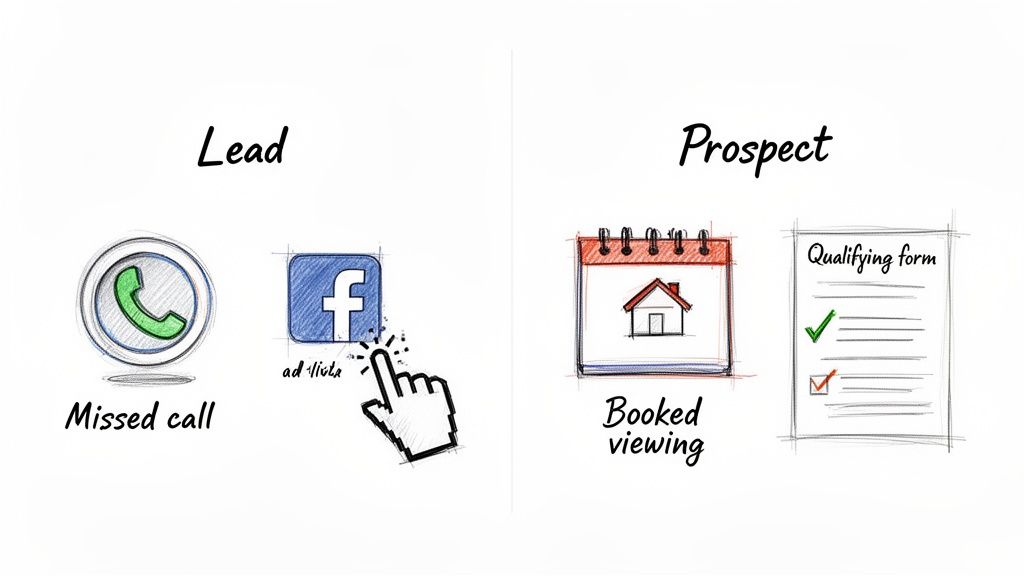
Knowing the textbook definition of a prospect vs lead is one thing, but seeing how it plays out in your day-to-day work is where the penny really drops. This isn't just about semantics; it's a fundamental shift in how you engage with people, what you prioritise, and where you sink your valuable time.
Let's ditch the theory and look at some real, boots-on-the-ground examples that Australian service professionals run into every single day. These scenarios perfectly illustrate that journey from a vague signal of interest to a genuine, two-way conversation.
Honestly, this transition—from a random contact to a potential customer—is where your sales efficiency is either won or lost.
The Real Estate Agent Scenario
For a real estate agent, leads are the lifeblood of the business. But they can also be a massive time-suck if you don't manage them properly. The real skill is in quickly sifting through the flood of initial enquiries to pinpoint the genuine buyers and sellers.
A Lead is:
Someone who clicks on your Facebook ad for a "Just Listed" property and drops in their name and email to see a few more photos. Sure, they've shown a flicker of interest, but you know absolutely nothing about their actual intent, budget, or timeline.
A Prospect is:
That same person clicks the ad but then gets an instant, automated SMS from you. They reply to a couple of quick qualifying questions, confirming they have their finance pre-approved and are looking to buy in the next three months. Better yet, they then click a link to book a viewing straight into your calendar.
The game-changer here is the two-way exchange of info and proven intent. The prospect didn't just passively look; they actively engaged, gave you key qualifying details, and took a concrete next step. That's a huge amount of manual chasing saved.
The Tradie Scenario
For tradies, the difference is often much more immediate and is all about urgency. A missed call could literally be a lost job, which makes the speed of qualification absolutely critical. Every minute you spend on a tyre-kicker is a minute you're not spending on a paying customer's urgent problem.
A Lead is:
A missed call from a number you don't recognise that goes to voicemail. It’s a potential job, sure, but it could be anything from a price shopper or a telemarketer to an actual emergency. The intent and value are a complete mystery.
A Prospect is:
The person whose missed call is instantly picked up by an AI assistant. The assistant gets their details, confirms they've got a plumbing leak that needs urgent attention, and verifies their address. The system then pings an immediate notification to the on-call plumber with all the job details laid out.
The Mortgage Broker Scenario
In the mortgage world, the sales cycle is a marathon, not a sprint, and qualification is far more detailed. A lead is just the very beginning of a long nurturing process. A prospect, on the other hand, is someone who has clearly shown they're ready to get serious about their financing journey.
A Lead is:
Someone who downloads your "First Home Buyer's Guide" from your website. They're curious about the topic, but they could be months, or even years, away from actually being ready to apply for a loan.
A Prospect is:
The person who, after downloading your guide, gets a follow-up email sequence. They click a link in one of those emails to use your loan affordability calculator, fill out a short fact-finding form, and then book themselves in for an initial consultation.
In every single one of these situations, the jump from lead to prospect is all about qualification and engagement. A lead is just a passive signal. A prospect is an active participant who is ready to have a proper sales conversation. Getting your head around this difference is the first step to building a sales process that actually works for you and makes you more money.
Automating the Transition from Raw Lead to Qualified Prospect
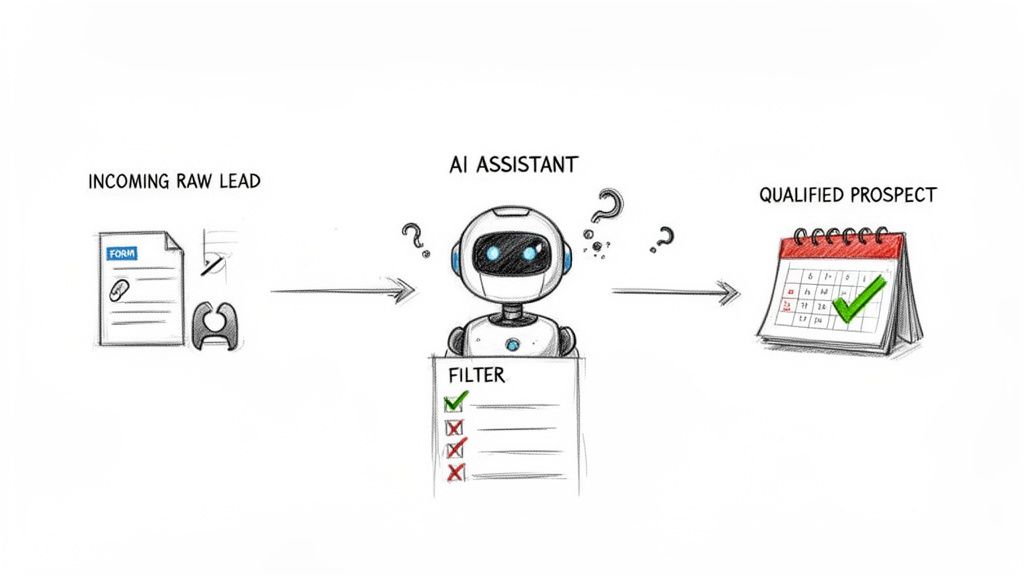
Manually sifting through every single enquiry to find the genuine prospects is a massive time sink. It’s a grind. Worse still, that critical moment where a raw lead could become a qualified prospect is often where things fall apart because of a slow response or a missed call.
This is exactly where a bit of smart technology can make all the difference.
Automation tools, like an AI assistant, can do the heavy lifting of initial qualification for you. This means no more opportunities slipping through the cracks and your team can focus their energy on high-value chats with people who are actually ready to talk business.
How AI Drives the Qualification Process
Picture an AI assistant as your business’s frontline qualifier, on the job 24/7. It doesn't just answer calls; it actively engages with leads to figure out if they’re the real deal.
Here’s how this changes the game for managing incoming interest:
- Instantly Engaging Every Lead: With features like instant missed call callbacks, every person who tries to reach you gets an immediate response. You capture their details and find out what they need while they’re still keen.
- Asking the Right Questions: You can set up the AI to ask your essential qualifying questions straight up. For a tradie, that might be, "Is this an emergency job?" For a real estate agent, "Do you have your finance pre-approved?"
- Filtering and Forwarding: Based on their answers, the system weeds out the time-wasters and telemarketers, forwarding only the warm, qualified prospects to your team for a proper follow-up.
For Aussie B2B service businesses, this is a game-changer. Content marketing already brings in three times more leads for 62% less cost than old-school methods. When an AI assistant captures these leads—say, through voicemail routing on local Telstra, Optus, or Vodafone numbers—it qualifies them on the spot, helping turn leads into prospects with a personal touch.
Automation isn't about replacing people. It's about making sure your team's time is spent on the conversations that actually bring in money. It handles the boring, repetitive job of sorting leads so you can focus on closing deals with prospects.
From Qualification to Booked Appointments
The whole point of qualifying someone is to figure out the next step. A truly effective automated system doesn’t just flag a prospect; it pushes them along in your sales process.
Modern AI assistants can even schedule appointments directly into your calendar. A lead calls, gets qualified, confirms they’re interested, and books a consultation or a viewing—all without you lifting a finger. This workflow turns a cold enquiry into a sales-ready meeting, just like that. Getting this right is key to a healthier sales pipeline, something we dive into in our guide on leveraging AI for lead conversion.
Tracking the Metrics That Truly Matter for Funnel Health
If you can't measure it, you can't improve it. Vague feelings about how your sales funnel is performing just won't cut it; you need hard data to understand the real story behind your prospect vs lead dynamics. Focusing on the right Key Performance Indicators (KPIs) helps you move beyond simple vanity metrics and gives you insights you can actually use.
A data-driven approach lets you pinpoint bottlenecks with surgical precision. For instance, if you're getting a high volume of new leads but a dismal number are converting into prospects, that’s a massive red flag. It tells you your qualification process is broken or your marketing is attracting the wrong crowd in the first place.
Key Metrics for Funnel Analysis
To get a clear picture of your funnel's health, start tracking these essential data points. They show you exactly how efficient your sales process is, from that first point of contact right through to identifying a genuine opportunity.
-
Lead-to-Prospect Conversion Rate: This is the big one. It's the most critical metric for judging how effective your qualification process is. You can calculate it by dividing the number of qualified prospects by the total number of leads you generated in a period, then multiplying by 100. A low rate here points to a problem right at the top of your funnel.
-
Cost Per Qualified Prospect (CPQP): While knowing your Cost Per Lead (CPL) is handy, CPQP is where the real value is. It measures how much you're actually spending to get a conversation with someone who fits your criteria and is ready to talk business. This tells you the true ROI of your marketing spend.
-
Sales Cycle Length (Prospect Stage): How long does it take for a qualified prospect to become a customer? Tracking this helps you forecast revenue far more accurately and spot if prospects are getting stuck or going cold during the sales process.
By keeping a close eye on these KPIs, you can make strategic adjustments backed by real evidence, not guesswork. This ensures every tweak you make to your sales and marketing process is actually helping your bottom line.
A consistent review of these numbers is fundamental to any successful sales operation. For a deeper dive into organising your sales pipeline, explore our expert advice on lead management best practices. This structured approach ensures fewer qualified opportunities slip through the cracks and your team's efforts are always focused on activities that drive revenue.
Got Questions? We've Got Answers
Can someone be a lead and a prospect at the same time?
Good question, but no – they're two distinct stops on the customer journey. Think of it like a promotion. A contact starts out as a lead. It’s only after you’ve qualified them and they’ve ticked the right boxes that they get "promoted" to a prospect.
A prospect is a much more valuable, advanced stage than a lead.
How long should I keep a lead in the funnel before giving up?
This really comes down to your industry's typical sales cycle. If you’re a tradie, a lead that goes cold for a day might be a lost cause. But for something with a longer consideration time, like a mortgage, you might nurture that lead for weeks before making a final call.
The real secret is having a solid follow-up process. Use automation to stay in touch without burning yourself out. This gives every lead a fair shot while you focus your energy on the ones who are actually keen.
What's the biggest mistake businesses make with leads vs. prospects?
Hands down, the most common (and most expensive) mistake is treating them exactly the same. When that happens, your sales team ends up chasing unqualified leads who were never going to buy, while genuine prospects who need that extra push get ignored.
Putting a clear, consistent qualification process in place is the single best thing you can do to fix this. It’s how you correctly sort your prospects from your leads, which helps streamline your entire sales effort and bring in more revenue.
Stop letting genuine prospects slip through the cracks. See how the OnSilent AI Personal Assistant can instantly qualify your leads, schedule appointments, and give you back hours every week. Start your 2-week free trial today!