

Outsourcing customer service isn't just about cutting costs anymore. For many Australian SMEs, it's a strategic move to tackle the real-world operational pressures that get in the way of growth, like staff shortages and sky-high overheads. It’s about ensuring you have consistent, 24/7 customer coverage without the headache and expense of building a large in-house team.
Done right, outsourcing can turn your customer support from a necessary expense into a genuine driver of growth.
Why Australian SMEs Are Outsourcing Customer Service
If you're running a small or medium-sized business in Australia, you'll know the conversation around outsourcing has completely changed. It’s no longer a simple cost-cutting exercise. It's a smart response to the persistent challenges that can grind a business to a halt and leave your team feeling totally burnt out.
Let's be honest, maintaining a dedicated, round-the-clock customer service team in-house is a massive undertaking. You're constantly dealing with high staff turnover, struggling to find people with the right skills, and sinking money into recruitment, training, and overheads.
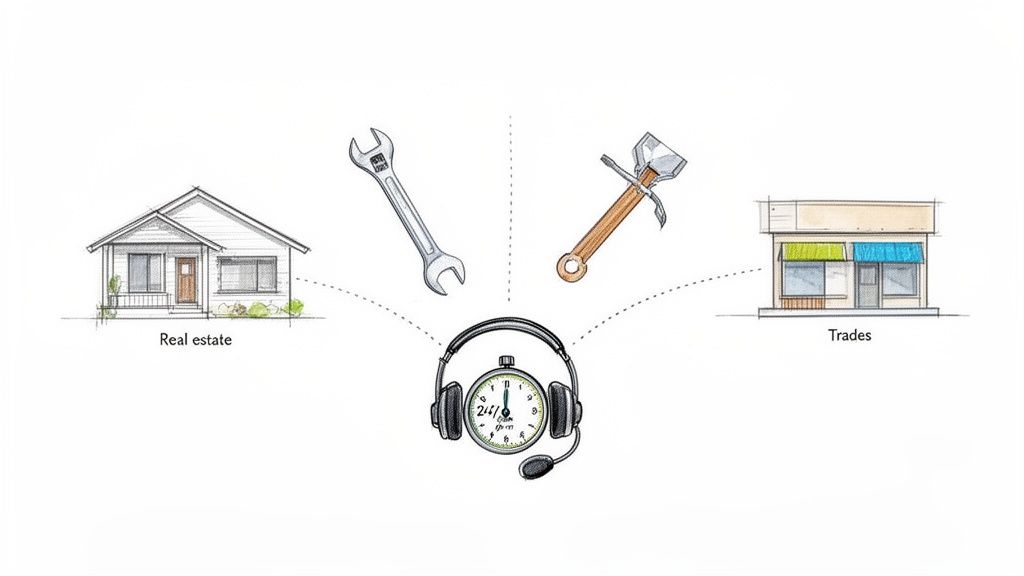
For service-based businesses like real estate agencies or tradies, every single missed call can mean a lost job. That's a risk most of us just can't afford to take.
Navigating Local Labour Dynamics
Australia's unique labour market is a huge factor pushing businesses towards outsourcing. The whole Business Process Outsourcing (BPO) industry is tipped to hit AUD 49.6 billion in revenue in 2024-25, and it's growing steadily despite workforce pressures.
Consider this: local contact centres are battling attrition rates of around 29% and absenteeism at 12.9%. On top of that, skills shortages are impacting up to 60% of businesses. When you combine rising costs with a shrinking talent pool, outsourcing your customer service starts to look like a very practical solution for stability.
By outsourcing, SMEs get instant access to a ready-made infrastructure and a trained talent pool. You get to bypass all the headaches of direct employment, ensuring consistent, professional coverage without the massive financial and admin strain of building it all from scratch.
A Strategic Move for Growth and Stability
The real beauty of outsourcing is that it lets you and your team get back to what you do best. A property manager can focus on growing their portfolio, and a plumber can focus on getting jobs done, all while knowing that customer enquiries and bookings are being handled professionally.
This approach delivers some serious advantages:
- 24/7 Availability: You can finally relax, knowing no lead will ever be missed, whether it's after hours, on a weekend, or during a public holiday.
- Access to Technology: You get to use advanced tools like AI call assistants and integrated CRMs without having to fork out huge amounts of cash for them.
- Scalability: Need to ramp up support during your busy season? Or scale back in the quiet months? Outsourcing lets you do it easily, without the drama of hiring and firing.
For a lot of Aussie SMEs, this is about more than just saving a few dollars. It's about understanding why outsourcing is key to unlocking global markets and building a business that can last. When you get it right, a reliable https://onsilent.com/ai-answering-service/business-answering-service/ becomes one of your most powerful tools for capturing leads, keeping customers happy, and building a much more resilient operation.
Figuring Out What You Actually Need from Outsourcing
Before you even think about outsourcing your customer service, you need to hit pause. Seriously. Jumping in without a clear plan is a recipe for wasting time and money on a solution that doesn’t actually fix your problems. It's like calling a plumber before you know where the leak is.
First thing's first: do a quick audit of your current call situation. And I don't mean guessing. For one solid week, track every single call that comes in. When did it ring? Did anyone answer? What was the caller even asking about? This simple bit of homework will shine a massive spotlight on your biggest headaches.
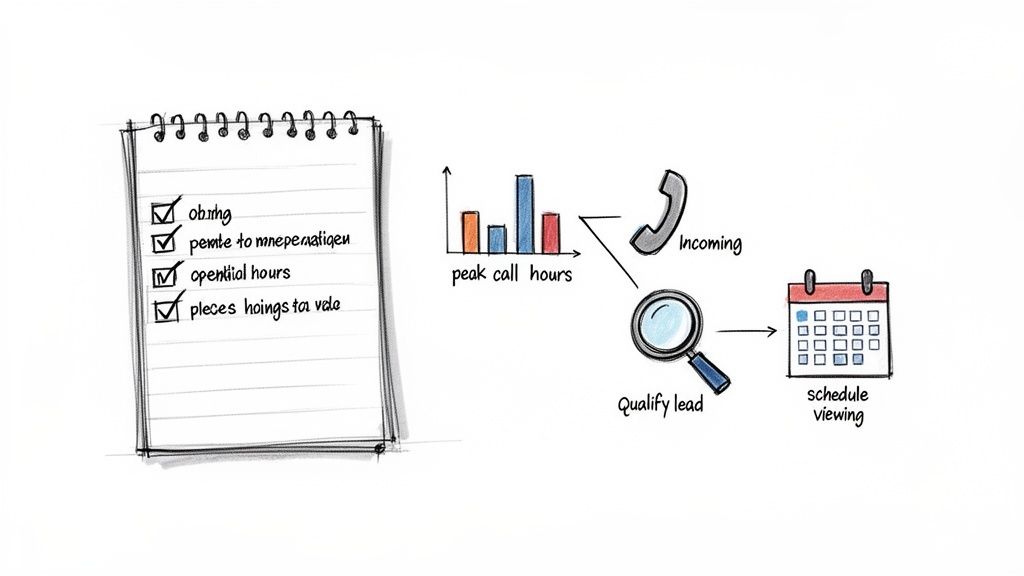
You might be surprised by what you find. Maybe you'll see that a whopping 30% of your calls hit after 5 PM when no one's around. Or perhaps you'll realise your team is stuck answering the same five questions over and over, all day long. This isn't just a minor annoyance—it's lost business and staff hours you can never get back.
Set Some Real, Measurable Goals
Once you have that data, you can stop talking in vague terms like "we need to improve customer service." That means nothing. You need to set concrete targets that tackle the specific issues you've uncovered.
Think about the actual outcomes you want to see. Proper goals sound more like this:
- Slash missed calls by 90% within the first 30 days.
- Get the average response time for new enquiries down from four hours to under five minutes.
- Boost qualified lead capture by 25% by making sure every after-hours call gets a proper response.
- Give my admin staff 10 hours of their week back by automating all the appointment booking.
These aren't just wishful thinking; they're clear benchmarks. They turn outsourcing from a hopeful punt into a strategic move with a return you can actually measure.
Map Out Exactly Which Tasks to Hand Over
With your goals locked in, now you can decide which specific tasks are ripe for an external partner or an AI assistant like OnSilent. You don't have to hand over everything. The whole point is to offload the repetitive, high-volume stuff that’s tying up your team, so they can focus on the work that actually makes you money.
Let's take a real estate agency, for example. A huge chunk of their incoming calls are predictable and perfect for outsourcing:
- New Buyer Enquiries: Filtering out the tyre-kickers by asking if they're pre-approved for a loan or have a house to sell.
- Booking Viewings: Scheduling private inspections or getting people registered for the Saturday open home.
- Rental Application Updates: Giving prospective tenants a quick status update without bothering the property manager.
- Basic Property Questions: Answering the usual stuff about council rates, body corporate fees, or what school zone it's in.
By breaking it down like this, the agency creates a super-specific brief. This document is gold, whether they end up hiring a call centre or plugging in an AI assistant, because it spells out exactly what needs to be done and what success looks like.
Honestly, this planning stage is the most important part of the entire process. Get this right, and you're not just buying another subscription service; you're investing in a solution that's a perfect fit for your business, paving the way for a smooth transition and results you can see on your bottom line.
Choosing Your Customer Service Model
So, you’ve mapped out what you need from your customer service. Now comes the big question: do you build your own team, bring in an external provider, or lean into automation? It’s the classic ‘build versus buy’ dilemma, and when it comes to customer service, you’ve got three main paths to consider.
Each one has its own trade-offs, and the right call really depends on your budget, how you like to operate, and where your business is headed. Let’s break down your options: sticking with an in-house team, partnering with a traditional Business Process Outsourcing (BPO) provider, or getting an AI call assistant on board. There's no single "best" choice here—it's all about finding the perfect fit for your situation.
The In-House Team
Keeping customer service in-house gives you the ultimate level of control. Your team lives and breathes your brand every day. They get your company culture on a deep level and can offer that genuinely personal touch. You’re in charge of their training, you manage their performance directly, and you can switch up processes on a whim.
But all that control comes with a hefty price tag. You're on the hook for salaries, benefits, office space, equipment, and all the ongoing training. Trying to scale up or down is a slow and expensive headache, and offering genuine 24/7 coverage? That’s usually a non-starter for most small businesses.
Traditional BPO Providers
Going with a traditional BPO is the classic way to handle outsourcing customer services. It gives you instant scale, letting you tap into a large, pre-trained workforce without all the direct HR overhead. BPOs are pros at handling high call volumes and can easily provide round-the-clock support, which is a massive win.
The biggest catch? There can be a real disconnect from your brand. Agents are often juggling multiple clients, and it can be tough to make sure they’re capturing your unique company voice. You're also putting a massive amount of trust in a third party to be the face of your business, which makes picking the right vendor absolutely critical.
The real value of a BPO is its ability to throw people at a problem. It’s a solid way to manage huge volumes of customer chats and calls, but your success really hangs on finding a partner that’s willing to truly invest in understanding your business and your customers.
AI Call Assistants
The newest kid on the block is the specialised AI call assistant. This route offers incredible efficiency and scalability at just a fraction of the cost of human agents. An AI can handle an unlimited number of calls at once, it works 24/7 without needing a coffee break, and it’s brilliant at repetitive jobs like qualifying leads or scheduling appointments.
For businesses hunting for a smart, automated front line, an AI answering service can be a complete game-changer. The main thing to think about here is the complexity of your calls. While setup is often fast, you need a system that can handle the specific nuances of your industry. It’s a perfect match for structured, predictable conversations but less so for sorting out complex, emotional problems. As you explore this, it’s worth learning how to automate customer service without losing the human touch, because striking that balance is everything.
Customer Service Model Comparison In-House vs BPO vs AI Assistant
To help you weigh your options, let’s put these three models side-by-side. This table breaks down the key differences in cost, control, and scalability.
| Factor | In-House Team | Traditional BPO | AI Call Assistant (e.g., OnSilent) |
|---|---|---|---|
| Cost | High (salaries, benefits, overhead) | Medium (per agent/hour fees) | Low (flat monthly subscription) |
| Control | Maximum | Moderate (managed via SLA) | High (customisable scripts/flows) |
| Scalability | Low & Slow (hiring process) | High (access to large workforce) | Instant & Unlimited |
| 24/7 Coverage | Very Difficult & Expensive | Standard Offering | Standard & Cost-Effective |
| Brand Voice | Excellent (deeply embedded) | Can be a challenge | Consistent (follows scripts) |
| Best For | High-touch, complex support | High volume, predictable tasks | Lead capture, scheduling, FAQs |
Looking at the comparison, it’s clear that what works for a startup trying to be lean and efficient might not be the right choice for an established enterprise needing to manage massive call volumes. The key is to match the model to your specific business goals and customer expectations.
Finding the Right Outsourcing Partner
Choosing a partner to handle your customer service is one of the biggest calls you'll make for your business. Let's be honest, it's about a lot more than just finding the cheapest hourly rate. You're handing over a core part of your operation, and you need a team that will represent your brand as if it were their own.
Get this wrong, and you risk damaging your reputation. But get it right? The right partner becomes a genuine asset, fuelling your growth.
First thing's first: look past the slick marketing brochures and hunt for real proof of expertise. You want to know if they have runs on the board in your specific industry, whether that’s real estate, trades, or something else. A team that already speaks your language and understands your customers' expectations needs way less hand-holding and will deliver better results from day one.
Key Questions for Potential Partners
When you start having conversations, don't just wing it. Go in with a checklist. How they answer will tell you everything you need to know about their skills and whether they're a good cultural fit. Don't be shy about digging into the nitty-gritty of their operations.
Here are a few questions I always recommend asking:
- Industry Specialisation: Can you show me some case studies or let me speak to other Aussie businesses in my industry that you work with?
- Technological Capability: What CRM systems do you already integrate with? Can your team handle AI-powered tools for things like automated callbacks or lead qualification?
- Data Security: How do you stick to Australian privacy laws? What's your plan for keeping my customer data safe and sound?
- Local Market Knowledge: How do you train your team on Australian slang, business etiquette, and the quirks of dealing with local carriers like Telstra or Optus?
A solid partner will welcome these questions with detailed, confident answers. If you get vague responses, that’s a massive red flag. It probably means they don't have the specific know-how your business needs.
Demystifying the Service Level Agreement
Think of the Service Level Agreement (SLA) as the rulebook for your partnership. It’s the formal document that lays out exactly what you expect and what they promise to deliver. This is no place for grey areas – everything needs to be crystal clear.
Your SLA should pin down the Key Performance Indicators (KPIs) that actually matter to your business goals. These could include things like:
- First-Response Time: The absolute maximum time a customer should wait for that first reply (e.g., under 60 seconds).
- Lead Qualification Accuracy: The percentage of leads they pass to your sales team that are actually qualified (aim for 95% or higher).
- Customer Satisfaction (CSAT) Score: A target score you agree on, based on post-call surveys.
The game is changing for customer service outsourcing in Australia. It's shifting away from basic call answering towards high-value, tech-savvy partnerships. In fact, the Australian call centre outsourcing market is tipped to grow at a CAGR of about 13.5% between 2025 and 2030. Today, nearly 60% of companies say their main reason for outsourcing is to get access to skilled talent, not just to save a few bucks.
At the end of the day, finding the right provider is about more than just a live phone answering service. You’re looking for a partner who brings strategic value, aligns with your tech, and genuinely understands what it takes to win in the Australian market.
Getting Your Outsourced Service Up and Running (and Measuring It)
Signing on the dotted line isn't the end of the process; it's just the beginning. The real work starts now. Getting this next part right—the integration and ongoing measurement—is what separates a successful outsourcing partnership from a frustrating one. You need a solid transition plan to make sure things go smoothly from day one.
This is about more than just redirecting your phone number. You’ve got to get into the nitty-gritty with your new partner. Think finalising call scripts that actually sound like your brand, not some generic robot, and sorting out the technical routing. A massive piece of this puzzle is hooking their system into your Customer Relationship Management (CRM) software. This ensures every customer interaction is logged and everyone has the full picture, preventing those awkward "let me just find your details" moments.
This simple map lays out the core steps of finding and locking in a BPO partner.
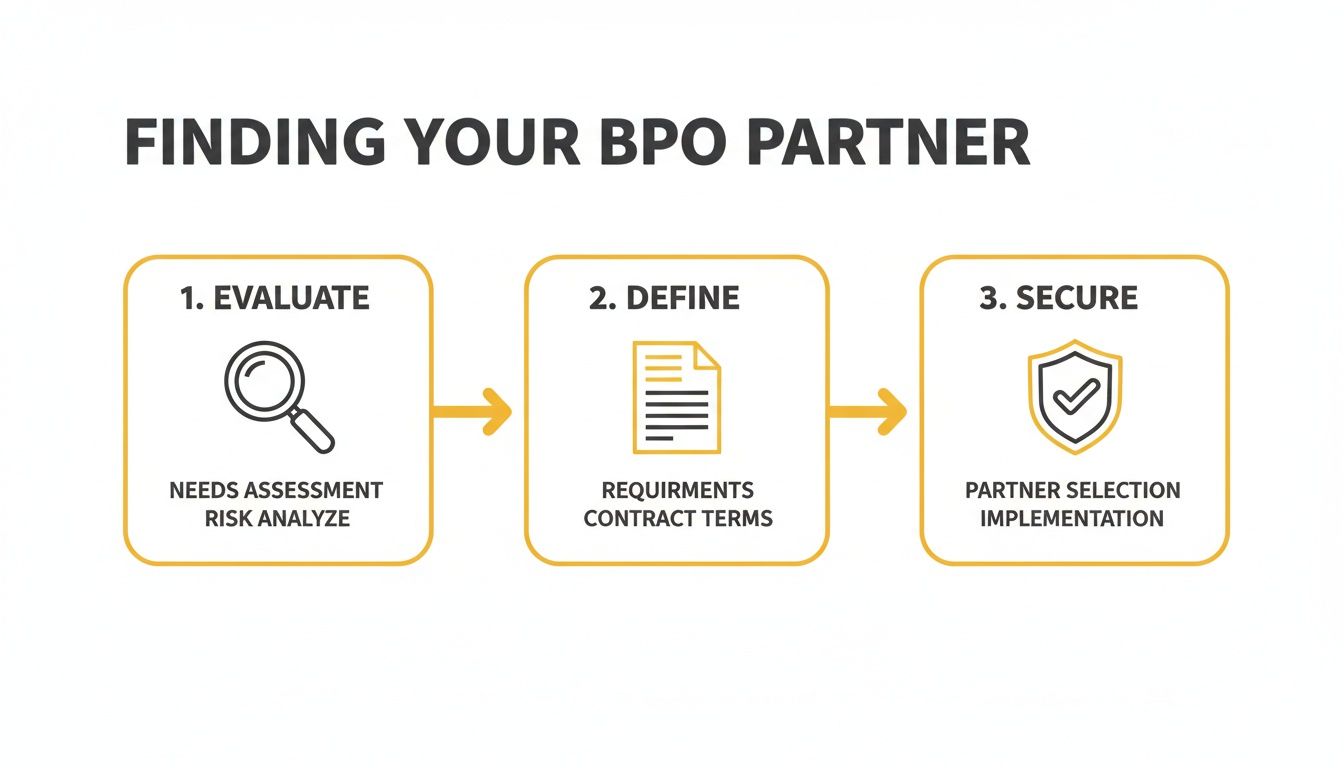
It’s a good reminder that all the hard work you do upfront—figuring out exactly what you need—pays off when you finally sign that agreement.
Keep Talking and Keep Improving
Once you're live, the game shifts to creating a solid feedback loop. This isn’t about breathing down their neck; it's about working together to make things better. I recommend setting up regular weekly or fortnightly check-ins with your partner. Use this time to go over performance, chat about any hiccups, and celebrate the wins.
This approach lets you tweak and improve things on the fly. For example, if you start noticing a bunch of callers asking the same question that isn't in the script, you can get it added straight away. This ongoing dialogue is what keeps the service aligned with your business as it grows and changes.
Here in Australia, customer experience is no joke. A single bad interaction is enough to send 32% of customers walking, which puts a whopping AUD 74 billion in sales on the line. It's why over 70% of Aussie contact centres are now using AI and automation to back up their agents. You can dig deeper into the latest trends shaping the Australian service industry to see what's coming.
Track the Numbers That Actually Matter
To figure out if this is all worth it, you have to track the right Key Performance Indicators (KPIs). Forget basic stuff like call volume. You need to focus on the data that tells you about business growth and efficiency.
Here’s what should be on your performance dashboard:
- Cost-Per-Lead: This one’s simple but powerful. Take your monthly service cost and divide it by the number of qualified leads it brings in. It’s a direct measure of your ROI.
- Customer Satisfaction (CSAT) Scores: A quick post-call survey is all you need to get a read on how happy your customers are with the support they received.
- Lead Capture Rate: What percentage of people who get in touch are actually turned into solid leads for your sales team? This number tells you how effective the service is at its core job.
- Impact on Your Team's Time: This is a big one. Chat with your internal team. How much less time are they spending on answering basic calls? Quantifying this shows how much headspace you’ve freed up for more important work.
When you monitor these specific outcomes, you can have real, data-driven conversations with your partner. It lets you make smart decisions to fine-tune your strategy, turning what could be just an operational cost into a genuine engine for growth.
Got Questions About Outsourcing Customer Service?
Deciding to outsource customer service is a big step, and it's totally normal to have a bunch of questions. Getting straight answers is the only way to feel confident you're making the right move for your business. Let's dig into the common things that come up when people are weighing up their options.
How Do I Know If My Business Is Actually Ready to Outsource?
You’ll know you’re ready when you start feeling those classic growing pains. Are your team members spending half their day on repetitive phone calls instead of the work they’re meant to be doing? Are calls getting missed during peak times or after hours? Is following up with every new lead starting to feel impossible?
If your phone has become a bottleneck that’s stopping you from landing new business or looking after your current clients, that’s a massive red flag. Bringing in an outsourced solution, whether it's a team of people or a smart AI, can free up your crew and make sure no opportunity slips through the cracks.
Will Outsourcing Feel Impersonal to My Clients?
That’s a fair concern, and one I hear all the time. But it's completely manageable if you're smart about it. The trick is to find a partner or a tool that can genuinely reflect your brand’s voice. With a traditional call centre, that means detailed training and well-thought-out scripts.
With a modern AI assistant, it’s all about customising greetings and responses so they sound professional and on-brand. Better yet, when you connect it to your CRM, the assistant already has the context it needs about your listings or services, making the whole conversation feel much more clued-in. The goal isn't to fool anyone; it's to give people fast, accurate, and professional help 24/7. Honestly, that’s often a better experience than waiting for a stressed-out team member to call back.
What's the Real Difference Between a Call Centre and an AI Assistant?
It really boils down to three things: scalability, cost, and what they’re designed to do. A traditional call centre gives you real people, which is perfect for those complex, delicate, or emotionally charged conversations. The trade-off? They cost more, and you're limited by how many agents are on deck at any given time.
An AI call assistant, on the other hand, is built for the high-volume, repetitive stuff—like qualifying new leads and booking appointments. It works around the clock, can juggle countless calls at once, and the cost for each interaction is significantly lower.
It all comes down to what you need. If you need complex problem-solving, a call centre might be the way to go. But if you're trying to efficiently handle a flood of initial enquiries and make sure you capture every single lead, an AI assistant is a far more scalable and budget-friendly choice.
How Can I Actually Measure the ROI of Outsourcing This?
Measuring the return on investment goes way beyond just looking at the monthly bill. First, you need a baseline. Figure out what your 'before' situation is costing you—estimate the value of leads you've lost to missed calls, and calculate the cost of your team's time spent answering basic questions.
Once you’re up and running with your new service, you need to track the right numbers:
- The number of qualified leads captured.
- The total number of appointments booked.
- How much less time your team is spending on the phone.
Then, you simply compare the monthly cost of the service to the value of the new business it’s bringing in, plus the productivity you've gained. For example, if an AI assistant snags three new client leads that you would have missed otherwise, the ROI becomes crystal clear. It makes tracking the financial impact of outsourcing customer services a tangible and straightforward exercise.
Ready to see how an AI assistant can capture every lead and free up your time? OnSilent handles your calls 24/7, qualifies enquiries, and books appointments so you never miss an opportunity. Start your free trial at https://onsilent.com.