

At its heart, customer service outsourcing is about handing off your customer support tasks to a specialised, third-party team. Think of it as bringing in the experts so you can stop wearing every single hat in your business. It’s a strategic way to offer top-notch support without the headache of building an entire department from the ground up.
Why Australian Businesses Outsource Customer Service

Picture a master plumber trying to be a top-notch electrician and a builder all at the same time. While it might be technically possible, it’s a recipe for burnout and mediocrity. You’d never truly master any one trade. That’s the exact corner many growing Aussie businesses back themselves into with in-house customer service.
When you’re just starting out, answering every call and email yourself feels doable. But as you grow, customer service can quickly spiral into a massive bottleneck, sucking up time, money, and focus that should be going elsewhere.
It’s Not Just About Cutting Costs
The conversation around outsourcing often gets stuck on saving money, but the real reasons are much more strategic. You only have to look at the Business Process Outsourcing (BPO) industry in Australia, with revenues tipped to hit a massive $49.6 billion in 2024-25, to see there’s more to the story. This growth is all about businesses offloading functions that aren’t their core strength to get sharper and more efficient. If you want to dig deeper, have a look at these insights on the Australian service industry.
For a scaling business, the real win from outsourcing customer service is the competitive edge it creates. You’re tapping into a level of expertise and delivering a customer experience that would be far too expensive or complicated to build yourself.
The Real Drivers Behind Outsourcing
When you partner with a customer service specialist, you’re not just getting a call centre. You’re unlocking some serious advantages that help you grow and keep things running smoothly.
- Access to 24/7 Support: Today's customers don't stick to 9-to-5. Outsourcing gives you that round-the-clock presence, making sure you never miss a lead or an urgent query after hours.
- Specialised Skills on Demand: A professional provider brings a whole team of trained agents, proven processes, and the right tech from day one. It lets you completely sidestep the steep and costly learning curve of doing it all yourself.
- Freeing Up Your Core Team: By handing off support tasks, your key people can finally get back to focusing on what actually drives revenue—whether that’s sales, product development, or building client relationships.
- Scalability and Flexibility: Need to handle a seasonal rush or a big marketing campaign? An outsourced team can scale up or down almost instantly, without the drama and paperwork of hiring and firing.
Finding Your Fit with Different Outsourcing Models
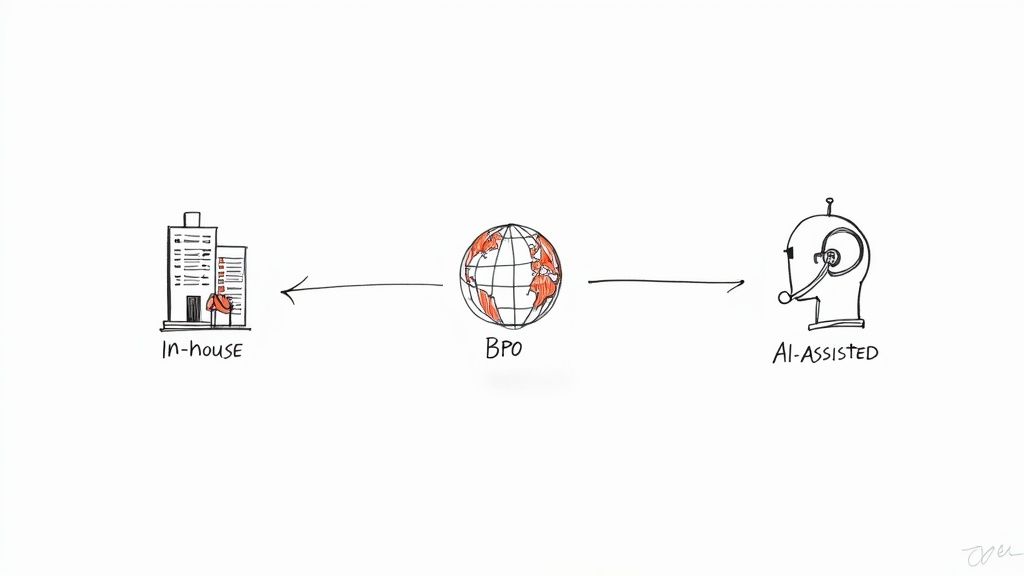
Choosing a model for customer service and outsourcing isn't a one-size-fits-all deal. It's more like picking the right tool for the job. Your budget, how you want your brand to come across, and your plans for growth all play a huge part in figuring out the best path for your Australian business.
Let's break down the main options you've got.
The most traditional setup is the good old in-house team. This approach gives you the tightest grip on training, brand voice, and quality control. Your team is right there with you, living and breathing your company culture, which can lead to a genuinely personal customer experience.
But all that control comes at a price. We're talking salaries, benefits, office space, and all the tech costs that come with it. It's often the most expensive route.
Traditional Business Process Outsourcing (BPO)
When businesses first start looking at outsourcing, they almost always stumble upon the BPO model. This is where you partner with a third-party company that specialises in handling customer interactions for other businesses. BPO providers bring expertise and infrastructure to the table that would be seriously expensive to build from scratch.
These partnerships are usually sorted by where they're located:
- Onshore: The provider is right here in Australia. This is great for cultural alignment and easy communication, but it’s also the priciest option.
- Nearshore: The team is based in a nearby country, like New Zealand or Fiji. You can find some cost savings here while keeping similar time zones.
- Offshore: The provider operates from somewhere further afield, like the Philippines or India. This is where you’ll see the biggest cost reductions, but you might run into cultural and language barriers.
While BPOs are fantastic for scaling up, they can sometimes feel a bit impersonal. The trick is to find a partner who really gets your brand and what you stand for.
Comparing Customer Service Outsourcing Models
To make things clearer, here's a quick comparison of the different models. Think of it as a cheat sheet to help you see where your business might fit best.
| Model | Typical Cost | Level of Control | Scalability | Best For |
|---|---|---|---|---|
| In-House | High | Maximum | Low (slow & costly) | Businesses with complex needs needing tight brand control. |
| Onshore BPO | High | Moderate | High | Companies wanting local expertise without hiring internally. |
| Nearshore BPO | Moderate | Moderate | High | Businesses seeking a balance of cost and cultural alignment. |
| Offshore BPO | Low | Moderate-Low | Very High | High-volume businesses focused on significant cost savings. |
| Hybrid Model | Variable | High (on core tasks) | High | Businesses wanting the best of both worlds—control and efficiency. |
| AI-Assisted | Very Low | High (programmatic) | Instant | SMEs and startups needing 24/7 coverage and efficiency. |
As you can see, there's a trade-off with each approach. The "best" one really depends on your specific priorities—whether that's cost, control, or the ability to grow quickly.
The Rise of Hybrid and AI-Assisted Models
These days, smart businesses are thinking beyond the simple "in-house vs. outsource" debate. A hybrid model is becoming a popular middle ground, blending the best of both worlds for a more flexible and effective setup.
For example, you might keep a small, expert in-house team to handle the really tricky, high-value customer problems. At the same time, you could outsource the routine stuff—like after-hours calls, booking appointments, or handling basic enquiries—to an external partner.
This strategy is all about being smart with your resources. You keep control where it matters most while gaining efficiency and saving money on the high-volume, repetitive tasks.
On top of that, AI-powered tools are opening up entirely new ways of doing things. An AI assistant can be a massive force multiplier for your team, whether they’re in-house or outsourced. It can handle common questions, qualify leads, and route calls 24/7, which frees up your human agents to focus on problems that need a real dose of empathy and critical thinking.
For many small and medium businesses, a clever AI tool can act as a complete business answering service, managing calls and tasks with perfect consistency at a fraction of the cost of a traditional team. This modern approach ensures you never miss an opportunity, giving you a solution that can easily grow with your business.
Weighing the Real Benefits and Potential Risks
Deciding to hand over your customer service to an outside team is a massive turning point for any business. It’s smart to walk into it with your eyes wide open, ready to weigh up the powerful advantages against the potential snags. Getting this right means you can maximise the rewards while keeping any downsides in check.
Let's be honest, the upsides are usually pretty clear from the get-go, especially when you look at your bottom line.
The Powerful Benefits of Outsourcing
One of the biggest draws for any business looking at customer service and outsourcing is the serious cost savings. When you build an in-house team, you're not just paying salaries. You've got recruitment costs, training, new tech, and the physical office space to think about. Outsourcing flips all those big upfront expenses into a simple, predictable operational cost.
Curious how the numbers actually stack up? You can get a clearer picture by exploring the typical costs of a virtual receptionist service.
But it's not just about the money. Outsourcing gives your operations a real shot of agility.
- Round-the-Clock Availability: You can suddenly offer 24/7 support without the headache of managing night shifts. This means you never miss a customer question or a hot lead, no matter when they reach out.
- Instant Scalability: Got a massive marketing campaign coming up or heading into your busy season? An outsourced partner can scale their team up or down almost overnight to handle the rush.
- Access to Expertise: You get immediate access to a team of trained professionals. These guys already have the skills, the processes, and the experience to deliver top-notch support from day one.
All of this gives your core team their time back. Instead of getting tangled up in repetitive support tasks, they can focus on what they do best—growing the business and bringing in revenue. It's a strategic play to make the whole operation more efficient.
Understanding the Potential Risks
Of course, it’s not all smooth sailing. It's just as important to be realistic about the challenges. Handing over customer conversations means you're giving up a bit of direct control, and that can feel pretty daunting.
A big concern is keeping your brand voice consistent. You need to make sure your company's personality and culture are coming through in every single chat. Then there's the critical issue of data security. You’re sharing customer information with a third party, so you have to be rock-solid confident in their security measures to protect that sensitive data.
Poor customer experiences are set to risk a staggering AUD$74 billion in Australian sales in 2024. With 32% of customers prepared to walk away after just one bad interaction, the pressure to get service right is immense. Outsourcing can really shore up reliability—BPO providers answer 86% of calls, often because they're available 24/7. You can dive deeper into these insights on the Australian service industry.
Finally, you can't ignore the potential for cultural and communication hiccups, especially with offshore teams. Misunderstandings can creep in and throw the customer experience off track. That’s why picking the right partner and setting up crystal-clear communication channels from the start is non-negotiable. It’s the only way to build a successful partnership that genuinely helps your business thrive.
Let's move past the theory and look at how this actually plays out in the real world. For a lot of Australian SMEs, outsourcing isn't just a line item on a budget; it's the key to unlocking growth by fixing a critical bottleneck in their operations. When you hand off the right tasks, you're not just buying a service—you're buying back time, boosting your service quality, and getting back to the work you're truly best at.
Here are a few classic scenarios where smart customer service and outsourcing made all the difference.
The Real Estate Agency That Never Sleeps
Picture a busy property management agency in Sydney. Their biggest headache? After-hours maintenance calls. Tenants ringing at all hours with burst pipes or lockouts. Calls would get missed, leaving tenants fuming and property managers feeling like they were on the clock 24/7. Burnout was a real problem.
Their solution was simple but effective: they partnered with an onshore BPO that specialises in after-hours support for real estate. This team wasn't just a generic call centre; they were trained on the agency's exact procedures for logging jobs and knowing what counts as a genuine emergency.
The results were instant.
- 100% of after-hours calls were answered, professionally and right away.
- Tenant satisfaction shot up because people felt looked after, no matter the time.
- Property managers got their evenings and weekends back, which did wonders for team morale.
What was once after-hours chaos became a smooth, reliable system, and their reputation for top-notch service got a serious boost.
The Trades Business That Reclaimed Its Day
Now, think about a growing electrical contracting business in Melbourne. They had a different problem. Their highly skilled sparkies were wasting chunks of their day on the phone, scheduling appointments and quoting small jobs. All that admin was pulling them off the tools, slowing down projects, and putting a cap on how much they could earn.
They decided to outsource all their "front-of-house" calls—appointment booking, lead qualification, the lot—to a dedicated virtual receptionist service. The best part? It plugged directly into their existing scheduling software.
The change was dramatic. The electricians could just focus on the job at hand, knowing their calendar was being managed perfectly in the background. It meant they could fit more jobs into each day, which translated directly into more revenue for the business.
The E-commerce Store That Nailed the Holiday Rush
Let's look at an online gift store in Brisbane. For ten months of the year, their small in-house team handled customer service like champs. But come November and December, it was a different story. The Christmas rush brought a flood of enquiries about order tracking, stock levels, and shipping times. They were completely swamped, responses were slow, and customers were getting antsy during their most important sales period.
They went with a hybrid model. They brought on a flexible, outsourced team just for that peak season. This team was trained to handle the high volume of repetitive questions, which freed up the core in-house staff to deal with the tricky, complex issues. It gave them the exact scalability they needed, right when they needed it, ensuring the holiday season was a success without the year-round cost of extra staff.
Your Step-by-Step Implementation Roadmap
Making the switch to an outsourced customer service model is a big move. But with a clear plan, it goes from being a massive headache to a manageable project. Think of this as your checklist for getting it right—building a partnership that actually works for the long haul.
The first, and most important, step is all about looking in the mirror. Before you even start Googling vendors, you need to get crystal clear on what you’re trying to fix. A vague goal like “improve customer service” just won’t cut it.
Stage 1: Define Your Goals and Scope
Start by getting specific about your pain points. Are you haemorrhaging leads because no one answers the phone after 5 PM? Is your best team member stuck doing mind-numbing admin instead of closing deals? Or are you getting swamped every time things get busy? Your goals need to be tied directly to these real-world problems.
Once you know why you’re doing this, you can figure out what to hand over. You don’t have to outsource everything.
- Routine Enquiries: Simple questions about your opening hours, location, or basic services are perfect for an external team.
- Appointment Scheduling: Stop the endless email tennis. Outsource the back-and-forth of booking jobs or property viewings and free up your skilled people.
- Lead Qualification: Let an outsourced team do the initial filtering. This ensures your sales crew only spends time on high-potential leads, not tyre-kickers.
- After-Hours Support: You can’t be on 24/7, but someone can. Capture every single opportunity, even when your office is dark.
Nailing down your scope like this makes it infinitely easier to find a partner who specialises in what you need, and it means you’re not paying for bells and whistles you’ll never use.
Stage 2: Select the Right Vendor
With a clear list of tasks in hand, you can start the hunt for the right partner. This isn't about finding the cheapest hourly rate. It's about finding a team that feels like a genuine extension of your own.
Really vet potential vendors. Look for experience in your specific industry, read their client testimonials, and ask for case studies that mirror your own challenges.
This diagram breaks down the simple but effective process a lot of SMEs follow to get a real win from outsourcing.
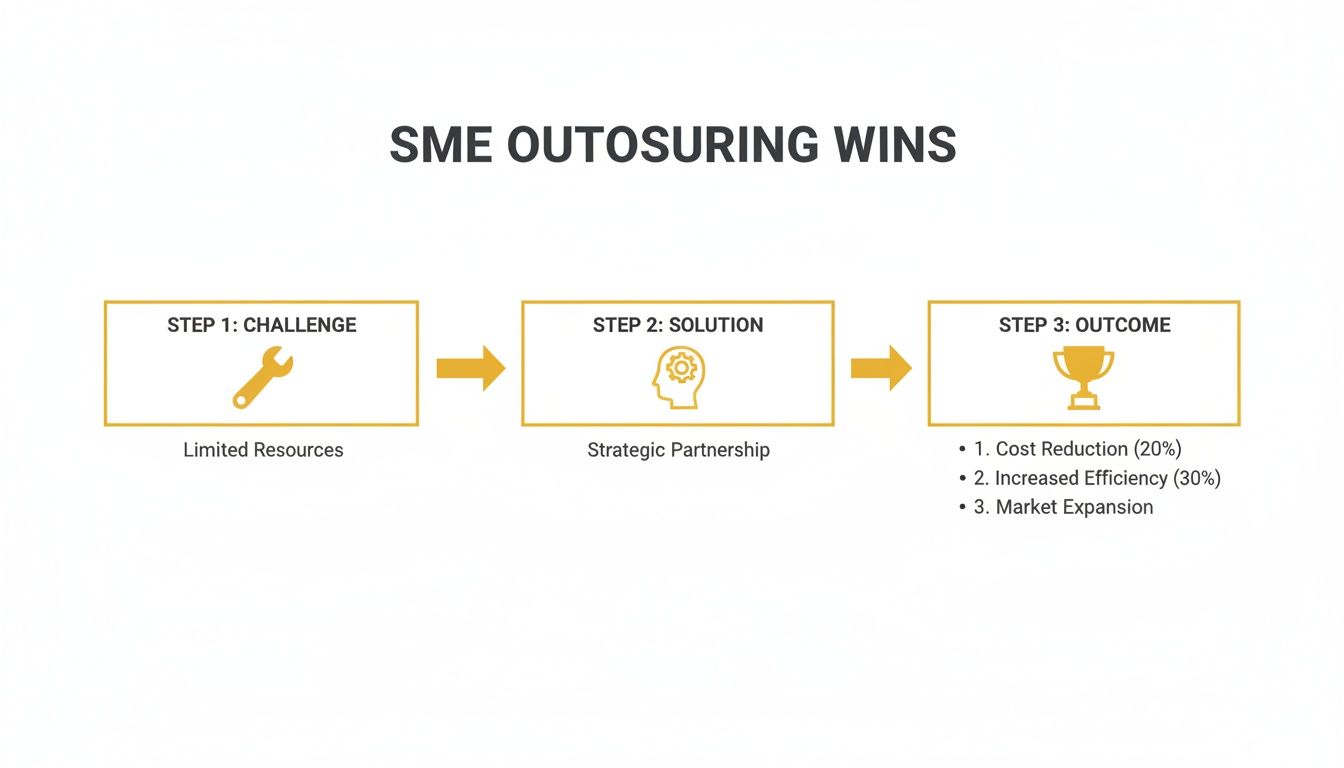
It shows how starting with a clear challenge, finding a smart outsourcing solution, and then measuring the results leads to real, tangible improvements for the business.
Stage 3: Onboard and Integrate Seamlessly
Once you’ve picked your partner, the real work begins: onboarding and integration. This is where you set your new team up for success. Give them everything they need—scripts, detailed FAQs, and a solid guide to your brand's tone of voice.
A seamless onboarding process is crucial. The goal is for the customer to have no idea they’re speaking with an external partner. The experience should feel unified and authentically yours.
Work closely with your provider to hook their systems into your CRM or scheduling software. This is non-negotiable. It ensures information flows smoothly, jobs get booked correctly, and new leads land where they’re supposed to without anyone having to do manual data entry.
And don't forget to set clear Key Performance Indicators (KPIs) from day one. Things like first-call resolution rate and average response time create a baseline for accountability. It's how you build a customer service and outsourcing partnership that keeps getting better over time.
The Future of Outsourcing with AI

The world of customer service and outsourcing is changing fast, and AI is right at the heart of it. This isn't some far-off sci-fi concept; it's happening right now, giving businesses incredibly powerful new ways to manage their customer interactions better and more affordably than ever before.
Think of intelligent automation as a new player on the outsourcing team. Instead of relying solely on a big BPO team of humans, businesses can now bring in AI-powered assistants. These tools are absolute workhorses for handling huge volumes of routine queries—like booking appointments or answering common questions—and they do it with perfect consistency, 24/7.
The Rise of AI Assistants
What’s great about this new approach is that it gives you instant scalability without the usual headaches and high costs of traditional outsourcing. There’s no need to spend weeks hiring and training a massive team. An AI system can handle one call or a thousand at the same time, all with the same level of performance. This makes it a perfect fit for businesses that see big swings in customer demand.
This isn't just a theory; the tech is already making waves. In fact, over 70% of contact centres in Australia and New Zealand are already using generative AI to keep their customers happy. Often, it's the outsourcing partners themselves driving this shift, integrating these tools to deliver smarter support without asking their clients to make a huge upfront investment.
The real magic of AI isn't about replacing people—it's about empowering them. By taking over the repetitive, predictable stuff, AI frees up human agents to focus on the complex, high-empathy conversations where they really shine.
This creates a smarter, more efficient system where technology handles the routine, and people manage the exceptions. If you're keen to dig deeper into how this works in practice, it’s worth checking out a practical guide to AI in customer service.
Tools like a dedicated AI answering service can either work alongside an existing outsourced team or, for many smaller businesses, act as a complete, cost-effective replacement for handling those front-line communications. This blend of human and AI collaboration is, without a doubt, where customer support is headed.
Common Questions About Outsourcing Customer Service
Thinking about outsourcing your customer service? It’s a big step, and it's totally normal to have a few questions pop up. Getting straight answers is the best way to feel good about the decision, so let’s get into the most common things business owners ask.
How Much Should I Budget?
The first thing on everyone’s mind is usually the cost. Pricing can be all over the place, from a simple per-hour rate to a fixed monthly fee.
The best way to figure it out is to get really clear on what you actually need. Are you after someone to cover the phones 24/7, or just need a hand with the after-hours rush? Pinpointing your exact needs helps you get quotes that make sense and stops you from paying for things you don't need.
How Do I Keep My Brand Voice?
This is a big one. How can you trust an outside team to sound like you? It all comes down to a solid onboarding process. Don't skimp on this part.
Giving your new partner detailed brand guidelines, walking them through common customer situations, and providing clear scripts is non-negotiable. This is how you make sure every single customer interaction feels authentic and protects the brand you’ve worked so hard to build.
Can I Just Start Small?
Absolutely. You don’t have to dive in headfirst. A lot of businesses get started by outsourcing just one specific thing, like handling appointment bookings or just taking the overflow calls you can't get to.
This hybrid approach is a great way to test the waters. It lets you see how it works for your business and scale things up when you feel ready.
Ready to see how an AI assistant can modernise your customer service? OnSilent handles calls, qualifies leads, and books appointments 24/7, freeing you to focus on your business. Explore the future of support at https://onsilent.com.