

Building rapport is all about creating a genuine, positive connection with your customers. It’s the stuff that builds trust and loyalty, and it starts from the very first hello. It boils down to active listening, a bit of personalisation, and making the person on the other end of the line feel like they're truly being heard.
Why Building Rapport Is a Business Essential
Let's get one thing straight: building rapport isn't just some fluffy, nice-to-have skill. It's a rock-solid business strategy that has a direct line to your bottom line.
In a world where customers have sky-high expectations, the first few seconds of any interaction—especially over the phone—can be the decider. It's what separates a loyal advocate from a scathing one-star review. It’s the difference between a one-off job and a long-term, profitable relationship.
This connection is built on trust. And trust often comes down to three simple things: speed, empathy, and competence. When a customer calls, they aren't just looking for an answer. They're sizing you up, testing whether your business actually cares about their problem and can solve it without a fuss.
The Cost of a Poor Connection
The gap between how quickly a business thinks it sorts out an issue and the customer's reality can be huge. This is where rapport falls apart and you start losing money.
The research paints a pretty stark picture. A whopping 69% of Australian contact-centre agents believe they solve issues in about 30 minutes. The customers? They report waiting an average of 5.2 days. That's not a gap; it's a canyon.
This infographic lays out the consequences when businesses just don't connect quickly or effectively.

As you can see, a slow or frustrating experience is a direct path to losing customers and copping reputational damage.
The stakes are incredibly high. With 57% of customers ready to ditch a business that’s hard to get in touch with, every missed call is a potential lost client. What’s more, 62% would plaster a negative review on social media after a bad experience, creating a ripple effect that scares off new business.
Turning Rapport into Revenue
Getting good at building rapport is your best defence against these disasters. It's about more than just being friendly; it's a strategic way to keep your customers coming back. When you nail that genuine connection, you show them your business is reliable, attentive, and respects their time.
Here’s why you can't afford to ignore it:
- It meets modern expectations: Today’s customers, including the 42% of Australians who want 24/7 contact options, expect service that’s both instant and empathetic.
- It builds financial resilience: A positive first interaction makes customers way more forgiving if something goes wrong down the track. They're much more likely to stick around.
- It creates brand advocates: Happy customers who feel valued are the best marketers you could ever ask for. They'll sing your praises for free.
Building rapport isn't just a feel-good idea; it's the foundation of effective communication and the engine of customer loyalty. By closing that experience gap, you protect your reputation and your revenue.
For a wider look at how great service fuels business success, check out these customer service best practices. At the end of the day, whether it’s through a well-trained team or smart tools, investing in rapport is investing in the long-term health of your business.
Mastering the First 30 Seconds of a Customer Call
Those first few moments on a call are everything. They really are make-or-break. In that tiny window, you have a chance to show you’re on the ball, friendly, and actually ready to help. Get this right, and you’re well on your way to building solid rapport from the get-go.
Let's ditch the robotic, scripted greetings. The aim here is to sound confident and warm straight away. It's amazing how a simple tweak in your language can shift a call from a cold transaction to a real, human conversation.
Beyond the Standard Greeting
A great opening line does more than just state your name and company. It should make the customer feel like their call is the most important thing happening in your world right now. It tells them you're prepared and genuinely happy to help.
Think about the difference between a flat, scripted welcome and one that feels authentic. Little adjustments make a huge impact on how the caller sees you. For a deeper look at call etiquette, our guide on how to answer the phone professionally has some more gold nuggets.
A thoughtful opening line can immediately disarm a frustrated customer or make a curious one feel welcome. It's about starting the conversation on the right foot. But it's just as easy to get it wrong and create an instant barrier.
Here’s a quick look at what works and what really, really doesn't.
Table: Effective Opening Lines vs Common Mistakes
| Effective Rapport-Building Opener | Common Mistake to Avoid | Why It Works |
|---|---|---|
| "Good morning, you're through to [Your Name] at [Company]. How can I help you today?" | "Hello." | It’s professional, welcoming, and immediately gets to the point without feeling rushed. |
| "Thanks for calling [Company]. This is [Your Name]. What can I do for you?" | "Please hold." (as the first words) | It shows appreciation for their call and frames you as a problem-solver from the start. |
| "Hi, you’ve reached [Your Name]. I can definitely help you with that." (If you know the context) | "[Company Name]." | This is brilliant for callbacks, showing you're prepared and proactive. It builds instant confidence. |
| "It’s [Your Name] from [Company]. I'm just getting back to you about…" | "Who is this?" | It’s direct, provides immediate context, and respects their time. |
The key takeaway? An effective opener is clear, positive, and puts the focus squarely on helping the customer. The common mistakes are often abrupt, impersonal, and can make the caller feel like an interruption.
The Power of Active Listening
Once you're past the greeting, your most powerful tool comes into play: active listening. And no, that doesn't just mean being quiet while they talk. It's about making a real effort to hear, understand, and remember what they’re telling you.
When you truly listen, you’re showing the customer you respect them and their time.
- Kill the distractions. Put your phone face down. Close those extra browser tabs. Give the caller 100% of your attention.
- Echo their problem back to them. Use phrases like, "Okay, so if I'm hearing you right, the main issue is…" This confirms you've understood and gives them a chance to add more detail.
- Tune into their tone. Are they stressed, confused, or in a hurry? Acknowledging how they feel with a simple, "I can hear how frustrating this must be for you," creates an instant human connection.
Actively listening is the fastest way to build trust. When people feel truly heard, their defensiveness drops, and they become more collaborative in finding a solution.
Mirroring Tone to Build Connection
Here’s a subtle but incredibly effective technique: mirroring. It’s all about matching the customer's pace of speech and general tone. You’re not mimicking them; you’re just getting on their wavelength.
If someone calls and they're talking a mile a minute, clearly in a rush, a slow, drawn-out response is only going to wind them up. Match their energy. Be direct and efficient. On the flip side, if a caller is more calm and considered, rushing them will just make them feel like you’re trying to get them off the phone. Slow it down and adopt a more measured pace.
By syncing up with their conversational rhythm, you’re subconsciously sending a signal that you’re on their side. It makes the whole interaction feel smoother, more natural, and way less confrontational. This one small adjustment can completely change the vibe of a call for the better.
Turning Enquiries into Trust with Personalisation
Once you’ve nailed that positive first impression in the opening 30 seconds, it’s time to make the interaction feel personal. A generic, one-size-fits-all script doesn’t just come across as lazy; it actively breaks down trust. It tells the customer they’re just another number in your system.
Real connection starts the moment you show them you remember who they are.
Personalisation is all about proving you’re actually paying attention. Think about the difference between asking, "Sorry, what was your name again?" and saying, "Hi Sarah, thanks for calling back. I've got your details right here." That simple act of recognition makes people feel valued and respected, turning a routine call into a genuinely positive experience.

The Real Cost of Impersonal Service
Getting this wrong has a direct, measurable impact on your bottom line. Poor customer experiences are becoming incredibly costly. As of 2024, an estimated AUD$74 billion in Australian sales is at risk purely because of bad service.
Recent Aussie CX studies paint a pretty stark picture. A massive 94% of consumers who had a negative interaction stopped buying from at least one company. For 32% of customers, a single poor experience is enough to make them walk away for good. If it happens again, that number skyrockets to 73%.
These figures aren't just statistics; they're proof that empathy and personalisation aren't "soft skills." They're absolutely essential for keeping your business afloat.
How to Actually Personalise Your Conversations
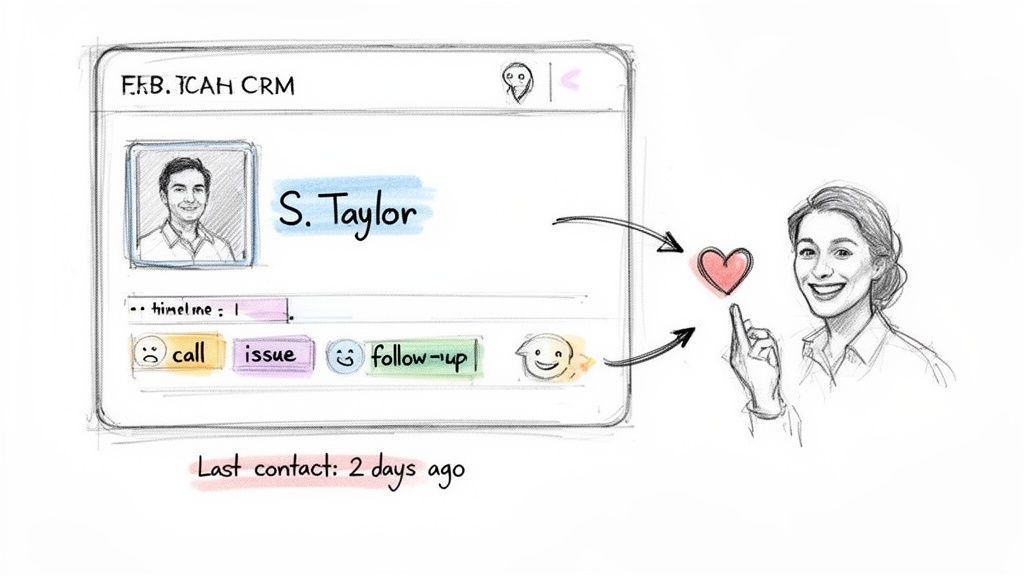
So, how do you put this into practice? It all starts with using the information you already have to make the conversation seamless. Your CRM is your best mate here—it’s the central memory bank for every single client interaction.
- Reference past chats: Kick things off with something like, "I can see you spoke with Tom last week about the leaky tap. Has that been sorted for you?" This immediately shows you’re on top of things and saves them from repeating their story.
- Acknowledge their history: For repeat clients, a simple "Great to hear from you again, Michael" goes a surprisingly long way. It shows you value their loyalty and makes the call feel less transactional.
- Use their name (but don't overdo it): Naturally dropping their name into the conversation reinforces that you’re speaking to them, not just reading from a script.
At its heart, personalisation is all about continuity. When a customer feels like their history with your business is remembered, they build a much deeper sense of trust. They’re far more likely to stick with you, even when things go wrong.
Use Empathy to Validate Their Concerns
When someone calls with a problem, they want to feel heard before they get a solution. Using phrases that validate their feelings is a powerful way to build an empathetic bridge and calm any tension. This is a crucial part of effective client communication management.
Give these validating phrases a try:
- "I can definitely see why that would be frustrating."
- "That sounds like a really difficult situation to be in."
- "Thanks for letting me know about this. Let's get it sorted out."
These statements don't mean you have to agree with them, but they prove you respect their point of view. Often, this simple act of validation is all it takes to turn a frustrated customer into a partner who’s ready to work with you to find a solution.
Real-World Rapport-Building: What to Say and When
Theory is great, but putting it into practice is what really counts. How you connect with an excited first-time home buyer is worlds away from how you’d handle a tenant with a leaking tap. It all comes down to context.
Let's get into some practical, real-world scenarios you can adapt for your own business.
These aren't just generic scripts. They’re starting points designed to show empathy and competence, helping you navigate those crucial first few moments of a conversation.
Scenarios for Real Estate Professionals
The emotional stakes in real estate are always sky-high. Whether someone is buying their dream home or dealing with a frustrating rental issue, your tone and choice of words have to match their energy.
Scenario 1: You’ve Got a Hot Buyer Lead
A potential buyer calls, buzzing with excitement about a new listing. Your job is to meet that energy and guide it toward a concrete next step.
- You could say: "Thanks for calling about 123 Smith Street! It's a fantastic property; you've got great taste. My name is [Your Name]. What was it about the listing that really jumped out at you?"
- Why this works: You’re immediately on their side with positive reinforcement ("fantastic property," "great taste"). The open-ended question invites them to share what matters to them, giving you priceless insight right from the start.
Scenario 2: Your Tenant Has a Maintenance Emergency
A tenant calls, clearly stressed about a burst pipe. Your number one priority is to de-escalate the situation with empathy and lay out a clear, immediate plan.
- You could say: "Hi [Tenant Name], thanks for letting me know straight away. A burst pipe sounds incredibly stressful—let's get this sorted for you immediately. I'm organising an emergency plumber right now. Can you confirm you're safe and tell me exactly where the water is coming from?"
- Why this works: You instantly validate their feeling of crisis ("incredibly stressful"), take ownership ("let's get this sorted"), and provide a decisive action ("organising an emergency plumber"). This pivots the conversation from problem to solution in seconds.
In real estate, acknowledging the emotion behind the call is just as important as the facts. Whether it's excitement or anxiety, validating their feelings is the fastest path to building trust.
If you’re focused on nurturing these vital long-term connections, there are some excellent communication tips for building strong tenant-manager relationships that offer even more practical advice.
Scripts for Trades Professionals
For tradies, every single call is a chance to build a reputation for being reliable and doing quality work. Rapport here is all about clarity, confidence, and showing respect for the customer's time and home.
Scenario 1: A Customer Wants a Quote for a New Job
A homeowner calls for a quote on a kitchen renovation. They're probably feeling a mix of excitement and worry about the budget.
- You could say: "Thanks for getting in touch. A kitchen reno is a big project, and it's smart to get all the details right from the start. To give you the most accurate quote possible, could you walk me through what you're picturing?"
- Why this works: You’re not just a salesperson; you’re an expert guide ("it's smart to get the details right"). This collaborative, no-pressure approach builds confidence and encourages them to open up about their vision.
Scenario 2: A Customer Isn't Happy With the Finished Work
A customer calls about a minor detail they're unhappy with on a recent paint job. Your mission is to listen, validate their concern, and stand by your commitment to quality.
- You could say: "Hi [Customer Name], I'm really glad you called me about this. I want you to be 100% happy with the job. Can you show me exactly what you're seeing? We'll come back and make it right."
- Why this works: Instead of getting defensive, you thank them for their feedback. You immediately state your goal—their total satisfaction—and propose a solution. This approach can turn a potential negative review into a powerful testament to your excellent customer service.
Using Automation to Enhance and Scale Rapport
Building genuine rapport with every single customer is fantastic, but let's be real—it's incredibly time-consuming. As your business grows, trying to keep that personal touch can start to feel like an uphill battle.
This is where technology can become your secret weapon. It’s not about replacing human connection, but about scaling the very things that build it in the first place.
An AI assistant doesn't need a coffee break, never misses a call, and won't forget a single detail. It nails the foundational elements of rapport—speed, reliability, and context—with perfect consistency, 24/7. This frees you and your team up for the high-value, empathy-driven conversations that only a human can truly master.
Meeting the Need for Speed and Accessibility
In Australia, customer patience is at an all-time low. Recent research shows just how much speed and efficiency matter when you're trying to win someone over.
A massive 87% of Australian customers say their top priority is getting an issue solved on the first try. They are all too aware of wasted time, having spent an estimated 123 million hours waiting to resolve complaints in the last year alone. For many, a slow or clunky experience is an instant dealbreaker.
This is where tools like an automated phone answering system come in, tackling this frustration head-on by making sure every single call gets answered instantly.
That immediate response is more than just a convenience; it sends a powerful message that you respect your customer's time. It also directly addresses the 42% of consumers who want 24/7 contact options, making your business feel accessible and dependable right from that first interaction. You can dig into more of these findings on Australian customer satisfaction over at Statista.
Seamless Handovers Build Trust
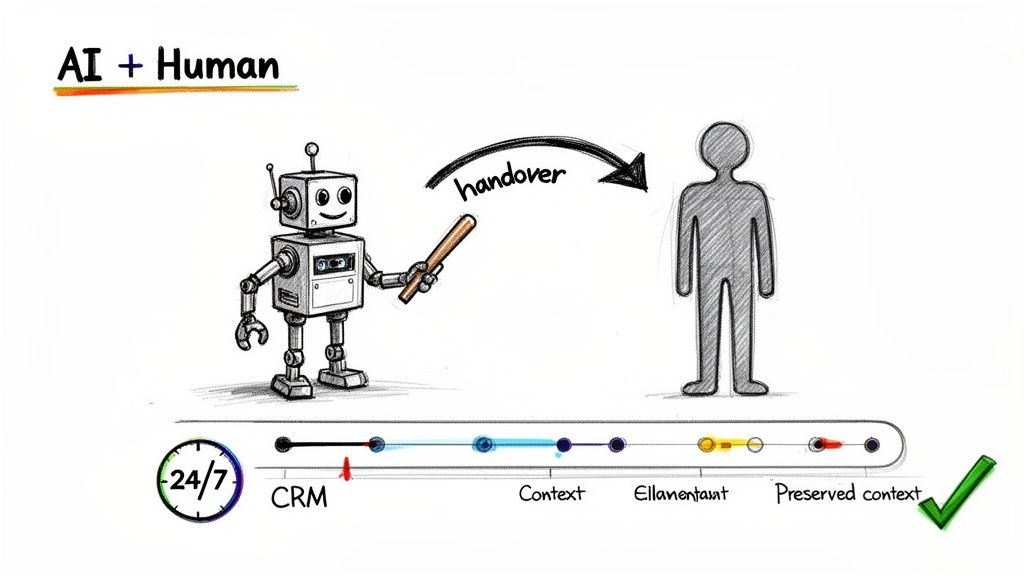
One of the quickest ways to kill rapport is forcing a customer to repeat their story. We've all been there, and it's infuriating. Automation puts a stop to this by creating a smooth, context-rich handover from an AI assistant to a real person.
When an AI assistant handles that initial contact, it can:
- Gather the basics: It can ask for names, contact details, and a quick summary of why they're calling.
- Talk to your CRM: It logs this info automatically, either creating a new customer record or updating an existing one.
- Brief you properly: By the time you step in, you have all the essential details right in front of you.
This completely changes the customer's experience. Instead of a frustrating back-and-forth, they get a smooth, intelligent conversation where they feel heard and remembered from the get-go.
This isn't about making your role obsolete; it's about making you more effective. By letting automation handle the routine stuff, you can pour your energy into what really counts: listening, empathising, and solving those tricky problems. It’s a strategic way to make sure that as your business scales, your ability to build genuine customer rapport scales right along with it.
Common Questions About Building Customer Rapport
Putting these strategies into practice is one thing, but the real world always throws curveballs. Let's tackle some of the most common hurdles professionals run into when trying to build genuine customer rapport.
How Can I Build Rapport with a Frustrated or Angry Customer?
When a customer is upset, your first instinct might be to jump in and fix the problem. Don't. Your absolute priority is to listen and show them you understand how they feel.
Start with phrases that validate their frustration. Something like, "I can absolutely see why that's so frustrating," or "Thank you for bringing this to my attention," shows you're on their side, not defending your business.
Then, prove you were listening by summarising what they told you. "Okay, so if I'm hearing you right, the main issue is…" This confirms you're engaged and gives them a chance to correct you. Only once they feel properly heard should you start talking about solutions. This simple shift turns a confrontation into a collaboration.
Can an AI Assistant Genuinely Build Rapport?
It’s a fair question. While an AI can't feel empathy, it can perfectly execute the foundational behaviours that lead to rapport. Think about it: a well-designed AI offers instant 24/7 responses, remembers a caller's entire history through its CRM integration, and delivers accurate info without missing a beat.
This consistency solves some of the biggest customer frustrations—like long wait times and having to repeat themselves to different people. It builds a solid base of trust and competence, so when a human does step in, they have all the context they need for a more meaningful, empathetic conversation.
What Is the Single Most Effective Technique for Phone Rapport?
If I had to pick just one, it's active listening. It’s easily the most powerful and surprisingly underused skill in the book. This isn’t just about staying quiet while someone else talks; it’s about truly understanding their intent, their emotion, and what they really need.
To do it right, you have to cut out distractions. When the customer finishes speaking, take a moment to paraphrase what you heard ("So, it sounds like you're looking for…") or ask a clarifying question. That simple act of making someone feel genuinely heard and understood is the fastest way to build a real connection over the phone.
Ready to scale your customer connections without losing that personal touch? OnSilent gives you an AI assistant that masters the fundamentals of rapport—instant responses, a perfect memory of past interactions, and seamless handovers to your team. You get to focus on what you do best.
Reclaim your time and never let a lead slip through the cracks again.
Find out how it works at https://onsilent.com