

Think of Body Corporate Management AI as a category of software that uses artificial intelligence to help run strata communities more smoothly. It’s essentially a digital assistant for strata managers and committees. It can handle everything from day-to-day communication and maintenance scheduling to crunching numbers for financial analysis and keeping an eye on compliance. The whole idea is to make managing the community a lot more efficient and proactive.
The New Digital Assistant for Your Strata Community
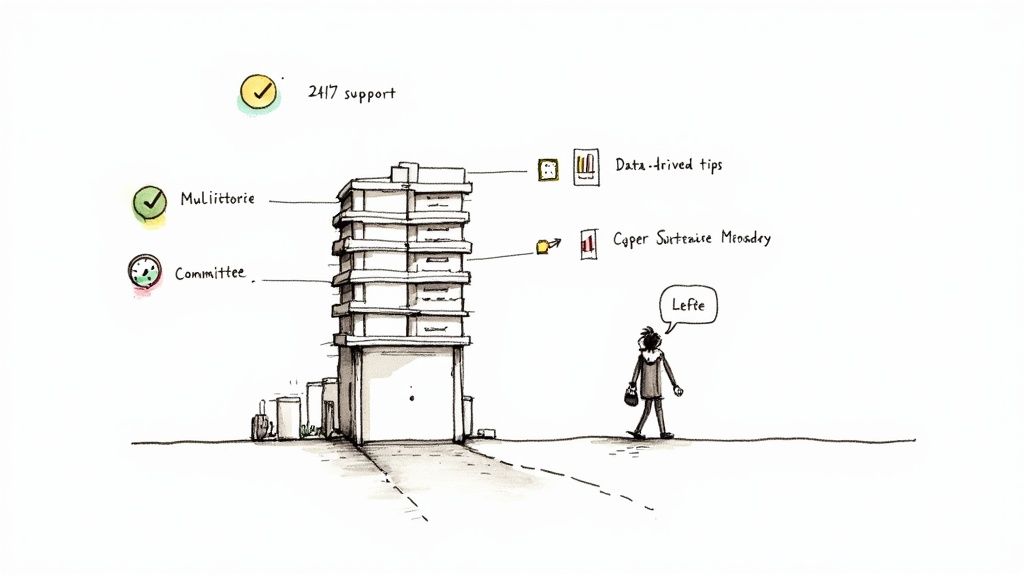
Imagine having a dedicated assistant for your committee who works around the clock. This assistant takes care of all the routine stuff, flags potential issues long before they become big problems, and even offers advice based on solid data—all without ever needing a coffee break. That's no longer science fiction; it's the new reality with body corporate management AI.
Let's be clear: this tech isn't about replacing skilled strata managers. It’s about giving them superpowers. By automating the soul-crushing admin, AI frees up managers to focus on what they do best—dealing with the complex, human-side of community living.
Tackling Timeless Strata Pain Points
AI goes straight for the classic headaches that plague strata committees and residents all over Australia. These are the problems that cause friction and drain everyone's time and money, but AI offers a much smarter way forward.
Here are the main areas where you'll see a real difference:
- Administrative Overload: Think about all the repetitive tasks—answering the same questions over and over, processing maintenance requests, sending levy reminders. AI automates these, slashing the manual workload.
- Communication Delays: AI-powered chatbots and communication tools give residents instant, 24/7 answers to common questions. No more waiting days for a simple response.
- Reactive Maintenance: Instead of just reacting when something breaks, AI can analyse data from building equipment to predict failures before they happen. This means you can schedule proactive repairs, saving a ton of money and hassle.
This shifts the entire management approach from constant firefighting to a calm, efficient, and forward-thinking operation. The use of AI in Australian body corporate management is picking up speed, and it's changing how these communities are run. A recent report even noted that AI adoption among businesses hit 89% in 2025, with finance teams—who are crucial for strata budgeting—using it for data analytics and financial reporting.
By handling the predictable and repetitive, AI gives human managers the time and data needed to excel at the unpredictable—managing relationships, solving complex disputes, and strategic planning.
To really get your head around the bigger picture and what this new digital assistant can do, it’s worth exploring Artificial Intelligence (AI) software development and its future impact. It’s time to discover a much smarter way to manage your community.
How AI Is Modernizing Strata Management Today
Alright, let's get out of the clouds and look at how body corporate management AI is actually solving real-world strata problems on the ground, right now. This isn't some far-off concept; it’s already making life easier for committees, managers, and residents in Aussie communities by tackling the nitty-gritty operational headaches with serious speed and smarts.
Think of it this way: AI is turning the endless cycle of reactive, manual tasks into proactive, automated systems. From predicting when a lift will fail to answering a resident’s question at midnight, it’s fundamentally changing the day-to-day rhythm of strata management for the better. The result? Less time wasted, lower costs, and a whole lot less stress for everyone.
From Reactive Repairs to Predictive Maintenance
Let's be honest, traditional building maintenance has always been a bit of a waiting game. The air-con dies during a January heatwave, a lift gives out first thing Monday morning—it's a recipe for emergency call-outs, eye-watering repair bills, and seriously unhappy residents. That whole reactive model is expensive and just plain disruptive.
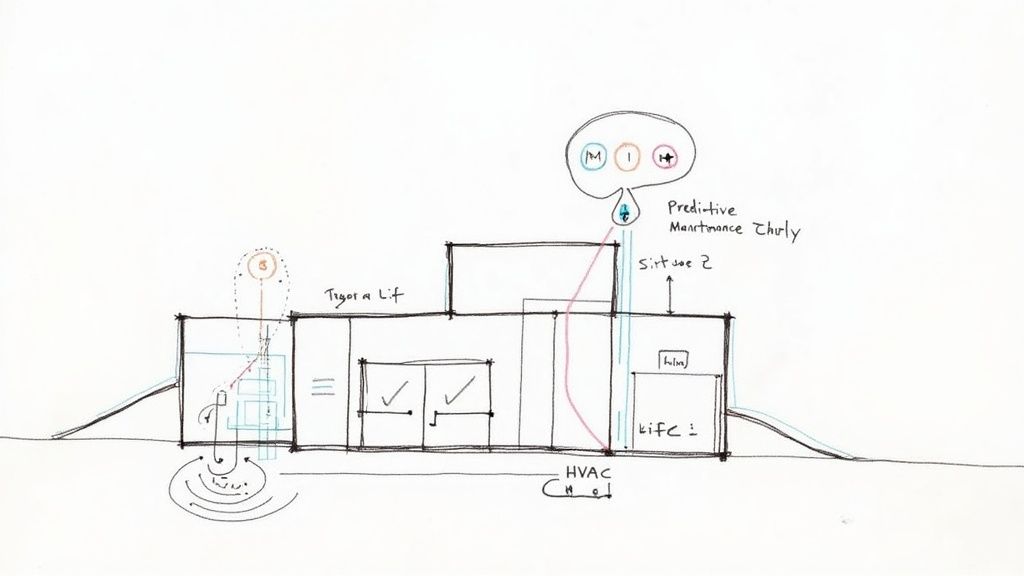
AI completely flips this script. By installing sensors on critical equipment like HVAC systems, pumps, and lifts, AI systems learn what 'normal' looks like. They continuously monitor performance, picking up on tiny anomalies—a slight change in vibration, a minor temperature fluctuation—that are invisible to the human eye but signal a failure is on the horizon.
This gives managers the power to schedule maintenance before a breakdown ever happens. It’s a game-changer. Not only does it stop inconvenient outages in their tracks, but it also helps expensive building assets last longer, delivering massive long-term savings to the body corporate.
Smarter Compliance and Governance
Keeping up with the constantly shifting sands of strata legislation, by-laws, and insurance rules is a massive undertaking for any committee. Miss one deadline or overlook a regulatory tweak, and you could be facing serious compliance breaches and financial penalties. Trying to track all this manually is a thankless, error-prone job.
This is where AI brings a new level of diligence to the table. These systems can be set up to automatically scan government sources for legislative updates, flagging any changes that impact your body corporate. It means the committee is always on top of its obligations without anyone having to spend hours drowning in legal jargon.
And it doesn't stop there. AI is also sharpening how governance documents are managed. For instance, advanced AI contract review software can chew through a dense service agreement with a contractor in minutes, highlighting risky clauses or bits that don't quite line up with your by-laws.
Think of the AI as a digital compliance officer, working tirelessly in the background to make sure the body corporate’s governance is solid, secure, and always up-to-date.
This proactive approach helps shield the committee and all owners from legal dramas, giving everyone peace of mind that the community is being run by the book.
Automated Resident Communications
One of the biggest time-sinks for any strata manager is fielding the same questions over and over again. "When's the next levy due?" "Where's the pet application form?" "What are the pool hours?" Answering these one by one creates communication jams and leaves everyone feeling a bit frustrated.
AI-powered chatbots and communication platforms are the perfect fix. These clever tools can be plugged into a resident portal or website to give instant, 24/7 answers to all those common questions. The AI is trained on your community’s specific by-laws, meeting minutes, and rules, so it provides accurate, relevant responses any time of day or night.
This automation hits two key goals:
- Residents get answers, fast: Owners and tenants find what they need straight away, without having to wait for business hours to roll around.
- Managers get their time back: By letting the AI handle the routine stuff, the strata manager is freed up to focus on the complex issues that actually need a human touch, like resolving disputes or planning major works.
It's a clear win-win. Simple questions get answered before they can turn into complaints, creating a much more positive vibe in the community.
Before we dive into the numbers, let's quickly compare the old way of doing things with the new AI-powered approach. The difference is pretty stark.
Comparing Traditional vs AI-Powered Body Corporate Management
| Management Area | Traditional Approach (Manual) | AI-Powered Approach (Automated & Predictive) |
|---|---|---|
| Maintenance | Reactive repairs after breakdowns. Scheduled checks based on time, not condition. | Predictive maintenance based on real-time sensor data. Issues are fixed before they cause outages. |
| Compliance | Manual tracking of legislation and by-laws. Time-consuming contract reviews. | Automated alerts for regulatory changes. AI-driven analysis of legal and service agreements. |
| Communication | Managers manually answer repetitive queries. Limited to business hours, causing delays. | 24/7 chatbots provide instant answers. Frees up managers for high-value tasks. |
| Dispute Resolution | Relies on manual review of emails and records. Can be slow and subjective. | AI triages disputes, analyses communication history, and flags potential conflicts early. |
| Financials | Manual data entry for invoices and budgets. Forecasting is based on historical averages. | Automated invoice processing. AI models predict future expenses with greater accuracy. |
As you can see, shifting to an AI-powered model isn't just about small tweaks—it represents a fundamental upgrade in how a body corporate can be managed, moving from a reactive stance to a proactive, data-informed one.
What's the Real-World ROI on Strata AI?
Whenever new tech comes up, the committee always asks the same question: "What's the actual return?" With body corporate management AI, the answer isn't about shiny new gadgets. It’s about delivering real, measurable value that you can see on the bottom line. This isn't an upgrade for the sake of it—it's a smart financial decision.
The return on investment (ROI) really boils down to three key areas that directly impact your community's finances and overall vibe. Let's break down how AI drives direct savings, beefs up your operational muscle, and simply creates a better place to live for everyone.
Direct Financial Savings
The most obvious win comes from slashing those predictable, recurring costs. AI does this by flipping the script, moving your body corporate from a reactive "put out the fire" spending model to a proactive, money-saving one.
Predictive maintenance is the perfect example. Instead of waiting for a lift or water pump to fail—which always leads to a pricey emergency call-out—AI keeps an eye on performance data to flag problems before they happen. This forward-thinking approach can knock down emergency repair costs by up to 20% and cut your overall maintenance bill in a big way.
On top of that, automating routine admin tasks directly trims the fat. Every automated email, scheduled levy reminder, or instantly answered query is time a strata manager or committee member isn't spending on manual grunt work. That time saved translates directly into lower admin fees or lets your manager get more done without hiking up costs.
Enhanced Operational Efficiency
Time is money, and AI gives strata managers a whole lot of it back. By taking over the relentless grind of daily admin, AI frees up managers to focus on the stuff that actually adds value, like negotiating better deals with contractors or planning long-term capital works.
Just think about the sheer volume of emails and calls a manager juggles. An AI system can triage incoming requests, answer the common questions on the spot, and get complex issues to the right person without delay. This speeds up response times and stops small frustrations from blowing up into major problems. You can see exactly how this works with strata management automation and the impact it has day-to-day.
The efficiency gain here isn't just about saving a few minutes. It's about fundamentally boosting the capacity of your management team, letting them achieve more with the resources they already have.
This productivity jump is part of a much bigger picture. The Australia’s AI Opportunity Report 2025 predicts that AI could pump an extra AUD 142 billion into the country's economy every year by 2030. Better yet, small and medium businesses—like many in strata services—are tipped to see a 22% faster productivity boost than bigger companies, all thanks to accessible AI tools. You can read more about these huge economic shifts in the full report on Australia’s AI future.
Improved Resident Experience
This one might be harder to stick on a spreadsheet, but the value of a happy, harmonious community is enormous. A great resident experience has a direct line to higher property values, lower owner turnover, and fewer costly disputes.
AI helps build this positive vibe in a few key ways:
- Faster Fixes: When residents get quick, accurate answers and see maintenance issues sorted out proactively, their satisfaction goes through the roof.
- More Transparency: AI-driven portals can give residents real-time updates on their requests and important community news, which builds a real sense of trust and inclusion.
- Less Friction: By automating things like levy reminders and booking common areas, AI gets rid of the little daily annoyances that often brew into bigger conflicts.
At the end of the day, a community that's well-run, efficient, and responsive is just a more desirable place to call home. This "livability factor" is a powerful asset, making an investment in body corporate management AI a strategic move for creating long-term value that every single owner can feel.
Your Step-by-Step AI Implementation Roadmap
Bringing body corporate management AI into your strata scheme isn’t a massive, one-time leap. Think of it more as a measured, step-by-step journey. You start small, prove the value, and build confidence along the way. A thoughtful plan ensures you pick the right tools for the right problems, setting your community up for success without causing a huge disruption.
Adopting AI is less about a complex technical overhaul and more about a smart, phased approach to solving real-world issues. By breaking the process down into manageable stages, your committee can move forward with clarity, making sure every decision is grounded in the community's actual needs.
Phase 1: Pinpoint Your Pain
Before you even glance at a piece of software, the first and most critical step is to figure out your community's biggest headaches. What are the recurring issues that drain the committee's time, frustrate residents, and cost the body corporate money? Getting specific here is absolutely key.
A great way to start is by brainstorming with the committee and your strata manager. Make a list of the most frequent complaints and operational bottlenecks.
- Is the after-hours emergency maintenance line constantly buzzing with non-urgent queries?
- Are you spending a fortune on reactive repairs for the same pieces of equipment over and over again?
- Does the strata manager spend hours each week answering the same five questions about by-laws?
- Is chasing up overdue levies a massive administrative black hole?
Once you have this list, prioritise it. Which problem, if you solved it, would deliver the most significant and visible win for the community? This focused approach helps you avoid the classic trap of adopting tech for tech's sake. Instead, it points you towards a solution that provides immediate, tangible value.
Phase 2: Evaluate Your Options
With a clear problem in mind, you can now start looking at potential AI partners. This isn't just about ticking off features on a list; it’s about finding a provider that genuinely understands the unique grind of the Australian strata sector. Your evaluation should be thorough, covering several critical areas to ensure you’re choosing a reliable, secure, and effective solution.
"The right technology partner doesn't just sell you software; they provide a pathway to better community management. Focus on vendors who prioritise Australian compliance, seamless integration, and genuine, local support."
When vetting potential AI vendors, your committee should be asking some pointed questions. Here’s a practical checklist to guide those conversations:
- Data Security and Sovereignty: Where will our residents' data be stored? Make sure the provider hosts data within Australia to comply with privacy regulations. This is non-negotiable.
- System Integration: How well does your platform play with our existing accounting or management software? A smooth integration prevents the nightmare of double-handling data.
- Local Support and Training: What kind of training and ongoing support do you offer? You want a team based in Australia that can actually help you during local business hours.
- Scalability and Future Vision: Can the solution grow with our community? Ask about their product roadmap to see if their future plans align with your long-term goals.
Phase 3: Launch and Learn
Rather than attempting a big-bang, building-wide rollout from day one, start with a pilot program. A controlled trial lets you test the technology in a real-world setting, gather feedback, and show its value to residents before you commit to anything bigger. This "launch and learn" approach minimises risk and helps build that crucial buy-in from the community.
A fantastic starting point is often an AI-powered communications tool, like an automated call assistant or a resident portal chatbot. These are relatively simple to set up and can deliver an immediate payoff by providing 24/7 answers to common questions.
This diagram shows the clear, positive flow of value that a well-implemented AI system can bring to a strata community.
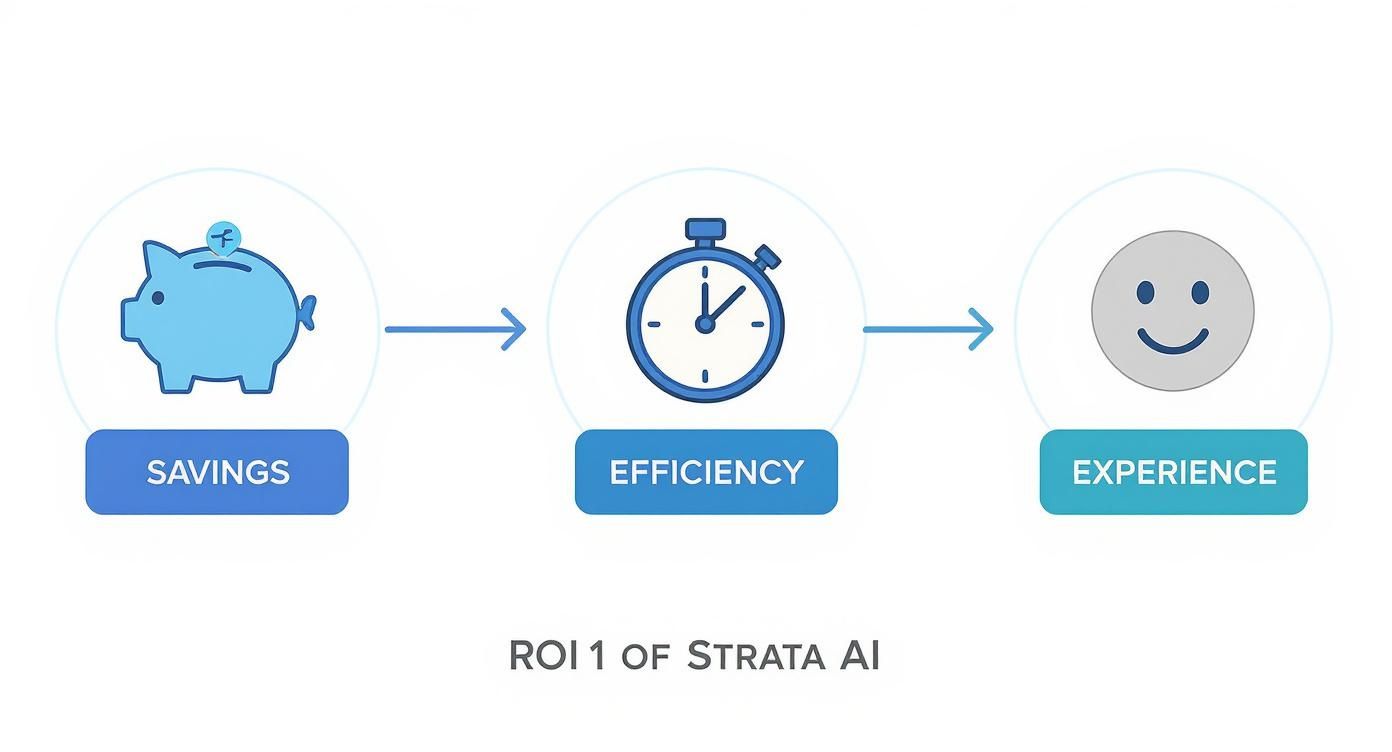
You can see how the initial savings and efficiency gains directly feed into a better resident experience, creating a positive feedback loop. By carefully following this implementation roadmap, your committee can confidently introduce body corporate management AI, turning a powerful concept into a practical asset for your entire community.
Navigating Australian Data Privacy and Legal Rules
Bringing AI into your body corporate management isn't just a tech upgrade—it's a massive responsibility. This technology will be handling incredibly sensitive data, from owner contact details to financial records, so getting your head around the legal side of things isn't just a good idea, it's non-negotiable. For any Australian strata scheme, this means you need to know the law.
The big one you need to be across is the Australian Privacy Act 1988. This piece of legislation is the rulebook for how organisations handle personal information, and it’s all built around the Australian Privacy Principles (APPs). These principles set out clear guidelines for how personal data is collected, used, and stored—and they apply directly to how any AI platform you use operates.
The Privacy Act and Your Responsibilities
Think about it: when an AI system processes a maintenance request or automatically sends out a levy notice, it's working with personal information. This means your body corporate, right alongside your AI provider, has a legal duty to comply with the APPs. For example, data should only be gathered for a specific, necessary reason, and it absolutely must be locked down tight against misuse or anyone getting access who shouldn't.
A crucial piece of this puzzle is the Notifiable Data Breaches (NDB) scheme. If personal information held by your AI platform is lost or accessed in a way that could cause serious harm, you are legally on the hook to tell the affected individuals and the Office of the Australian Information Commissioner (OAIC). This makes choosing an AI vendor with a rock-solid, transparent plan for when things go wrong an absolute must.
Protecting resident data goes way beyond legal box-ticking. It’s about trust. A single data breach can shatter the confidence that holds a community together, making iron-clad security the foundation of any responsible AI rollout.
This is also where data sovereignty comes into play. It’s a simple but vital concept: keeping data inside the country it came from. You should insist that your AI provider stores all resident data on servers physically located within Australia. It’s a game-changer for security, ensuring the data falls under Australian laws and protections, which gives you far more legal certainty than if it were floating around on a server somewhere overseas.
Key Questions for Your AI Vendor
Before you even think about signing a contract, your committee needs to do its homework. Treat it like a security audit. Asking sharp, direct questions is the best way to see how seriously a vendor takes protecting your community's privacy.
Here’s a quick checklist to get you started:
- Data Location: Can you guarantee in writing that all of our body corporate’s data will be stored exclusively on Australian-based servers?
- Encryption Standards: What specific encryption methods do you use to protect our data, both when it’s moving online and when it's sitting on your servers?
- Access Controls: Who in your company can actually see our data? What systems do you have to limit and track that access?
- Incident Response: Show us your documented plan for a data breach. How and when will you let us know if something happens?
- Third-Party Sharing: Do you share our data with anyone else? If so, who are they, and why do you need to?
These questions are your first line of defence. For a deeper look into how AI communication tools can handle sensitive info, you can find out more about securing AI-driven phone call systems and apply the same thinking. By putting data privacy first from day one, your body corporate can bring in AI with the confidence that you’ve done right by every single resident.
How to Choose the Right AI Technology Partner
Picking the right AI partner is probably the most important decision you'll make on this journey. The market's crowded, sure, but not every solution is built for the unique world of Australian strata communities. Your choice here will genuinely make or break your success, so it pays to be thorough.
Think of it like hiring a new, permanent team member. You wouldn't just glance at their CV; you’d check their references, see if they gel with the team, and make sure they have the right skills for the long haul. The same thinking applies here.
Key Evaluation Criteria
When you're looking at potential body corporate management AI partners, it’s best to focus on the basics that will guarantee a smooth and genuinely useful addition to your operations. A slick-looking dashboard doesn't mean much if the engine underneath isn't solid.
Your checklist should put these things front and centre:
- Seamless Software Integration: The AI has to play nicely with your current accounting and management software. If it doesn't, you're just signing up for more admin work, forcing staff to constantly switch between programs.
- Intuitive User Experience: It needs to be dead simple to use, both for your strata managers and for residents. A clunky, confusing system will just gather digital dust and create endless headaches.
- Customisable Reporting: Every body corporate has its own quirks and priorities. A good partner will offer flexible reporting dashboards that let you track the numbers that actually matter to your community.
Standalone Tools vs Integrated Platforms
As you start looking around, you’ll mainly find two types of setups: standalone AI tools that fix one specific problem (like a simple communications chatbot), and fully integrated platforms that offer a whole suite of AI features.
Standalone tools can be a great way to dip your toe in the water with a pilot program, letting you test the technology without a massive commitment. But for real, long-term value, an integrated platform usually wins out by creating one central hub for all your management data. When you're weighing up your options, taking a look at the different types of strata and body corporate management software out there can give you a better feel for what a complete solution can do.
A true technology partner is more than just a software vendor. They should offer solid Australian-based training, responsive ongoing support, and a clear roadmap for the future that lines up with your community’s goals.
At the end of the day, you want to find a provider who gets the specific challenges of strata management in Australia. They need to be invested in your success, not just trying to close a deal. That partnership approach is what ensures the technology keeps delivering value for years.
AI Vendor Evaluation Checklist
To help you structure your decision-making, we've put together a checklist. Use these questions to cut through the marketing noise and get to the heart of what each potential partner can really offer your body corporate.
| Evaluation Criteria | Key Questions to Ask | Importance (High/Medium/Low) |
|---|---|---|
| Industry Expertise | Do they have proven experience in the Australian strata sector? Can they provide local case studies or references? | High |
| Software Integration | How does your platform integrate with our current management software (e.g., MRI Strata Master, PropertyIQ)? Is it a native integration or a basic API connection? | High |
| Data Security & Privacy | Where is our data stored? Does your platform comply with Australian privacy principles (APPs)? What are your data security protocols? | High |
| User Experience (UX) | Can we get a live demo for our team and committee members? Is the interface intuitive for non-technical users? | High |
| Scalability | Can the solution grow with our portfolio? How is pricing structured as we add more lots or buildings? | Medium |
| Training & Support | What does the onboarding process look like? Is support based in Australia? What are your standard support hours and response times? | High |
| Customisation | Can we customise workflows, reports, and communication templates to match our specific needs? | Medium |
| Product Roadmap | What new features are you planning for the next 12-24 months? How do you incorporate client feedback into development? | Medium |
| ROI & Pricing | What is the total cost of ownership (including setup, subscription, and support fees)? Can you help us build a business case to demonstrate ROI? | Low |
This checklist isn't just about ticking boxes. It’s about starting the right conversations to make sure you're choosing a partner, not just a product.
Common Questions About AI in Strata Management
Bringing new tech into your community always kicks up a few questions, and when it’s about the place you live, getting clear answers is crucial. For a lot of committee members and residents, the whole idea of body corporate management AI can sound a bit futuristic or confusing. So, let’s tackle the most common questions head-on and clear up what this technology actually means for your strata scheme.
Getting everyone on the same page is the first step. It helps build confidence as your community starts looking at smarter, more efficient ways to manage things.
Will AI Completely Replace Our Strata Manager?
Nope, and this is probably the biggest myth out there. The goal isn't to replace your strata manager but to give them a major upgrade—think of it as a super-efficient assistant who handles all the repetitive admin that bogs down their day.
AI is brilliant at things like:
- Answering common questions from residents, instantly, any time of day or night.
- Automatically pinging out levy reminders and meeting notices.
- Spotting and flagging routine maintenance needs before they turn into bigger headaches.
This frees up your strata manager to focus on the truly human stuff. We’re talking about mediating tricky disputes, negotiating better deals with contractors, and giving the committee expert strategic advice. These are complex tasks that need empathy and real-world experience, things a machine just can't replicate.
Is Implementing AI Expensive for a Body Corporate?
The cost isn't as scary as you might think. Many of today's AI tools are subscription-based (often called SaaS, or 'software-as-a-service'), which makes them surprisingly affordable, even for smaller schemes. The real trick is to stop thinking of it as a cost and start looking at the return on investment (ROI).
When you add up the savings from things like predictive maintenance catching problems early, less time spent on admin, and just general efficiency gains, the system often pays for itself. A smart way to start is by picking one key pain point—like handling after-hours calls—and trying out a targeted, cost-effective AI solution for that first.
The best AI rollouts begin by solving one specific, high-impact problem. It’s the quickest way to prove the value and build a solid case for doing more down the track, making sure every dollar you spend makes perfect financial sense.
How Secure Is Our Residents' Data with an AI System?
Data security is the top priority—it's completely non-negotiable. Any reputable AI provider working in Australia has to comply with the Australian Privacy Act, full stop.
Your committee needs to be really thorough when checking out potential vendors. Ask them straight up about their data encryption, find out where their servers are physically located (onshore Australian hosting is the gold standard), and get the details on their protocol if a data breach were to happen. You should only ever go with a provider who is totally transparent about their security and has a proven track record of keeping sensitive community data safe.
Ready to see how an AI assistant can free up time and improve communication in your strata community? OnSilent provides a powerful, easy-to-use AI call assistant that handles resident enquiries 24/7, ensuring no issue is missed. Reclaim your time and build a more responsive community by visiting https://onsilent.com to start your free trial.