

An assistant property manager is the engine room of any successful real estate agency. They’re the ones on the ground, acting as the main point of contact for tenants, coordinating maintenance, and supporting the leasing team. In short, they are the problem-solvers and organisers who keep a property portfolio ticking over smoothly day after day. This role is absolutely crucial for keeping both tenants happy and owners confident in your agency.
The Unseen Engine of Property Management
Picture a busy airport. You’ve got the pilots (property managers) who set the flight path and the airline owners who decide the destinations. But who’s making sure everything runs on time, coordinating the ground crew, and guiding every plane in and out safely? That’s the air traffic controller—and in property management, that’s the assistant property manager. They are the communication powerhouse at the very heart of it all, handling incoming requests, dispatching tradespeople, and ensuring every move-in and move-out goes off without a hitch.
Without someone expertly managing this central hub, things would descend into chaos pretty quickly. Tenant repair requests would fall through the cracks, leasing enquiries would go unanswered, and property owners would start to doubt the agency’s ability to look after their valuable assets. The work of an assistant property manager is the unseen engine that drives both profitability and stability.
The Growing Demand for Skilled Assistants
This vital role is becoming more important than ever. The Australian property management market is booming, valued at USD 8.1 billion in 2024 and expected to climb to USD 11.0 billion by 2033. This growth is being driven by high rental demand and ever-increasing rules and regulations, which seriously ramps up the need for skilled professionals to handle the workload. You can dig deeper into the Australian property management market trends on imarcgroup.com.
A top-tier assistant property manager doesn't just tick off a to-do list; they bring order to the chaos. Their knack for juggling competing priorities has a direct impact on tenant retention, portfolio growth, and the agency's reputation as a whole.
Everything they do, day in and day out, is directly linked to the financial health and operational success of the entire portfolio. Once you grasp that their main function is to be an expert coordinator, it’s easy to see why mastering property management efficiency is non-negotiable. This solid foundation of proactive management is what separates a struggling portfolio from a thriving one, making the assistant property manager a truly indispensable part of the team.
What an Assistant Property Manager Actually Does
If you really want to get your head around the role of an assistant property manager, forget the dry job descriptions. Instead, let's walk through a typical day. This job is a constant balancing act, a real-time mix of proactive planning and reactive problem-solving. It’s not just one job; it's four different roles all rolled into one.
The morning might kick off with a frantic call about a burst water pipe, throwing the day's carefully planned schedule out the window. This single event sets off a chain reaction that perfectly sums up what an APM does: they're the central coordinator. They have to calm down a stressed tenant, get an emergency plumber on the way, and then log every detail for the property owner and the insurance claim. That's the core of it—bringing calm and order to chaos.
This concept map really shows how an assistant property manager is the central hub connecting tenants, owners, and maintenance.
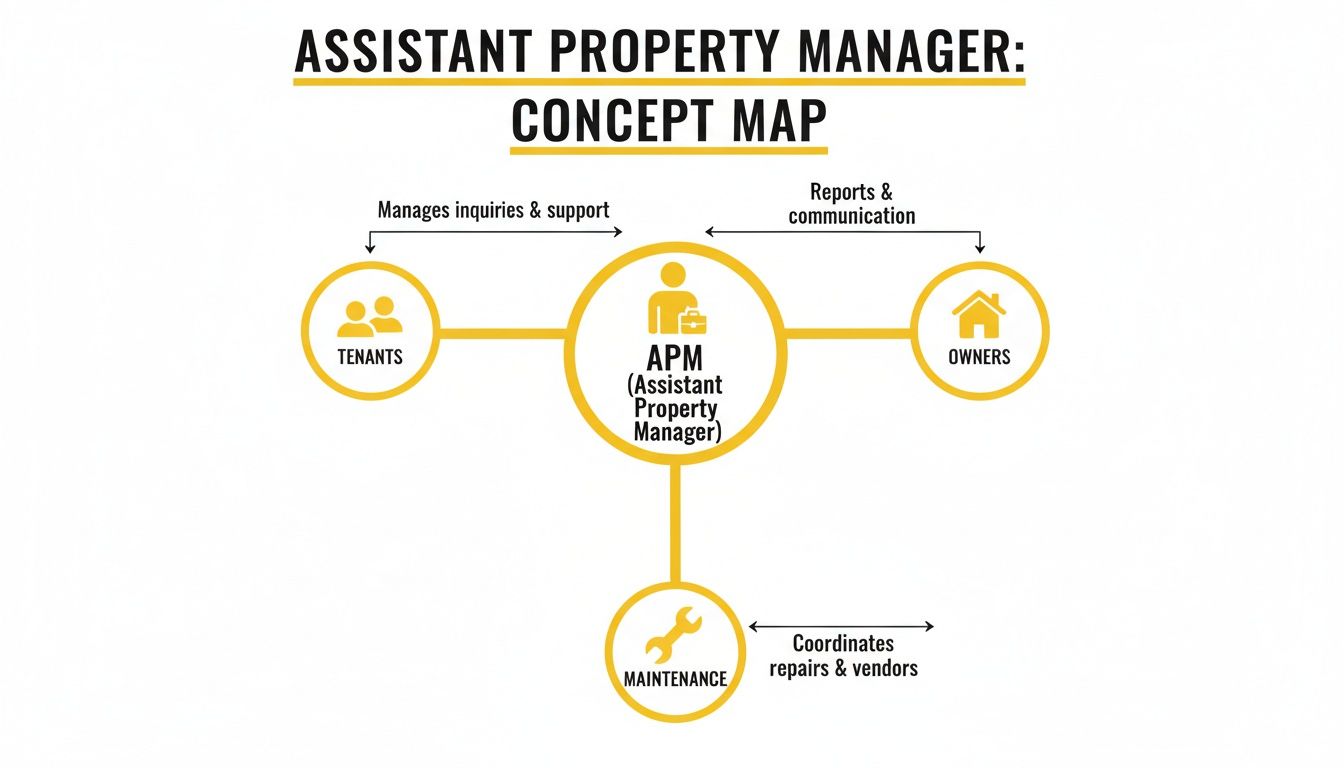
You can see straight away that success in this role is all about juggling relationships and keeping information flowing in every direction at once. The APM is that critical link making sure everyone’s needs are met without anything falling through the cracks.
The Four Hats an APM Wears Every Day
As the day moves on, you'll see an assistant property manager's work is guided by four main areas of responsibility. Each one demands a totally different set of skills, and they often have to switch between them in a heartbeat.
Here’s a quick look at the core duties and what they look like in practice.
Assistant Property Manager Key Responsibility Areas
| Responsibility Area | Example Tasks |
|---|---|
| Tenant Relations | Handling tenant enquiries and complaints, sending notices, managing lease renewals, and building a positive community vibe. |
| Maintenance Coordination | Dispatching trades for urgent repairs, getting quotes for routine jobs, scheduling garden maintenance, and checking work is done right. |
| Leasing Support | Processing rental applications, checking references, assisting with property viewings, and preparing lease agreements. |
| Financial Administration | Following up on overdue rent, processing invoices from contractors, and helping prepare monthly financial reports for owners. |
Let's break down what each of these areas actually involves.
Tenant Relations
This is all about being the first point of contact for tenants. It goes way beyond just fielding complaints. A great APM builds positive relationships, sends out notices for inspections, and manages lease renewals to keep good tenants happy and the property occupied. It’s about fostering a stable, satisfied community.
Maintenance Coordination
After dealing with the morning's burst pipe, the APM might spend the next hour getting quotes for non-urgent repairs, like a dodgy oven. Then they'll move on to scheduling the regular garden maintenance and making sure all the work orders are closed out properly once the job is done to a high standard. This pillar is all about protecting the owner's asset and keeping it in top shape.
Leasing Support
The middle of the afternoon could be spent sifting through a stack of new rental applications. This is a super detail-oriented job that involves checking references and verifying employment to find the best possible tenants. If you want to get this part right, it’s worth reading up on how to screen tenants effectively. They also help out with property viewings and drafting up the final lease documents.
Financial Administration
The day usually winds down with financial admin. This means chasing up any late rent payments, processing invoices from the plumber and gardener, and helping the property manager pull together the monthly financial reports for owners. Accuracy here is non-negotiable.
The real skill of an assistant property manager isn't just ticking off these tasks, but being able to switch hats seamlessly. One minute they are an empathetic listener for a tenant, the next a firm negotiator with a contractor, and then a meticulous administrator for the owner.
You can see how it all connects. A well-maintained property (Maintenance) leads to happier tenants (Tenant Relations), which means lower vacancy rates and better financial results (Leasing & Financials). The assistant property manager is the one keeping all these plates spinning, making sure the entire portfolio runs like a well-oiled machine.
The Skills That Set You Apart
Thriving as an assistant property manager isn’t just about being organised. It’s about nailing that unique mix of technical know-how and genuine people skills. You've got to be able to balance the methodical with the human, making sure both the property and the people in it are looked after. Think of it as being both the architect and the diplomat for a community.
You need the hard skills to understand the blueprint—the legal nitty-gritty of a lease, how to drive property management software, and the financial reporting that keeps everything on track. But at the same time, you need the soft skills to navigate the tricky relationships with tenants, owners, and contractors. Honestly, having one without the other is just a recipe for disaster.

Let’s break down what really separates a good assistant property manager from a great one.
Essential Hard Skills
These are the practical, teachable abilities that form the technical backbone of the job. They're the tools you’ll use every single day to manage properties effectively and keep everything above board.
- Software Proficiency: You have to be comfortable using property management platforms like PropertyMe or Yardi. These are your central command centres for everything from tracking rent to logging maintenance jobs and managing leases.
- Legislative Knowledge: Getting your head around the Residential Tenancies Act in your state isn’t optional—it’s non-negotiable. This knowledge is your guide for lodging bonds correctly, issuing the right notices, and handling disputes by the book.
- Financial Acumen: This is more than just chasing up rent. It’s about processing invoices, helping with budgets, and understanding trust accounting to make sure every dollar is accounted for, accurately.
- Attention to Detail: A single mistake in a lease or a missed detail on an inspection report can spiral into major legal or financial headaches. Being meticulous isn't just a preference; it’s a must.
Crucial Soft Skills
While hard skills might get your foot in the door, it’s the soft skills that will make you truly brilliant at this job. These are the interpersonal abilities that turn tense situations into positive outcomes and build the kind of trust that lasts.
An assistant property manager's true value lies in their ability to handle conflict with empathy and solve problems with composure. They are the shock absorbers for the entire property portfolio, turning friction into resolution.
These skills are often tougher to measure on a CV, but you’ll spot them a mile away in action.
- Exceptional Communication: You need to communicate clearly and professionally with all sorts of people—from a frustrated tenant with a leaky tap to a busy tradie and a financially focused property owner.
- Problem-Solving: When a pipe bursts at 2 AM, you’ve got to think on your feet. That means staying calm under pressure, figuring out the situation quickly, and coordinating a fix without any delay.
- Empathy and Patience: You're dealing with people's homes, which means you’re often dealing with their stress. Being able to genuinely listen, see things from a tenant's point of view, and stay patient can de-escalate a conflict in minutes.
- Negotiation: Whether you're talking through a lease renewal with a tenant or agreeing on a job cost with a plumber, finding that fair middle ground is a skill you'll use constantly.
How Your Performance Is Measured
In any results-focused business, performance is everything, and being an assistant property manager is no different. Agencies need clear, hard data to see how well their portfolios are being managed. Your success isn't just about how busy you feel; it’s measured by specific Key Performance Indicators (KPIs) that tell the real story about the health of the properties you look after.
These metrics aren't just for your boss to review. They give you an objective way to see how your daily grind contributes to the agency's bottom line and reputation. Getting a handle on these KPIs is essential for proving your worth and paving the way for a solid career. Think of them as the scoreboard for your work.
Core Metrics That Define Success
While every agency has its own way of doing things, there are a few core KPIs that are universally seen as the mark of a great assistant property manager. They usually boil down to three main areas: efficiency, tenant happiness, and financial health.
Key performance indicators you'll almost always come across include:
- Tenant Response Time: This is all about how quickly you get back to tenant enquiries, whether it’s a simple question or an urgent call about a burst pipe. A speedy response time is the bedrock of good customer service.
- Maintenance Resolution Speed: It's one thing to respond, but this KPI tracks the time from when a repair is first reported to when the job is officially closed. Being able to coordinate effectively with tradies is a must here.
- Vacancy Rates: This is the percentage of empty, non-earning units in your portfolio. Your role in the leasing process—from processing applications to organising viewings—has a direct impact on how fast a property gets a new tenant.
- Rent Arrears Percentage: This KPI tracks overdue rent as a percentage of the total rent roll. Your diligence in chasing up late payments is what keeps the cash flow healthy for your property owners.
An assistant property manager's performance is a direct reflection of the portfolio's stability. Low arrears and swift maintenance resolutions aren't just numbers on a report; they are signs of a well-managed asset and a secure investment for the owner.
Why These Numbers Matter
Each KPI tells a story about how effective you really are. For instance, a low vacancy rate doesn't just happen by magic. It’s the direct result of your efficient leasing support, building positive relationships that make tenants want to renew, and turning around maintenance quickly to make a property attractive.
In the same way, keeping rent arrears below 2-3% shows you’ve got firm but fair communication skills and are on top of your admin. These are the measurable results that bosses look for when they're thinking about promotions. They prove you’re not just an administrator but a proactive manager who adds real, tangible value.
Building Your Career in Property Management
Don't make the mistake of seeing the assistant property manager role as just another job. Think of it as a launchpad—a powerful one—for a long and rewarding career in real estate. This is your training ground. It’s where you’ll master the fundamentals that hold up the entire industry, from sharp negotiation and financial admin to navigating tricky tenancy laws.
The career path is usually pretty clear. Many people kick things off as a leasing consultant, step up to an assistant PM role, and then move on to become a Property Manager handling their own portfolio. From there, the doors swing open to roles like Senior Property Manager, Department Head, or even owning your own agency one day.
Your Career Trajectory and Earning Potential
With every step up the ladder, you're taking on more responsibility and, naturally, boosting your earning potential. Salaries will always vary depending on your location and experience, but the upward trend is obvious:
- Assistant Property Manager: This is where you start, often with a few years' experience under your belt, focusing on support and keeping all the plates spinning.
- Property Manager: Now you’re managing a full portfolio, building direct relationships with owners and making key strategic decisions.
- Senior Property Manager: At this level, you’re overseeing more complex portfolios and often leading a team of other property managers.
The Australian Real Estate Services industry is on track for some serious growth over the next five years, all thanks to strong demand for housing. With around 45,440 businesses in the game, this boom is going to create a massive need for skilled property professionals. It’s a secure and genuinely promising career choice. You can read more about the growth in Australian real estate services on ibisworld.com.
The skills you pick up as an assistant property manager—problem-solving, financial oversight, and talking to all sorts of people—are valuable everywhere. They set you up for leadership roles both inside and outside of property management.
This foundational experience is incredibly versatile. Getting a handle on the various facets of the real estate industry, including title and real estate services, is a massive plus for your long-term career. The skills you learn here don’t just build a career in property management; they build a career in real estate, full stop.
Using AI to Master Your Workflow
Let's be honest, the biggest challenge for any assistant property manager isn’t a lack of skill; it's the relentless flood of inbound communication. You're constantly juggling tenant calls, leasing enquiries, and maintenance requests. It feels like a never-ending battle against the clock, often leaving you with little time for the high-value work that actually moves the needle.
This is where a bit of modern tech can completely change the game.
Imagine having a digital front desk that never sleeps. An AI call assistant can act as your first line of defence, ready to go 24/7. It can answer routine calls, qualify new tenant enquiries, and even schedule property viewings automatically. Think about it: while you’re out conducting an inspection, an AI could be handling ten different viewing requests at the same time, making sure no lead ever falls through the cracks.
This isn’t about replacing your role. It’s about supercharging it, freeing you up to focus on what humans do best—building solid relationships with owners and solving complex problems.
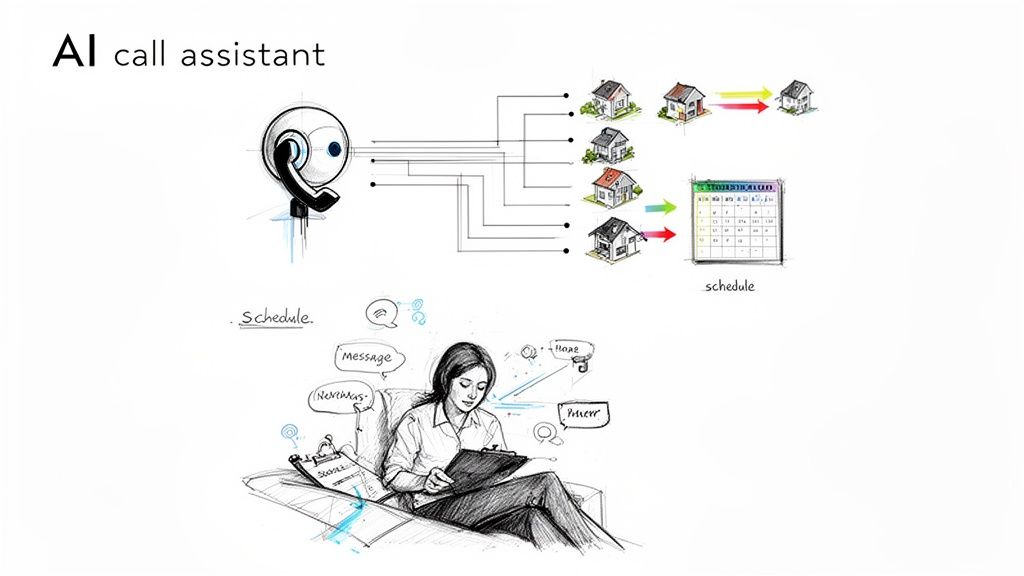
This level of automation directly tackles the biggest headaches of the job, clawing back precious hours and making the entire team more efficient.
How AI Streamlines Core Tasks
The pressure on property management teams right now is immense. Australia's national rental vacancy rates are sitting near record lows. Cities like Melbourne (1.4%) and Sydney (1.5%) are feeling the squeeze with extremely tight market conditions. This undersupply creates a tidal wave of enquiries for every single listing, making smart tech less of a "nice-to-have" and more of an essential tool for survival.
An AI assistant helps you manage this pressure by taking over key workflows:
- Lead Qualification: The AI can ask prospective tenants pre-set questions about their budget, move-in date, and if they have pets. This filters out unsuitable applicants before they ever hit your inbox.
- Automated Scheduling: Forget the endless back-and-forth emails. It can sync with your calendar to book inspections and appointments on the fly, cutting out all that admin friction.
- Instant Responses: For common questions like, "What are the application requirements?" or "Is the property still available?", the AI delivers immediate answers, which massively improves the applicant's experience.
By automating these repetitive, time-sucking tasks, you get to shift your focus. Instead of being constantly reactive, you can start proactively managing your portfolio. This is the secret to unlocking greater productivity and dodging burnout.
Ultimately, bringing this kind of tech into your daily grind is about creating more capacity. It allows a single assistant property manager to handle a much larger volume of work with greater accuracy and a lot less stress.
To really get a handle on your workflow, it’s worth exploring some of the best AI tools for project management out there. And for property-specific needs, understanding how to implement 24/7 tenant support with AI can be a genuine game-changer, transforming how you work and delivering a better service to both tenants and owners.
Got Questions? We’ve Got Answers
Stepping into a new career always brings up a few questions. Let’s tackle some of the common ones that pop up for aspiring and new assistant property managers, giving you the straightforward answers you need to get a real feel for the role.
What’s the Toughest Part of Starting as an Assistant Property Manager?
Honestly, the biggest challenge is often just the sheer volume and variety of communication you have to manage. You’re the central hub for tenants, owners, and tradies, which means your phone is constantly ringing, your inbox is always full, and you’re fielding requests left and right.
Learning to prioritise what’s urgent, manage everyone’s expectations, and stay organised when you’re constantly being interrupted is the real learning curve. This is exactly where tools that can handle the initial back-and-forth for you become a lifesaver, cutting through the noise so you can focus.
Do I Actually Need a Real Estate Licence in Australia?
Yep, you absolutely do. In pretty much every Australian state and territory, you’ll need a real estate qualification to work legally in property management. This is usually a Certificate of Registration or an Assistant Agent's certificate.
The rules do change a bit depending on where you are, so it's super important to check with the local authority—like Fair Trading in NSW or Consumer Affairs in Victoria. Make sure you’ve got the right ticket before you start your job hunt.
How Can I Make My Job Application Stand Out?
To really make an impression, go beyond just listing your skills—show them. Instead of saying you’re a "good communicator," tell a quick story about a time you calmed down an angry tenant or juggled a tricky repair job under pressure. Specific examples are gold.
Also, lean into your tech skills. Mention any property management software you've used and show you're keen to learn new tools, like AI assistants, that make the job more efficient. A proactive attitude and a genuine passion for the property world will put you miles ahead of candidates who just tick the basic boxes.
Ready to reclaim your time and focus on what truly matters? OnSilent handles the calls, qualifies the leads, and schedules the viewings, so you can build relationships and grow your portfolio. Start your free trial today and see how much time you can save.