


Picture this: you're instantly responding to every single enquiry, day or night, and you know exactly which suburbs are about to boom before anyone else catches on. This isn't some far-off fantasy—it's what artificial intelligence is delivering to the Australian real estate industry right now. From automating the daily grind to pulling in qualified leads, AI is quickly becoming a non-negotiable tool for agents and brokers.
The New Competitive Edge in Australian Real Estate
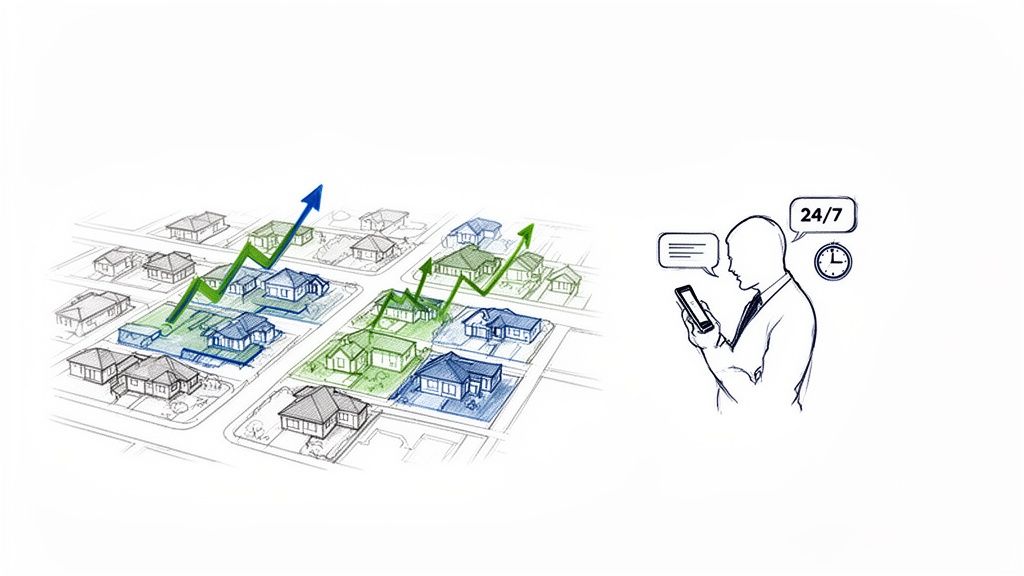
In a market where tight supply and lightning-fast price changes are the norm, real estate professionals are tapping into AI to get a serious leg up. Think of it as your ultimate co-pilot, working around the clock to handle the repetitive stuff so you can focus on what you do best: building relationships and closing deals. It's no longer just about having a website; it's about having smart systems that do the heavy lifting for you.
This tech is particularly crucial in Australia's tough housing market. While old-school valuation methods can fall short, AI crunches massive amounts of data—we're talking sales history, migration patterns, and economic trends—to give you incredibly sharp market insights. This data-first approach is vital as the country pushes to meet the National Housing Accord's massive building targets while facing a major supply shortage.
From First Contact to Final Valuation
The applications for AI in real estate are both practical and seriously powerful, touching every part of the property journey. Instead of manually answering every call or email, intelligent systems can step in, making sure no lead ever goes cold.
Here’s a look at the immediate wins:
- Instant Lead Response: An AI assistant can chat with potential buyers or sellers the second they get in touch, answering their questions and qualifying them on the spot.
- Smarter Decision-Making: Predictive analytics help you pinpoint high-growth suburbs and forecast property values with far greater accuracy than ever before.
- Massive Efficiency Gains: Automation takes care of the admin grind, freeing up hours every single week for you to spend on money-making activities.
By bringing these tools on board, agents aren't just saving time—they're building a more responsive and intelligent business. It lets you get on the front foot and be proactive, grabbing opportunities that you might have otherwise missed.
This guide will walk you through the accessible AI tools that are already changing the game. We'll break down how to put this tech to work—from a simple https://onsilent.com/ai-answering-service/ai-answering-service/ to more complex market analysis—so you can see a real return on your investment and secure your spot at the front of the pack.
How AI is Actually Being Used in Real Estate Today
Let's cut through the jargon. Think of AI in real estate not as some sci-fi concept, but as the sharpest assistant you've ever had—one that never sleeps and crunches numbers for breakfast. It’s a tool built to take on the mind-numbing, data-heavy tasks that eat up your day, so you can get back to what you do best: building relationships and closing deals.
At its heart, AI is all about spotting patterns and making educated guesses, but on a scale that’s simply impossible for a human.
Instead of manually digging through a handful of comps for a property appraisal, an AI platform can chew through thousands of data points in seconds. We’re talking historical sales, current market buzz, planned infrastructure projects, and even local demographic shifts. The end result? A much sharper, data-driven picture of what a property is really worth.
Making Day-to-Day Tasks a Whole Lot Easier
The real-world uses of AI in real estate are turning clunky, old-school workflows into smooth, efficient processes. It's like swapping a street directory for Google Maps; sure, both get you there, but one does it faster, with live traffic updates, and without any of the guesswork. This tech is brilliant at automating the predictable parts of your job.
For property managers, this could mean an AI system that flags a potential maintenance issue before the air conditioner actually breaks down, just by analysing usage patterns and equipment age. For agents, it’s about automatically drafting five different versions of a compelling property description or launching a laser-focused social media ad that finds the right buyers without you lifting a finger.
The real magic of AI is its ability to make sense of massive amounts of data that would give any person a headache. It finds the important stuff in all the noise, turning raw info into smart business insights that give you a genuine edge.
From Smart Predictions to Hands-Off Marketing
AI's role goes way beyond just ticking boxes. It's also a powerful forecasting tool that helps you get ahead of the market curve. Predictive analytics algorithms can sift through economic trends and population growth stats to pinpoint up-and-coming suburbs long before they hit the mainstream news. It’s like having an economist on your team, constantly scouting for the next boom area.
This isn't just theory—it's already delivering real results. Australian agencies are using generative AI and predictive analytics to streamline everything from writing marketing copy to identifying top-tier investment opportunities. With the market tipped for 6-8% national growth by 2026, these tools are becoming non-negotiable. Some platforms can process over 100 different metrics to predict investment returns of 12-18% with a 60-70% accuracy rate—a level of insight you just can’t get from a spreadsheet.
For a closer look at what this means for the Aussie market, this video on how AI is shaping the future of property investment in Australia is well worth a watch.
This move from being reactive to proactive is a total game-changer. It's not just about working faster; it's about working smarter. The table below really spells out the difference between the old way of doing things and the new AI-powered approach.
Traditional Methods vs AI-Powered Real Estate Solutions
Here’s a quick comparison to show just how much more efficient and capable AI tools are compared to the conventional way we’ve always done things in real estate.
| Real Estate Task | Traditional Method (The Old Way) | AI-Powered Solution (The New Way) |
|---|---|---|
| Property Valuation | Manually pulling recent sales from a limited area. | Analysing thousands of data points, including trends and sentiment, for a precise valuation. |
| Marketing Copy | Writing property descriptions from scratch for each listing. | Generating multiple unique, compelling descriptions in seconds. |
| Tenant Enquiries | Answering the same questions about rent and maintenance repeatedly. | Using an AI chatbot to provide instant, 24/7 answers to common tenant queries. |
| Lead Qualification | Spending hours on the phone to determine if a lead is serious. | Automatically scoring leads based on their online behaviour and engagement. |
As you can see, the new way is all about leveraging data and automation to get better results with less manual effort.
Ultimately, the goal of using AI in real estate isn't to replace your gut instinct or your expertise—it's to supercharge it. By taking over the tedious, time-sucking tasks, AI hands you back your most precious asset: your time. This means more breathing room to focus on the big picture, nurture your key client relationships, and deliver a level of service that makes you stand out from the competition.
Supercharging Lead Generation with AI
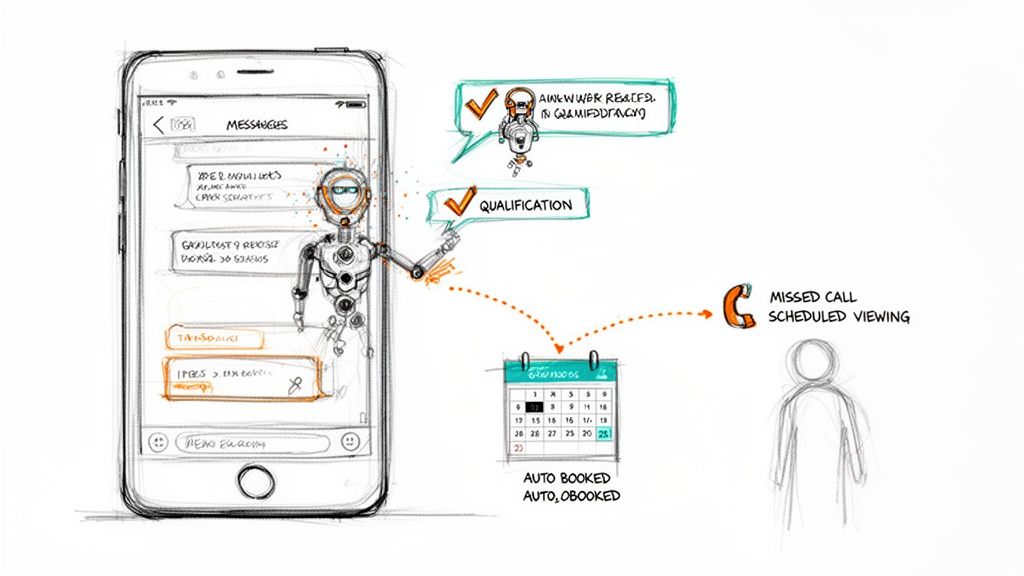
In real estate, every missed call is a missed opportunity. You know the drill: voicemail tag, delayed callbacks, and leads going cold. It's a massive drain on your most valuable asset—your time. This is exactly where AI in real estate steps in to change the game, turning lead management from a reactive chore into a powerhouse automated system.
Picture this: a potential buyer finds your listing online at 10 PM on a Tuesday. Instead of leaving a voicemail that you might not hear until morning, they're instantly greeted by an AI assistant. This isn't some clunky chatbot. It's a smart tool that can answer specific questions about the property, figure out how serious they are, and even book a viewing straight into your calendar.
This kind of always-on engagement means no matter when an enquiry comes in—whether you're in a meeting, at a showing, or fast asleep—every single lead is captured and nurtured right away. It's a level of responsiveness a human agent simply can't match, and it's how you convert interest into an appointment before a competitor gets the chance.
The New Lead Management Workflow
The difference between the old way and an AI-driven approach is night and day. Traditionally, you’d be sifting through emails, returning calls one by one, and just hoping you caught people at the right moment. The new workflow is a whole lot smarter.
Here’s how an AI-powered system transforms an enquiry from start to finish:
- Instant Engagement: The second a lead comes in from a missed call or a web form, the AI makes contact. It can ask qualifying questions like, "Are you pre-approved for a mortgage?" or "What's your ideal move-in date?"
- Intelligent Qualification: Based on the answers, the AI scores the lead's urgency. This means you can immediately focus on the hot leads ready to make a move, instead of wasting time on tyre-kickers.
- Automated Scheduling: For qualified prospects, the AI taps into your live calendar and schedules a viewing or a follow-up call, sending confirmations to both you and the client.
By the time you actually speak to a new lead, they're already warmed up, qualified, and booked in. You can see how a dedicated real estate lead capture AI agent could slot right into your business.
The real win here is speed. By responding instantly and professionally, AI systems create a seamless client experience from the very first interaction, building trust before you've even picked up the phone.
From Reactive to Proactive Lead Generation
Beyond just handling inbound interest, AI in real estate is letting agents flip the script from a reactive to a proactive strategy. Instead of just waiting for the phone to ring, AI tools can analyse market data and public records to pinpoint potential sellers before they've even thought about listing.
For example, an AI could flag homeowners who have been in their property longer than the local average, have recently paid off their mortgage, or live in a rapidly appreciating area. It can then kick off a personalised outreach campaign for you, starting a conversation and positioning you as the neighbourhood expert. This helps you build a solid pipeline of future listings while you're busy servicing your current clients.
Of course, high-quality presentation is still king for attracting buyers. Using the best virtual home staging software, which often has AI built-in, can seriously boost your listings and pull in more engagement and leads.
Ultimately, by taking care of the initial grind of lead generation and qualification, AI doesn't just save you time—it creates it. This newfound freedom lets you pour your energy into the high-value, relationship-building activities that only a human can do, like nailing negotiations and giving clients that expert guidance they need.
Unlocking Investment Opportunities with Predictive Analytics
Forget trying to pick the next property hotspot from a magazine list that's already six months out of date. Relying on gut feelings or old-school methods is like navigating with a torn map. The world of property investment is getting a serious upgrade, and it's all thanks to the predictive power of AI in real estate.
Think of it as having a crystal ball, but one that’s backed by mountains of data. It lets agents and investors see where the market is heading with a clarity that just wasn't possible before.
Instead of just looking at what sold last year, AI-driven analytics goes deeper—much deeper. It’s like having a team of a thousand analysts working 24/7, sifting through every tiny detail that nudges a property's value up or down. It’s about spotting the hidden connections between seemingly random bits of information to catch a trend before it even becomes a trend.
By making smarter, data-backed decisions, you can give your clients advice that puts them ahead of the curve, find killer opportunities for your own portfolio, and cement your reputation as a genuine market expert.
Beyond Guesswork to Data-Driven Certainty
So, how does this AI fortune-telling actually work? It all comes down to crunching a massive amount of data—we’re talking over 100 different metrics for a single suburb. This builds a super-detailed, living picture of a local market's health and what’s coming next.
Some of the key data points these AI models chew through include:
- Infrastructure Spending: It keeps an eye on council approvals for new train lines, roads, and hospitals—all massive flags for future growth.
- Demographic Shifts: It tracks population growth, average incomes, and local job trends to figure out where demand is heading.
- Rental Market Dynamics: It digs into rental yields, vacancy rates, and tenant demand to get a read on the health of the investment market.
- Market Sentiment: It even scans online property forums and news articles to gauge how confident people are feeling about an area.
But here's the clever bit: the AI doesn't just look at these things one by one. It understands how a new school might impact property prices in five years, or how a spike in rental demand could signal a wave of first-home buyers is on its way. This complete picture allows you to pinpoint undervalued suburbs with serious growth potential long before they hit anyone else’s radar.
The real game-changer with AI in real estate investment is moving from looking in the rearview mirror to looking ahead through the windscreen. It’s the difference between hearing about a property boom after it’s happened and being one of the first to get in on the ground floor.
The Tangible Returns of AI-Guided Investing
This data-first approach isn't just theory; it's delivering the goods. AI-powered suburb prediction tools are completely changing how Aussie real estate pros build their portfolios. They're sniffing out undervalued gems months ahead of the pack and generating some serious returns.
These platforms crunch over 100 metrics across 15,000 suburbs. Early users are already seeing gains of 12-18%, blowing the 6-9% from traditional methods out of the water. On top of that, these AI-guided strategies are hitting a 60-70% success rate, a huge leap from the typical 40-50% coin toss of conventional approaches.
Since early 2024, median prices for properties flagged by AI have jumped 8-12% annually, easily outpacing the suburbs everyone is talking about. For a closer look at the numbers, you can learn more about how AI is shaping property portfolios in Australia.
This isn't just a small step forward; it's a massive shift in how investment decisions are made. By tapping into these predictive insights, you're giving yourself and your clients a powerful edge, making sure every move is backed by solid data, not just wishful thinking. It’s the kind of tech that lets you act with confidence, lock in better deals, and build stronger, more profitable property portfolios.
Your Roadmap to Implementing AI in Your Business
Adopting new technology can feel like a massive undertaking, but bringing AI into your real estate business doesn't have to be complicated. With a clear plan, you can start small, target specific problems you're facing right now, and then scale up once you see the results.
This isn't about choosing flashy, expensive software; it's about understanding your own business first. Think about your biggest operational headaches. Where are the bottlenecks that cost you time, money, and maybe even your sanity?
Is it the constant stream of late-night enquiries that go unanswered until the next morning? Or perhaps the administrative overload from manually updating your CRM and chasing up paperwork is burning you out. Pinpointing these specific pain points is the most important first step because it gives you a clear target for what you actually want AI to solve.
Identifying Your Biggest Pain Points
Before you even glance at a single AI tool, take a moment to honestly audit your daily workflow. This little self-assessment will guide your entire strategy, making sure you invest in a solution that delivers real, noticeable value from day one.
A few common challenges that AI is perfectly suited to tackle include:
- A high volume of unqualified enquiries: Spending way too much time on the phone with people who aren't serious buyers.
- Missed calls and lost leads: Potential clients calling while you're with another client, leading to frustratingly lost opportunities.
- Administrative overload: Hours disappearing into data entry, scheduling appointments, and sending the same follow-up emails over and over.
- Inconsistent lead nurturing: Lacking a solid system to consistently stay in touch with your entire database of contacts.
Once you’ve identified your number one challenge—let's say it's missed calls from potential sellers—you can start looking for an AI tool built specifically for that purpose. This focused approach is far more effective than trying to adopt a complex, all-in-one system right out of the gate. To get this right, it helps to first develop a digital transformation roadmap with AI to guide your thinking.
Selecting the Right AI Tools
With your problem clearly defined, choosing the right software becomes much easier. The market for AI in real estate is growing fast, but not all tools are created equal. Your focus should be on solutions that are user-friendly, integrate smoothly with the systems you already use (like your CRM), and offer reliable local support.
Look for features that directly solve the pain point you identified. If missed calls are the issue, an AI receptionist for Australian business that can automatically call back, qualify leads, and book appointments could be the perfect fit. It's always a good idea to prioritise tools that are built for the real estate industry and understand its unique demands.
The best AI tool isn't the one with the most features; it's the one that solves your biggest problem with the least amount of friction. Aim for simplicity and a clear return on investment.
This simple but powerful process shows how raw property data can be turned into actionable investment strategies using AI.
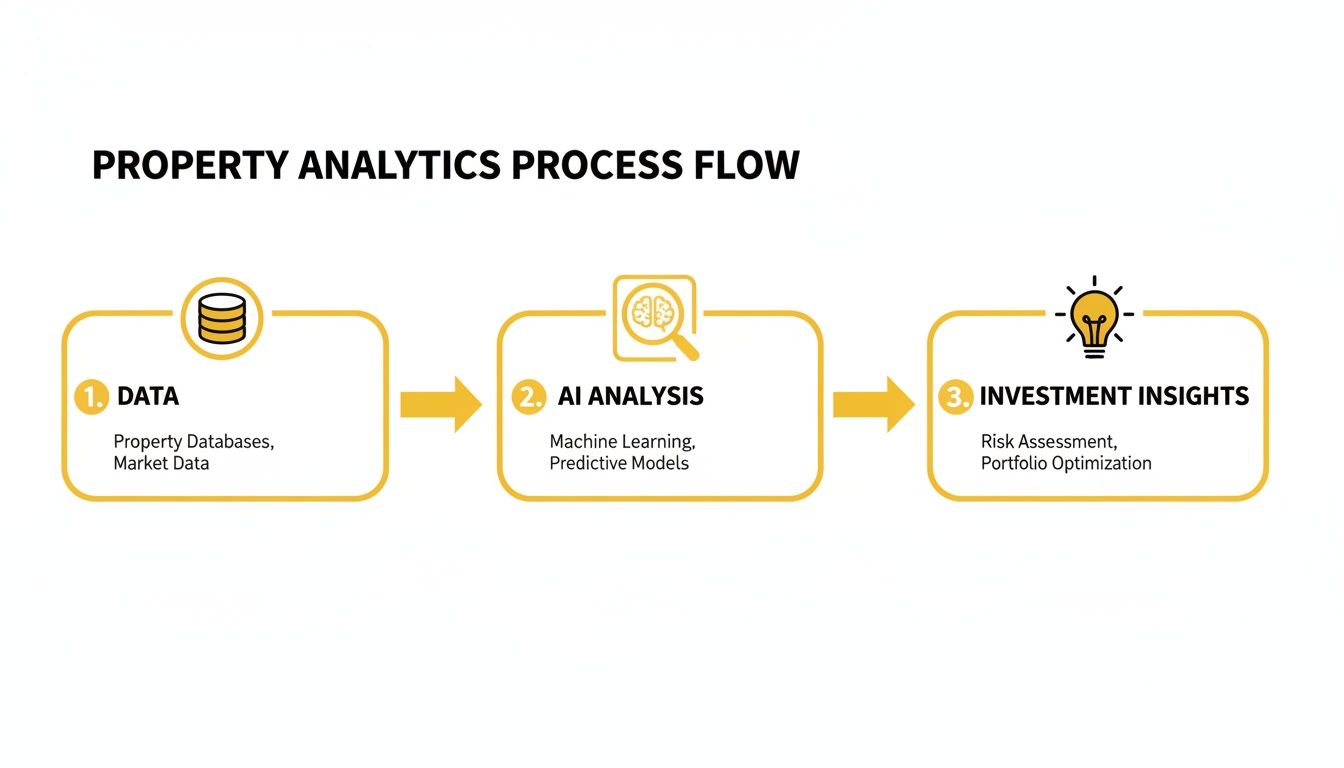
It highlights how AI acts as the engine, processing complex information to produce clear, data-driven insights for smarter decision-making.
Launching Your Pilot Program
You don't need a massive, business-wide rollout to get started. A pilot program is the perfect way to test an AI tool with a small, controlled group before committing fully. It lets you measure the impact, gather feedback, and work out any kinks in the process without turning your whole operation upside down.
To make this process as smooth as possible, we've put together a simple checklist to guide you through selecting and deploying your first AI tool.
| AI Implementation Checklist for Real Estate Professionals |
| :— | :— | :— |
| Phase | Action Step | Key Consideration |
| 1. Discovery | Define your biggest operational bottleneck (e.g., missed calls, lead follow-up). | Focus on one specific problem to solve. Don't try to fix everything at once. |
| 2. Research | Identify 2-3 AI tools that directly address your main pain point. | Look for solutions with good reviews, local support, and easy integration. |
| 3. Goal Setting | Set a clear, measurable goal for a pilot test. | Example: "Reduce unanswered calls by 50% in 30 days." |
| 4. Pilot Team | Select one or two motivated agents to participate in the test. | Choose team members who are open to new tech and will provide honest feedback. |
| 5. Onboarding | Provide brief but thorough training on how to use the new tool. | Ensure they understand how it fits into their current workflow. |
| 6. Execution | Run the pilot program for a set period (e.g., 30 or 60 days). | Don't change other variables during the test so you can isolate the tool's impact. |
| 7. Review | Track your key metrics and gather feedback from the pilot team. | Did you hit your goal? What worked well? What needs to be adjusted? |
| 8. Decision | Based on the results, decide whether to roll out the tool to the wider team. | A successful pilot gives you the confidence and data to expand. |
By following this step-by-step roadmap, you can demystify the process of bringing AI in real estate into your business. Start with your biggest problem, choose a tool that solves it, and test it on a small scale. This methodical approach ensures a smooth transition and sets you up for some serious efficiency gains.
Right, let's get this sorted. Using AI in real estate isn't just about getting things done faster; it's about being responsible with these new tools. As AI becomes a bigger part of our daily work, we need to get our heads around the ethical and regulatory side of things. This isn't just about ticking boxes – it's crucial for keeping your clients' trust and protecting your business.
Think of it this way: AI is a powerful assistant, but it’s not a replacement for your professional judgement.
When you adopt this tech the right way, it shows you're a forward-thinking leader. It tells clients you're not just jumping on a bandwagon, but you’re committed to using the best tools fairly and openly.
Upholding Data Privacy in Australia
The moment you use an AI platform to manage client chats or size up a new lead, you're handling their personal information. Here in Australia, that puts you under the Privacy Act 1988, which has clear rules on how personal data should be collected, used, and kept safe. It's on you to make sure any AI tool you bring on board is playing by these rules.
That means being upfront with your clients about how their data is being used. A simple heads-up in your privacy policy or client agreement, explaining that you use AI-assisted tech for communication and analysis, is a great start. The goal is to keep the trust you've worked so hard to build by being straight with them.
Think of AI as a new member of your team. You wouldn't let a new assistant be careless with client files, right? You’ve got to make sure your AI tools treat digital information with the same level of security and respect for privacy.
Tackling the Risk of Algorithmic Bias
One of the biggest conversations around AI in real estate is about something called algorithmic bias. An AI model is only as good as the data it learns from. If the historical data it's fed is full of old market biases—like undervaluing homes in certain postcodes or favouring specific demographics—the AI can accidentally learn and repeat these unfair patterns.
For example, an automated valuation model (AVM) might keep pricing homes in a particular neighbourhood lower than they’re really worth, all because it’s running on old, skewed data. This is exactly where your expertise is non-negotiable.
Here’s how you stay in the driver's seat:
- Always Double-Check AI Outputs: Never just take an AI-generated property valuation or market report as gospel. Use it as a starting point, then bring in your local knowledge and do your own homework.
- Ask About the Data: Ask your AI provider where their models get their data from. A decent platform will be open about its methods and what it does to reduce bias.
- You Make the Final Call: The final decision should always rest with you. AI gives you powerful data, but you provide the context, the nuance, and the ethical gut-check that tech just can't.
By actively managing these issues, you're doing more than just following the rules. You're cementing your role as the expert advisor, using sharp tools to deliver a better service while holding yourself to the highest standards in the industry.
Common Questions About AI in Real Estate
Jumping into any new system always brings up a few questions. Let's tackle some of the most common ones we hear from real estate professionals about bringing AI into their business. We'll give you clear, straight-up answers to help you feel confident and cut through the noise.
Isn't AI Technology Way Too Expensive for a Solo Agent or Small Agency?
Not at all. The latest AI tools are built to be affordable and grow with you. Many work on a subscription basis (SaaS), which means even a solo agent can get access to some seriously powerful features without a massive upfront cost or getting locked into a long-term contract.
The trick is to start small and solve a specific, high-impact problem first. Think about it: an AI call assistant that catches and qualifies every single missed call offers a return you can see and measure almost immediately. That makes the tech an operating expense that quickly pays for itself, not some huge capital investment you have to sweat over.
How Much of a Tech Whiz Do I Need to Be to Use These AI Tools?
Honestly, you don't need to be a tech expert. The best AI platforms for real estate have been designed with agents and property managers in mind, featuring simple dashboards and easy-to-use mobile apps. Getting set up is usually quick, and managing it day-to-day is a breeze.
If you can handle a smartphone and a CRM, you've got all the skills you need to get started. Plus, any decent provider will have great customer support and a proper onboarding process to make sure you and your team feel comfortable and can get the most out of the system right from day one.
The whole point of AI in real estate is to make your life simpler, not to add a bunch of technical headaches. It’s about giving your skills a boost, not forcing you to learn how to code or become a data scientist.
Is AI Going to Replace Real Estate Agents?
This is the big one, but the answer is a definite no. AI is here to make agents better, not replace them. Just think of AI as your tireless assistant, the one who handles all the repetitive, time-sucking tasks that slow you down, like answering those first-round enquiries 24/7 or booking in viewings.
This frees you up to nail the high-value, human parts of the job that technology just can't touch. These are the skills that really matter:
- Building Real Relationships: You can’t automate trust. AI can't replicate the genuine connection you build with a client.
- Negotiating Tricky Deals: It takes a human to read the room and navigate the emotional ups and downs of a complex negotiation.
- Giving Expert, Local Advice: Your years of experience and deep knowledge of the neighbourhood are things AI can only dream of.
At the end of the day, AI takes care of the transactional stuff, letting you shine at the relational side of things that defines a truly great agent. It’s about smart backup, not a total takeover, so you can be more efficient and client-focused than ever.
Ready to see how an AI assistant can give you back your time and make sure you never miss a lead? OnSilent offers a powerful, easy-to-use AI call assistant designed specifically for Australian real estate professionals. Start your 2-week free trial and find out just how much more you can get done.