

For strata managers, AI isn't some far-off concept; it's like having a hyper-efficient co-pilot on your team. Think of it as a digital assistant that gets straight to work sorting emails, prioritising maintenance requests, and generally clearing your plate so you can focus on the bigger picture—things like community building and strategic problem-solving. It's the upgrade every manager needs to keep up with rising owner expectations without burning out.
Moving Beyond the Overwhelmed Strata Manager
Ever feel like an air traffic controller trying to manage a dozen incoming flights with just a handful of sticky notes and a landline? That chaotic scene is a pretty accurate picture of daily life for many strata managers. You're constantly buried under a mountain of repetitive emails, urgent phone calls, and complex compliance paperwork. The pressure is on, with operational costs climbing and residents expecting instant answers to everything.
This constant administrative grind leaves almost no time for what really matters: proactive management, long-term planning, and actually fostering a positive community. Instead of solving complex building issues or sitting down with the committee to map out future goals, you're stuck in a reactive loop, putting out one small fire after another. It’s not just inefficient—it’s completely unsustainable.
The Shift from Manual to Automated
This is where AI steps in to clear the logjam. It’s not about replacing the human touch that’s so crucial to good strata management. It’s about augmenting it. Think of AI as your new assistant, the one who happily takes on all the mundane tasks that chew up a staggering 40% of your day.
This jump from manual to automated isn't just a small tweak; it's a fundamental change in how strata schemes are run. The image below perfectly captures this evolution, showing how clunky, old-school methods are giving way to smarter, AI-powered solutions.
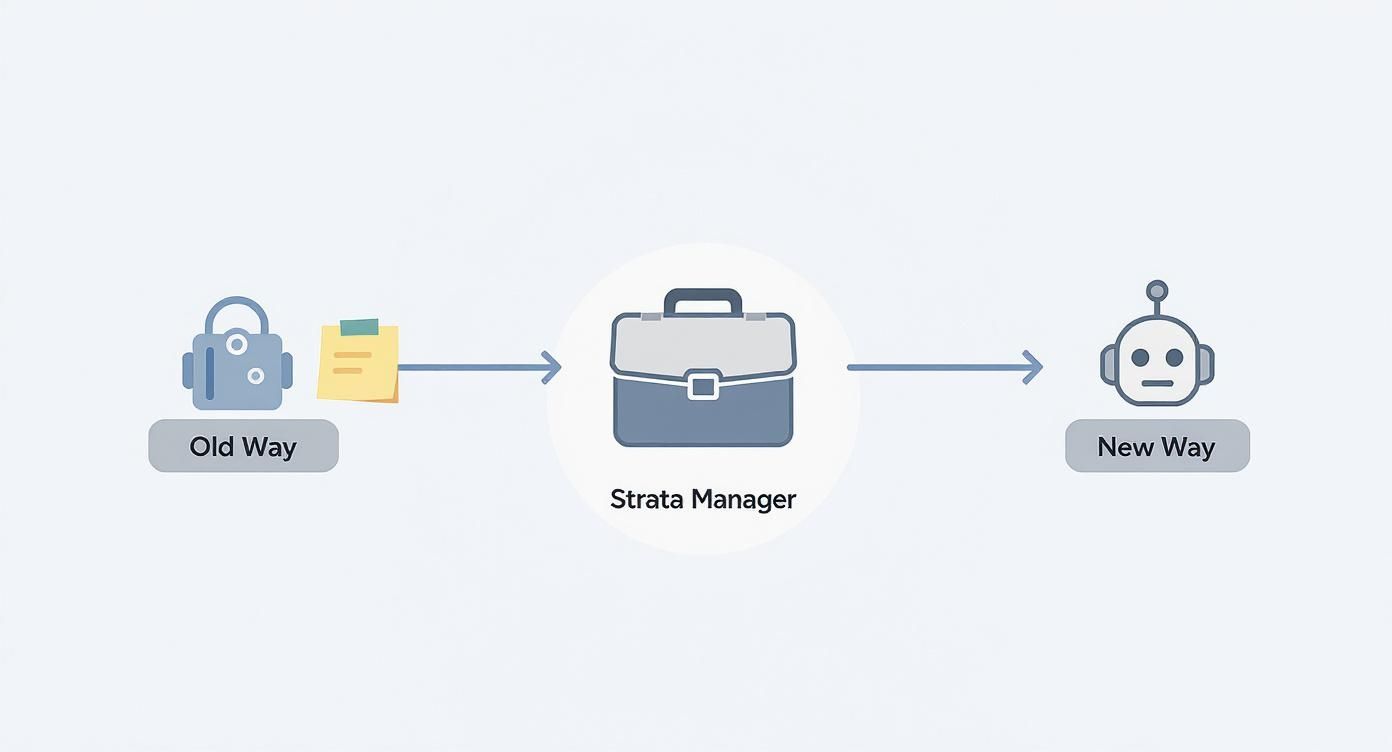
It really highlights the journey from being buried in paper to being empowered by technology, which ultimately leads to a much smoother, more efficient operation.
To give you a clearer picture, let's look at how a typical day changes.
A Day in the Life: Manual vs AI-Powered Strata Management
This quick comparison shows how AI transforms common strata tasks, freeing up valuable time and slashing manual effort.
| Common Strata Task | The Old Manual Way (Time & Effort) | The New AI-Powered Way |
|---|---|---|
| Morning Email Triage | Spend the first 60-90 mins manually reading, sorting, and flagging hundreds of emails. | AI sorts, tags, and drafts replies for common queries before you've even had your first coffee. |
| Handling Maintenance Requests | Field calls and emails, create manual work orders, and chase up tradies for updates. High effort, lots of back-and-forth. | AI logs requests, identifies urgency, sends job details to the right tradie, and follows up automatically. |
| Answering Resident Queries | Repeatedly answer the same questions about bylaws, meeting dates, or levy payments. Time-consuming and repetitive. | An AI-powered knowledge base provides instant, 24/7 answers to residents, deflecting routine calls. |
| Preparing for Meetings | Manually sift through documents, emails, and reports to compile an agenda and minutes. A real time-sink. | AI parses documents, extracts key action items, and generates draft agendas and summaries in minutes. |
As you can see, the difference is night and day. It’s about working smarter, not harder.
By taking over the routine queries and tasks, AI gives strata managers their time back. It cuts down on human error and lets you focus on strategic work that actually boosts property value and resident happiness.
This new approach allows a single manager to handle their portfolio far more effectively, improving not just their own job satisfaction but the overall health of the communities they serve. If you're keen to dig deeper into automation, our guide on streamlining administrative processes with productivity tools is a great next step. It’s all about building a more scalable and resilient way to manage property.
How AI Actually Works in Strata Management
Let's pull back the curtain on how AI actually helps strata managers. Forget the complex code and confusing tech talk for a second. The best way to think about AI is like a super-efficient apprentice you've trained specifically for your portfolio. It doesn't show up on day one with generic skills; it learns the ins and outs of your buildings—from how certain owners communicate to which plumbing issues pop up every winter.
This "learning" is what makes it so useful. It's not just a fancy to-do list with pre-programmed rules. It sifts through thousands of data points—old emails, maintenance logs, tenant questions—to get a real feel for context, urgency, and what people actually need. That's where the real grunt work gets done.
From Chaos to Clarity: The Role of NLP
The key bit of tech making this possible is called Natural Language Processing (NLP). It sounds complicated, but the idea is simple: it’s about teaching a computer to read and understand human language, just like a person would.
Think about training a new receptionist. You'd explain how to spot the difference between an email about a burst pipe flooding a basement and a casual question about when the gardens will be mulched. One is a red-alert, all-hands-on-deck situation, while the other can wait. NLP is just a digital version of that training, but it happens in a split second.
An AI system like OnSilent, for example, uses NLP to scan an incoming email and instantly make sense of it.
- It sees words like "burst pipe," "flooding," or "water everywhere" and immediately flags the message as high priority.
- On the other hand, it spots phrases like "AGM minutes," "next meeting," or "garden beds" and sorts them into the standard administrative queries pile.
This intelligent sorting turns a chaotic inbox into a perfectly organised, actionable workflow before you've even had your first coffee. It’s all about bringing some much-needed order to the constant flood of communication that comes with the job.
Turning Understanding into Action
Figuring out what a message means is only half the job. A genuinely useful AI takes the next step and turns that understanding into action. Once it has sorted out a request, it can automatically kick off the next logical step.
AI doesn’t just read your emails; it understands the job-to-be-done behind each one. It connects the resident's problem directly to the operational solution, dramatically cutting down on manual handling and wait times.
This kind of efficiency is becoming non-negotiable. The Australian property management market, which includes strata, was pegged at USD 8.1 billion and is tipped to hit USD 11.0 billion by 2033. More growth means more properties, more residents, and more headaches. AI-powered tools are shifting from a "nice-to-have" to a "need-to-have." You can dig into the numbers and trends in this detailed industry report.
For instance, after spotting an urgent leak, the AI can:
- Create a Work Order: It automatically generates a new maintenance task right in your system.
- Draft a Response: It can whip up a draft email for you to check, letting the resident know you're on the case.
- Notify the Manager: It pings the right strata manager with a quick summary of the issue and what's already been done.
This all happens in seconds. It’s this ability to not just understand but also act that makes AI less of a gimmick and more of an indispensable part of your strata management team.
How AI Tools Actually Work in Your Day-to-Day Operations

Theory is one thing, but the real test of any new tech is how it holds up on a chaotic Tuesday morning. For strata managers, this is where AI stops being a buzzword and becomes your most reliable team member. It's not about replacing people; it's about handling the small, repetitive tasks that pile up and create massive bottlenecks, freeing you up to do the real problem-solving.
Let's break down five game-changing ways AI can tackle the biggest headaches in day-to-day strata management. Each of these is a practical step toward running a tighter, more responsive, and better-organised operation.
1. Automated Communication Triage
Imagine walking into the office and your inbox is already sorted by priority. That urgent email from a committee member about a by-law breach? It’s sitting right at the top. The routine question about bin collection day? Neatly filed away for later. This isn't a pipe dream; it's what AI-powered communication triage delivers.
Instead of you manually sifting through a flood of messages, an AI assistant gets to work instantly. It scans incoming emails for keywords, tone, and who sent it, figuring out that "water leak" needs attention now, while "AGM minutes" can wait. From there, it can automatically sort these messages, assign them to the right person, and even tee up tasks in your management software.
Example in Action: A resident emails at 10 PM saying, "The garage door is stuck again and my car is trapped inside." The AI instantly flags this as a high-priority security and access issue. It creates a new task, pings the on-call manager with an alert, and even drafts a quick reply to the resident to let them know their message has been received. All before a human has even seen it.
This flips your workflow from reactive to proactive, ensuring the critical stuff never slips through the cracks. It’s one of the core AI automation capabilities that brings immediate order to the daily communication storm.
2. Intelligent Maintenance Request Handling
Let’s be honest, maintenance requests are a constant administrative drain. They often land in your inbox half-baked, missing the key details you need to actually send the right tradie. AI brings a layer of intelligence to this whole process, making it smarter from the very first click.
When a resident reports a leak, for instance, an AI system can prompt them to upload a photo. The AI then looks at the image to get a sense of the severity. Is it a minor drip or a massive ceiling stain that points to a much bigger problem?
This quick analysis lets the system:
- Classify Urgency: It figures out if the job is an emergency, standard, or low-priority fix.
- Notify the Right Contractor: Based on the issue—plumbing, electrical, you name it—it automatically shoots the details over to the right pre-approved contractor.
- Keep Everyone in the Loop: It pings an automated update to the resident and logs the request for the committee’s records.
Suddenly, the strata manager isn't the manual go-between anymore. This cuts down delays and means a faster, more accurate response when things go wrong.
3. Instant Document and By-Law Retrieval
How much of your week is spent digging for a specific clause in a set of by-laws or trying to find that pet application form from three years ago? Strata schemes run on a mountain of paperwork, and finding the right info quickly is a constant battle.
AI tools can read and index your entire document library—by-laws, minutes, financials, correspondence, the lot. Using a simple search bar, a strata manager can pull up the exact information they need in seconds.
Think of it as a search engine just for your building. You can ask questions in plain English, like, "What are the rules for balcony renovations in SP 12345?" The AI will scan everything and serve up the specific clauses, complete with a link back to the original document. This is a massive time-saver and a brilliant tool for ensuring compliance and giving accurate advice.
4. Voicemail and Call Analysis for After-Hours Issues
Urgent problems don't keep office hours. A burst pipe or a lift breakdown often happens at night, leaving a frantic voicemail as the first point of contact. Manually checking voicemails is slow and clumsy, especially when a crisis is brewing.
This is where AI for strata managers really shines. An AI-powered answering service can instantly convert voicemails to text. It then scans the message for keywords that scream "emergency," like "fire," "flood," or "stuck in lift."
If it detects an urgent issue, the system immediately escalates it by:
- Sending an SMS alert straight to the after-hours contact.
- Emailing the full transcript to the management team.
- Logging the call as a high-priority incident in your system.
This ensures that real emergencies get an immediate response, while non-urgent calls are simply logged for follow-up during business hours. To see how this works, you can learn more about how an AI answering service can completely change how you handle calls.
5. Proactive Resident Engagement and Communication
A huge chunk of any strata manager's day is spent answering the same questions over and over. "When's the next meeting?" "How do I book the BBQ area?" "Where do I get a new access fob?" They're important questions, but answering them one by one creates a serious bottleneck.
AI can field these queries by powering a 24/7 knowledge base or chatbot that gives instant, correct answers. By training the AI on your building's specific rules and procedures, you can make sure residents get consistent information every time they ask.
On top of that, AI can help draft communications. When a notice needs to go out about window cleaning or lift maintenance, the AI can whip up a clear, professional draft from just a few key points. This saves time and keeps the tone consistent across all your communications, which goes a long way toward improving owner satisfaction and cutting down your admin load.
Smarter Financial Planning and Risk Mitigation with AI
While sorting emails and calls is a massive time-saver, the real strategic power of AI for strata managers goes much deeper, right into a building's financial health and long-term stability. It’s a game-changer for helping committees shift from reactive spending to proactive, data-driven financial decisions.
By digging through years of financial records, AI can spot patterns that are almost impossible for the human eye to catch. This means it can generate far more accurate budget forecasts, cutting down on those frustrating, unexpected special levies that owners hate. It helps committees make smarter calls on everything from day-to-day expenses to topping up the capital works fund.
Optimising Budgets and Capital Works Funds
Predictive analytics is the engine driving this financial intelligence. AI doesn't just glance at last year's spending; it looks at maintenance history, asset depreciation, and even wider economic trends to model future costs with incredible precision.
Think about it this way: an AI model could analyse the maintenance history of a building's lifts and flag that a major component is likely to fail within the next 18 months. This kind of heads-up allows the committee to plan and budget for the replacement, turning a potential emergency cash grab into a scheduled project. This is the level of planning that maintains property values and keeps owners happy.
AI transforms budgeting from an annual guessing game into a continuous, data-informed process. It empowers committees to see around corners, plan for future expenses, and build a more resilient financial foundation for their community.
This is where AI-powered tools really shine. By feeding this predictive data into your core systems, committees can squeeze more value out of their existing property management accounting software, making sure every dollar is put to its best use.
Navigating the Volatile Australian Insurance Market
Let's be honest, securing fair and comprehensive strata insurance in Australia has become a massive headache. Premiums are all over the place, thanks to climate change, rising construction costs, and insurers constantly re-evaluating risk. This is where AI gives you a serious advantage in a tough market.
Instead of working off old data, AI models can chew through a huge range of variables to build a detailed, up-to-date risk profile for your building. This isn't just about claims history. It involves scanning maintenance logs for deferred work and even assessing the building's exposure to floods or bushfires based on its location.
This data-rich approach sends a clear message to insurers: you’re on top of your risk management. And that can lead to much more favourable conversations when it's time to negotiate premiums.
Proactive Risk Identification and Mitigation
Perhaps AI's greatest strength here is its ability to flag risks before they turn into expensive claims. It can pinpoint the exact issues that make insurers nervous, giving strata managers and committees a clear roadmap for taking action and reducing their liability.
What kind of risks are we talking about?
- Dodgy Fire Safety: Spotting things like out-of-date fire panel reports or overdue sprinkler system inspections.
- Deferred Maintenance: Flagging those recurring plumbing issues or structural cracks that could spiral into a major failure.
- High-Risk Tenancies: Identifying commercial tenants whose operations might bump up the building's insurance risk.
This forward-thinking approach is already paying off. While strata insurance premiums in Australia recently saw a 2.8% increase, it was a far more moderate rise than in previous years. This is partly thanks to better climate risk modelling—powered by AI—which helps everyone better predict and prepare for losses from extreme weather.
By using AI to systematically find and fix these liabilities, you’re essentially presenting your building as a lower-risk investment to insurers. It’s a data-backed strategy that not only helps fight against underinsurance but also paves the way for more stable premiums, securing the financial future of the entire strata scheme.
A Practical Roadmap for Getting Started with AI
Bringing new tech into your strata management practice can feel like a massive undertaking. But honestly, getting started with AI is more straightforward than you might think. With a solid plan, you can introduce tools that boost your efficiency without turning your entire workflow upside down.
The secret is to take it step-by-step. Focus on integration, security, and getting your team on board right from the beginning. This roadmap will walk you through the important bits to make sure your new AI tool is a valuable addition, not just another piece of software.
Phase 1: Seamless Integration with Your Existing Systems
The first question every strata manager should ask is, "Will this new thing actually work with the software we already use?" A brilliant AI tool is useless if it creates information silos or forces your team to jump between a dozen different programs. The real value comes from a smooth, seamless connection.
Your goal is to find an AI partner that adds to, rather than replaces, your main property management platform. Think of it as an intelligent layer that sits on top of your current systems, pulling information and pushing updates automatically. This keeps everything in one place and saves you the headache of managing separate, disconnected tools.
For example, a tool like OnSilent can plug straight into your CRM. When it handles a call from a resident, the details are logged directly against the right property file. This kind of connectivity is non-negotiable if you want to keep things running efficiently.
Phase 2: Putting Data Security and Privacy First
In strata, you're handling a mountain of sensitive resident information. That means data security isn't just a nice-to-have; it's a must-have. When you’re looking at AI tools for strata managers, you absolutely have to know where and how your data is being stored and handled.
With Australian privacy laws getting tougher all the time, choosing an AI provider that hosts data onshore is a critical part of staying compliant. It ensures your residents' information is protected under local laws, protecting your practice from potential breaches and legal dramas.
Don't be shy about asking potential vendors direct questions. Ask about their security protocols, encryption standards, and how they comply with the Australian Privacy Principles (APPs). A transparent, security-focused partner will have clear answers and all the documentation ready to go.
Phase 3: Getting Your Team and Committee on Board
Even the most amazing technology will gather dust if your team doesn't actually use it. A successful rollout all comes down to good change management. Start by explaining the "why" behind the shift—focus on how AI will cut down on tedious tasks, reduce after-hours calls, and free them up to do more meaningful work.
To get everyone on board, try these strategies:
- Start with a Pilot Program: Roll the AI tool out with a small, keen group first. This lets you iron out any kinks before it goes live for everyone.
- Provide Proper Training: Make sure everyone gets hands-on training that’s relevant to their specific day-to-day tasks.
- Highlight the Quick Wins: Show off early successes, like how the AI sorted out an after-hours emergency on its own. This builds momentum and gets people excited.
By involving your team and committee early and showing them the clear benefits, you’ll turn any doubters into your biggest supporters. For a deeper dive into bringing AI into your operations, check out this practical guide to implementing AI in business.
How to Measure the True ROI of AI
So, you're thinking about bringing AI into your strata management business. Great! But justifying the investment needs more than just a vague promise of "making things more efficient." To really prove the value of AI, you need a clear way to measure the real, tangible returns.
It’s about moving past the buzzwords and getting down to the brass tacks: the Key Performance Indicators (KPIs) that show a direct impact on your bottom line and the quality of service you provide. When you can show stakeholders the hard data, they'll see AI not as an expense, but as a smart investment in the future of the business.
Reclaimed Time and Operational Efficiency
The first and most immediate win you'll notice is time. So. Much. Time. Every single admin task that AI takes off your plate—sorting emails, answering the same old questions, manually logging maintenance requests—translates directly into saved hours. And those hours have a clear dollar value.
Start by getting a baseline. How much time is your team really spending on that repetitive grind? Once you know that, you can track how much those hours drop after you bring in an AI tool. For example, if an AI assistant like OnSilent starts handling 50% of your routine inbound calls, that’s a huge, quantifiable chunk of time your managers get back. Time they can now spend on high-value work, like liaising with committees or navigating complex disputes.
Think of it this way: if a manager earning $80,000 a year gets back five hours a week, that's over $9,600 in recovered productivity in a year. From just one team member. That reclaimed time is the bedrock of your ROI calculation.
Enhanced Service Levels and Resident Satisfaction
All that newfound efficiency should naturally lead to better service. And better service means happier residents. When you can prove this, you’ve got a powerful story to tell. Happy residents are less likely to complain and more likely to comply with by-laws, which makes life easier for everyone.
Here’s what you should be tracking:
- Average Response Time: How quickly are residents getting a first response, both during and after hours? AI can make this near-instantaneous.
- First-Contact Resolution: Are issues getting sorted out in the first interaction? AI helps cut down that frustrating back-and-forth.
- Resident Satisfaction Scores: A simple survey before and after you implement AI can give you concrete proof of the improvement.
Seeing your response times plummet and your satisfaction scores climb is powerful evidence that the tech isn't just saving you time; it's making your service genuinely better.
Tracking Your AI Success A KPI Scorecard
To really get a grip on the impact of AI, you need to measure what matters. This scorecard will help you track the key metrics before and after implementation, giving you the hard data you need to see the direct impact on your business operations and financials.
| Key Performance Indicator (KPI) | How to Effectively Measure It | What Success Looks Like |
|---|---|---|
| Admin Hours per Manager | Track weekly time spent on tasks like call triage, email sorting, and data entry before and after AI deployment. | A 25-40% reduction in time spent on low-value administrative tasks within the first three months. |
| Average First Response Time | Use your ticketing or communication system's analytics to measure the time from query submission to first reply. | A drop from hours to under 5 minutes for initial acknowledgement and triage of resident queries. |
| First-Contact Resolution Rate | Monitor the percentage of resident issues resolved in a single interaction without needing escalation. | An increase of 15-20% in issues resolved on the first contact, reducing follow-up communications. |
| Cost of After-Hours Support | Calculate the monthly cost of on-call staff or third-party answering services. | A 50-70% reduction in after-hours support costs as AI handles most routine and non-urgent enquiries. |
| Manager-to-Portfolio Ratio | Divide the number of properties managed by the number of strata managers on your team. | The ability to increase the number of lots per manager by 10-15% without a drop in service quality. |
| Resident Satisfaction (CSAT) Score | Send a simple, post-interaction survey asking residents to rate their experience on a scale of 1-5. | An improvement in your average CSAT score from, for example, 3.5 to 4.5 out of 5. |
By keeping a close eye on these numbers, you move the conversation from "we think this is working" to "we can prove it's working." This data-driven approach is essential for demonstrating the true, measurable value of your AI investment.
Proactive Cost Avoidance
Sometimes, the biggest returns come from the costs you don't have to pay. Think of AI as your financial safeguard. It can spot potential issues before they blow up into expensive emergencies.
A predictive maintenance alert that flags a failing water heater before it floods a basement can save you thousands in repairs and insurance claims. It’s the same with compliance—by flagging potential by-law breaches early, AI helps you sidestep hefty fines and legal battles. You’re shifting from a reactive, expensive model to a planned, controlled one, and that directly protects the scheme's budget.
Scalable Growth Without Added Headcount
Here's the real game-changer. AI for strata managers fundamentally alters how your business can grow. When you automate a huge chunk of the admin workload, a single manager can suddenly handle a larger portfolio of properties without being stretched to the breaking point.
This scalability is where the ROI really shines. It means you can take on new buildings and increase your revenue without the usual jump in salary costs. That improved manager-to-portfolio ratio is a clear sign that AI is directly fuelling sustainable growth. For any strata management company looking to expand, that’s not just a benefit—it’s a massive competitive advantage.
Common Questions About AI in Strata Management
Bringing any new technology into the fold is bound to raise a few questions. When it comes to AI for strata managers, committees and management teams usually have some key concerns on their minds. Let's tackle them head-on, so you can make a confident decision for your community.
Will AI Replace Our Strata Managers?
This is easily the most common question we hear, and the answer is a firm no. Think of AI as a powerful assistant, not a replacement. Its whole purpose is to take on the high-volume, repetitive admin that bogs down your team.
By automating things like call sorting, answering routine questions, and logging maintenance requests, AI frees up your managers. This gives them back the time to focus on the high-value work that truly needs a human touch—empathy, strategic planning, and complex problem-solving. No machine can do that.
Is Our Building's Data Safe with an AI?
Data security is completely non-negotiable. Any reputable AI provider will be using modern data encryption and solid security protocols to keep your sensitive information locked down.
For Australian strata schemes, it's absolutely crucial to pick a partner that sticks to local privacy laws and hosts all data onshore. This ensures your community's information is protected under the Australian Privacy Principles, giving everyone—from managers to residents—total peace of mind.
How Much Technical Skill Is Needed to Use AI?
You don't need to be a tech wizard. Modern AI tools are built to be user-friendly, with intuitive interfaces that require very little training. If you can use a smartphone app or your usual office software, you've got all the skills you need. The whole point is to make your workflow simpler, not add a layer of technical jargon.
Can AI Understand Our Building's Unique Rules?
Absolutely. A key part of setting up an AI is training it on your specific information. The AI model learns your building’s by-laws, unique procedures, and even historical data. This means it provides support that's actually relevant and context-aware for your scheme, instead of just spitting out generic answers.
Ready to see how an AI assistant can reclaim hours of your day and improve resident communication? Discover how OnSilent handles calls, sorts requests, and streamlines your workflow. Start your free trial today.