

If you're a strata manager, you know the drill: an inbox overflowing with resident queries and a logbook full of missed after-hours calls. It’s the daily grind. This guide isn't about some far-off, futuristic tech. It’s about a real solution available today—AI-assisted communication for strata managers—designed to finally put an end to the after-hours overload and get your operations running smoothly.
Reinventing Your Strata Communication Command Centre
Picture your office right now. It's probably a bit like a manual switchboard, right? Every single call and email needs a human to answer, figure out what's needed, and pass it along. This system is a recipe for bottlenecks, especially after hours, which leaves you with frustrated residents and a burnt-out team.
Now, imagine swapping that for an intelligent command centre. One that automatically handles routine questions, flags genuine emergencies, and organises requests 24/7—even while you're fast asleep.
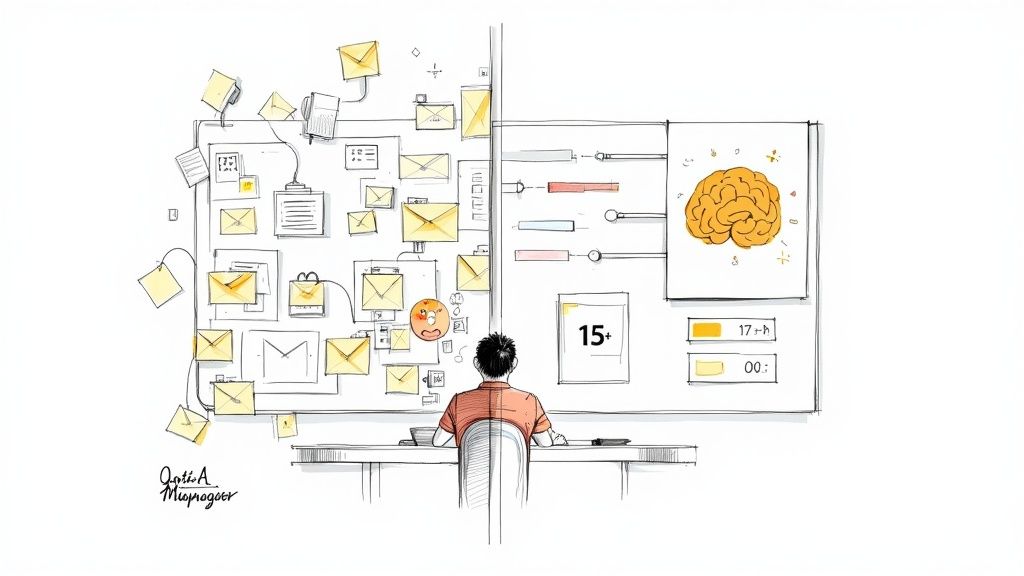
This is what AI-assisted communication is all about. It’s not about replacing the human touch that's so crucial in strata management. It’s about giving your team a serious upgrade, freeing them up from repetitive admin to focus on what they do best: solving complex problems and building stronger communities. The real goal here is to tackle the insane workloads and communication jams that have become the norm in our industry.
The Impact on Daily Operations
You really see the difference when you look at the numbers. In the non-stop world of Australian strata management, where high call volumes can bury even the most efficient teams, this tech is a genuine game-changer.
Think about a typical small to medium strata agency in Sydney or Melbourne, juggling over 50 calls a day. These aren't just quick chats; they're maintenance requests, by-law questions, and everything in between. Each call, once you factor in logging the details, chews up about six minutes.
But what if an AI assistant could handle 60% of those routine interactions? Suddenly, that’s 30 calls a day your team doesn't have to touch.
This kind of efficiency boost changes everything. Instead of constantly playing catch-up, your team can finally get on the front foot and address issues before they blow up.
By automating the front line of communication, strata managers can shift their focus from being simple message-takers to strategic community facilitators, dramatically improving both service quality and job satisfaction.
Addressing the After-Hours Challenge
After-hours is where the real headaches start. Urgent problems always seem to pop up when you have the fewest people on deck. Traditional answering services can be expensive, and they often don't have the specific context needed for your buildings.
An AI-powered system, on the other hand, provides a consistent and intelligent first point of contact. It ensures no urgent call ever gets lost in the void. For a closer look at how this works, you can find more on our guide to https://onsilent.com/call-management-solutions/after-hours-call-answering-service/.
To see how AI tools are directly taking on these after-hours demands, it's worth reading about how property management chatbots revolutionising tenant communications. This guide will lay out a clear roadmap with real-world examples from the Australian strata industry, helping you move from feeling overloaded to being in complete control.
How AI Actually Understands Strata Communication
To really get your head around AI-assisted communication, you need to peek under the bonnet—but don't worry, we'll skip the confusing technical stuff. It's best to think of the AI less like a sci-fi robot and more like a super-efficient virtual assistant who’s been trained for one job and one job only: understanding and organising strata messages.
This assistant doesn't "think" like we do. Instead, it uses incredibly smart pattern recognition to get specific tasks done with mind-boggling speed and accuracy. It’s all about chopping up communication into simple, actionable bits.
From Words to Meaning with NLP
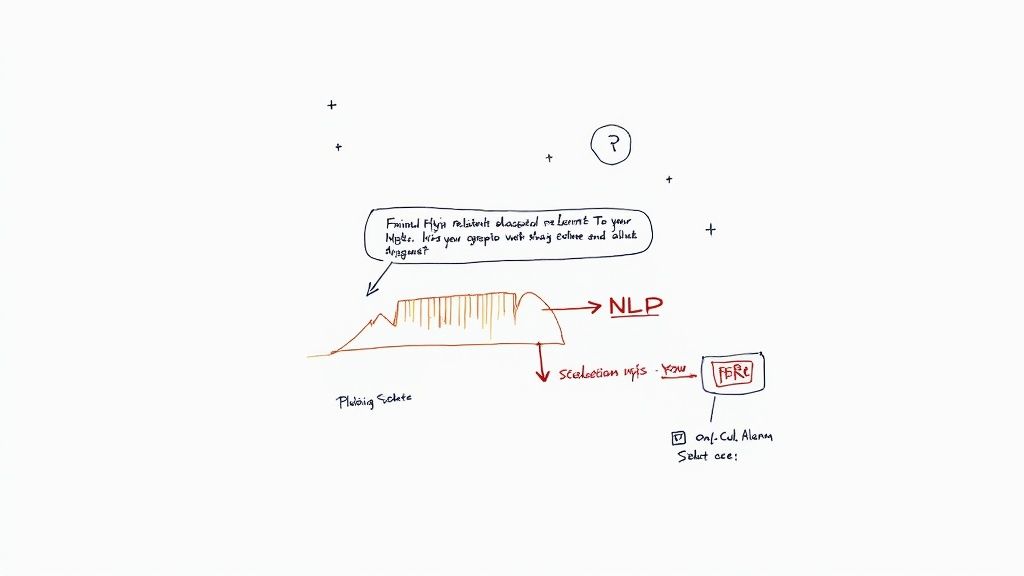
The whole process kicks off with something called Natural Language Processing (NLP). This is the magic that lets the AI read an email or listen to a voicemail and actually get the gist of it. Think of it as a translator, but instead of swapping Spanish for English, it turns messy human language into neat, structured data the system can use.
For instance, when a resident emails, "The tap in my kitchen sink won't stop dripping," NLP doesn’t just see a jumble of words. It spots the key info:
- Topic: "tap," "kitchen sink," "dripping"
- Intent: Report a maintenance issue
- Object: Plumbing fixture
This is how the AI knows it's a maintenance request about plumbing, and not a by-law question or someone asking about the next AGM. If you’re curious about how far this tech has come, it’s worth checking out what ChatGPT predicts about internal communication.
Automated Triage: The Digital Sorting Hat
Once the AI figures out the what, it moves on to the how important. This is automated triage. Just like a nurse in the ER assesses patients as they come in, the AI sorts all incoming messages based on how urgent they are and what they’re about.
It scans the message for certain keywords and context to make the call. A "dripping tap" is clocked as non-urgent, but a message with phrases like "burst pipe" or "water flooding" gets an immediate red flag as a high-priority emergency. This digital sorting hat makes sure nothing critical ever gets buried in a swamped inbox.
The real value of AI triage isn't just sorting emails; it's about creating a predictable, reliable system where the most critical issues always rise to the top, ensuring your team’s attention is directed where it's needed most.
Intelligent Routing: Getting It to the Right Person
The final piece of the puzzle is intelligent routing. Now that the message is understood and categorised, the system decides what to do with it next.
This could mean a few different things:
- Escalating an emergency: It might instantly ping the on-call manager via SMS for something like a fire or major flood.
- Creating a work order: For that non-urgent plumbing job, it could automatically log a work order in your maintenance platform.
- Answering a simple query: It might just fire back a pre-approved answer to a common question, like what day the bins go out.
This whole seamless flow—from understanding to sorting to routing—is what turns a chaotic flood of messages into a clean, organised workflow. It lets your team respond faster, smarter, and with a whole lot less stress.
The Real-World Benefits for Your Strata Agency
Knowing how AI works is one thing, but seeing the real results it can deliver for your agency is what truly counts. Bringing AI-assisted communication into your strata management practice isn't about chasing the latest tech trend. It's a smart, strategic move that delivers clear, measurable wins across your entire operation.
When you boil it down, the benefits stack up into three core areas: huge gains in operational efficiency, serious financial savings, and a standout resident experience that puts your agency head and shoulders above the competition.
Let's unpack what this actually looks like in the day-to-day world of strata management.
Boost Your Operational Efficiency
Every strata manager will tell you that time is their most precious—and scarcest—resource. You know the drill. The endless stream of routine questions, from "What's the Wi-Fi password for the common room?" to "When's the next committee meeting?", slowly chips away at the day. It’s a constant drag, pulling your team away from the high-value work that really matters.
Think of AI-assisted communication as your agency's ultimate gatekeeper. It works around the clock, 24/7, handling all those repetitive, low-level queries on its own. This frees up your skilled managers to get stuck into the complex stuff: resolving disputes, preparing budgets, and overseeing major works projects. It’s a fundamental shift from constantly putting out fires to proactively managing your portfolio, and honestly, it’s a total game-changer for productivity.
This kind of automation creates a much cleaner, more organised workflow where your team's expertise is pointed exactly where it's needed most. You can see how an AI answering service makes this happen by fielding calls and filtering enquiries before they even hit your team's desks.
Realise Significant Financial Savings
The money side of bringing AI into strata management is refreshingly direct and easy to see. By automating your frontline communications, you can slash operational costs in a few key areas, generating a solid return on your investment.
Just think about the cost of a traditional after-hours call centre. They often charge a premium for a service that doesn't have specific knowledge about your buildings. An AI system, on the other hand, handles these calls for a fraction of the price while providing consistent, accurate information anytime.
It goes further than that. Faster, more accurate logging of maintenance issues stops small problems from blowing up into expensive emergency repairs. A resident's vague email about a "small leak" is instantly triaged by the AI, which can prompt them for photos and more details. This leads to a quicker, better-informed response that can prevent thousands of dollars in water damage.
The numbers really speak for themselves. For a mid-sized portfolio, this can easily translate into annual savings of AUD 38,700. This figure breaks down into AUD 19,200 saved from 480 otherwise billable labour hours, AUD 15,000 in avoided emergency repair costs, and AUD 4,500 by getting rid of print and postage for routine notices.
Return on Investment Breakdown: AI vs. Traditional Communication
To put the financial impact into perspective, let's compare a traditional strata management model with an AI-assisted one for a typical mid-sized portfolio. The numbers highlight not just direct cost savings but also the value of reclaimed time and mitigated risks.
| Metric | Traditional Model (Annual Cost/Impact) | AI-Assisted Model (Annual Savings/Impact) |
|---|---|---|
| Admin Labour (Routine Enquiries) | AUD 19,200 (480 hours @ $40/hr) | AUD 19,200 (Hours automated) |
| After-Hours Call Centre | AUD 8,000 – AUD 12,000 | AUD 6,000 – AUD 9,000 (Vs. AI subscription) |
| Emergency Repair Costs | AUD 25,000 (Reactive call-outs) | AUD 15,000 (Proactive triage prevents escalation) |
| Printing & Postage (Notices) | AUD 4,500 | AUD 4,500 (Digital communication) |
| Total Annual Impact | AUD 56,700 – AUD 60,700 (Cost) | AUD 44,700 – AUD 47,700 (Savings) |
This table illustrates a clear financial argument. The investment in AI doesn't just cut costs; it converts operational drains into tangible financial gains, allowing you to re-invest resources into growth and service improvement.
Deliver an Enhanced Resident Experience
Let's face it, people today expect instant answers. Waiting a full 24 hours for a reply to a simple question just doesn't cut it anymore. AI-assisted communication meets this expectation head-on, delivering immediate, genuinely helpful replies anytime, day or night.
This 24/7 availability is huge for building trust and keeping residents happy. They feel heard and looked after, knowing their query has been logged and acknowledged straight away, even if it's 2 AM on a Sunday. This level of service really elevates your agency's reputation and can be a massive differentiator in a crowded market.
By providing instant, consistent, and accurate communication, AI doesn't just solve problems faster—it builds a foundation of trust and reliability between residents and your management agency, turning a transactional relationship into a positive community partnership.
At the end of the day, a better resident experience means fewer complaints, smoother operations, and stronger, more harmonious communities. It's a positive feedback loop that benefits everyone involved—from the individual owner and the strata committee to your own management team.
Everyday AI Use Cases in Strata Management
Abstract ideas are one thing, but the real magic of AI-assisted communication for strata managers happens when you see it in action. This is where the tech stops being just another line item on a budget and becomes a real, hands-on partner that makes life easier for your team and residents alike.
Let's walk through a few common, everyday situations where an AI assistant makes a real, noticeable difference. These aren’t pie-in-the-sky ideas; this is what’s happening in strata agencies across Australia right now.
Taming the Inbox with Intelligent Triage
Picture your agency’s main inbox on a Monday morning. It’s a complete jumble of everything: a resident asking about pet by-laws, another reporting a broken garage door, and a third chasing up a levy notice. A human manager would have to manually read, sort, and forward every single one.
An AI assistant does this in a flash. It scans all incoming messages and instantly figures out what they’re about.
- By-law query: A question about pets gets spotted, and a pre-approved, standard reply with a link to the building’s by-laws is automatically sent back.
- Maintenance request: The broken garage door email is flagged as a non-urgent maintenance issue, and a work order is drafted up, ready for review.
- Finance question: The levy notice enquiry is routed straight to the accounts team without a manager ever having to touch it.
This automated sorting makes sure every message lands in the right place, with the right priority, in seconds. No more digital traffic jams.
Emergency Routing When Every Second Counts
Now, let’s dial up the urgency. A resident sends a panicked message at 10 PM saying, "There's water pouring through my ceiling from the apartment above! It's a burst pipe!" In a typical setup, that email might sit there until morning or get lost in a generic after-hours service.
With AI, the system instantly picks up on keywords like "burst pipe," "pouring," and "flooding." This triggers an immediate emergency protocol.
The AI doesn't just flag the email; it acts. It can instantly fire off an SMS alert to the on-call strata manager and your preferred emergency plumber, complete with the resident's contact details, unit number, and the original message. This cuts through the usual delays and gets a critical incident an immediate response, potentially saving thousands in damages.
Think of an AI assistant as a vigilant 24/7 sentry for your properties. It never sleeps or takes a break, ensuring a genuine emergency is identified and escalated the moment it’s reported, dramatically cutting down risks and response times.
Streamlining Maintenance Requests from Start to Finish
One of the biggest time-sinks in strata is handling maintenance requests. A vague email like "the light is out" kicks off a frustrating game of back-and-forth just to get the basic details.
AI-assisted communication turns this into a smooth, one-and-done process. When a resident reports an issue, the AI acts like an intelligent fact-finder.
For example, if someone reports a broken air conditioner, the AI can be programmed to automatically ask the right follow-up questions:
- "Could you please provide the make and model of the unit?"
- "Can you describe the issue? Is it not turning on, making a strange noise, or not cooling?"
- "To help our technician, could you please upload a photo of the unit and the problem area?"
- "What are the best days and times for a technician to get access to your unit?"
Once all this info is gathered, the AI bundles it into a perfectly detailed work order and sends it off to the right contractor. All the manager has to do is give the final nod. This simple workflow saves countless hours and makes sure tradies show up prepared.
Automating Routine Follow-Ups and Reminders
Finally, think about all the repetitive, predictable messages your team sends out. Reminders for Annual General Meetings (AGMs), chasing overdue levies, or sending out newsletters are all essential but tedious jobs.
An AI system can handle these workflows for you. You can set it up to send personalised AGM reminders via email and SMS to all lot owners 30, 14, and 3 days before the meeting. In the same way, it can automatically send polite but firm payment reminders for overdue levies at set times, tweaking the tone slightly with each message based on your agency's policy.
This frees your team from being calendar-watchers and lets them focus on more important community building. The system does the nagging, so your managers don't have to.
Your Step-by-Step AI Implementation Roadmap
Bringing new tech into the business can feel like a massive job, but breaking it down into a clear, step-by-step plan makes all the difference. Think of this as your roadmap for adding AI-assisted communication into your strata agency—a guide to make the transition smooth and get you real results from day one. It’s about a structured approach, not a blind leap of faith.
The first step has nothing to do with technology. It's all about understanding what's really slowing your agency down. Jumping into a solution without knowing the problem you’re trying to solve is a surefire way to waste time and money.
Assess Your Agency's Pain Points
Before you even glance at a vendor's website, you need to do an honest audit of how you handle communications right now. Where are the biggest bottlenecks? What tasks are eating up your team's time for the least amount of reward? A clear diagnosis is the first step towards an effective cure.
Start by asking your team a few honest questions:
- Which resident enquiries do we get over and over again?
- How many hours a week are we burning just logging and assigning maintenance requests by hand?
- What’s our biggest headache when it comes to after-hours calls?
- Where do the longest delays happen when replying to owners or the committee?
Your answers will build a "pain point profile" that shows you exactly where AI-assisted communication for strata managers can make an immediate difference. This isn't just about being more efficient; it's about spotting the best chances to improve your service and cut down on team burnout.
Evaluate Vendors and Integrations
Once you know what needs fixing, you can start hunting for the right tool. But it’s crucial to remember that not all AI solutions are created equal, and many Australian organisations are still figuring this stuff out. Despite all the buzz, a mere 22% of Australian organisations have a clear strategy for using AI. This reveals a massive opportunity for strata agencies that get it right.
When you're looking at vendors, don't get distracted by flashy features. Focus on how the platform will actually fit into your daily workflow. The most critical question you can ask is, "Does this plug straight into our current software, like Strata Master?" A tool that makes you jump between different systems just creates more work, defeating the whole purpose. A great platform should feel like a natural extension of your existing tools, not some clumsy add-on.
This visual shows how a good AI assistant should work: sorting incoming requests, flagging emergencies, and automating the simple, repetitive jobs.
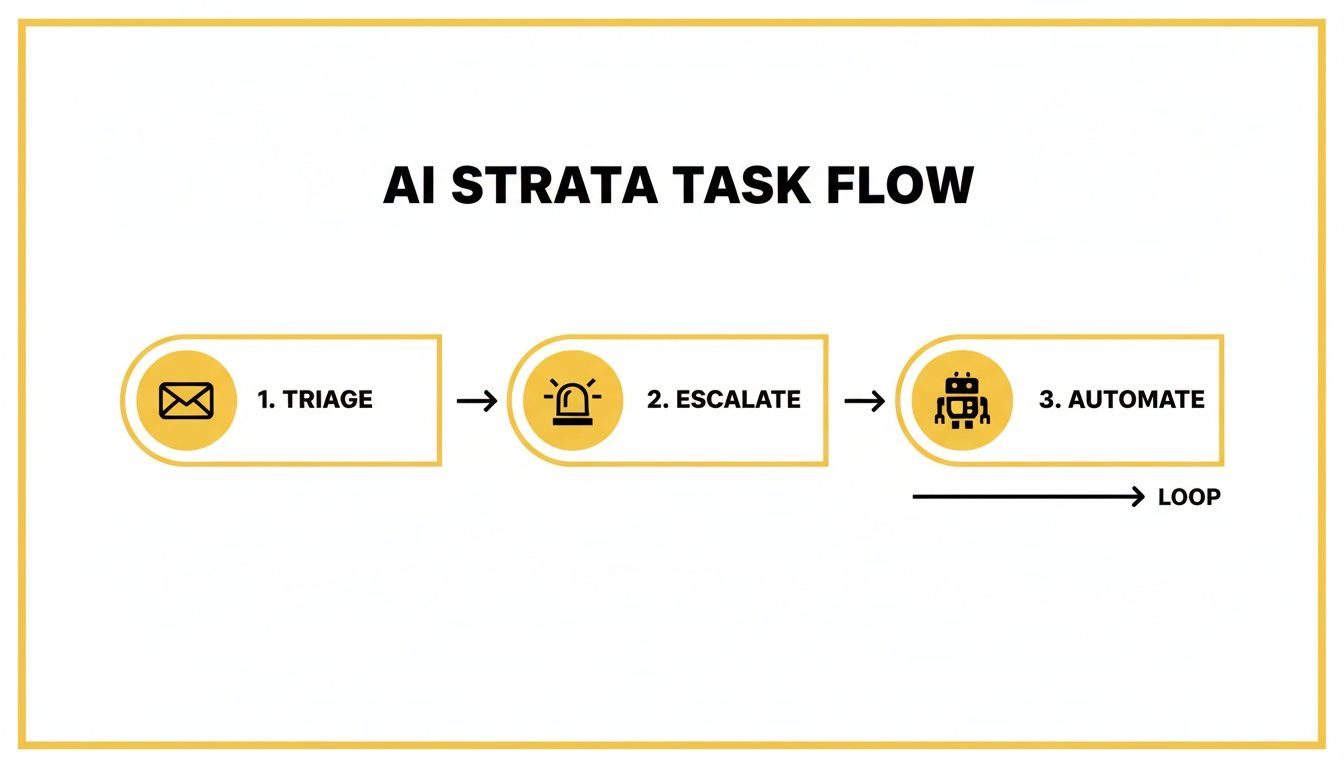
This workflow is all about creating an orderly process out of the daily communication chaos, making sure every message gets to the right place.
Address Data Security and Privacy
In strata, you're handling sensitive resident data all day, every day. That means data security and privacy aren't just important—they're non-negotiable. Any AI vendor you consider has to prove they are serious about protecting information and follow Australian privacy laws, like the Privacy Act 1988.
When you're looking at AI, your first question shouldn't be "What can it do?" It should be "How does it protect our clients' data?" Security needs to be the foundation of your plan, not an afterthought.
Ask potential vendors some direct questions about their security:
- Where is our data stored, and is it encrypted?
- Who can access the communication logs?
- What's in place to stop someone from getting unauthorised access?
Choosing a provider that puts security first builds trust with your clients and protects your agency from some pretty serious legal and reputational risks. You might also find it useful to learn about the bigger picture of strata management automation and how it all fits into a secure system.
Onboard Your Team and Measure Success
Even the most powerful tool is useless if your team doesn’t know how to use it—or worse, doesn't want to. A successful rollout needs a proper onboarding plan and clear communication. You need to frame the AI assistant not as a replacement, but as a new teammate designed to handle all the boring, repetitive tasks nobody likes doing anyway.
Kick things off with hands-on training that uses real-world examples from your "pain point profile." Show your managers exactly how the tool logs maintenance jobs or answers by-law questions automatically, connecting the dots between the tech and their daily frustrations.
Finally, to make sure the investment is worthwhile, you have to measure your success. Set up some clear key performance indicators (KPIs) before you go live.
Key KPIs to Track
- Average Response Time: How quickly are resident enquiries being acknowledged and sorted out?
- Resident Satisfaction Score: Use simple surveys to see if residents feel like they're getting a better, faster service.
- Manager Workload Distribution: Track how much less time your team is spending on admin versus important, strategic work.
- After-Hours Incident Resolution: Monitor how quickly urgent, out-of-hours issues are being handled.
These numbers will give you hard data to show a clear return on investment (ROI), proving that AI isn't just another cost—it's a powerful way to make your strata agency more efficient and ready for growth.
Here is the rewritten section, crafted to sound completely human-written and natural, following the provided style guide and examples.
Future-Proofing Your Strata Management Business
Adopting AI-assisted communication isn’t just about making things a little more efficient; it’s a strategic move to secure your agency’s future. Let’s be honest, resident expectations are changing fast. Instant, digital service is no longer a perk—it’s the new standard for any modern strata business.
As we've covered, this technology delivers real, tangible benefits right now. It slashes administrative workloads and provides a superior, 24/7 service experience. It also directly tackles the burnout that so many strata managers face by automating the repetitive, draining tasks, freeing your team up to focus on the high-value work of community management.
Staying Ahead of the Curve
AI-powered communication is quickly shifting from a nice-to-have to a must-have. Agencies that get on board now will build much more resilient operations, capable of handling growing portfolios without needing to proportionally grow their headcount. This is exactly how you build a scalable, future-ready business.
Putting these tools in place sends a clear message to your clients—both current and prospective—that you’re a forward-thinking agency serious about providing the best possible service. It’s a signal that you value efficiency, transparency, and responsiveness, which are massive differentiators in the Australian strata market.
The goal of AI isn’t to replace the crucial human element of strata management. It's to augment it, giving talented managers the tools they need to be more effective, proactive, and focused on building strong, well-managed communities.
Building a More Resilient Agency
Ultimately, using AI to assist with communication is about building a more robust and client-focused business. It cuts down on the risk of human error, ensures critical after-hours issues are never missed, and genuinely improves team morale by fostering a more manageable work-life balance.
This isn’t some far-off, futuristic concept. The tools are here, and the benefits are clear. Now is the perfect time to explore AI solutions like OnSilent to strengthen your operations. By doing so, you’re not just solving today’s communication headaches—you are actively setting your strata management business up for long-term success.
Got Questions About AI in Strata? We've Got Answers
Bringing any new tech into the fold naturally comes with a few questions. It’s smart to get your head around how AI fits into your agency before you even think about making a move. We've rounded up the most common queries we hear from strata managers and laid out some clear, no-nonsense answers.
Will AI Replace Our Strata Managers?
This is the big one, and the short answer is a definite no.
Think of AI as a hyper-efficient assistant for your team, not a replacement. Its job is to take on the repetitive, time-sucking tasks that tie up your managers' day—things like answering the same five questions over and over or logging basic maintenance requests.
By getting that admin off their plate, your skilled managers are freed up to focus on the stuff humans are actually good at. We're talking about navigating tricky owner disputes, crunching the numbers on budgets, and building genuine relationships with your committees. It's about giving them a leg up, not showing them the door.
How Tricky Is It to Integrate With Our Current Software?
You'll be glad to hear that modern AI platforms are built to play nicely with the tools you're already using. In fact, seamless integration with leading strata management software like Strata Master or PropertyIQ is a non-negotiable feature for any solution worth its salt. The whole point is to create one smooth workflow, not another isolated system to wrangle.
A good provider will make sure the AI tool plugs straight into your current setup.
- CRM Sync: New enquiries and resident details pop up automatically in your central database. No double-handling.
- Maintenance Platforms: Work orders get created and logged without anyone needing to manually type them in.
- Communication Channels: The AI can field emails and calls, feeding every bit of information back into your main system.
This approach means you get a smooth transition without the headache of learning a completely separate, disconnected program.
What Happens If the AI Can't Solve a Problem?
An AI assistant knows its own limits. It’s programmed to handle the predictable, information-based questions it gets a million times a day. But when a resident has a complex, emotional, or just plain weird problem that’s outside its scope, it doesn’t just throw its virtual hands up. It ensures a smooth handover.
The system is designed to spot when a human touch is needed. It’ll seamlessly pass the conversation over to a manager, giving them the full chat history so they can jump in without missing a beat.
This way, residents never feel like they're stuck talking to a wall. They get a lightning-fast answer from the AI for the simple stuff and are efficiently handed over to a real person for anything more complicated.
How Is Our Residents' Data Kept Safe?
Data security is absolutely non-negotiable. In strata, you're dealing with sensitive personal information, and there’s no room for error. Any reputable AI provider in Australia builds their systems to meet strict local laws, including the Privacy Act 1988.
You should expect robust encryption for all data, whether it's being sent or just sitting on a server. Strong access controls are also a must, ensuring only authorised staff can see communication logs. Always go with a vendor who is upfront about their data policies and can show you exactly how they’re committed to protecting your clients' privacy.
Ready to see how an AI assistant can handle your communications without dropping the ball on service? The team at OnSilent can show you how to roll out a secure, efficient solution that actually empowers your strata managers. Find out more at https://onsilent.com.