

An AI assistant for strata managers Australia is like having a digital receptionist who’s always on, 24/7. It’s a smart system built to answer calls, sort out tasks, and manage the constant flow of communication for you. The whole idea is to soak up that relentless pressure from incoming queries, freeing you up to focus on the proactive, high-value work instead of just putting out fires all day.
The Unspoken Reality of Modern Strata Management
The phone rings. It’s a tenant reporting a minor leak. Before you can even finish that call, another one comes through—an owner with a question about their quarterly levy notice. At the same time, an email pops up from a contractor who needs access to the building. Sound familiar? This is the daily reality for a strata manager in Australia: a non-stop juggling act of urgent demands.

Every single phone call, voicemail, and email represents a job that needs doing, but the sheer volume of it all creates a constant state of interruption. In this kind of environment, finding the time to knuckle down and focus on the big-picture responsibilities feels almost impossible.
The Friction Between Urgent and Important
Here’s the core of the problem: the constant tug-of-war between what feels urgent and what’s actually important. Answering a call about a noisy neighbour is urgent, no doubt. But preparing a detailed, accurate budget for the upcoming Annual General Meeting is important. Too often, the tyranny of the urgent wins, and that crucial strategic work gets shoved to the back of the queue.
This reactive cycle has some serious consequences:
- Administrative Backlogs: Paperwork, compliance checks, and financial reporting start to pile up, which can lead to missed deadlines and a whole lot of stress.
- Declining Service Quality: When you’re spread too thin, following up with people suffers. Owners and residents can start to feel neglected or like they’re not being heard.
- Professional Burnout: The mental exhaustion from constantly switching tasks and trying to manage competing priorities is a massive contributor to burnout in our industry.
This cycle of reactivity isn't a sign of bad management; it's a structural problem. It’s born from outdated communication workflows. The old-school model of one person handling everything just doesn't scale for the demands strata professionals face today.
A Strategic Solution to Communication Overload
This is exactly where an AI assistant comes in. It’s specifically designed to absorb this pressure. Think of it as an intelligent filter that handles the high volume of routine chats so you and your team don’t have to. It can log a maintenance request, answer a common question, or schedule a callback, all without needing a human to step in.
This isn't about replacing people—it's about making them more effective. By automating that first line of communication, an AI assistant for strata managers Australia gives your team the power to reclaim their day. It creates the breathing room you need to shift from being reactive to proactive, letting you focus on what really matters: building community, managing assets properly, and delivering genuinely exceptional service.
For a deeper dive into how this kind of tech is changing the game, check out this guide on AI adoption for property management.
How an AI Assistant Actually Works for Strata
So, what exactly is an AI assistant, and how does it actually work in a busy strata office? Let's break it down.
Forget the science fiction stuff. Think of it as a super-smart digital team member who already knows your portfolio inside and out and is on duty 24/7. It’s your new first line of defence, built to handle the constant flood of calls and emails that bog your team down.
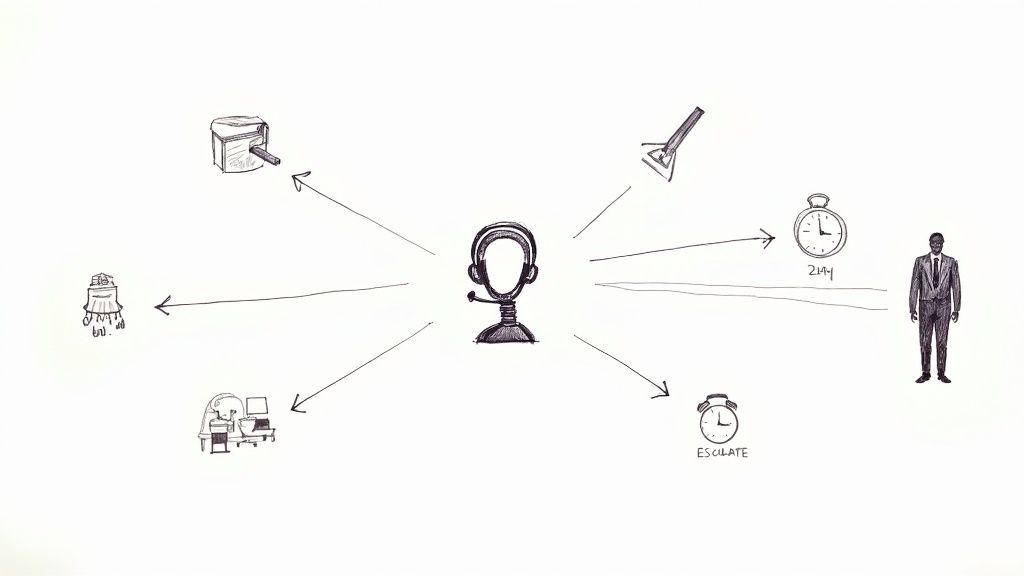
The secret sauce behind this is a technology called Natural Language Processing (NLP). In simple terms, NLP is the AI's ability to listen and understand. It lets the system hear a caller's words, figure out what they really mean, and then decide what to do next—just like an experienced strata assistant would.
Understanding What Callers Really Want
This is where it gets clever. NLP allows the AI to tell the difference between two calls that might sound similar but are worlds apart in urgency. It knows "the water is off in the building" is probably a scheduled maintenance notice, while "water is pouring through my ceiling!" is a code-red emergency.
How? The system has been trained on thousands of real-world conversations from property and strata management. This training helps it pick up on keywords, tone of voice, and subtle phrases that signal urgency. It’s not just listening; it’s comprehending.
This leads to its most important job: triage.
- Urgent Stuff: A call about a burst pipe or someone stuck in a lift is immediately flagged as high priority. The AI follows your custom rules, like instantly calling your go-to emergency plumber and sending an SMS alert to the on-call manager.
- Everyday Questions: Someone wants to know when the bins go out or how to order a new key fob. The AI sees this as a standard request, answers it on the spot using its knowledge base, or logs a ticket for your team to handle during business hours.
- The Tricky Ones: An owner calls with a complex by-law complaint. The AI knows this needs a human touch. Instead of trying to solve it, it captures all the details, creates a comprehensive job ticket, and assigns it to the right manager.
At its heart, an AI assistant is a filter. It sorts, categorises, and directs every call and voicemail, ensuring emergencies get an immediate response while routine tasks are handled without interrupting your team's focus.
Putting the Workflow on Autopilot
Once a call is sorted, the AI assistant plugs directly into your daily operations. It doesn’t just answer the phone—it takes the next step. Every conversation is automatically logged in your strata software, creating a perfect, time-stamped record without anyone lifting a finger.
This automated process means nothing slips through the cracks. Voicemails are transcribed and tagged, missed calls are logged with a clear action item, and every communication is accounted for. That chaotic inbox and endless list of voicemails? They become a neatly organised queue of tasks.
For a broader look at how this technology is being applied, checking out the various AI use cases in property management can give you a great sense of what’s possible.
To truly appreciate the difference, let’s look at a typical day in a strata office, both with and without an AI assistant on the team.
A Day in Strata With and Without an AI Assistant
| Scenario | Traditional Manual Workflow | AI-Assisted Workflow |
|---|---|---|
| Morning Rush | The phone rings off the hook. Two managers are tied up with minor queries while an urgent leak voicemail sits unheard. | The AI assistant answers all calls, handling routine questions instantly. It flags the urgent leak, transcribes the voicemail, and sends an alert to the maintenance manager. |
| Contractor Coordination | A manager spends 30 minutes on the phone with a plumber, trying to explain a non-urgent job and find a time to grant access. | The AI logs the job and automatically sends the plumber a work order with all details, including access instructions and contact info, based on pre-set rules. |
| After-Hours Emergency | An owner calls at 10 PM about a stuck garage door. The call goes to a generic answering service, which takes a message. The manager sees it the next morning. | The AI answers the call, understands it's an urgent access issue, and immediately dispatches the on-call technician according to the building's emergency protocol. |
| Follow-Up & Admin | The team spends the last hour of the day manually entering call notes into the system, trying to remember details from earlier conversations. | All calls, transcriptions, and actions taken by the AI are already logged in the strata software. The team simply reviews a clean, organised task list. |
As the table shows, it's not just about answering calls. It's about reclaiming countless hours and making sure the team is always focused on the work that truly matters.
Calculating the Real ROI of Strata AI
Sure, understanding how an AI assistant works is one thing. But seeing the real-world impact it has on your agency’s bottom line? That’s what actually matters.
An AI assistant isn't just some clever bit of tech; it’s a financial asset that delivers a serious return on investment (ROI). For a busy Australian strata agency, this return isn't just about vague "efficiencies"—it's measured in three critical ways: recovered time, direct cost savings, and better service quality.
When you start to break down the numbers, the value becomes crystal clear. We're talking about measurable gains that make for a healthier, more profitable business.
Quantifying Recovered Time and Human Hours
The most immediate return you’ll see is in time. Just think about the hundreds of routine calls a strata manager deals with every week—the same old questions about levy payments, requests for key fobs, or reports of non-urgent maintenance. Each call might only take five minutes, but they add up, chipping away at your team's most valuable resource.
An AI assistant for strata managers in Australia can handle a massive chunk of these calls without anyone needing to lift a finger. Let's do some quick back-of-the-napkin maths:
- Average Calls Per Day: A small to medium strata agency could easily get 50+ calls a day.
- Time Per Call: Let's say the average chat, including logging the details afterwards, takes about 6 minutes.
- AI Handling Rate: If an AI assistant successfully handles just 60% of these calls, that’s 30 calls off your team's plate, every day.
That simple calculation works out to 180 minutes, or three full hours, recovered every single day. That’s 15 hours a week of skilled staff time that can be shifted from repetitive admin to high-value, proactive management.
Reducing Costs by Preventing Escalations
Beyond just saving time, an AI assistant gives you a direct financial return by stopping small problems from turning into expensive disasters. You know how it is in strata—the speed of response to a maintenance issue can be the difference between a quick fix and a massive insurance claim.
A voicemail about a small water leak that isn't heard until the next morning can easily become thousands of dollars in water damage repairs.
The AI's ability to triage issues 24/7 is a genuine game-changer. It instantly picks up on keywords like "leak," "burst," or "flood" and follows your emergency protocol on the spot, getting the right contractor on the job in minutes, not hours.
This instant triage is a powerful risk mitigation tool. It turns your phone system from a passive message-taker into an active, 24/7 building guardian, protecting the assets you manage and saving the owners corporation a fortune on emergency call-outs and damage repairs.
Boosting Service Quality and Owner Retention
Finally, the ROI isn't just about the hard numbers. It's also about service quality, which is just as crucial. In a competitive market, keeping owners happy and loyal is everything. Missed calls and slow response times are the number one cause of frustration and can be the final straw that makes a committee look elsewhere.
An AI assistant guarantees every single call is answered, every concern is logged, and every owner feels heard—day or night. This 24/7 responsiveness drastically improves the resident experience, building trust and reinforcing the value your agency provides.
Better service leads to happier committees, positive word-of-mouth, and a more stable client book. Our guide on strata management automation dives deeper into how these operational tweaks directly boost client satisfaction.
At the end of the day, bringing in an AI assistant allows strata managers to automate the grind of repetitive tasks, which can add up to some impressive annual savings. Studies have shown this can reach up to AUD 38,700 from slashing administrative labour and cutting down on emergency repair costs. You can find more insights on AI for body corporate managers and its financial benefits.
Meeting Australian Privacy and Compliance Standards
Bringing any new tech into your strata business, especially one that handles phone calls and messages, is bound to raise questions about privacy and your legal duties. When you’re looking at an AI assistant, getting the compliance right isn’t just about ticking boxes—it's about keeping the trust you've built with owners and committees.
The main piece of legislation to know is the Privacy Act 1988. It's the rulebook for how personal information is collected, used, and kept safe in Australia. Any AI tool that records calls or turns voicemails into text is handling personal data—names, phone numbers, and sometimes the very sensitive details of a resident's problem. Compliance is absolutely non-negotiable.
This means the AI partner you choose must have a rock-solid understanding of Australian law. Their entire system for handling data has to line up with the Australian Privacy Principles (APPs). We're talking about more than just a privacy policy on a website; it’s about having a proper framework for data security and getting resident consent.
Navigating Key Legislation
While the Privacy Act is the big one, a couple of other rules also pop up. For strata managers, knowing your obligations here is key to using AI responsibly.
- The Spam Act 2003: If your AI assistant helps with sending messages, like SMS reminders for an upcoming AGM, you have to follow the rules. That means getting consent and giving people an easy way to opt out.
- State-Specific Surveillance Laws: The rules around recording phone calls can be different from state to state. It's vital to make sure your AI system’s process for notifying people about call recording meets the specific rules for every state you operate in.
All these regulations point to one crucial thing: transparency. Owners and residents need to be told upfront that their call might be handled and recorded by an AI system. A simple, clear message at the start of the call is usually all it takes. And as you work on improving your communications, our guide on AGM scheduling for strata and body corporate has some great tips for keeping your meeting notices compliant, too.
Your Due Diligence Checklist
Picking the right AI provider is the most important step you'll take to stay compliant. They aren't all the same, so you need to do your homework. Concerns about data security are common; in fact, about a third of Australian organisations see data loss from AI tools as a major risk. That's a pretty big deal when you're handling sensitive strata information. You can dig deeper into what Australian firms are saying about AI adoption to see the bigger picture.
When you're checking out a potential AI partner, look for one that treats Australian privacy law as a core part of its design, not just an add-on. Their commitment to data security shows how much they respect your clients and your business.
Use this checklist to size up any potential vendors:
- Onshore Data Storage: Ask them flat out: where is the data stored? You should insist on a provider that keeps everything—call recordings, transcripts, all of it—on servers located within Australia. This is the single biggest factor for staying compliant with the Privacy Act.
- Transparent Privacy Policy: Can you easily find and understand their privacy policy? If it’s full of confusing jargon, walk away. You need a provider who is crystal clear about how they handle data.
- Data Encryption: Is all the data encrypted, both when it's being sent and when it's stored? This is a basic security standard that keeps resident information safe from prying eyes.
- Access Controls: Who can get into the data? The platform must give you strong controls to limit access to sensitive information, ensuring only authorised people in your agency can see it.
A Practical Guide to Rolling Out Your AI Assistant
So, you're ready to bring an AI assistant into your strata management agency. Good move. But this isn't about just flipping a switch and hoping for the best. It's a planned transition, broken down into clear, manageable stages to give your team the tools they need without disrupting your workflow.
The journey starts with a simple audit of your current communication headaches. Before you can find the right solution, you need to know exactly what problems you're trying to solve. Is your team drowning in after-hours calls? Are routine maintenance requests tying up your senior managers?
Nailing down these specific bottlenecks helps you set clear goals for what you want the AI to achieve. This clarity is crucial for picking the right partner and, just as importantly, for measuring your success down the track. While everyone talks about AI, a shocking 22% of Australian firms report having a visible strategy for it. This shows a massive opportunity is being missed, especially in the practical world of strata.
Choosing the Right AI Partner
Once you know what you need, the next step is finding an AI provider that fits your agency like a glove. The single most important factor here? Integration. An AI assistant for strata managers in Australia has to talk seamlessly with the tools you already rely on every single day.
Look for a partner with proven, ready-to-go integrations for key Australian strata management platforms. This is non-negotiable if you want a truly efficient setup.
- Property Management Software: Your AI needs to log calls, create tasks, and pull up property info directly within systems like MRI Strata Master or PropertyIQ. No manual data entry.
- Existing Phone Systems: The solution has to work with your current phone setup, routing calls correctly without needing a team of IT wizards to make it happen.
- Email and Calendars: Integration with tools like Outlook or Google Workspace is a must, so follow-up actions and scheduled callbacks are automatically synced.
The Training and Rollout Phase
After you’ve picked a partner, it's time for the 'training' phase. Think of it like onboarding a new team member. This is where you customise the AI to understand the specific rules and quirks of your portfolio.
You’ll feed it key information, such as:
- Building-Specific Rules: All the details on pet policies, parking regulations, and common area use for each building you manage.
- Preferred Contractor Lists: Your go-to plumbers, electricians, and locksmiths for different types of maintenance jobs.
- Emergency Protocols: Step-by-step instructions for how the AI should handle urgent situations, from burst pipes to lift breakdowns.
This customisation is what ensures the AI responds accurately and consistently, upholding your agency's professional standards. It can work hand-in-hand with other powerful software for strata managers to create a seriously efficient operation.
Pro Tip: A phased rollout is your best bet for a smooth transition. Start by activating the AI on a small handful of properties or just for after-hours calls. This gives your team a chance to get comfortable with the new workflow and lets you fine-tune the AI's responses based on real-world calls.
This simple flow should guide how you choose a vendor and get things up and running.
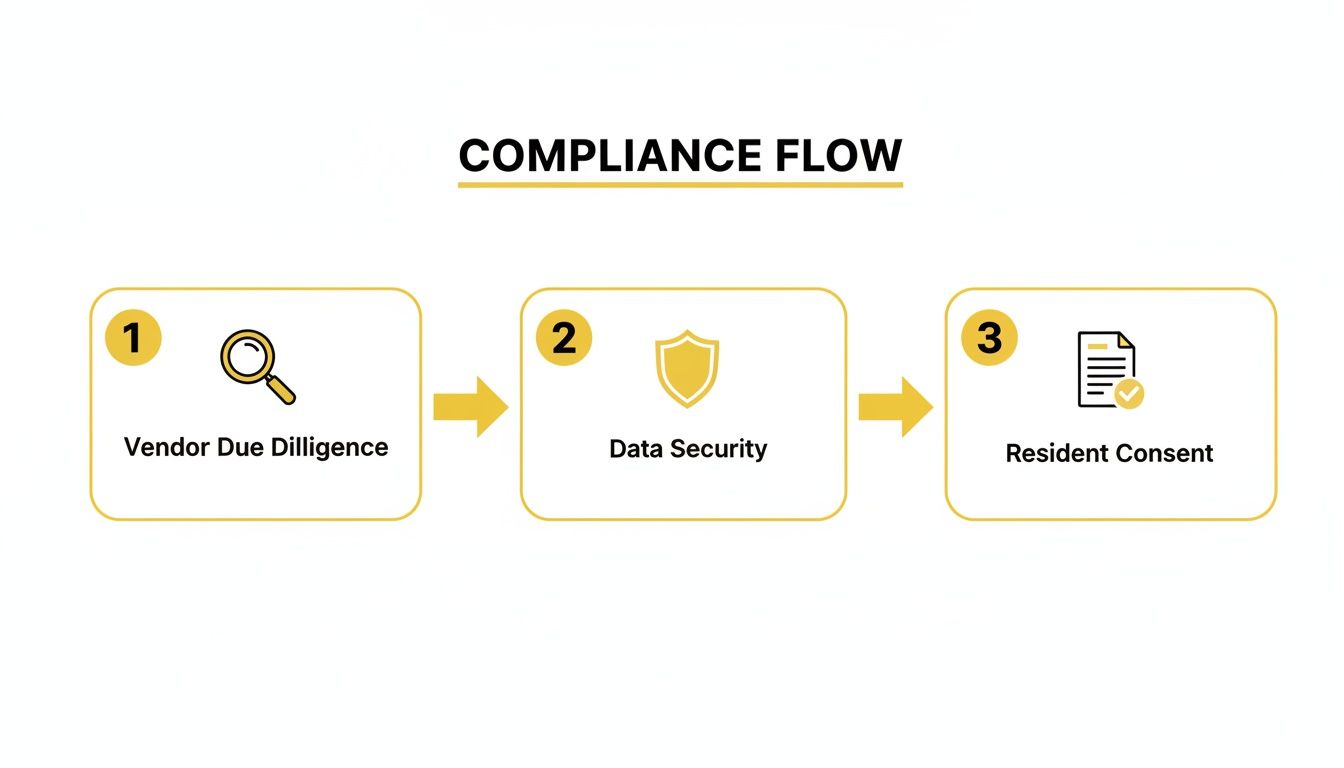
By focusing on proper vendor checks, data security, and getting resident consent sorted, you're setting yourself up for a compliant and successful launch from day one.
Here's the rewritten section, crafted to sound like an experienced human expert in strata management technology.
How to Measure the Success of Your AI Investment
Putting an AI assistant in place is one thing, but proving it was the right move is another. To really justify the investment, you need to go beyond just feeling less busy and get into the hard data. Tracking the right Key Performance Indicators (KPIs) gives you the concrete proof you need to show exactly how an AI assistant for strata managers in Australia is improving your operations, your bottom line, and your service quality.
This isn't about getting tangled up in complex analytics. It's about measuring real, tangible changes in your daily grind. The right metrics will show you precisely where the AI is delivering the goods and help you tweak its performance as you go.
Operational Efficiency Metrics
The first place you'll see a massive difference is in your team's day-to-day efficiency. These KPIs are all about tracking the time you get back and the workload you offload, which directly impacts your team’s capacity to focus on what matters.
Kick things off by tracking these core metrics:
- Reduction in Average Call Wait Times: How long does it take for a caller to get through? A huge drop here is a clear sign the AI is handling the call volume, stopping people from getting frustrated and hanging up.
- Decrease in Voicemail Backlog: Count how many voicemails are left unheard at the end of each day. When that number consistently hits zero (or close to it), you know the AI is nailing its job of transcribing and creating tasks from messages that used to pile up for days.
- Time to First Response: For non-urgent stuff, how long does it take for an issue to get logged and acknowledged? The AI’s instant logging should slash this time, making owners feel heard immediately.
These numbers prove your AI is successfully soaking up the constant flood of calls and messages, freeing your team from the relentless tyranny of the ringing phone.
An AI assistant isn't just another line item on your expenses; it's a productivity multiplier. The hours it claws back are hours your skilled managers can pour into proactive work—things like budget forecasting, compliance checks, and building stronger committee relationships. That’s the stuff that actually grows the business and keeps clients happy.
Financial and Service Quality KPIs
Beyond just saving time, your AI needs to deliver a real financial and service-level punch. These KPIs connect the dots between the tech and your bank account, proving its value to stakeholders, committees, and anyone questioning the investment.
Here are the key financial and service metrics you should be watching:
-
Percentage of Issues Resolved Without Human Intervention: You need to track how many calls—like simple by-law questions or logging a maintenance request—are fully sorted by the AI without a human ever touching them. A high percentage here, especially after hours, directly cuts down your labour costs. Aiming for 70-80% of routine queries to be handled by the AI is a fantastic benchmark to shoot for.
-
Reduction in Emergency Call-Out Fees: Take a good, hard look at your contractor invoices. If you see a noticeable drop in those pricey after-hours or emergency call-out fees, you know the AI's instant triage is working. It’s stopping minor issues from blowing up into full-blown, expensive crises.
-
Improvement in Owner Satisfaction Survey Results: This is the ultimate test. Before you implement the AI, run a survey asking owners about their communication experience. Do it again a few months later. A measurable jump in those satisfaction scores is powerful, undeniable proof that the 24/7 availability and instant responses are making a real difference to the people who matter most.
Common Questions About AI in Strata Management
Adopting any new bit of tech is bound to come with a few questions, and it’s smart to do your homework. When Aussie strata managers start looking into an AI assistant, a few common worries tend to pop up again and again. Getting straight answers is the only way to make a confident call for your agency, your team, and the committees you look after.
Let's tackle these questions head-on. No tech jargon, just practical answers about what this change really means for your day-to-day grind.
Will an AI Assistant Make Our Strata Administrators Redundant?
This is usually the first question on everyone's mind, and thankfully, the answer is a simple and resounding no. The whole point of an AI assistant for strata managers in Australia is to empower your team, not replace them. It’s a tool designed to take the high-volume, mind-numbing tasks off their plate – the stuff that leads to burnout.
Think about all those calls about bin collection days or the same by-law question that gets asked a dozen times before morning tea. The AI handles that. This frees up your skilled administrators to focus on the work that actually needs a human brain: things like mediating a complex dispute, forecasting a tricky budget, or building real, personal relationships with your committees.
It’s all about filtering out the noise so your best people can do their best work.
How Does the AI Handle an Angry or Distressed Owner?
A well-built AI knows its limits. It’s been trained to pick up on specific keywords, changes in tone, and the kind of language that signals a caller is upset, angry, or dealing with something sensitive.
When it detects a situation like this, its number one job is to escalate immediately.
An AI’s role in a crisis isn’t to solve the problem—it’s to get the call to an empathetic human as fast as humanly possible. It intelligently routes the call to the right manager, often with a quick text summary so your team member knows exactly what they’re walking into.
This ensures that the really tough, emotional situations always get the nuance and expertise only a person can provide, while the AI successfully filters out the huge volume of routine calls.
What Does a Typical Implementation and Cost Look Like?
Getting started is usually a lot quicker and less painful than managers expect. A typical setup can have an AI assistant up and running in just a few weeks, not months. The first step involves connecting the system to your current phone and property management platforms and then "training" it on your portfolio’s specific rules, preferred contractors, and emergency plans.
When it comes to cost, most Aussie providers work on a flexible subscription model, often called Software as a Service (SaaS).
This way of doing things has a few big upsides:
- Operating Expense: The cost is a predictable monthly fee, usually based on the number of buildings or lots. This makes it a simple operating expense, not a massive upfront capital investment you have to save for.
- Scalability: You only pay for what you’re using. As your portfolio grows or changes, the service can easily scale up or down with you.
- Total Value: It’s easy to just look at the monthly price tag, but it’s crucial to weigh up the total value. Look for things like local Australian support, help with integration, and ongoing training for your team.
Ready to see how an AI assistant can reclaim hours in your day and transform your service quality? OnSilent provides a purpose-built solution that handles the calls, filters the noise, and lets you focus on what truly matters.
Discover how OnSilent can work for your strata agency today.