

Think of an AI assistant for body corporate management as a specialised software tool designed to take the repetitive admin, finance, and communication tasks off a strata manager's plate. It’s like having a dedicated digital team member working 24/7 to handle routine enquiries, process paperwork, and keep an eye on important deadlines. This frees up the human managers to focus on the more complex, strategic parts of their job.
The End of Administrative Overload in Strata Management
Is your team drowning in a sea of admin? The daily grind of strata management is often a relentless cycle of chasing levy payments, answering the same resident questions over and over, and making sure every single compliance detail is tracked perfectly. This constant pressure, mixed with rising operational costs and tricky legislative demands, leaves very little time for strategic planning or actually engaging with owners.
For years, these headaches were just considered part of the job. But that's changing. An AI assistant for body corporate management isn’t some futuristic fantasy anymore; it's a practical, here-and-now solution built to tackle these exact pain points.
Meet Your New Digital Team Member
Imagine a hyper-efficient team member who never sleeps, never takes a holiday, and never makes a data entry error. That's the heart of what an AI assistant does in a strata context. It’s not about replacing skilled managers. It's about giving them superpowers by taking the most time-consuming, repetitive work off their hands.
This digital assistant can:
- Handle Routine Communications: Instantly answer common resident questions via phone or email about things like levy due dates, bin collection schedules, or how to access common areas.
- Automate Financial Admin: Send out automated levy reminders, track arrears, and process supplier invoices without a human needing to touch them.
- Manage Compliance Deadlines: Keep track of schedules for critical tasks like fire safety inspections or lift maintenance, sending alerts so nothing costly gets missed.
By automating these high-volume tasks, the AI assistant creates the breathing room your team needs to focus on what really matters—building strong community relationships and providing high-value, strategic advice to the body corporate committee.
The real power of an AI assistant is its ability to transform a manager's role from reactive problem-solver to proactive community leader. By automating the noise, it amplifies the impact of human expertise.
Unlocking Efficiency with Intelligent Automation
A key piece of the puzzle here is automation. Technologies like Intelligent Document Processing (IDP) are a game-changer. It's a crucial AI-powered automation that helps you understand how AI can pull information from documents and slash admin overload. Instead of someone manually reading and typing in data from invoices or forms, the AI does it instantly and with pinpoint accuracy.
This guide will dive into how this technology is fundamentally reshaping strata management for the better, right across Australia. We’ll look at detailed use cases with platforms like OnSilent, which offers advanced AI call management solutions, and walk through implementation steps and privacy considerations. We're here to show you how an AI assistant can become your firm’s most valuable asset. The era of administrative overload is over.

How Does AI Actually Work in Body Corporate Management?
Let's be clear: an AI assistant isn't some kind of magic wand. It’s a highly specialised system, trained to tackle specific, high-volume tasks with incredible speed and accuracy. Think of it less like a thinking robot and more like a hyper-focused digital specialist on your team. This specialist has a very clear set of instructions and access to just the right information, letting it handle the predictable, repetitive jobs that currently bog down strata managers.
Instead of trying to understand everything, an AI assistant for body corporate management is trained on a narrow, relevant set of skills. These core functions are designed to automate the most time-consuming parts of the job, acting as a force multiplier for your human team.
Breaking Down the Core Functions
When you look at what these AI assistants do, their work really boils down to three key areas. Each one directly targets a common bottleneck in the day-to-day grind of strata operations.
- Automating Resident Communications: The assistant can field a massive volume of common enquiries that flood your phone lines and inbox. We're talking about all those questions about levy payments, access to common facilities, or how to lodge a maintenance request.
- Smoothing Out Financial Admin: It can automatically send out levy reminders, follow up on arrears based on rules you've set, and even process supplier invoices by pulling out the key data. This slashes manual data entry and frees up your finance people for more important work.
- Managing Compliance and Maintenance: The AI keeps an eye on crucial deadlines for things like fire safety inspections or lift servicing. It can automatically generate work orders for scheduled maintenance and send timely alerts to managers, preventing those costly oversights that keep you up at night.
This is all about tackling the biggest headaches in strata management head-on.
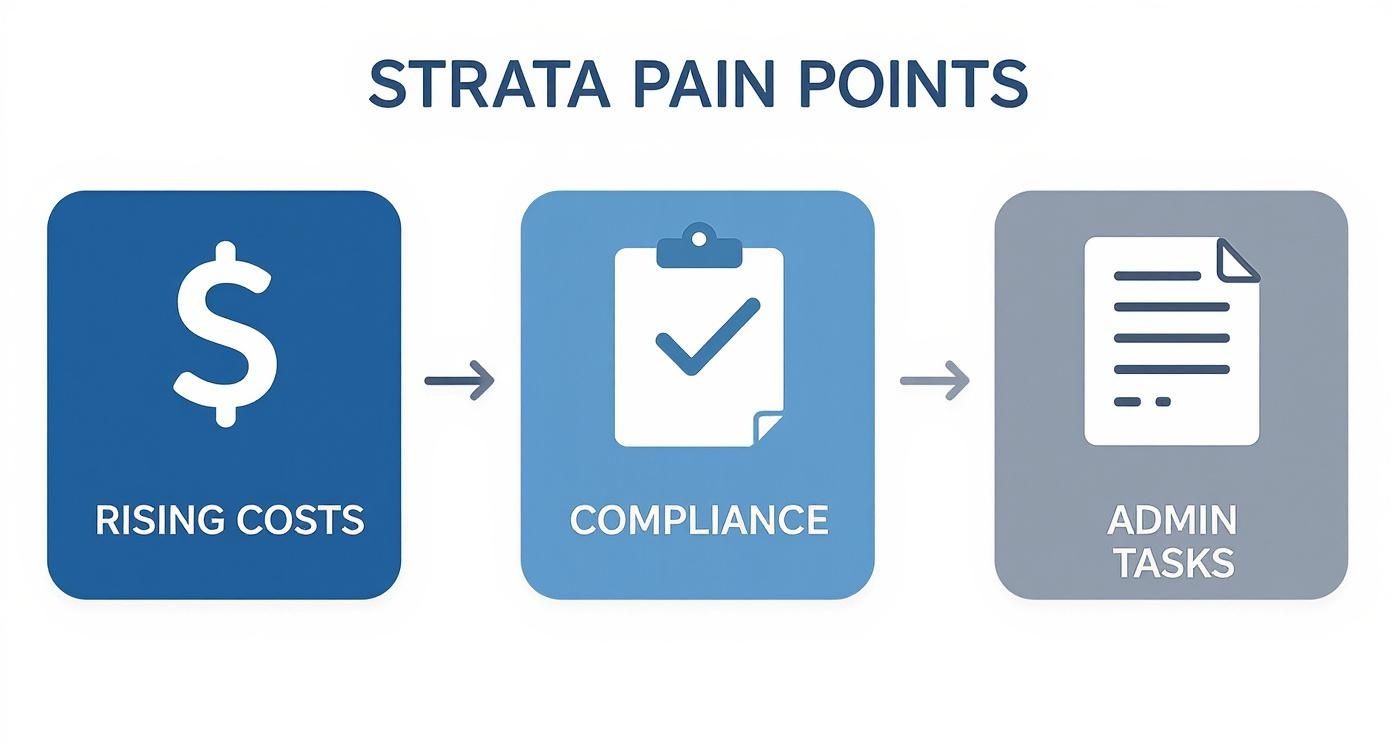
As you can see, rising costs, tricky compliance rules, and the never-ending pile of admin are the three core pressures that AI automation is built to relieve.
The Big Shift: From Manual Grind to Automated Flow
The real difference hits home when you compare the old way of doing things with an AI-assisted workflow. Manually handling every task isn't just slow; it's also wide open to human error, especially when your team is stretched thin. Automation brings a level of consistency and reliability that’s tough to match.
This isn't just a theory; it's a trend sweeping across the Australian body corporate sector. In fact, over 60% of new strata buildings in Melbourne now use some form of smart technology to automate tasks like maintenance scheduling and resident communication. The push for smarter, more efficient operations is happening right now. You can get more details on these forward-thinking trends in this report on Melbourne's body corporate sector.
To really see the difference, have a look at the table below. It shows the stark contrast in efficiency between the old manual grind and the new AI-powered approach.
Manual Strata Tasks vs AI-Assisted Workflows
| Task | Traditional Manual Process | AI-Assisted Process |
|---|---|---|
| Resident Enquiry | Manager gets a call, finds the info, and calls back. This can take 5-10 minutes per call, easily. | AI answers instantly, pulls info from the database, and provides an answer in seconds. |
| Arrears Follow-Up | Admin staff have to manually check records, then draft and send out individual reminder emails. | AI automatically spots overdue accounts and sends out scheduled, polite reminders without anyone lifting a finger. |
| Invoice Processing | Someone has to manually type in all the invoice details from a PDF into the accounting software. | AI scans the invoice, grabs all the important data, and automatically populates the system. Done. |
By taking over these rule-based tasks, the AI doesn't just shave off a few minutes here and there. It fundamentally reshapes a strata manager's workday. It shifts their focus from being a clerk to being a strategic advisor and a community leader.
Ultimately, the goal is to create a seamless operation where technology handles the predictable stuff, and your people handle the exceptional situations that require a human touch. This partnership allows a strata management firm to grow its portfolio without having to proportionally grow its admin headcount, locking in both profitability and top-tier service. It turns the strata manager role into something more strategic, more fulfilling, and far more valuable to the committees and owners you serve.
The Real-World Benefits Driving AI in Australian Strata
Bringing an AI assistant for body corporate management on board isn't just about looking modern; it's a smart, strategic move to tackle the real pressures facing the Australian strata industry right now. With operational costs climbing and compliance getting more complex by the day, firms are looking for better ways to work. AI offers clear, measurable benefits that hit these challenges head-on.
The case for AI isn't some fluffy, futuristic idea. It’s built on three solid pillars of value. Each one directly solves a common pain point, turning the daily grind into a chance to grow and offer better service. Frankly, making this shift is becoming essential just to stay afloat and competitive.
Driving Down Operational Costs
One of the first things you'll notice is a big drop in administrative overhead. Let's be honest, repetitive tasks are the bread and butter of strata management, but they also suck up a huge amount of time and resources. Manually entering data, chasing up levy payments, and processing supplier invoices chew through staff hours that could be put to much better use.
An AI assistant takes over these workflows with perfect accuracy. Picture this: an invoice lands in your inbox. Instead of someone having to open it, read it, and punch the details into your accounting software, the AI just does it. Instantly. This automation adds up to real savings in a few ways:
- Fewer Labour Hours: By automating routine financial and admin jobs, you slash the hours spent on manual grunt work. For a standard strata firm, this can easily free up hundreds of hours every year.
- More Capacity: Your current team can suddenly manage a larger property portfolio without needing to hire more admin staff, which directly boosts profitability.
- Less Costly Errors: Automation gets rid of the human errors that creep into data entry or payment processing, saving you both the time and money it takes to fix them.
This newfound efficiency means you can point your most valuable asset—your people—towards high-value work like strategic planning and building stronger client relationships.
Strengthening Compliance and Risk Management
Keeping on top of compliance is a massive, high-stakes part of the job. Miss a crucial deadline for a fire safety inspection or slip up on Australian privacy laws, and you could be facing hefty fines and serious damage to your reputation. The old way of doing things, relying on spreadsheets and manual reminders, is just too prone to human error.
An AI assistant acts like a tireless compliance watchdog, systematically tracking key dates and legal requirements. It can automatically flag an upcoming inspection, generate a work order for scheduled maintenance, and keep a clean audit trail of every conversation and action taken. It’s a proactive approach that dramatically cuts down your risk.
By turning compliance from a manual checklist into an automated, proactive system, an AI assistant provides a rock-solid safety net. It makes sure nothing critical ever slips through the cracks, protecting both the strata firm and the body corporate.
This systematic process doesn't just prevent expensive fines; it gives you peace of mind. It creates a framework of accountability where everything is logged and auditable—something that’s invaluable when you're in a dispute or a committee meeting. As Australia's regulations keep changing, having a system that can adapt and enforce the rules is a huge advantage. You can see how Australian organisations are gearing up for this AI-driven future by checking out what bodies like the National AI Centre are doing.
Elevating Resident and Owner Satisfaction
In a service industry like strata, the resident experience is everything. But managers are often so swamped with admin that they can't provide the quick, consistent communication owners have come to expect. Answering the same questions about bin day or visitor parking over and over leaves little time for the conversations that really matter.
An AI assistant completely changes this dynamic by offering instant, 24/7 support. When a resident has a question after hours, they get an immediate, helpful answer instead of an old-school answering machine. That instant response seriously improves satisfaction and cuts down on frustration.
For instance, a resident can report a non-urgent maintenance issue at 10 PM and get an instant confirmation that their request is logged, all without a human lifting a finger. This kind of service builds trust and makes residents feel heard, which ultimately leads to happier owners and a stronger reputation for your community.
Putting AI to Work: A Real-World Scenario
Theory is great, but let's see how an AI assistant for body corporate management actually performs when the rubber meets the road. The best way to get it is to walk through a classic, everyday situation that gives strata managers a headache.
Picture this: It's 10 PM on a Tuesday. A resident spots a flickering light in a common hallway. It's not an emergency, but it’s annoying, and they want to report it. In a traditional setup, this simple report kicks off a surprisingly clunky chain of events.

The Old Way: A Familiar Story
In the past, the resident’s call would go to the after-hours number. This either rings an on-call manager directly or gets forwarded to a generic answering service. Neither option is ideal.
If the manager gets the call, they're woken up late at night for a non-urgent problem. This is a fast track to burnout and makes it harder to be sharp for the real emergencies. If it goes to a call centre, an operator who knows nothing about the building takes a message—and you just have to hope it gets passed on correctly the next morning.
Either way, the resident is left hanging, wondering if anyone even got their message. The next day, the manager has to piece together the info, create a work order, and then call the resident back to confirm. It's a whole lot of fuss, multiple phone calls, and manual data entry for one minor issue.
The AI-Powered Workflow: A Much Better Approach
Now, let's replay that same 10 PM scenario, but this time with an AI assistant like OnSilent plugged into your workflow. The difference is night and day.
The resident dials the same after-hours number. Instead of a person, a professional, conversational AI assistant greets them. Using Natural Language Processing (NLP), the AI understands what they're saying just like a human would.
Here’s a step-by-step look at what happens next:
- Intelligent Triage: The AI instantly figures out what the call is about. It picks up on keywords like "flickering light" and "hallway" to classify the issue as non-urgent maintenance. No human intervention needed.
- Automated Job Logging: The assistant is already linked to your strata management software. It automatically creates a new maintenance job, logs all the details the resident provided, and assigns a ticket number on the spot.
- Instant Confirmation: Within seconds of hanging up, the AI sends an SMS to the resident. The message confirms their request was received, gives them the job ticket number, and lets them know it will be handled during business hours.
- Clean Manager Notification: A tidy notification pops up on the strata manager's dashboard or in their email, summarising the logged job. No disruptive phone calls—just a clear, actionable item waiting for them in the morning.
This whole process is done and dusted in under a minute. The on-call manager gets a full night's sleep, the resident feels heard, and the admin is already taken care of.
By turning after-hours calls from a manual, disruptive chore into a slick, automated workflow, the AI assistant creates a win-win. Managers are shielded from burnout, and residents get a far better, more responsive service.
The benefits are obvious. The AI hasn't just saved time; it's also wiped out the risk of a message being misheard or written down incorrectly. More importantly, it provides an instant, professional response that builds trust between your company and the residents.
This one example shows how an AI assistant for body corporate management is more than just a fancy tool—it becomes a core part of running an efficient, modern, and resident-focused operation. It handles the predictable stuff so your team can focus on the exceptional.
How To Roll Out an AI Assistant and Keep Data Safe
Bringing new tech on board can feel like a massive undertaking, but rolling out an AI assistant for body corporate management is actually a pretty structured, step-by-step process. Forget about a disruptive overhaul; think of it as a phased introduction designed to slot right into how you already work. The real key is to be methodical, focusing on the tech setup and the all-important data security right from the get-go.
A successful rollout isn't just about flicking a switch. It’s about smart planning. By breaking the process down into clear stages, you can make sure the transition is smooth, your team feels empowered, and your residents’ trust is maintained.
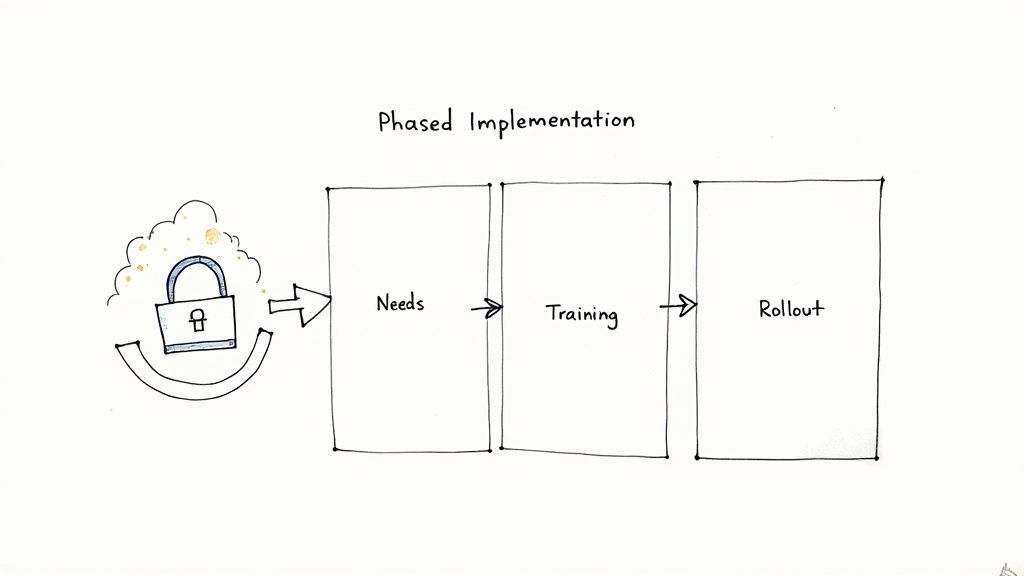
A Four-Step Game Plan for Implementation
Getting started is a lot more straightforward than you might think. A typical implementation follows a clear, logical path, making sure the AI assistant is dialled in to your specific needs and your team is ready to hit the ground running.
- Figure Out Your Pain Points: First things first, what’s driving you mad? Are you swamped with after-hours calls? Is chasing up invoices eating up your week? Nailing these down helps you pick an AI solution with the right tools and gives you clear goals to aim for.
- Get it Talking to Your System: A good AI assistant should play nice with your current strata management software. This step, usually handled by the AI provider, involves linking the systems via an API. This allows data like maintenance requests and resident details to flow securely between them without any manual double-handling.
- Train Up the Team: While the AI is doing the heavy lifting, your team still needs to know the ropes. Training usually covers how to keep an eye on what the AI is doing, how to step in when a complex issue needs a human touch, and how to make the most of the new, simplified workflows in their daily tasks.
- Roll it Out in Phases: You don't have to automate everything overnight. Start small. Pick one key function, like handling all after-hours calls. Once that’s humming along nicely, you can gradually bring in other features, like automated arrears reminders or invoice processing. This approach keeps disruption to a minimum and lets your team get comfortable with the changes.
Putting Data Privacy and Security First
In strata management, you're handling sensitive resident info, which makes data privacy a complete non-negotiable. Any AI provider worth their salt must show a rock-solid commitment to securing this data in line with Australian law. When you're bringing in an AI assistant, thinking about data privacy is essential. Getting your head around the role of Artificial Intelligence in enhancing cybersecurity can give you a real leg up in protecting that sensitive information.
Here are a few key security measures to look for:
- Compliance with Australian Privacy Principles (APPs): The system absolutely must stick to the national standards for how personal information is collected, used, and stored.
- Solid Data Encryption: All data, whether it’s just sitting there or being sent somewhere, should be encrypted to shield it from anyone who shouldn't see it.
- Secure Data Handling: The AI should only access the bare minimum information it needs to do its job. There also need to be clear rules for how that data is managed and who gets to look at it.
This focus on security is only getting more important. The latest industry reports show that Australia's shifting regulations are a huge driver for tech adoption, with around 40% of strata titles in states that are going through major reforms. This is pushing for greater accountability—something AI technology is perfectly built to support. You can dive deeper into this trend in the 2025 CHU State of the Strata Market Report.
With tools like the OnSilent app, which you can download from the Apple App Store, you can feel confident you’re using a platform designed with these security needs baked right in.

Figuring Out the Payback on Your AI Investment
Bringing an AI assistant on board is a serious business move, and just like any other investment, you need to be able to see a real return. We're not just talking theory here; the goal is a tangible return on investment (ROI) that makes a solid business case. For an AI assistant in body corporate management, this isn't about guesswork. It's actually a pretty straightforward process of adding up the efficiency gains and cost savings.
Let's be real—the financial pressure on Australia’s body corporate sector is immense right now. We're seeing costs for essentials like insurance, utilities, and maintenance jump by as much as 15-20% in some major cities. This climate makes sharp financial control non-negotiable and pushes the need for smart tools that deliver measurable savings. It's a point many industry leaders are making: AI is becoming vital for good governance. If you want to dive deeper into these trends, check out the latest budget impacts on the strata industry.
Tallying Up the Saved Hours
The clearest way to see your ROI is to calculate the time your team gets back in their day. The first step is to track how many hours are currently spent each week on tasks that your new AI assistant can take over. This gives you a solid baseline to measure against.
Think about these classic time-wasters:
- Routine phone calls: How much time is spent every single week answering the same old questions about levy due dates, bin night, or where visitors can park?
- Chasing arrears: Add up the hours your team spends manually sending out levy reminders and following up with owners who are behind on payments.
- Handling invoices: Measure how long it takes to manually key in data from every supplier invoice into your accounting system.
Once the AI is up and running, you just compare the before and after. Say the AI saves your team 20 hours a week, and your average hourly staff cost is $40. That’s a direct saving of $800 every week, which adds up to over $41,000 a year.
But it’s not just about cutting costs. It’s about freeing up your team's most valuable asset—their time—so they can focus on high-value work like strategic planning, tackling complex problems, and actually building stronger relationships with committees and owners.
Adding Up the Savings from Fewer Errors
On top of the time saved, an AI assistant cuts down on costly human errors and oversights that can really hit your bottom line. These savings can be a bit trickier to nail down upfront, but they're incredibly significant and show how the tech helps manage risk.
Just think about the financial hit from things like:
- Late payment fees because a supplier invoice was missed.
- Fines for non-compliance with fire safety or maintenance rules.
- Wasted time fixing up manual data entry mistakes.
An AI-driven system doesn't forget. It automates reminders and tracks deadlines with perfect accuracy, basically acting as your compliance safety net. Preventing even one potential compliance breach or a few data entry slip-ups each year can easily translate into thousands of dollars saved, contributing directly to a healthy ROI. In many cases, the AI pays for itself just by stopping these financial leaks.
Common Questions About AI in Strata Management
Bringing any new tech into the mix is bound to stir up a few questions. When we start talking about an AI assistant for body corporate management, managers want to know what it really means for their day-to-day, their budgets, and the software they already use. Let's tackle the big ones head-on and clear the air.
Getting these common worries out of the way helps you see how AI can be a powerful ally, not just another complicated thing to learn. The whole point is to feel confident about how these tools can actually support your team and help the business.
Will an AI Assistant Replace Our Strata Managers?
Absolutely not. Think of an AI assistant as a tool for augmentation, not replacement. It’s built to take over the high-volume, repetitive admin work that bogs down a manager's day. This frees up your skilled team to focus on the high-value stuff that actually needs a human brain.
Here’s a simple way to look at it: the AI handles the predictable, while your managers handle the exceptions. This lets them get back to what they do best:
- Complex problem-solving that needs a deft touch with negotiation and critical thinking.
- Strategic financial planning and giving solid advice to the body corporate committee.
- Building strong relationships with owners and stakeholders—something a machine can never do.
The AI is just a tool to make your team more efficient and impactful. It empowers them to operate at a higher, more strategic level, rather than being a substitute for their professional skills.
How Difficult is Integrating AI with Our Current Strata Software?
That's a very common worry, but modern AI assistants are designed to play nice with others. Reputable providers build solutions that connect seamlessly with the big strata management platforms we use here in Australia, like StrataMax, Urbanise, or PropertyIQ. This is usually handled through secure Application Programming Interfaces (APIs).
The AI provider almost always takes care of the technical heavy lifting. Their team will get the system configured to sync with your database, whether it’s for logging maintenance requests or pulling up resident details for a communication.
A good tech partner will walk you through a smooth, guided transition with minimal disruption to your daily workflow. The goal is for the AI to feel like a natural extension of your existing software, not some clunky add-on.
Is This Technology Affordable for a Smaller Strata Firm?
Yes, it’s much more accessible than you might think. Most AI services today run on a subscription model, often called Software as a Service (SaaS). This approach gets rid of the need for a massive, upfront investment, making it a viable option for firms of all sizes.
Pricing is usually scalable, based on things like the number of lots you manage or how many tasks you need automated. This flexible model means smaller firms can get their hands on the same powerful technology as the big players. The return on investment often shows up pretty quickly through major savings in admin labour and running costs, making it a smart financial move for any growing business.
Ready to see how an AI assistant can reclaim hours in your day and elevate your service? OnSilent provides a powerful, easy-to-implement AI call assistant that handles resident communications, qualifies enquiries, and ensures no opportunity is missed.