


It's easy to get bogged down in sales jargon, but understanding the difference between a "lead" and a "prospect" isn't just semantics—it's the key to focusing your time where it'll actually pay off. Think of it this way: a lead is anyone who's shown a flicker of interest, like someone who downloaded a free guide from your website. A prospect, on the other hand, is a lead you’ve actually talked to and confirmed is a genuine potential customer. They have a real need, the budget to solve it, and the authority to make a decision.
So, What's the Real Difference Between a Lead and a Prospect?
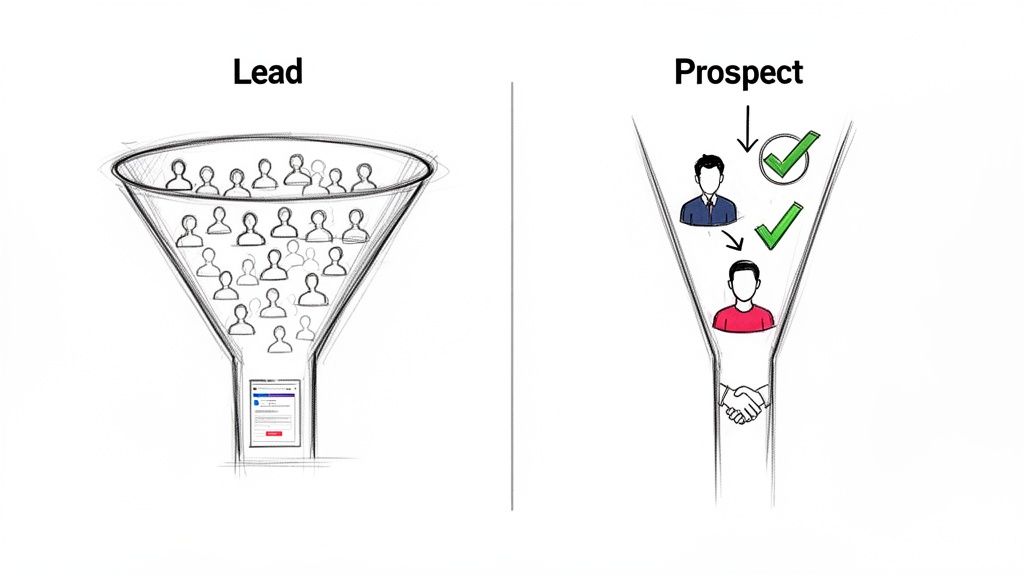
For any Aussie service business—whether you’re a real estate agent in Melbourne or a tradie in Perth—nailing this distinction is crucial. It’s the difference between chasing every single person who fills out a form and zeroing in on conversations that actually have a shot at turning into paid work.
A lead is floating around at the top of your sales funnel. They've raised their hand, but you don’t really know anything about them yet. They could be a competitor, a student doing research, or just a tyre-kicker.
A prospect has moved down that funnel because you've engaged with them. You've had a proper two-way chat, asked the right questions, and figured out they fit your ideal customer profile. It’s this switch from a one-way signal to a real conversation that marks the turning point.
Lead vs Prospect At a Glance
To make it even clearer, let’s break down how a lead evolves into a prospect across a few key areas. This table is a handy cheat sheet.
| Attribute | Lead | Prospect |
|---|---|---|
| Qualification Status | Unqualified or barely touched | Properly qualified against your criteria |
| Communication Flow | One-way (they reached out to you) | Two-way dialogue has started |
| Position in Funnel | Top of the Funnel (TOFU) | Middle of the Funnel (MOFU) |
| Level of Interest | Just curious or becoming aware | Confirmed need and serious intent |
| Data Available | Just the basics (name, email) | Deeper info (budget, timeline, needs) |
A lead shows curiosity; a prospect signals intent. If you let that simple idea guide your sales and marketing, you'll stop wasting time and start investing it where it truly counts.
This isn’t just theory; it has a massive impact on your bottom line. In Australia, the average lead conversion rate for B2B companies is a measly 2.3%. The top performers? They're hitting up to 10%. That huge gap shows just how valuable it is to focus your energy on qualified prospects instead of a mountain of raw leads.
As you start to refine your process, you’ll naturally want to get more specific. Understanding terms like what is a Marketing Qualified Lead (MQL) is the next step. This helps get your marketing and sales teams on the same page, making sure everyone knows exactly who to talk to and when.
Mapping the Journey from Contact to Customer
Knowing the difference between a lead and a prospect is a solid start, but the real magic happens when you understand how one becomes the other. This journey isn't random; it's a structured process that takes a simple touchpoint—like a missed call or a website enquiry—and turns it into a real sales opportunity, ready for a proper chat.
It all kicks off with lead capture. This is the moment a potential customer first enters your world. They might fill out a "request a quote" form, download a suburb report from your real estate site, or ring your business number after you've knocked off for the day. At this point, they're just an undefined, unqualified lead. You don't know who they are or what they really want.
Next up is the most critical phase: lead qualification. This is where you roll up your sleeves and figure out if they're a good fit. It’s a two-way conversation designed to cut through the noise, moving beyond basic contact details to understand their actual needs, budget, and timeline.
From Initial Interest to Qualified Intent
For a service-based business in Australia, this could be a quick phone call with a few sharp questions. An electrician, for instance, might ask a new lead, "Are you looking for an urgent repair or planning a future renovation?" That one question immediately helps sort them by intent and urgency.
The goal here isn't just to collect data. It's to draw a clear line in the sand between the tyre-kickers and the people with a genuine problem you can solve. Making that distinction is what turns a lead into a prospect.
Once qualified, they officially become a prospect and move into the nurturing phase. Now, the conversation gets more personal. Instead of blasting them with generic marketing emails, you might follow up with a detailed quote, schedule a site visit, or send over a case study that’s directly relevant to their situation. This is where you build trust and show them you know your stuff.
Keeping track of every interaction is crucial, which is why finding one of the best CRM programs for small business can be a game-changer.
The Final Steps Toward a Sale
The journey hits its peak when a prospect signals they're ready to pull the trigger, turning them into a sales opportunity. They might outright ask for a contract or book a final consultation to lock in the details. This is the green light for you or your sales team to focus on closing the deal.
Without a map like this, businesses end up treating every enquiry the same, wasting precious time and energy on contacts who were never going to buy. This roadmap makes sure you're always pointing your efforts toward the people who matter most.
Comparing Essential Qualification Criteria
It’s one thing to know the textbook difference between a lead and a prospect, but it’s another thing entirely to know how to separate them in the real world. This is where your qualification criteria become your most valuable filter, making sure your sales team only spends time on conversations that actually have a chance of going somewhere.
A tried-and-true framework for this is BANT, which stands for Budget, Authority, Need, and Timeline. A lead might vaguely tick one of these boxes, but a genuine prospect has to meet a clear threshold across most, if not all, of them. Nailing this distinction stops you from chasing dead-end contacts who can't or won't ever buy.
This flowchart shows the simple but critical journey from an initial contact to a qualified prospect.
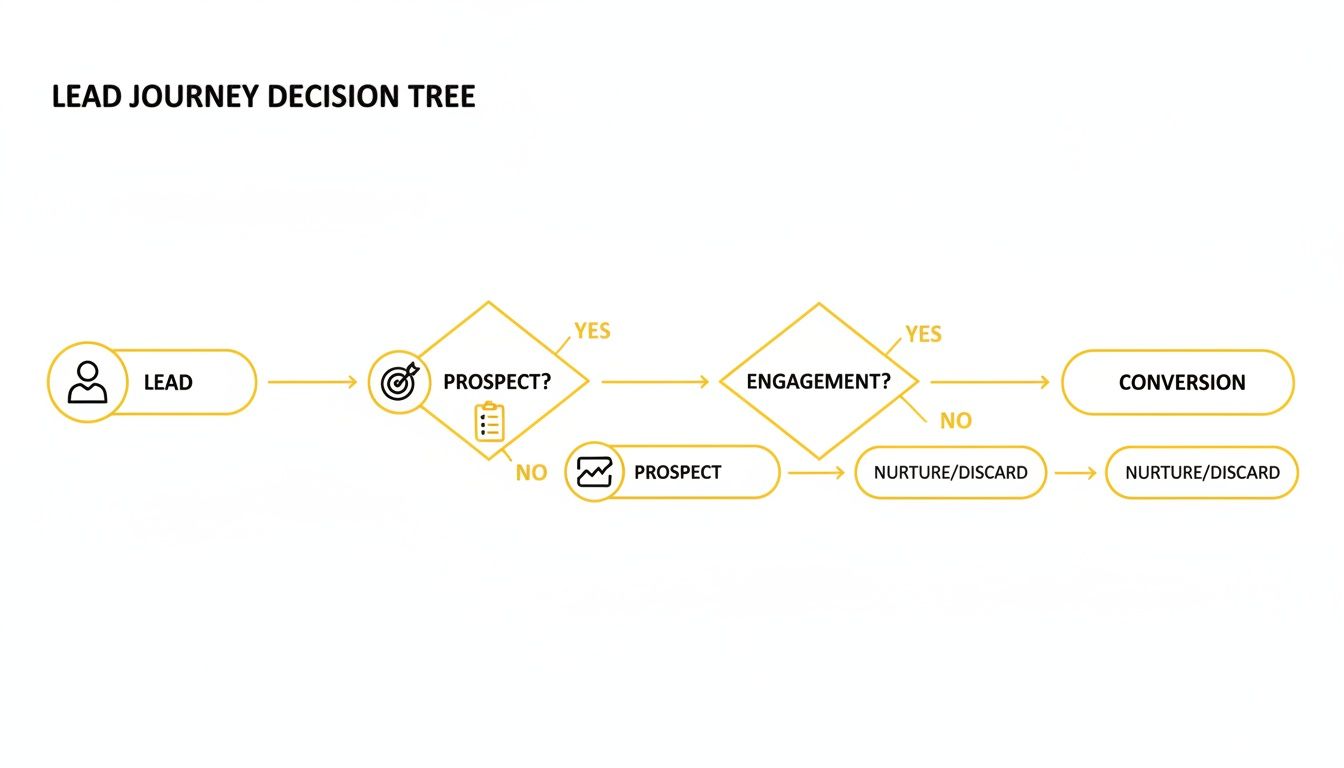
As you can see, qualification is the essential bridge that turns a broad lead into a focused prospect, primed and ready for a proper sales conversation.
Breaking Down the BANT Framework
Let's look at how a lead and a prospect stack up against each piece of the BANT puzzle. This side-by-side view really clarifies the shift from someone just being curious to someone showing qualified intent.
1. Budget (Financial Capacity)
- Lead: You have no idea if they can afford your service. They might have downloaded a free guide or sent a vague pricing enquiry without any real financial context.
- Prospect: You've actually spoken with them and confirmed they have an allocated budget—or at least a realistic financial capacity—that lines up with your pricing.
2. Authority (Decision-Making Power)
- Lead: The person you're talking to could be anyone—an assistant, a researcher, or just one of many people involved. You haven't confirmed if they're the one who signs off on the purchase.
- Prospect: You've identified them as the key decision-maker or at least someone with serious pull when it comes to the final call.
A lead shows curiosity; a prospect signals intent. This simple distinction, proven through qualification, is the bedrock of an efficient sales process.
Assessing Need and Timeline
The last two parts of BANT are often the clearest signs that someone is ready to talk seriously.
3. Need (The Problem to Solve)
- Lead: Their need is usually pretty vague or completely unconfirmed. Think of a mortgage broker getting a lead who is "just looking" at property, with no specific problem driving their search.
- Prospect: They have a clear, well-defined problem that your service directly solves. They've told you their pain point, and you've confirmed you have the solution.
4. Timeline (Urgency to Purchase)
- Lead: There's no set timeline. They might be thinking about doing something "in the next year or two" with zero urgency.
- Prospect: They have a clear timeframe for making a decision, whether that’s within the next week, month, or quarter.
Applying this framework rigorously is a core part of effective lead management best practices, because it ensures your resources are aimed at opportunities with the highest chance of converting. For a more tactical guide on this, especially for high-stakes sales, check out this piece on mastering prospect qualification.
The results of getting this right speak for themselves. While the average Australian e-commerce conversion rate hovers around 1.78%, dedicated landing pages that qualify prospects see conversion rates soar to between 8.8% and 18.2%. That massive gap shows just how valuable it is to turn your leads into properly qualified prospects.
How This Looks in the Real World for Aussie Businesses
Putting these ideas into practice is where you really see the value. For busy Aussie service pros, telling a lead from a prospect isn't just theory—it’s how you stop wasting time and start focusing on the stuff that actually makes you money. Let's look at a few real-world examples to see how it all plays out.
Picture this: you're a real estate agent in Sydney. You've got a free report on your website about property trends in the Northern Beaches. Someone pops in their name and email to download it. That person is a lead. Sure, they’ve shown a tiny spark of interest, but you have no idea what their real intention is. They could be a nosy neighbour, a uni student doing research, or someone who might think about selling in a few years.
Now, flip the script. You get an email from someone who not only downloaded that same report but is also asking to schedule a private inspection for one of your listings. They even mention they have mortgage pre-approval from a major bank and want to buy within the next three months. This person is a prospect. They've got a genuine need, a budget, and a clear timeframe. They should be at the top of your list.
What About for Tradies?
This difference is just as crucial for tradies. Say you're a plumber in Melbourne. Someone fills out your website contact form asking, "How much to fix a leaking tap?" That's a lead. The request is vague. You don't know where they are, how urgent it is, or any specifics about the job. You have to follow up just to figure out if it's even a real opportunity.
Compare that to a phone call from a homeowner who says, "G'day, I've got water pooling under my kitchen sink and need someone urgently. I'm in Fitzroy. Are you free this arvo?" This person is a prospect. They have an immediate, specific problem and they're ready to hire someone now. That call should jump the queue ahead of the vague website enquiry every single time.
Understanding the context behind an enquiry is everything. A lead has a problem, but a prospect is actively looking for your solution within a set timeframe.
Technology also gives us clues about context. In Australia, desktop users convert at 3.2% while mobile users convert at just 1.8%. This often suggests that people browsing on a desktop are more serious, qualified prospects, while those on mobile might just be kicking tyres and need a bit more nurturing. You can dig into more stats like this in this Australian marketing statistics report from eloquent.com.au.
By thinking this way, you can instantly sort through your enquiries and make sure your valuable time goes where it counts.
How to Automate Your Lead Qualification Process
Sifting through every single lead manually is a massive time-drain, especially when you're already flat out with appointments and actual jobs. Instead of spending your days weeding out the tyre-kickers, you can use automation to do the heavy lifting. This way, you only spend your time on genuine, sales-ready prospects.
This is where a bit of smart tech comes in handy, bridging that gap between someone first reaching out and becoming a qualified opportunity.
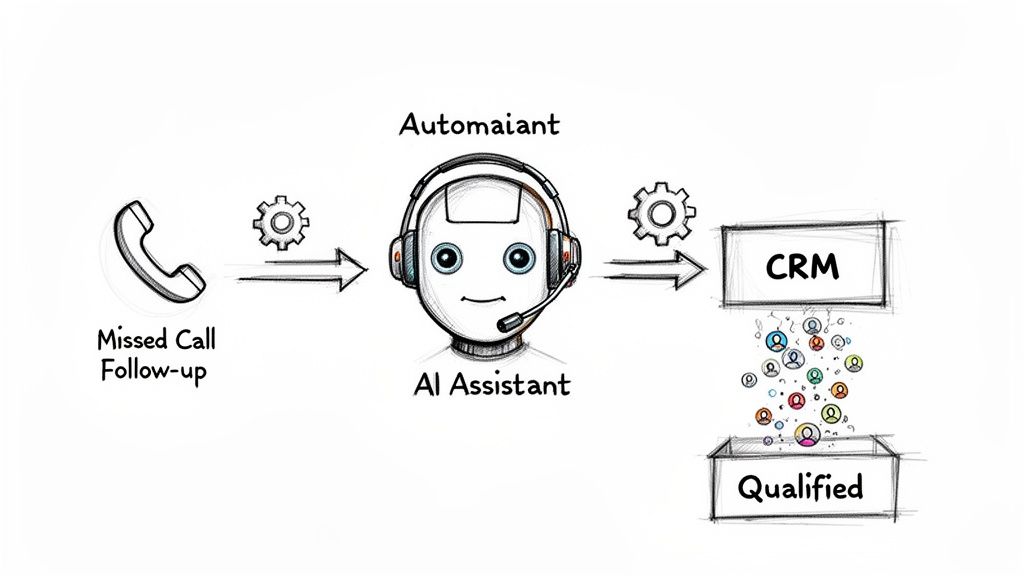
Think of an AI call assistant as your first line of defence, engaging with every call, 24/7. You can set it up to ask specific qualifying questions right from the get-go, which instantly separates the serious enquiries from those who are "just looking."
Setting Up Your Automated Filter
The trick is to give your AI assistant a clear script built around your ideal customer. By feeding it a few smart questions, you can immediately sort incoming calls and figure out who is just a lead versus who is a prospect worth your immediate attention.
Here are a few simple examples of qualifying questions you can automate:
- For a real estate agent: "Thanks for calling. Are you looking to buy a property, or are you thinking of selling your home?"
- For a plumber: "No problem, we can help with that. Is this an urgent emergency repair, or are you planning a future renovation project?"
- For a mortgage broker: "To get started, could you let me know if you're a first-home buyer or looking to refinance an existing loan?"
These questions do more than just collect info; they segment your callers in real-time. Based on their answers, the system knows what to do next, automatically pushing the urgent or high-value calls straight to the top of your list.
Automation flips your qualification process from a reactive chore into a proactive system. It makes sure that by the time a contact gets to you, they've already been vetted, saving you countless hours.
Capturing Every Single Opportunity
One of the biggest leaks in any sales funnel is missed calls. It’s a fact: 85% of people whose calls go unanswered won't bother calling back. An AI assistant plugs this leak by making sure every call is answered or immediately followed up with an automated SMS, capturing leads that would otherwise disappear into thin air.
This creates a really smooth workflow. The AI engages the caller, qualifies them, and then logs the whole conversation straight into your CRM. It can create new contacts, tag them based on their answers, and even schedule appointments. It essentially turns a raw lead into a qualified prospect without you having to lift a finger.
Building this kind of efficiency is a cornerstone of any modern business. For those looking to streamline their operations even further, exploring a range of small business automation tools can open up new ways to save time and focus on what you do best. Ultimately, it frees you from the admin grind, letting you put your energy into closing deals with pre-vetted, high-intent prospects.
Got Questions? We’ve Got Answers.
When you're trying to fine-tune your sales process, the little details matter. Getting the difference between a lead and a prospect right is one of those details that can make or break your team's focus. Here are a few common questions that pop up.
When Does a Lead Actually Become a Prospect?
A lead officially graduates to prospect status the moment you've qualified them. This isn't just about them downloading an ebook or filling out a form—that’s a one-way street. The real change happens when you have a two-way conversation and confirm they’re a solid fit for what you offer.
Think of it as a checkpoint. Once you’ve actually spoken to them and verified they have a real need, the budget to back it up, and the authority to give the green light, they've earned the title of prospect.
Can Someone Be a Lead and a Prospect at the Same Time?
Nope, it’s one or the other. These terms mark two very different stages of the sales journey. A contact starts its life as a lead, and only after you’ve done your homework and qualified them do they get "promoted" to a prospect.
It's like moving up a ladder; you don't stay on the old rung. A prospect is simply a lead who has been properly vetted, signalling they're ready for the next, more serious stage of your sales funnel.
The moment a lead is qualified, they stop being just a lead. They become a prospect. This signals a shift from casual interest to verified intent, and your communication needs to change with it.
What Are the Best Metrics to Track This Conversion?
If you want to know how well you're turning leads into prospects, you need to be tracking the right numbers. Focusing on these specific metrics will show you exactly where your sales funnel might be getting clogged up.
A few key metrics you should be watching:
- Lead-to-Prospect Conversion Rate: This is your most direct measure of success. It’s the straight-up percentage of leads your team successfully qualifies into prospects.
- Time to Qualify: How long does it take from the moment a new lead comes in to when they're contacted and qualified? A shorter timeframe almost always leads to better conversion rates.
- Cost Per Prospect: Everyone tracks Cost Per Lead, but that doesn't tell the whole story. Calculating the cost to get a qualified prospect gives you a much sharper picture of your marketing ROI.
How Can I Get My Team Better at Qualifying?
Getting better at lead qualification really comes down to having a solid, repeatable system. You need to give your team the right tools and knowledge to consistently spot the high-value contacts from the time-wasters.
Start by creating a crystal-clear, written definition of what a qualified prospect looks like for your business. Use a framework like BANT (Budget, Authority, Need, Timeline) to keep it simple. Then, arm your team with scripts full of smart, open-ended questions designed to pull this information out naturally. Running regular role-playing sessions and listening back to call recordings will help sharpen their skills in no time.
Ready to stop wasting time on leads that go nowhere? OnSilent works 24/7 as your front line, automatically engaging, qualifying, and booking appointments with genuine prospects. That way, you only talk to people who are actually ready to buy. Learn how our AI Personal Assistant can transform your sales process today.