


Think of a virtual receptionist as your business's frontline support, but without the front desk. They offer professional, remote call-answering and admin help, giving you a flexible and surprisingly affordable alternative to hiring a full-time, in-house employee.
For Aussie businesses, this means you can get every single call answered professionally during local business hours—and often well beyond—without the hefty overheads of a traditional salary, super, and office space.
What Is a Virtual Receptionist in the Australian Context?
So, what are we actually talking about here? Let's break it down.
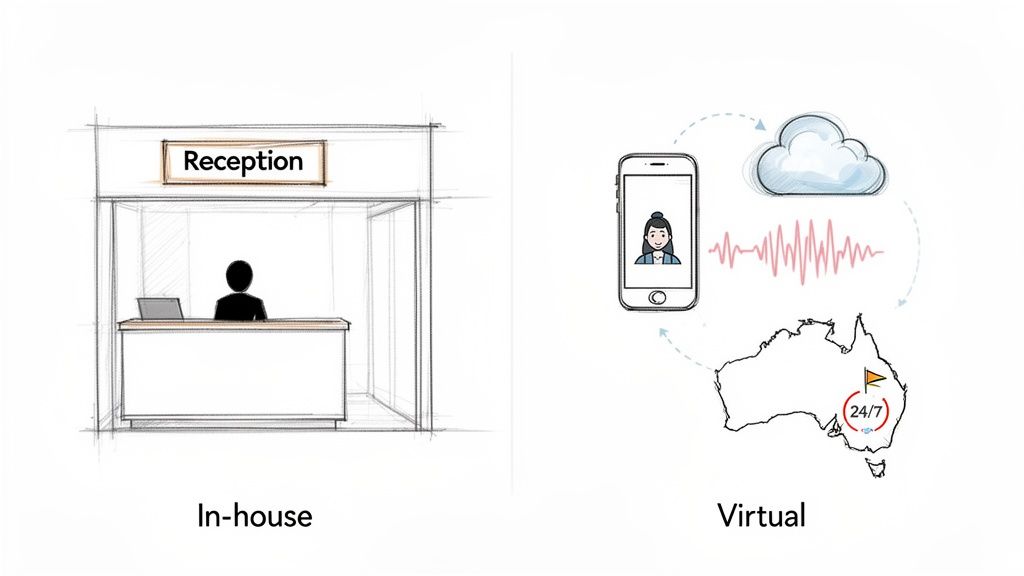
Imagine the difference between a traditional receptionist and a virtual one like comparing a classic brick-and-mortar shop to a slick e-commerce site. Both get the job done, but one gives you way more flexibility, scalability, and bang for your buck, all without being chained to a physical location.
A virtual receptionist handles your incoming calls from a remote spot, making sure no customer ever gets dumped into a voicemail black hole. Critically, they operate right here in the Australian business landscape, so they're completely across local accents, business hours, and cultural quirks. That local touch is massive for keeping your brand looking professional.
This isn't just a niche idea anymore; it's booming. The global virtual assistant market is set to jump from USD 19,506.2 million in 2025 to a whopping USD 55,406.3 million by 2035. This huge shift gives Australian small and medium businesses access to the kind of sophisticated tools that used to be only for the big players.
The Two Main Flavours of Virtual Receptionists
When you start looking into virtual receptionists in Australia, you’ll find they generally come in two main flavours. Each has its own strengths, so figuring out which one suits your business is the first step.
-
Live (Human-Operated) Services: This is the classic model. Real people based in call centres answer your phone. They follow a script you give them, take messages, transfer calls, and can do some basic scheduling. They offer that human touch that some clients really value.
-
AI-Powered Assistants: This is the modern approach, and it’s what services like OnSilent are all about. It uses artificial intelligence to manage calls, and it can handle a massive volume of them at the same time, 24/7. This means you never miss an enquiry, day or night.
The big win with AI is its sheer efficiency and smarts. An AI receptionist can instantly weed out spam calls, fire off immediate call-backs to missed callers, and plug straight into your CRM to log leads or book appointments automatically. That level of automation is a game-changer, freeing up a huge amount of your time.
Why Does This Distinction Matter for Your Business?
Choosing between a live service and an AI assistant really comes down to what you’re trying to achieve. A live service is fantastic for providing personalised, empathetic chats, which is great for more sensitive industries. The catch? They’re usually limited to standard business hours and can only handle one call at a time.
An AI-powered virtual receptionist, on the other hand, is built for scale and rock-solid consistency. It guarantees every single lead is captured and qualified, no matter when they call or how busy your lines are. This makes it the perfect fit for high-volume businesses like real estate agencies or trade services, where every missed call is a missed opportunity.
To get a sense of how this works in the real world, it’s worth looking at the role of a real estate virtual assistant, which shares a lot of the same core functions. At the end of the day, a virtual receptionist service helps Australian SMEs put a polished, professional foot forward and compete with the big guys, all without the financial headache of traditional staffing.
To make it even clearer, let's compare the different models side-by-side.
Virtual Receptionist Models at a Glance
This table breaks down the key differences between sticking with a traditional setup and exploring modern virtual options.
| Feature | Traditional Receptionist | Live Virtual Receptionist | AI Virtual Receptionist (e.g., OnSilent) |
|---|---|---|---|
| Availability | Standard business hours | Extended hours, but not 24/7 | 24/7/365, never takes a break |
| Call Capacity | One call at a time | One call per operator at a time | Unlimited concurrent calls |
| Cost | High (salary, super, benefits) | Moderate (monthly subscription) | Low (cost-effective plans) |
| Spam Filtering | Manual, inconsistent | Basic, relies on operator | Advanced, automatic filtering |
| Lead Capture | Manual data entry | Manual data entry | Automated CRM integration |
| Response Speed | Instant if available | Instant if available | Instant, every time |
As you can see, while a human touch has its place, an AI-powered system like OnSilent offers unmatched efficiency, scalability, and consistency, ensuring your business is always on and ready for the next customer.
So, Why Are Aussie Businesses Making the Switch?
The move to virtual receptionists across Australia isn't just some passing trend. It's a smart, practical reaction to the real-world squeeze that small and medium businesses feel every day.
Think about it: a tradie on a noisy worksite, a real estate agent running between back-to-back viewings—the problem is always the same. You just can't be in two places at once. This is where switching from the old-school setup to a virtual one stops being a "nice to have" and becomes a must-have for any business looking to grow.
For a lot of business owners, the first nudge is all about the money. Hiring a full-time receptionist in-house is a massive financial commitment. Once you add up the average salary, super, annual leave, and sick pay, you're easily looking at a bill of over $70,000 a year. A virtual receptionist service flips that on its head, turning a huge fixed cost into a small, predictable monthly expense.
But it’s not just about saving cash; it’s about putting that money back into what actually grows the business.
From Overwhelmed to Always On
Look past the dollars and cents, and you'll find the real reason for the switch: the constant battle to look professional. A sole trader plumber can't sound professional taking a new job enquiry from under a sink. A mortgage broker loses serious credibility if every potential client hits a generic voicemail.
A virtual receptionist makes sure every single call gets answered quickly and professionally. It instantly projects an image of a bigger, more organised operation, even if you're a one-person show.
This consistency builds trust right off the bat and boosts your brand. It levels the playing field, letting smaller businesses offer the same polished customer experience as their giant competitors.
The real value is simple: You get to focus 100% on your work, knowing your frontline communication is handled perfectly. That boost in focus and productivity is the benefit people always underestimate.
Capturing Every Opportunity, Around the Clock
Let's be real—your customers don't stick to a 9-to-5 schedule. People are often looking for services in the evening or over the weekend. If you miss those calls, you're missing out on revenue. Simple as that.
One of the biggest wins with virtual receptionists, especially AI-powered ones like OnSilent, is their 24/7 availability. This solves a massive headache for Aussie businesses by making sure every lead is captured, no matter when they decide to call.
- After-Hours Enquiries: A real estate agent can grab the details of a buyer scrolling through listings at 10 PM.
- Weekend Emergencies: A tradie can lock in an urgent weekend job without having their family time blown up.
- Time Zone Differences: A tourism operator can take bookings from international visitors without missing a beat.
Modern AI assistants take it even further. If a call is missed for any reason, the system can automatically ring the person back within minutes. This proactive follow-up is a game-changer for converting leads. It shows you're on the ball and makes sure you never lose a customer to a competitor just because you couldn't get to the phone in time.
Scaling Smart, Without the Hiring Headache
Business is never a straight line. A real estate agency gets swamped with calls after a new property launch. A tradie's phone rings off the hook after a big storm. Trying to handle these peaks and troughs with in-house staff is a nightmare. It means either hiring expensive temp staff or burning out your team.
Virtual services scale up or down without you lifting a finger. They can handle one call or a hundred at the same time, with zero changes to your setup. This flexibility lets your business grow and adapt to whatever the market throws at it, minus the cost and hassle of hiring and firing.
You only pay for what you need, when you need it. It’s an agile approach that keeps your capacity perfectly matched to your demand—a cornerstone of running a smart, modern business.
Key Features Tailored for Australian Industries
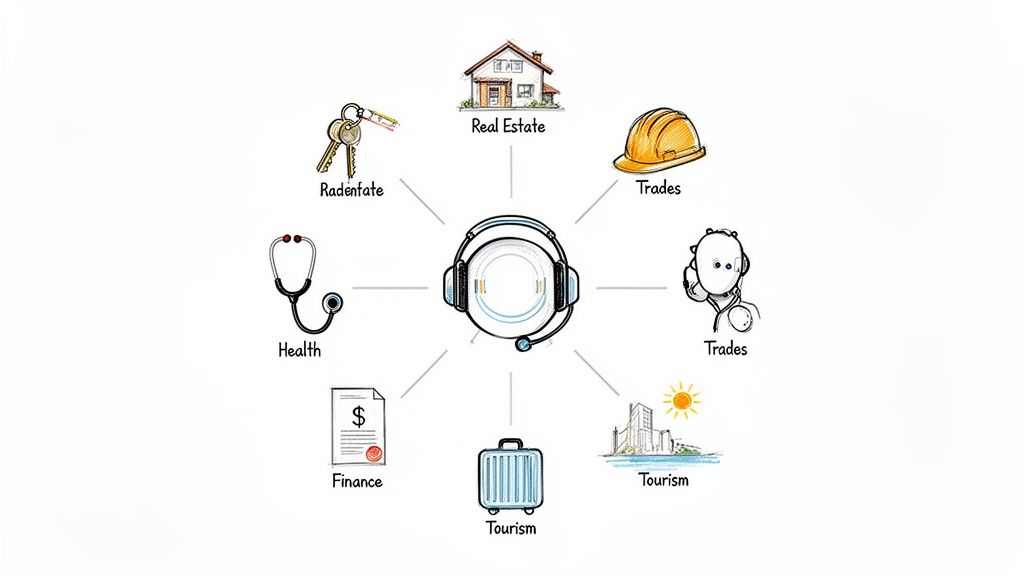
A virtual receptionist isn't a one-size-fits-all gadget. Its real magic happens when it’s fine-tuned to solve the specific headaches of different Aussie industries. Whether it’s qualifying property leads or managing patient bookings, the right features can completely change how your day runs.
This is where AI-powered assistants like OnSilent really shine. They go way beyond just taking a message. They become a genuine part of your workflow, customised to handle exactly what your sector throws at them. Let's break down how this actually works for a few key local industries.
Real Estate Agents and Property Managers
The Aussie property market moves at a lightning pace. For real estate professionals juggling inspections, client meetings, and negotiations, a missed call is often a missed opportunity. It's a constant threat.
Picture an agent, Sarah, in the middle of a busy open home. Her phone is buzzing non-stop with calls from buyers wanting to book a private viewing for another listing. Instead of those calls going to voicemail, her OnSilent assistant answers every single one, qualifying the enquiry on the spot.
The AI can ask the crucial questions she would, like:
- "Are you a cash buyer or do you have finance pre-approved?"
- "What's your ideal settlement timeframe?"
- "Is this for an investment or a place to live?"
Based on the answers, the assistant checks Sarah's calendar and CRM, then books qualified buyers straight into her available viewing slots. Unqualified leads are noted down, and a summary is sent for Sarah to look over later. By the time her open home is done, her week is already filling up with genuine appointments—all without her lifting a finger.
Tradies and Service Professionals
For plumbers, sparkies, and other tradies, the worksite is the office. Trying to answer the phone while you're up a ladder or under a house isn't just tricky—it can be downright dangerous. But every unanswered call could be a decent-paying job nabbed by the competition.
Take Dave, a plumber in Melbourne. His phone gets hammered with calls, and a lot of them are just spam or tyre-kickers. His AI virtual receptionist acts as a brilliant filter.
When a call comes in, the assistant can immediately ask, "Is this about a new job, an existing booking, or something else?" This one simple step weeds out the salespeople and non-urgent stuff, letting genuine customer calls get the attention they deserve. For a new job, the AI can grab all the key details like the address, what the plumbing issue is, and even fire off an instant quote for standard jobs based on rates Dave has already set.
This means Dave can stay focused on the tools, knowing that only qualified, urgent leads will be flagged for him to deal with immediately. All the other job details are neatly transcribed and waiting in his app when he knocks off for the day. For more advanced setups, you can even explore things like intelligent call routing to send certain types of jobs straight to different team members.
Health and Wellness Practitioners
Confidentiality, accuracy, and a calm, professional tone are absolutely non-negotiable in the health sector. For chiropractors, physios, and psychologists, managing appointments and patient details requires a careful touch.
Dr. Emily runs a busy psychology practice and uses her AI assistant to handle all incoming calls for new appointments. The system can offer callers available time slots, send booking confirmations via SMS, and even automatically email out digital intake forms for new patients to fill in before their first visit.
This kind of automation is becoming more common, with the global medical virtual assistant market tipped to reach an estimated $3.7 billion by 2031. This trend shows a growing trust in AI for professional services. Cloud-based systems have made these tools affordable and accessible, allowing Aussie health professionals to offer a smooth, stress-free patient experience from the very first call.
Mortgage Brokers and Financial Advisors
In the finance world, qualifying leads is everything. A mortgage broker can easily burn hours on the phone with potential clients, only to find out they aren't actually in a position to move forward. That’s valuable time that could've been spent on applications that are ready to close.
An AI assistant can run that initial qualification process perfectly, every single time. It can ask the key questions to figure out if a lead is solid:
- Have you saved a deposit?
- What is your approximate annual income?
- Are you a first-home buyer?
This initial screening ensures that by the time a lead is booked for a chat, the broker already has the basic info they need. It turns the first meeting from a fact-finding mission into a proper strategy session, which can seriously shorten the sales cycle and improve conversion rates.
Navigating Pricing and Plans in Australia
Figuring out the cost of a virtual receptionist in Australia can feel a bit like trying to compare mobile phone plans—there are a bunch of different models, each with its own weird structure. But once you pull it apart, it’s actually pretty straightforward to see which one gives you the best bang for your buck. The real trick is to look past the headline price and dig into what you’re actually getting for your money.
The whole industry has blown up recently, thanks to the massive shift towards flexible work and businesses needing a cost-effective way to handle customer service. The global market for virtual receptionists is tipped to hit USD 15,928.08 million in 2025, and a big chunk of that growth is coming from Aussie SMEs who want to look professional 24/7 without the massive overheads of hiring staff.
Common Pricing Models Explained
For Aussie businesses dipping their toes into the world of virtual receptionists, the costs usually fall into one of three buckets. Each one is a good fit for different call volumes and business needs.
- Pay-Per-Call or Pay-Per-Minute: This is the old-school way of doing things. You get billed for the exact number of calls taken or the total time your receptionist is on the phone. It can be a decent option if your phone barely rings, but watch out—costs can get out of control fast when you get busy.
- Monthly Minute Bundles: With this model, you buy a block of minutes each month for a flat price. It gives you a bit more predictability than pure pay-as-you-go and usually works out cheaper per minute. The downside? You might end up paying for minutes you never use or get stung with hefty fees if you go over your allowance.
- Flat-Rate Subscriptions: This is the approach modern AI assistants like OnSilent use. You pay one simple, predictable fee each month for a whole suite of features, often including unlimited calls. It’s hands down the best value and gives you total budget certainty, especially if your call volume is steady or high. No more stressing about surprise bills.
Here’s an example of a simple, no-fluff pricing page from an AI-powered provider.
This kind of clear, tiered structure lets you see exactly what’s included at each price point, so there’s no guesswork involved.
Uncovering Hidden Costs
When you’re weighing up different providers, you’ve got to ask about the potential hidden fees that can blow out your bill. A lot of the traditional services tack on extra charges that aren't obvious on their main pricing page.
Make sure you ask if they charge extra for things like booking appointments, qualifying leads, handling after-hours calls, or even just setting up your account. Those little "add-ons" can turn a seemingly cheap plan into a serious monthly expense.
This is where all-inclusive subscription plans really shine, as they usually bundle all the essential features into one flat fee. With an AI solution, things like 24/7 availability and appointment booking aren't expensive extras; they’re just part of the package.
For a deeper dive, our guide on virtual receptionist costs breaks down everything you need to know. Getting the full picture means you can pick a plan that genuinely helps your business grow, without any nasty financial surprises down the track.
A Buyer's Checklist for Choosing the Right Provider
Choosing a virtual receptionist service is a big decision. Get it right, and it’s a massive boost to your brand’s professionalism and efficiency. But with so many options out there for Australian businesses, it's easy to feel a bit lost. This is a practical, no-nonsense checklist to help you cut through the noise and find the perfect fit for your specific needs.
Thinking about this decision, it helps to apply the same principles as finding the right outsourcing vendors for any part of your business. You’re looking for a partner who offers reliability, scalability, and genuine long-term value—not just the cheapest price tag.
This decision tree shows how your call volume and predictability can point you to the right pricing model.
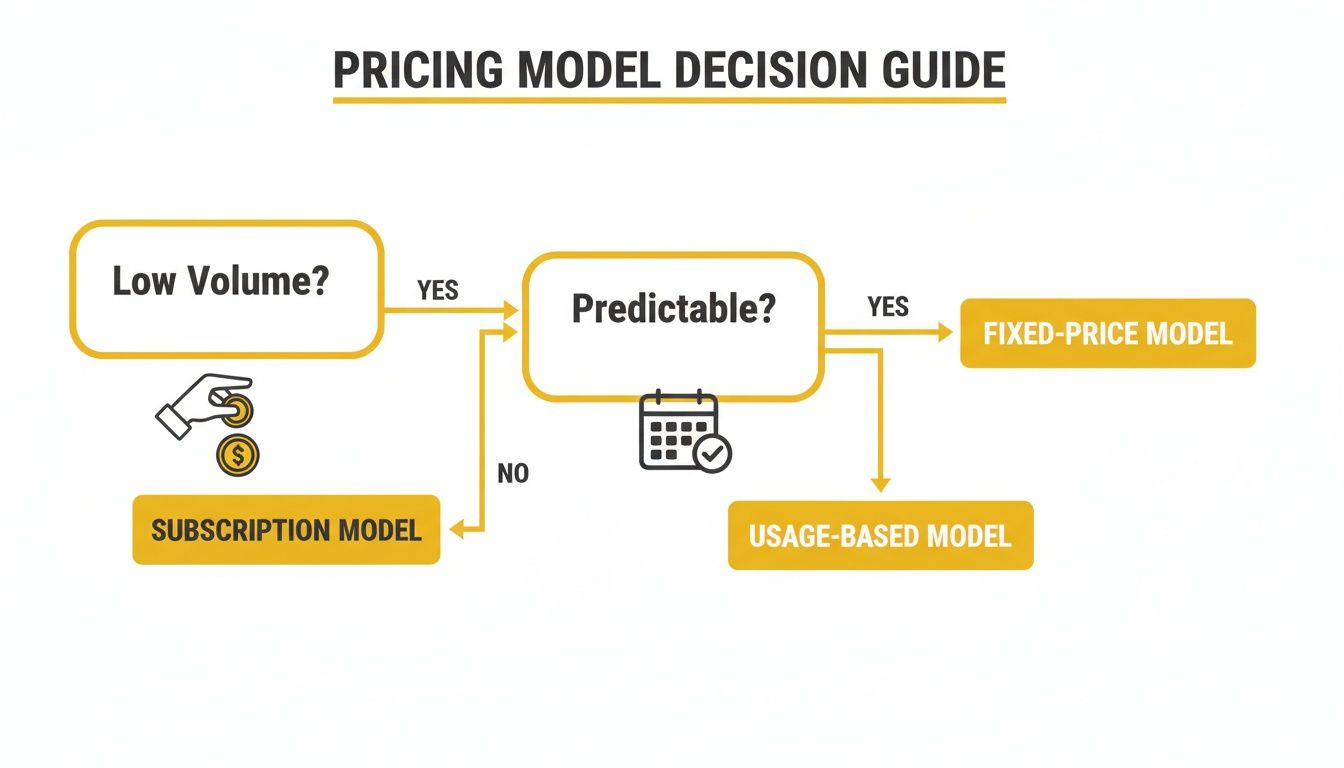
The key takeaway? If your calls are all over the place, a pay-per-use model might be a good starting point. But for businesses with steady or high call volumes, you’ll find some serious cost savings with a flat-rate subscription.
Australian Carrier Compatibility
First things first: the service has to play nice with your existing phone setup. In Australia, that means confirming it’s fully compatible with our major carriers to dodge any technical headaches down the track.
You need to ask a very direct question: "Does your service work reliably with Telstra, Optus, and Vodafone?" Any quality provider will have a clear, proven process for plugging into these networks. For instance, a modern AI assistant like OnSilent gives you a dedicated local number and upgrades your current voicemail, making sure missed calls are routed perfectly, no matter which carrier you're with.
Integration with Your Business Tools
A virtual receptionist shouldn't be an island. To actually be useful, it needs to connect with the software you already use to run your business—especially your Customer Relationship Management (CRM) system.
Without that connection, you're stuck doing manual data entry, which pretty much defeats the whole point. Ask potential providers:
- Can your system sync directly with my CRM to log new leads?
- Can it book appointments that show up in my calendar automatically?
- What other software integrations do you support?
This kind of automation is where AI-powered systems really shine. They’re built to be the bridge between your phone line and your business software, so every interaction is captured and actioned without you lifting a finger.
Australian-Based Support
When you need a hand, you need someone who gets the local context and is actually awake during your business hours. Outsourcing support to a different time zone can lead to some seriously frustrating delays when you've got an urgent problem.
Make sure you verify where their support team is based. Getting help from an Australian-based team means faster fixes and talking to people who understand the nuances of the local market. It’s a critical piece of the puzzle for keeping your business running smoothly.
Scalability to Grow with You
Your business isn't going to stay the same size forever. The right virtual receptionist service should be able to handle your call volume today and adapt effortlessly as you grow.
Ask providers how their service manages a sudden spike in calls. Can it handle one call as easily as one hundred at the same time? This is where the difference between human-operated and AI models becomes crystal clear. AI solutions offer almost infinite scalability, ensuring you never miss a call during a big marketing campaign or your busy season—all without any change in cost or performance.
A Quick Checklist for Evaluating Providers
To make things even easier, here’s a checklist to use when you're comparing different virtual receptionist services. It covers the essentials that really matter for Australian businesses.
Essential Features Checklist
| Feature | Importance | Questions to Ask Provider | How OnSilent Delivers |
|---|---|---|---|
| Local Carrier Compatibility | Critical | Do you fully support Telstra, Optus, and Vodafone networks? | Yes, provides a dedicated local number that works seamlessly with all major Australian carriers. |
| CRM/Calendar Integration | High | Can you sync call data with my CRM? Can it book appointments in my calendar? | Yes, built-in integrations automate lead logging and appointment scheduling with popular tools. |
| Australian-Based Support | High | Is your support team based in Australia and available during my business hours? | Yes, our support team is 100% Australian-based for fast, relevant help. |
| Scalability | High | How do you handle sudden increases in call volume? Is there a limit? | Near-infinite scalability. The AI handles one call or hundreds simultaneously with no drop in performance. |
| Cost Predictability | Medium | Is your pricing a flat rate, or will my bill fluctuate with call volume? | Offers simple, flat-rate monthly plans for predictable budgeting and unlimited call handling. |
| 24/7 Availability | Medium | Do you operate outside of standard business hours and on public holidays? | Yes, the AI service is active 24/7/365, ensuring no call is ever missed, day or night. |
This checklist isn't just about ticking boxes; it's about making sure your new service will be a true asset, not another headache to manage.
Choosing Between AI and Human Models
Finally, you’ll need to decide which type of service best suits your business goals. Live, human-powered services offer that traditional, personal touch, which can be great for certain kinds of client conversations.
On the other hand, an AI-powered model delivers unmatched efficiency, 24/7 availability, and serious cost-effectiveness. It guarantees every lead is captured, every spam call is filtered, and every missed call is returned automatically.
For a deeper dive into how these different solutions stack up, check out our complete guide to virtual receptionist services. By carefully thinking through these five key points, you can confidently choose a partner that will become a real game-changer for your Australian business.
Your Questions Answered: Virtual Receptionists in Australia
Thinking about bringing a virtual receptionist on board? It’s only natural to have a few questions. How does it work in the real world? Is it secure? And can it really get the hang of Aussie slang?
Let's cut through the noise. Here are the clear, straightforward answers to the most common questions we hear from Aussie business owners.
How Does a Virtual Receptionist Handle Australian Accents and Slang?
This is a big one, and fair enough. You need your customers to feel heard and understood, not like they're talking to a brick wall.
The good news is, quality providers have this sorted. Live virtual receptionist services typically hire Australian-based staff, so your callers are always chatting with a local who gets the lingo. Easy.
An advanced AI virtual receptionist, like OnSilent, takes a different but equally effective route. Our system has been trained on mountains of Australian speech data.
This isn’t just about basic words; it’s about understanding the nuances of accents from Perth to Parramatta, picking up on common slang, and grasping the unique rhythm of how Aussies talk. The tech is smart enough to understand context, ensuring every conversation flows naturally and professionally.
Can I Keep My Existing Business Phone Number?
Yes, absolutely. You’ve worked hard to get that number out there, and you shouldn’t have to change it. Any decent provider will integrate smoothly with your current setup.
It usually works by forwarding your calls. You simply set your existing business number to divert to a unique number the service gives you when you're busy or can't answer. For instance, with OnSilent, our system acts like a supercharged voicemail. If a call goes unanswered, it’s instantly routed to your dedicated local OnSilent number.
This all happens behind the scenes. Your customers keep dialling the same number they’ve always used, and the experience is seamless. There’s no need to reprint business cards or update your website. It’s a simple flick of a switch to add a much smarter layer to your existing phone line.
What Happens if a Call Is Too Complex?
Another common worry. What if a caller has a tricky question or an urgent, sensitive issue? Every professional service has a clear plan for this, making sure no caller gets stuck.
A live receptionist is trained to know the limits of their script. If a call gets too complex, they’ll either do a "warm transfer" (where they brief you before connecting the call) or take a detailed message for the right person on your team to handle.
An AI assistant like OnSilent is programmed with smart escalation paths. If it hits a query it can't handle, it can:
- Offer to flick the caller an SMS with a link to more info.
- Take a detailed message and a full transcript for you to check out.
- Schedule a call-back from a real person when it suits everyone.
This way, every single enquiry is captured and sent exactly where it needs to go. No more lost leads or frustrated customers.
Is My Customer Data Secure?
Data security isn't just a buzzword; it's a must. Any provider worth their salt operating in Australia must comply with local laws, including the Privacy Act 1988. This protects both your business and your customers.
When you’re checking out a service, always ask about their data protection policies. Where are their servers? What kind of encryption do they use? Services like OnSilent are built with security at their core, making sure every call recording, transcript, and piece of customer info is locked down tight, whether it's in the app or synced to your CRM.
Honestly, choosing a provider who is upfront about their security and compliance with Aussie regulations is non-negotiable. It’s the only way to protect your business’s and your clients' sensitive information.
Ready to see how an AI-powered virtual receptionist can give you your time back? Find out how OnSilent can capture every lead, filter out the spam, and let you focus on what you do best. Explore our features and start your free trial today.