

Outsourcing your customer service is a big step. It’s about handing over customer-facing tasks to someone else, whether that’s a traditional call centre or a slick AI assistant. For a service-driven SME in Australia, making this move can free up a massive up to eight hours per week. Think about it: every call answered, every lead qualified, and no opportunity missed, even after you’ve clocked off for the day.
When Should You Outsource Your Customer Service?
Are you a real estate agent trying to talk to a seller while a potential buyer is calling you mid-showing? Or maybe you're a tradie on a job site, and the list of quotes you need to follow up on is getting longer by the minute?
These aren't just small annoyances. They’re classic signs that your business is starting to outgrow your ability to handle every customer interaction yourself. The thought of outsourcing customer service usually pops up right after one of these moments of pure frustration.
This isn’t just a cost-saving exercise. It’s a strategic move to get your most valuable asset back—your time. It ensures every potential client gets a fast, professional response. When calls go unanswered or leads go cold, you’re not just losing one job; you’re putting your reputation and future referrals on the line.
Pinpointing the Trigger Moments
Knowing when to make the leap comes down to spotting the trigger points in your daily grind. These are the clear signs that your current setup is stretched to its limit.
- You're Missing Opportunities: Your voicemail is always full, or by the time you call someone back, they've already hired the competition. That's a huge red flag.
- Admin is Taking Over: If you're spending more time scheduling appointments and answering basic questions than actually doing the work you get paid for, it’s time to delegate.
- Your Business Hours are Stifling Growth: People don't just look for services between 9 am and 5 pm. If you can’t grab the enquiries that come in at night or on weekends, you're leaving cash on the table.
- The Customer Experience is a Bit Shaky: Trying to sound professional on the phone while you’re halfway up a ladder rarely works out well. Outsourcing ensures every single caller gets a consistently high-quality experience.
Understanding Your Outsourcing Options
So, you've realised you need help. What's next? You need to get your head around the different models out there. Before you jump in, it's worth thinking through the strategic decision of insourcing versus outsourcing and what it means for your business long-term.
There’s a reason the Aussie outsourcing market is booming. It pulled in USD 62,023.7 million in revenue and is expected to hit USD 122,594.5 million by 2030. Local businesses are clearly seeing the benefits.
The real question isn’t just if you should outsource, but how. The right model—whether it’s a team of real people or an AI assistant—boils down to your specific business needs, how many calls you get, and where you want to be in a few years.
To help you get a clearer picture, here’s a quick breakdown of your main options.
Customer Service Models at a Glance
| Model | Best For | Key Benefit | Potential Drawback |
|---|---|---|---|
| In-House Team | Businesses needing deep product knowledge and tight control over brand voice. | Unmatched brand alignment and direct team management. | High overheads (salary, benefits, training, office space). |
| BPO (Call Centre) | Companies with high call volumes that need scalable, 24/7 human support. | Access to a large, trained workforce and cost savings on labour. | Can feel impersonal; less flexibility for small businesses. |
| AI Call Assistant | SMEs and sole traders needing cost-effective, 24/7 lead capture and basic support. | Huge cost savings, always-on availability, and seamless CRM integration. | Limited ability to handle complex, emotional customer issues. |
Each path offers a different mix of cost, control, and capability. An in-house receptionist offers that personal touch but comes with a hefty price tag. A traditional Business Process Outsourcing (BPO) firm gives you scale but can be inflexible. And an AI assistant, like OnSilent, provides 24/7 efficiency and smart integrations at a fraction of the cost, making it a perfect starting point for most SMEs.
Figuring out which of these paths is right for you is the first real step toward building a more resilient and responsive business.
Choosing Your Model: BPO vs AI Assistant
So, you've decided it's time to get some help with your customer service. The next big question is: what kind of help? This usually boils down to two main paths: sticking with a traditional Business Process Outsourcing (BPO) partner or embracing a modern AI call assistant.
There's no single right answer here. The best choice depends entirely on what your day-to-day operations actually look like.
Think about a property manager who’s constantly dealing with complex, often emotional tenant disputes. They really need that human touch – agents who can navigate tricky conversations with empathy. A BPO makes a lot of sense for them.
Now, picture a mortgage broker. Their main game is speed and efficiency. They need to qualify leads 24/7 and get appointments booked automatically. For them, an AI assistant is a much better fit. It’s all about matching the tool to the job.
Speed and Flexibility
One of the biggest differences you'll notice straight away is the setup time. Getting started with a BPO can be a real marathon. It often takes weeks to get contracts sorted, train agents on the ins and outs of your business, and get all the systems talking to each other. It’s a serious upfront investment of your time.
An AI assistant, on the other hand, can be up and running in minutes. You can literally download an app, tweak a few settings, and have it managing your calls almost instantly. For a small business that needs to be nimble, that kind of agility is a massive win.
This flexibility also applies to scaling. With a BPO, if you suddenly need more (or fewer) agents, you’re often looking at renegotiating your contract. But an AI assistant? It can handle one call or one hundred calls at the same time without you having to change a thing. It scales at the speed of your business, not at the speed of a contract negotiation.
Technical Capability and Integration
Let's be honest, modern AI assistants pack some serious features that are often out of reach for small businesses using a traditional BPO, mainly due to cost and complexity. These tools are built to slot right into the systems you already use, like your CRM.
- Concurrent Call Handling: An AI assistant can juggle dozens of inbound calls at once. No lead ever gets a busy signal or gets dumped into voicemail again.
- Intelligent Spam Filtering: Smart algorithms can spot and block spam callers before they even reach you, keeping your lines clear for actual customers.
- Instant Analytics: You get access to call logs, transcripts, and performance data right from a mobile app. This gives you real-time insights into what’s happening with your customer interactions.
This flowchart gives you a quick visual guide on which solution might be right for your specific challenges.
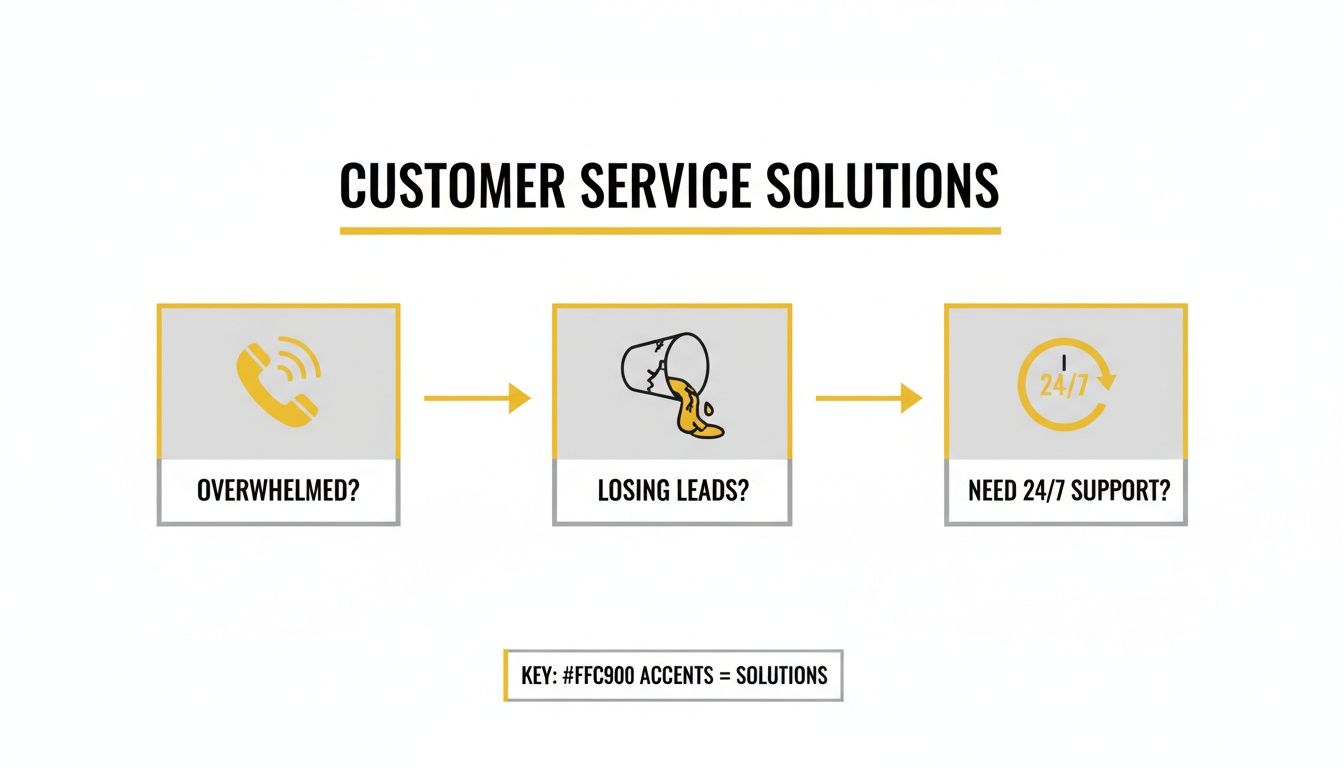
As the decision tree shows, whether you're feeling swamped with calls, watching leads slip through the cracks, or just need someone to cover the phones around the clock, there’s a clear path to a solution.
Making the Right Choice for Your Business
The demand for specialised support is booming. The Australian call centre outsourcing market hit USD 2,602.6 million in 2024 and is expected to more than double by 2030. With over 35,587 BPO firms operating in Australia, you’ve got a lot of options. But not all of them are a good fit for SMEs.
The key is to pick a solution based on your actual workflow, not just what's trendy. Take a hard look at your biggest headaches—is it missed calls after hours? A mountain of admin? Inefficient lead qualification? Let that guide your choice.
For many service-driven professionals, an AI answering service strikes the perfect balance of cost, efficiency, and 24/7 availability. It takes all those repetitive tasks off your plate, freeing you up to focus on the high-value work that actually grows your business. Making the right choice here isn't just about outsourcing; it's about building a smarter, more responsive operation.
Integrating Your New Solution Seamlessly
Picking the right customer service partner is a massive step, but the real magic happens when you weave that solution into the very fabric of your business. The good news? Modern tools are built for speed. Forget about the long, drawn-out onboarding processes of the past—you can have a fully automated workflow up and running in minutes, ready to capture every single opportunity.
A smooth transition all starts with connecting the new service to your existing communication channels. This is way simpler than it sounds. For instance, setting up call forwarding from your current Telstra or Optus mobile is a quick DIY job. In a few clicks, you can ensure every call is instantly routed to your new assistant, with zero downtime.
This immediate connection means you start seeing the benefits straight away. No more missed calls while you’re showing a property or in the middle of a job on-site.
Connecting to Your Business Brain
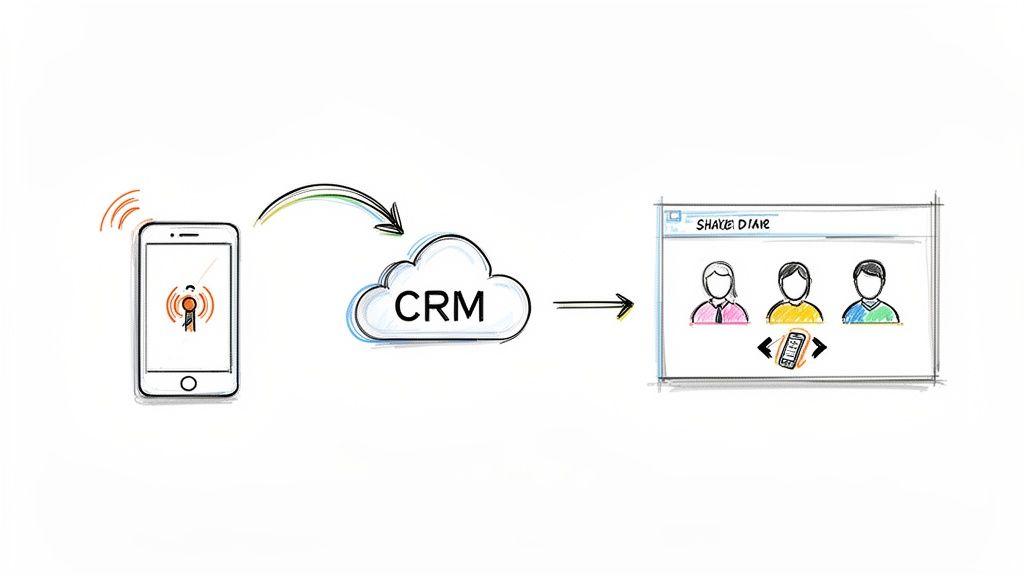
Next up, and this is crucial, is integrating the solution with your Customer Relationship Management (CRM) system. This is the difference between just answering calls and actively growing your business. When your outsourced service "talks" to your CRM, every new lead is captured and every appointment is logged automatically.
Think about it from a mortgage broker’s perspective. A qualified buyer’s details and their appointment time are saved directly into their client database the second the call ends. There's no manual data entry, and zero risk of a hot lead getting lost in a messy notebook. To really give your team an edge, you can even explore tools like real-time agent assist solutions that provide helpful guidance during live calls.
A successful integration isn't just about the tech; it's about building a system where no opportunity can fall through the cracks. It turns your customer service from a reactive chore into a proactive, automated lead-generation machine.
This kind of automation creates a reliable pipeline, ensuring consistent follow-up and a professional experience for every single person who calls.
Fostering Team Collaboration
Even if you’re a sole trader, you probably work with partners or an assistant from time to time. Modern outsourcing platforms are built for collaboration, helping you present a unified, organised front to your customers.
Let's take a small real estate agency as an example. With shared access features, the whole team can see incoming enquiries and call transcripts in a single dashboard.
- Principal Agent: Gets a bird's-eye view of all new buyer and seller leads.
- Sales Associate: Can jump in to follow up on a specific enquiry if the principal is tied up.
- Admin Assistant: Can check call notes to schedule viewings and update client files.
This shared visibility cuts out confusion and makes sure the right person handles each enquiry, fast. If you want to get more advanced with how you direct calls, getting your head around the principles of intelligent call routing can offer some great insights for setting up efficient workflows.
This collaborative approach ensures that even with an outsourced solution, your team stays perfectly in sync, delivering a seamless experience that makes your business look bigger and more professional than ever.
How to Measure Outsourcing Success
Once your new outsourced solution is up and running, the real work begins: tracking whether it's actually delivering the goods. And I don't mean just looking at vanity metrics like total call volume. To really get a handle on your return on investment, you need to zero in on Key Performance Indicators (KPIs) that are directly wired to your business goals.
Let's be honest, answering a hundred calls is pretty meaningless if none of them turn into actual business. The right KPIs are your compass, telling you if your outsourcing customer service strategy is actually making you money or just costing you.
Defining KPIs That Actually Matter
Forget generic metrics. Your KPIs need to reflect what success actually looks like for your business. Think about what moves the needle.
Here are a few real-world examples to get you started:
- A mortgage broker shouldn’t obsess over answered calls. A much smarter KPI is the number of qualified buyers booked for a consultation. That’s what directly fuels the sales pipeline.
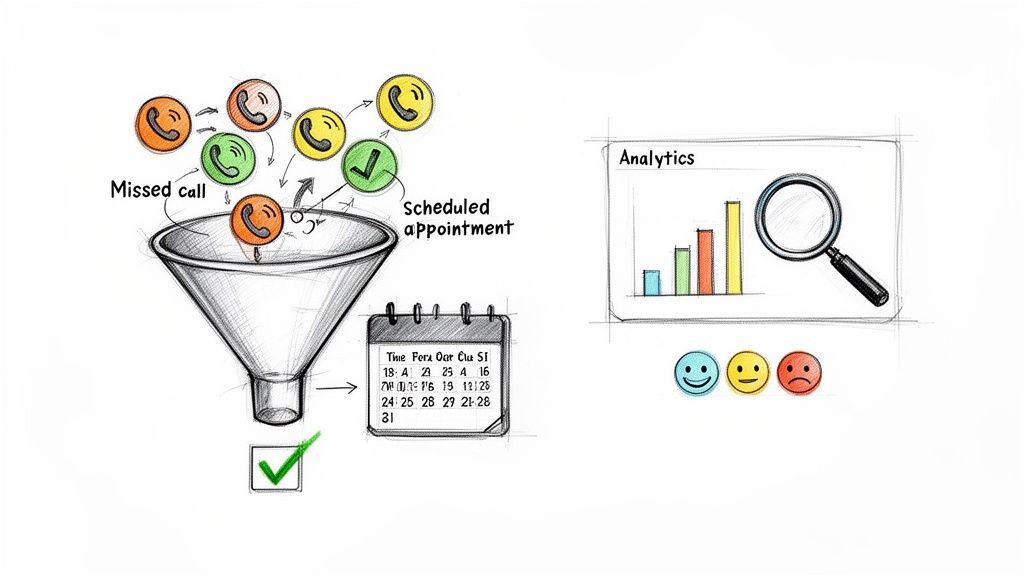
- A tradie gets far more value from tracking the percentage of missed calls that get converted into a scheduled job than just glancing at call duration.
- A real estate agent could measure the number of new seller leads captured and properly logged in the CRM from those pesky after-hours calls.
These are outcome-focused metrics, and they give you a clear, unfiltered picture of performance. They prove that your investment isn't just another line item on the expense sheet—it's a genuine driver of growth.
The goal is to move from tracking activity to tracking impact. Answering calls is an activity. Booking a qualified appointment that leads to a sale is an impact.
To give you a clearer idea, here are some sample KPIs we often see with service-driven SMEs.
| Business Type | Primary KPI | Secondary Metric |
|---|---|---|
| Plumbing Service | Number of emergency jobs booked | Average response time |
| Mortgage Broker | Qualified consultations scheduled | Lead-to-appointment conversion rate |
| Real Estate Agency | New seller leads captured | After-hours call answer rate |
| Legal Firm | New client intake forms completed | First Contact Resolution (FCR) |
| IT Support | Support tickets logged via phone | Customer Satisfaction (CSAT) score |
Use this table as a starting point. The key is to pick metrics that genuinely reflect a positive step forward for your business operations and revenue.
Using Platform Analytics for Actionable Insights
Most modern outsourcing solutions—especially AI assistants—come with a treasure trove of data right in their dashboards. This is where you can stop guessing and start making smart, data-backed decisions. It's time to dive into the analytics and see what's really going on.
Look for these key data points:
- Call Logs and Transcripts: Seriously, read these. Reviewing transcripts is the fastest way to understand common customer questions. You can use this intel to refine your service scripts or tweak your automated responses.
- Sentiment Analysis: Many AI platforms can now gauge a caller's sentiment (positive, neutral, negative). This gives you a pulse on customer satisfaction without having to send out a single survey.
- Peak Call Times: Knowing when your phone rings off the hook is gold. It helps you adjust staffing, fine-tune your marketing campaigns, or even decide when to turn on your AI assistant.
By checking these analytics regularly, you create a powerful feedback loop. You can quickly spot what’s working, ditch what isn’t, and make small adjustments that add up over time.
If you really want to get into the nitty-gritty of this, our guide on essential communication metrics offers more detailed strategies. Proactive monitoring ensures your outsourced service keeps evolving with your business, delivering measurable success month after month.
Getting Real About Costs, Risks, and Common Traps
Deciding to bring in outside help for your customer service is a big move. It’s not just about picking a provider; it’s about taking a hard, clear-eyed look at the numbers, potential risks, and the common mistakes that can trip up even the most prepared business owner. Getting this stuff sorted upfront means your investment will actually pay off, without any nasty surprises down the track.
The financial side is usually the first thing people think about. A traditional BPO service often charges per agent, per hour. That can get expensive, fast—especially if you need someone on deck 24/7. This model usually comes with setup fees and long-term contracts, making it a pretty hefty commitment.
On the flip side, an AI assistant like OnSilent typically runs on a flexible monthly subscription. This gives you a predictable cost that’s just a fraction of hiring a single human agent, making it much easier for a small business to budget for.
Protecting Your Brand and Your Data
Beyond the budget, there are a few operational risks you need to get a handle on. One of the biggest worries when you outsource customer service is keeping your unique brand voice intact. Nothing damages customer trust faster than an external agent who sounds robotic or just plain… off.
And then there's the data. Handing over customer information requires absolute confidence in your provider’s security measures. It's a huge deal.
To get on top of these risks, you have to do your homework.
- Brand Voice Alignment: Ask potential providers how they train their teams or set up their AI to match your tone. For an AI assistant, this means customising scripts and responses until they sound exactly like you would.
- Data Security Protocols: You need to ask about their data encryption, privacy policies, and if they’re compliant with Australian regulations. Any provider worth their salt will be totally transparent about how they protect sensitive info.
Here’s a common pitfall I’ve seen time and time again: assuming your new partner understands your business from day one. They don't. Clear, detailed onboarding and constant communication are non-negotiable for success. Don’t just set it and forget it; you have to treat your outsourced team like an extension of your own.
Your Due Diligence Checklist for Picking a Provider
A clunky integration or blurry expectations can wipe out all the benefits of outsourcing before you even get started. Before you sign on the dotted line, get straight answers to these critical questions. This is how you make sure you’re choosing a partner that’s both effective and secure.
- What does your onboarding process really look like? Is it a quick setup call or a proper multi-week process?
- How do you guarantee my brand’s tone of voice is maintained? Ask for specific examples of script customisation.
- What are your data security and privacy measures? Don't settle for vague promises; you want specifics.
- Can your system integrate with my existing CRM? This is make-or-break for a smooth, automated workflow.
- What do your performance reports include? Make sure they track the metrics that actually matter to your business.
Asking these questions gives you the confidence to pick a partner who gets your operational needs and will protect your business for the long haul.
Got Questions About Outsourcing Customer Service?
Deciding to outsource your customer service is a big step, and it's only natural to have a few questions rattling around. It’s a move we see plenty of Aussie service professionals consider. Let's tackle the most common queries head-on so you can move forward with confidence.
What’s This Actually Going to Cost Me?
This is always the first question, and fair enough. The answer? It really depends on the path you take.
A traditional BPO call centre usually bills you per agent, per hour. That can stack up fast, especially if you need someone on deck 24/7. For a smaller business, this can become a hefty fixed cost you just don’t need.
On the other hand, an AI call assistant is a different beast altogether. You’re typically looking at a predictable, flat-rate monthly subscription. We're talking less than what you’d pay an in-house receptionist for a single day's work. It makes round-the-clock support genuinely accessible for SMEs.
Will I Lose My Brand’s Personal Touch?
Losing that personal connection you've built with your customers is a massive, and very valid, concern. With any kind of outsourcing, the secret sauce is customisation. A good provider won't just give you an off-the-shelf solution; they'll work with you to nail your brand's specific tone and language.
- With a BPO: This means a lot of hands-on agent training and giving them detailed scripts to follow.
- With an AI Assistant: The power is in your hands. You can jump in and directly tweak scripts, greetings, and responses until the assistant sounds just like a natural extension of your business.
The end goal is always the same: create a seamless experience where your customer feels like they’re talking to your company, not some faceless third party.
How Do I Know My Customer Data is Safe?
Handing over client information is a huge deal, and you're right to be cautious. Data security should be at the absolute top of your list when you’re checking out potential partners.
You should never have to compromise on security. Don't be shy about asking potential providers directly about their data encryption, their privacy policies, and how they comply with Australian regulations. A partner worth their salt will be completely transparent about how they protect your—and your customers’—data.
Make sure whoever you go with has rock-solid security protocols to guard against breaches and keep sensitive info locked down.
How Quickly Can I Get This Up and Running?
The time it takes to get started can be a real deal-breaker.
Getting set up with a BPO can be a bit of a marathon. You’re often looking at several weeks to get contracts sorted, train up the agents, and get all the systems talking to each other.
An AI assistant, however, is built for speed. You can literally be up and running in minutes. Download an app, forward your number, and tweak a few basic settings. For a busy professional who needed a solution yesterday, that kind of agility is a massive win in the world of outsourcing customer service.
Ready to see how an AI assistant can completely change your business communications? With OnSilent, you can set up a professional, 24/7 answering service in minutes and never miss another lead. Start your free trial today and discover a smarter way to manage your calls.