

An after hours phone answering service is your secret weapon for making sure your business never misses a customer call, long after you've locked up for the day. Think of it as a professional front desk that's always on, capturing leads, handling urgent queries, and providing top-notch service 24/7. It's how you stop potential cash from slipping through your fingers.
Why Your Business Is Losing Money After 5 PM

Picture this: a high-value lead calls your business at 7 PM, credit card in hand. No one picks up, so they dial your competitor instead. Just like that, a single missed call could cost you thousands in lost revenue. It’s a painfully common story for many small businesses across Australia.
The reality is, your customers aren't just operating between 9 and 5 anymore. They're on their own schedule, and they expect you to be, too. When they need help, they want it now—whether it's late on a Tuesday night or first thing Sunday morning. If you're not there to answer, you're directly hurting your bottom line.
The Immediate Cost of a Missed Call
Every unanswered ring is more than just a missed opportunity; it sends a clear message to a potential client that their business isn't a priority. That sort of impression can do real damage to your reputation and push good customers away for good.
In fact, research shows that a staggering 34% of callers just hang up and never call back if they don't get a quick answer. That’s a huge chunk of business walking out the door. We've written before about the real impact of unanswered calls on customer behaviour, and it's not pretty.
When your business is closed, your competition is often just a click away. An unanswered call is an open invitation for a motivated customer to find someone else who can solve their problem immediately.
So what's the fix? Well, this isn't just about being convenient; it’s a critical business strategy. Many businesses turn to solutions like an after-hours phone answering service or even explore tools like marketing automation software that never sleeps to plug the gap.
Let's break down the tangible damage that can happen when that after-hours call goes to voicemail.
The Hidden Cost of Unanswered After Hours Calls
| Impact Area | Consequence for Your Business |
|---|---|
| Lost Revenue | The most obvious hit. A potential customer calls a competitor, and you lose the sale instantly. |
| Damaged Reputation | Unavailability makes your business seem unprofessional or too small to handle their needs. |
| Poor Customer Experience | A motivated buyer or a client with an urgent issue is left frustrated and feeling ignored. |
| Missed Opportunities | It’s not just about sales. You could be missing out on partnership offers or crucial supplier calls. |
These aren't just minor hiccups; they're direct hits to your growth and stability. Every single missed call chips away at your business's potential.
Capturing Every Opportunity Around the Clock
An after-hours phone answering service acts as your frontline defence against all that lost revenue. It guarantees every caller is greeted professionally and their needs are handled, no matter the time on the clock. It’s a system designed to stop the leaks, making sure every lead is captured and every urgent issue gets flagged. You can learn more about how to reduce missed calls with the right tools.
Think about the real-world benefits of being always available:
- Capture More Leads: A potential client doing research late at night can have their details taken down or even book a time to talk right then and there.
- Improve Customer Loyalty: An existing client with a real problem gets an immediate, human response, cementing their trust in your business.
- Enhance Professional Image: Your business instantly looks bigger, more organised, and more dedicated than competitors who just send calls to a dead-end voicemail.
At the end of the day, being accessible after hours is what separates the good businesses from the great ones. It turns a massive vulnerability into a serious competitive advantage.
How a Modern Answering Service Actually Works
If you're picturing a simple message-taking service, it's time for an upgrade. Today's solutions are more like a 24/7 professional concierge for your business, making sure you never miss a beat.
Think of it this way: voicemail is like a locked door with a "back in 5" note taped to it. A modern answering service, on the other hand, greets every single visitor, figures out what they need, and makes sure they get the right help, right away.
The whole thing is built on a simple, seamless process. It all kicks off with call forwarding – a standard feature on just about any phone plan. When a call comes through to your business number and you can't get to it, your carrier automatically flicks it over to your answering service. It happens instantly, completely behind the scenes.
Once the call lands with the service, that's where the real magic happens. This is where customisation makes all the difference.
From Call Forwarding to Smart Responses
Your after hours phone answering service doesn't just pick up and say "hello." It follows a carefully designed script that you've put together, ensuring every single conversation is perfectly in line with your brand's voice and how you run your business. This isn't just a basic greeting; it's a smart, flowing conversation.
It usually breaks down into three key steps:
- Greeting and Identification: The service answers with your custom greeting, sounding just like a professional extension of your team.
- Information Gathering: It then asks a few smart questions to figure out who's calling and what they need. Are they a new lead? An existing client with a problem? Or just a general enquiry?
- Action and Notification: Based on their answers, the service takes the right action – maybe it books an appointment, takes a detailed message, or flags an urgent issue. You then get an instant notification straight to your phone via SMS or email.
A modern service often ties in with your other business tools to make sure no lead ever slips through the cracks. It becomes a vital part of your sales process, especially for industries like real estate that rely on specialized lead generation services.
The Evolution from Human Agents to AI Assistants
Not too long ago, this entire process was handled by human operators. While a human touch is nice, the model had some serious limitations. An operator can only handle one call at a time, the quality of service can be a bit hit-or-miss, and the costs are high, especially if you need someone on deck 24/7.
The cost of poor call centre performance is staggering. Across Australia in 2023, customers spent a collective 107 million hours on hold waiting for service. It shows just how big the customer service problem is and why businesses are desperate for a better way.
Voicemail is a passive message collector. A modern AI answering service is an active business assistant that qualifies leads, books appointments, and filters calls so you only focus on what truly matters.
This is exactly where AI-powered assistants like OnSilent have completely changed the game. An AI assistant can handle dozens, or even hundreds, of calls simultaneously without ever putting a single person on hold. It works flawlessly around the clock for a tiny fraction of what a traditional human-run service would cost.
For small and medium-sized businesses today, AI offers some massive advantages:
- Instant Scalability: Get a sudden rush of calls? No problem. It can handle five calls or fifty in an hour without breaking a sweat.
- Perfect Consistency: Every caller gets the exact same professional, on-brand experience, every single time. No off days.
- Cost-Effectiveness: Without the massive overhead of human operators, AI services pack a powerful punch at a price point that actually makes sense for SMEs.
This shift in technology has turned a powerful after hours phone answering service from a luxury into an essential, affordable, and practical tool for any Australian business serious about growth.
Choosing Between Human Agents and AI Assistants
When you're looking for an after hours phone answering service, you’ll hit a fork in the road pretty quickly: do you go with a traditional team of human agents or a modern AI assistant? There's no single "best" answer that fits every business. The right choice really hinges on your specific needs, your budget, and how you operate day-to-day.
So, instead of trying to declare an outright winner, let's put them head-to-head. This breakdown will help you see the key differences through the lens of what actually matters to your business here in Australia.
No matter which path you take, the basic journey of a call is the same. It comes in, gets diverted to the service, and then someone—or something—assists the caller.
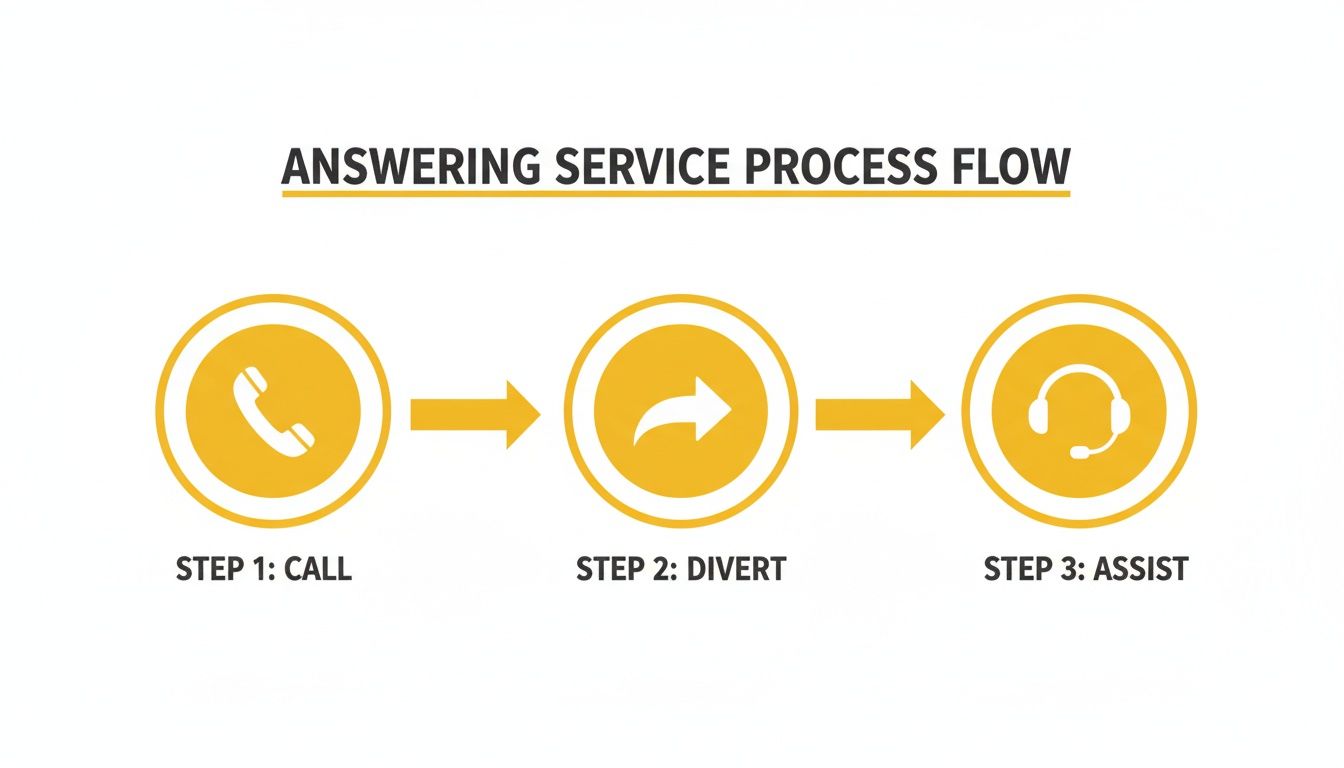
It’s that final "assist" step where things get interesting and the two options really start to show their differences.
Human Answering Service vs AI Call Assistant
To make it even clearer, here’s a table that breaks down the core features side-by-side. Think of this as your cheat sheet for figuring out which model aligns best with your business goals.
| Feature | Traditional Human Service | AI Call Assistant (e.g., OnSilent) |
|---|---|---|
| Cost Structure | Typically per-minute or per-call pricing, leading to variable monthly bills. | Flat-rate monthly subscription, offering predictable and stable costs. |
| Call Handling Capacity | One agent handles one call at a time. High volume leads to queues and missed calls. | Can handle a virtually unlimited number of calls simultaneously. No queues, no missed calls. |
| Service Consistency | Quality can vary depending on the individual agent, their training, or even their mood. | Delivers a perfectly consistent, on-brand experience on every single call, 24/7. |
| Availability | Usually 24/7, but may rely on rotating shifts which can impact consistency. | Always on, 24/7/365, with zero downtime or "off days." |
| Tech Integration | Basic integrations (like email summaries) are common, but deeper CRM or calendar links can be clunky or costly. | Built for deep integration with CRMs, calendars, and other business software for seamless automation. |
| Scalability | Scaling up to handle more calls often means higher costs and potential delays. | Scales instantly and flawlessly at no extra cost, perfect for marketing campaigns or busy seasons. |
Ultimately, the choice comes down to what you value most. If you need budget certainty and a system that can grow with you without missing a beat, an AI assistant is tough to beat. But if you believe only a human touch will do, a traditional service might be the way to go, as long as you're prepared for the variable costs and potential inconsistencies.
Cost Structures and Predictability
The most immediate difference you’ll notice is how you pay. It’s not just about the final dollar amount, but about financial predictability—something every small business owner knows is worth its weight in gold.
Traditional human-operated services usually work on a usage-based model. You’ll pay a monthly base fee, plus extra for every minute or every call they handle. While it seems simple enough, it can make your monthly bills a bit of a lottery. Run a successful ad campaign that makes the phone ring off the hook, and your costs could suddenly shoot through the roof.
On the other hand, AI assistants like OnSilent typically run on a flat-rate subscription. You pay one predictable fee each month, no matter how many calls you get. This makes budgeting a breeze. You know exactly what you’re in for, with no nasty surprises. In fact, research shows AI services can cost up to 90% less than live operators while still giving you that crucial 24/7 coverage.
Human services often come with variable costs tied to call volume, making your monthly expenses unpredictable. AI assistants typically offer a flat monthly fee, giving you complete budget certainty.
For a growing business where cash flow is king, that kind of financial stability is a massive advantage.
Scalability and Handling Peak Times
What happens when ten potential clients all decide to call you at the same time? This is where the operational gap between humans and AI becomes a chasm.
A human agent, by nature, can only handle one call at a time. It’s simple physics. If a second, third, or tenth call comes in, everyone else gets dumped into a queue, listening to hold music. In that time, you can bet a good portion of those frustrated callers will hang up and ring your competitor.
An AI assistant, however, can handle a virtually unlimited number of calls at once. Ten, fifty, even a hundred calls can be answered instantly and professionally. Not a single person ever gets put on hold. This gives you flawless scalability, ensuring you never miss a lead, even when you’re flat-out busy.
Just think about it:
- A real estate agent drops a hot new listing and gets a flood of enquiries. An AI can field every single call, qualify the buyers, and even book in the viewings.
- A plumber runs a local promo that generates a huge spike in calls. An AI instantly sorts the "burst pipe" emergencies from the "can I get a quote" requests, without dropping a single lead.
This ability to scale on a dime makes an AI assistant a far more robust and reliable choice for any business with fluctuating call volumes.
Consistency and Service Quality
When you hire a human answering service, you're relying on individuals. And while most are highly professional, the quality of service can be a bit of a mixed bag. It can depend on the specific operator's training, their experience, or even just what kind of day they're having. This can lead to an inconsistent experience for your customers.
AI assistants completely remove that human variable. They follow your custom script to the letter, every single time. Every caller gets the exact same professional, on-brand greeting and service, ensuring a consistently high standard that makes your business look good.
This consistency is vital for building a rock-solid reputation. An AI doesn't have "off days"—it delivers a flawless performance 24/7/365. If you want to take a closer look at what this technology can do, you can learn more about the specifics of an AI answering service.
Integration With Your Business Tools
Finally, think about how this service plugs into the other tools you use to run your business. A modern after hours phone answering service should feel like a seamless part of your operation, not just a message-taking silo.
While some human services offer basic CRM integration, it can sometimes be clunky or tacked on as an expensive extra. AI assistants, however, are built from the ground up to integrate deeply with other software. For instance, an AI like OnSilent can:
- Connect directly to your CRM to log new leads automatically.
- Sync with your calendar to book appointments in real time.
- Update your client records with call notes and summaries.
This level of integration turns your answering service into a powerful automation engine. It saves you hours of admin and makes sure no critical info ever falls through the cracks, letting you focus on the work that actually makes you money.
It’s one thing to talk about the theory, but seeing an after-hours phone answering service in action is where the penny really drops. For busy Aussie professionals, this isn't just a nifty add-on; it's a tool that actively brings in revenue, smooths over client relationships, and keeps your business looking professional, long after you’ve clocked off.
Let's get practical. The following scenarios show exactly how top professionals are using smart answering services to get a real leg up on the competition. Each one is a real-world example of how the service can capture valuable leads and give you your personal time back.
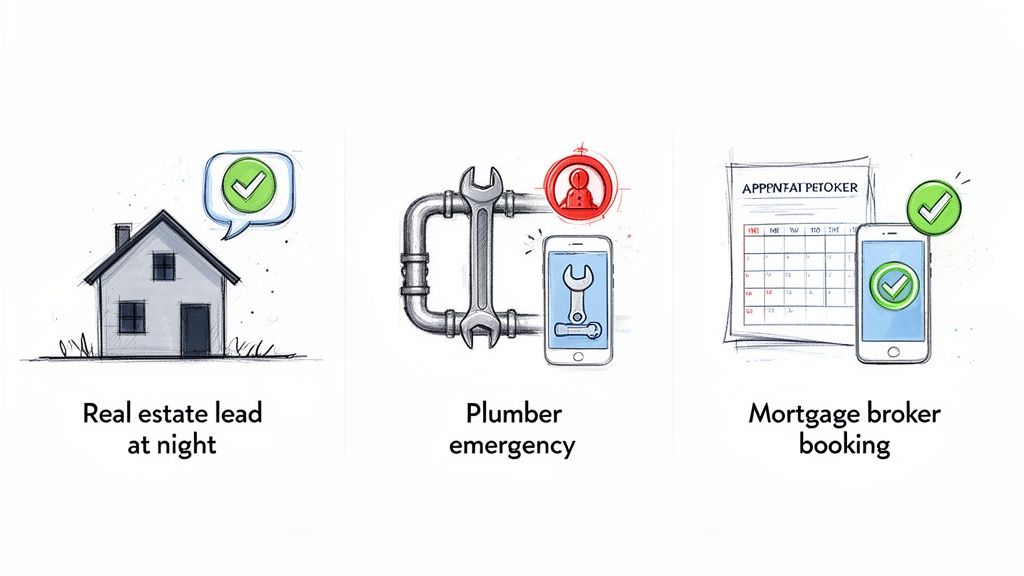
The Real Estate Agent Closing Deals After Dark
Picture this: it’s 9 PM on a Friday. A motivated buyer is scrolling through listings and finds your new property. They're keen and call straight away, probably expecting to hit a voicemail. Instead, your AI assistant answers instantly.
The assistant follows a script you’ve set up just for real estate enquiries:
- It gets straight to the point, confirming the property address the caller is interested in. No confusion.
- It then asks a few qualifying questions, like "Are you pre-approved for a home loan?" and "Do you have a property to sell first?"
- Next, it offers to book a viewing, checking your calendar in real-time and locking in an available slot for Saturday morning.
The buyer hangs up, seriously impressed, with a viewing already booked. Meanwhile, you get an instant SMS with the new lead's details, their answers, and the confirmed appointment. That red-hot lead was captured and actioned in minutes, all while you were enjoying your Friday night.
A potential buyer calling after hours is usually at their peak level of interest. An AI assistant grabs that momentum, turning a simple phone call into a qualified, scheduled appointment before your competitors even know the lead exists.
This isn’t just about securing the lead. It saves you from the tedious game of phone tag the next morning. You can start your day with a quality appointment already sitting in your calendar.
The Plumber Filtering Emergencies from Enquiries
If you’re a plumber, you know that not all after-hours calls are equal. A quote request at 10 PM can wait until morning, but a burst pipe needs your attention right now. An intelligent answering service is the perfect gatekeeper, sorting the urgent from the non-urgent with pinpoint accuracy.
A panicked homeowner calls late on a Sunday—their kitchen is flooding. Your AI assistant picks up immediately. The script is programmed to listen for keywords like "burst pipe," "flooding," or "emergency."
When the caller says one of these trigger words, the system’s rules kick in. It doesn't just take a message. It fires off a high-priority SMS alert straight to the plumber's personal phone with the caller's name, number, and the critical issue. The plumber can then call back within minutes to handle the real emergency.
Fifteen minutes later, another call comes in. This person wants a quote to install a new hot water system next month. The assistant politely gathers their details, explains that quotes are handled during business hours, and assures them the team will call back in the morning. This routine enquiry is logged and sent as a standard email summary, ready for follow-up.
This is how an after-hours phone answering service protects your personal time without ever letting a high-value, urgent job slip through the cracks.
The Mortgage Broker Booking Consultations Overnight
A potential first-home buyer is up late, anxiously digging through home loan info. They’re feeling a bit overwhelmed but are motivated to get started. They find your mortgage brokerage online and decide to call, hoping to get a jump on the process.
Your AI assistant answers, providing a professional and reassuring voice. The system is designed to gently guide them through an initial discovery process.
- It asks what type of loan they’re looking for (e.g., first home, refinancing, investment).
- It gathers their contact information and asks for the best time for a follow-up call.
- Crucially, it offers to book a complimentary 15-minute initial consultation, syncing with the broker's calendar to show real-time availability.
The client books a slot for the next afternoon, feeling relieved and like they’ve already made progress. The broker wakes up to a new, pre-qualified consultation in their calendar, complete with notes on what the client needs. This simple, proactive step turns a late-night researcher into a confirmed lead and starts building trust before you've even said hello.
Getting Your After Hours Answering Service Up and Running
Switching from a voicemail full of missed opportunities to a slick, 24/7 operation might sound like a huge undertaking. But honestly, setting up a modern after hours phone answering service is surprisingly simple. Let’s walk through the steps, from picking the right provider to getting the system dialled in for your Aussie business.
The real goal here is to look past the price tag and focus on what actually makes a difference day-to-day. You need to think about how well the service plays with the tools you already use, how much control you have over the call scripts, and what they’re doing to keep your client data safe.
What to Look For When Choosing a Service
Before you sign on the dotted line, there are a few things that should be non-negotiable. A cheap service that creates more work for you isn't a bargain—it's a headache that will cost you leads and admin time down the track.
Here’s your checklist:
- Integration Capabilities: Can the service plug straight into your Customer Relationship Management (CRM) software or calendar? Manually typing in new leads is a massive time-waster, so a smooth integration is a must.
- Script Customisation: Your business has its own personality. You need a service that lets you build detailed, custom scripts to guide conversations, qualify new leads, and sound like you, not a robot.
- Security and Privacy: You're trusting them with sensitive client info. Make sure they’re up to scratch with Australian privacy principles and have solid security in place to protect that data.
Good integration is a particularly big deal. Australia's call centre industry is in a bit of a crisis right now, with average wait times ballooning to an incredible 1.8 hours. The problem is made worse by clunky systems; only 23% of our local call centres use integrated platforms, forcing agents to jump between different programs. You can read more about how system integration impacts customer service in Australia to see just how bad it is.
Your Step-by-Step Implementation Plan
Once you've found a provider that ticks all the right boxes, getting started is straightforward. Modern solutions have made this whole process incredibly easy, even if you’re not a tech whiz.
Step 1: Set Up Conditional Call Forwarding
This is the technical bit, but it’s way easier than it sounds. All you’re doing is telling your mobile provider to send any calls you can't answer over to your new service number.
For the big Aussie carriers, it’s usually just a quick code you punch into your phone:
- Telstra: Dial
**61*[service number]# - Optus: Dial
**61*[service number]# - Vodafone: Dial
**61*[service number]#
This setup means only the calls you miss or are too busy to take get forwarded. You can still answer your phone like normal whenever you’re free.
Step 2: Customise Your Scripts and Rules
This is where you make the service your own. You’ll jump into the provider’s platform and map out exactly how you want calls handled. For instance, a plumber might set a rule to get an instant SMS for any call that mentions "emergency," while a real estate agent could create a script with a few questions to qualify potential buyers.
A great script does more than just take a message. It’s your front-line filter, your information-gatherer, and your appointment-setter, all rolled into one. It makes sure every call is handled with purpose.
Step 3: Connect It to Your Business Tools
Last but not least, link the service to the software you rely on every day. Connect it to your calendar, and it can book appointments straight into your free slots. Link it to your CRM, and new leads get logged automatically without you lifting a finger. This is the automation that turns a simple answering service into a proper business assistant.
Solutions like OnSilent have completely flipped the script on this process. Forget about long onboarding calls and technical headaches. You can now do the whole thing yourself in minutes, right from an app on your phone. For any busy professional, that kind of speed and simplicity is a game-changer. It turns what used to be a complex project into something you can knock over on your lunch break.
Calculating the True ROI of Your Answering Service

When you’re looking at an after hours phone answering service, it’s all too easy to just focus on the monthly fee. But that’s missing the bigger picture. The real story is in the return on investment (ROI), and trust me, it goes way beyond a simple line item in your budget. The true value is in what you gain—captured revenue, your time back, and a stronger brand.
Thinking of this service as just another expense is a mistake; it’s a tool that actively generates revenue. The most obvious return comes from the new business it snags for you. Every single lead you capture after 5 PM is income you would’ve otherwise lost completely. If one new client is worth $1,500 to your business, the service often pays for itself by catching just one of those calls.
Breaking Down the Financial Benefits
Figuring out your potential ROI isn't as complicated as it sounds. You just need to look at three key areas where the service delivers real, tangible value. This simple framework helps you see the numbers clearly and make a decision that’s backed by data, not just a gut feeling.
- Value of Captured Leads: First, work out the average lifetime value of a new client. Then, have a think about how many potential leads might be calling you after hours each month. Even if you only capture a fraction of these, it can lead to a serious revenue boost that completely dwarfs the cost of the service.
- Value of Your Reclaimed Time: Let's be honest, your time has a dollar value. Figure out your hourly rate and multiply it by the hours you waste each week on after-hours calls or chasing up missed leads. Getting that time back to focus on high-value work is a direct financial win.
- Value of an Enhanced Reputation: This one’s a bit harder to put a number on, but it’s incredibly important. A solid reputation for top-notch customer service leads to more referrals and repeat business. Being available 24/7 positions you as a professional, reliable choice, which builds massive long-term value.
The cost of a single lost client is almost always higher than the monthly cost of an answering service. By preventing that loss, the service provides an immediate and positive return on investment.
The Cost-Benefit Equation
Modern AI solutions have made this whole calculation even more attractive. AI assistants can be up to 90% more affordable than traditional human-run services, offering predictable, flat monthly fees instead of a per-call cost that can blow out. This makes budgeting a breeze and kills the risk of a surprise bill after a busy month.
When you weigh the small, fixed monthly fee of a service like OnSilent against the huge, unknown cost of a missed opportunity, the financial benefit is undeniable. Taking a look at the true virtual receptionist cost shows just how accessible this tech has become for Aussie businesses. It's a small investment for a powerful tool that protects your revenue, gives you back your personal time, and builds a brand that customers trust and recommend.
Still Have Questions? We've Got Answers
Stepping into the world of an after-hours phone answering service can feel a bit new, so it's natural to have a few questions. We’ve pulled together the most common queries we hear from Aussie professionals like you to clear things up and help you make a confident choice for your business.
Think of this as your quick-start guide to understanding how it all works in the real world.
Will My Clients Know They’re Speaking to an AI?
Honestly, the goal here isn’t deception—it’s professional efficiency. Modern AI assistants are designed to be upfront. They’ll introduce themselves clearly before gathering the info they need, making sure the whole experience is smooth and helpful for your callers.
It’s all about getting the job done right and giving your clients the immediate, accurate service they need. The focus is on being a reliable extension of your business, not on trying to perfectly imitate a human chat.
How Hard Is It to Set Up Call Forwarding?
It's surprisingly straightforward and usually takes just a couple of minutes. Most AI assistants walk you right through the process inside their app. You'll get a dedicated business number, and then all you have to do is activate 'conditional call forwarding' with your mobile provider.
This is a standard feature with all the major Aussie carriers like Telstra, Optus, and Vodafone. You just punch in a simple code, and your phone knows to automatically flick any unanswered or busy calls over to your new answering service. Easy as that.
How Are Urgent and Emergency Calls Handled?
This is where you really get to take control. You decide what counts as an urgent call and set the rules to match your business needs. It's a critical function, and you can completely customise it.
A plumber, for example, could flag keywords like 'burst pipe' or 'emergency leak' to kick off a specific action.
When the system picks up on these keywords, you can program it to skip the usual message-taking and instead fire off an immediate, high-priority SMS alert straight to your personal phone. This way, you’re in the loop instantly when a real emergency hits.
Everything else—quote requests, general questions—gets neatly logged and sent to you in a summary to tackle during your regular business hours. This kind of smart filtering is a huge win; it protects your downtime while making sure you never miss out on a critical job.
Ready to capture every lead and deliver exceptional service 24/7? Discover how OnSilent can transform your after-hours communication. Start your free 2-week trial today and see the difference for yourself.