

So, what do we actually mean when we talk about creating business systems?
It’s about intentionally designing repeatable processes that get you predictable results. It’s how you turn the day-to-day chaos of running a service business into a smooth, reliable operation.
We're not just talking about buying some fancy software. It's about building a solid framework so your business can hum along nicely, even when you’re not there pulling all the levers. This is your ticket out of the daily grind and onto the path of real, sustainable growth.
Why Your Service Business Feels Stuck Without Systems
If you feel like you’re constantly being dragged into every little thing and each new client project feels like you’re starting from scratch, you’re not alone. You're seeing the classic signs of a business running on pure grit and hustle.
This is a common trap for service-based SMEs, whether you're a real estate agent drowning in enquiries or a tradie juggling jobs across town. It’s a frustrating loop where taking on more work just seems to create more mess.
The problem isn't that you're not working hard enough. The real issue is the lack of a defined operational backbone. Without systems, your business revolves entirely around you—you become the go-to for every single question, decision, and approval.
The True Meaning of Business Systems
When I say ‘systems,’ don’t just think about technology. A real business system is the documented, repeatable way you get something done. Think of it as the playbook for your entire operation.
This covers everything from the ground up:
- How you capture and qualify a new lead.
- The step-by-step process for bringing a new client on board.
- The exact method for delivering your service consistently, every single time.
- The procedure for sending invoices and chasing up payments.
Even though the benefits are crystal clear, a surprising number of Aussie businesses are slow to formalise these processes. Research shows that only 23% of firms see technology adoption—a huge part of modern systemisation—as a top strategic priority for 2025. This gap goes a long way in explaining why so many service businesses feel like they’re running in place. You can read more about these trends over at the Australian Industry Group.
A business without systems is just a high-stress job you've created for yourself. It’s the intentional design of these processes that transforms a chaotic practice into a scalable asset.
At the end of the day, building systems means you stop being the bottleneck. It gives your team a clear guide to follow, which means your customers get consistent quality, and you get to focus on growing the business instead of putting out fires.
Your Blueprint For Systemising Core Operations
Before you even think about writing a single Standard Operating Procedure (SOP), you need a clear blueprint. I see it all the time – business owners dive headfirst into documentation without a high-level map. It’s like trying to build a house without architectural plans. You end up with a mess, wasted effort, and a whole lot of frustration.
Creating solid business systems starts with a bit of a 'business self-audit'. You need to pinpoint the core processes that actually drive your success.
Think about the entire journey a customer takes with you. How does a complete stranger first hear about your business? What are the exact steps you take to turn that initial phone call into a paying client? And what does your service delivery look like from start to finish? These are the crucial workflows you need to get out of your head and onto paper.
This infographic pretty much nails the journey most business owners take from feeling overwhelmed to finally getting some clarity.
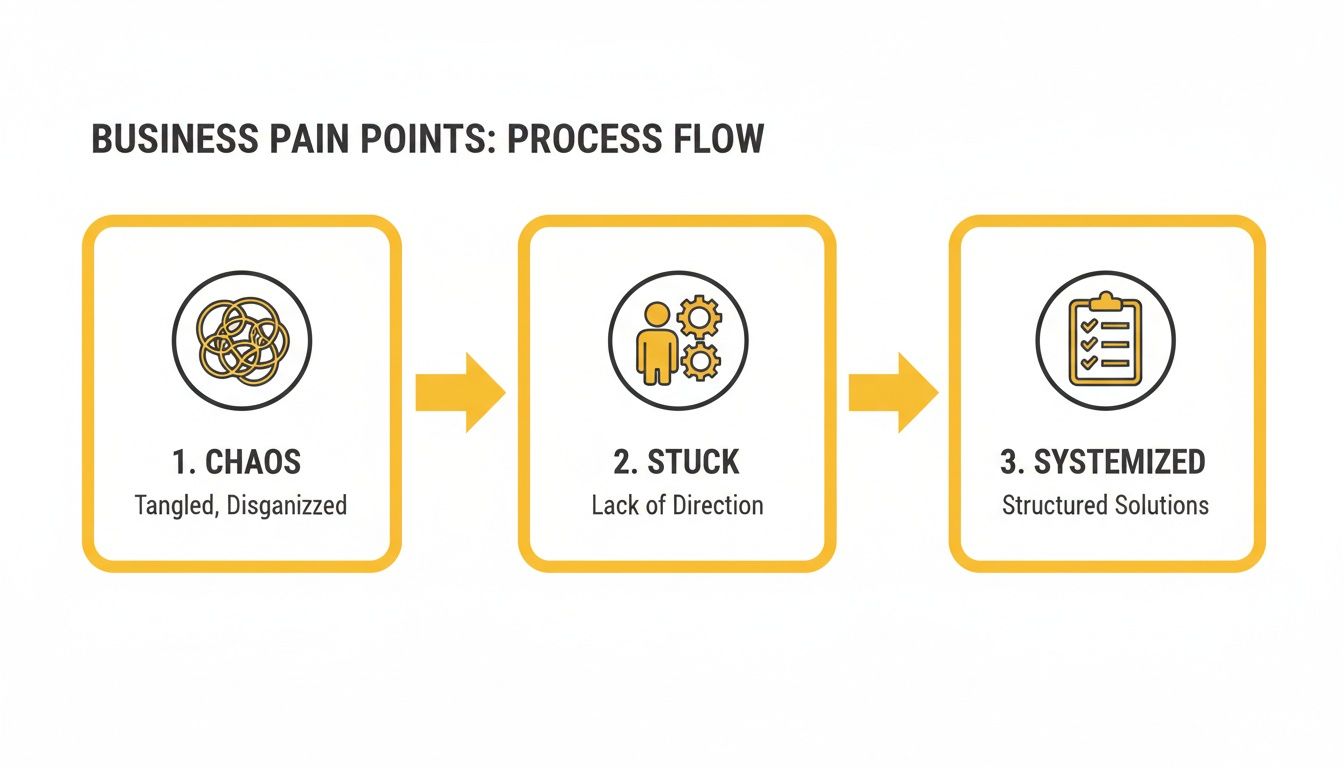
That feeling of being 'stuck' in the middle is completely normal. The good news is that systemising your work is the clear, structured path forward.
Deconstructing Your Service Delivery
Let's get practical. Imagine you run a trade business that specialises in kitchen renovations. Your core service isn't just "do the reno." It's actually a series of connected steps that have to happen in the right order for the job to be a success.
Mapping this out might look something like this:
- Initial Enquiry & Quoting: How you handle that first phone call, schedule a site visit, and put together a detailed quote.
- Job Confirmation & Deposit: The steps for getting the client's sign-off, collecting the deposit, and getting the job locked into your schedule.
- Pre-Construction Planning: This is all about ordering materials, lining up other tradies like plumbers and sparkies, and confirming the start date.
- On-Site Execution: The daily workflow for your team on-site, from demolition and installation right through to the finishing touches.
- Project Completion & Handover: Your process for the final walkthrough, dealing with any snags, sending the final invoice, and officially handing the project back to a happy client.
When you break down a big, complex service into these smaller, manageable stages, you create a visual workflow. This map is the foundation for everything that comes next – all your documentation and automation efforts. For some more hands-on advice on this, check out this guide on how to streamline business processes to spot where things are slowing you down.
To make this even clearer, here's a framework I use with service businesses to help them sort through their operations and decide what to tackle first.
Core Process Identification Framework for Service SMEs
| Business Area | Core Process Example | High-Impact Task (Systemise First) | Measurement of Success (KPI) |
|---|---|---|---|
| Marketing & Sales | Client Acquisition Funnel | Responding to new website enquiries | Lead Response Time (e.g., under 15 minutes) |
| Client Onboarding | New Client Setup | Sending welcome packet & contract | Client Onboarding Time (e.g., from signed contract to project start in 48 hours) |
| Service Delivery | Kitchen Renovation | Scheduling subcontractors & material delivery | On-Time Project Completion Rate (e.g., 95% of jobs finished on schedule) |
| Finance & Admin | Invoicing & Payments | Sending final invoice upon project completion | Days Sales Outstanding (DSO) (e.g., average invoice paid in 14 days) |
| Client Offboarding | Project Handover | Requesting a review or testimonial | Review Acquisition Rate (e.g., 50% of completed jobs leave a review) |
This table isn't just a list; it's a tool to help you prioritise. By focusing on the high-impact tasks and measuring what matters, you start making real progress, fast.
The goal isn't to document every tiny task right away. It's about understanding the high-level flow of value through your business. Pinpoint the critical path your clients and projects follow.
From Mapping To Action
Once you have this visual map, you can finally start spotting the bottlenecks. Where do things go wrong most often? Which steps cause the most stress for you or your team? These pain points are the perfect places to start systemising.
By focusing on these critical junctions, you're not just creating documents for the sake of it; you're solving real operational headaches. This approach builds momentum and shows everyone the value of your new systems from day one.
When you're ready to turn these mapped-out processes into automated workflows, take a look at these business process automation examples that are perfect for service-based businesses. This blueprint is your first major step towards building a business that runs smoothly and consistently, without needing you to put out fires all day.
Documenting Processes Your Team Will Actually Use
Let's be honest, the whole idea of creating Standard Operating Procedures (SOPs) can feel like a massive chore. For most business owners I talk to, it’s the one task that permanently lives at the bottom of the to-do list. But you need to reframe this in your mind. Documentation isn't about creating some dusty binder that sits on a shelf; it's about building your ticket to freedom.
When you have well-documented processes, you've got powerful tools for training new hires, delegating tasks with confidence, and keeping quality high. They empower your staff, reduce how often you need to be directly involved, and guarantee every single client gets the same top-notch service, no matter who on your team is doing the work.
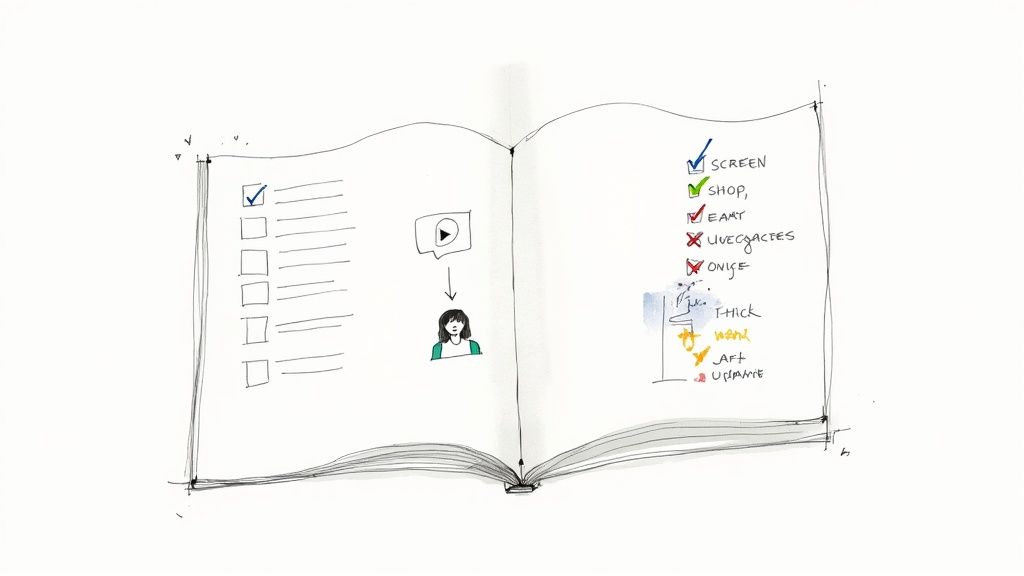
This image nails it. It’s all about turning those complex thoughts and workflows swirling in your head into clear, actionable steps that anyone can follow.
The Secret To Getting Team Buy-In
The biggest mistake I see business owners make? Trying to write every single SOP themselves, locked away in their office. The real secret to creating documents your team will actually use is simple: involve the people who do the work. They’re the real experts on how things get done day-to-day, and their input is gold for making sure your systems are accurate and practical.
When your team helps build the system, they feel a sense of ownership. It’s no longer some top-down rule they have to follow; it’s a collaborative tool they helped create to make their own jobs easier. That buy-in is the difference between a system that gets used and one that gets ignored.
If you’re just getting started, a practical guide on how to create standard operating procedures can be a huge help in structuring your thoughts.
Your team knows the reality of the workflow. They know the shortcuts, the common snags, and the little things you might overlook from a distance. Involving them isn't just a morale booster; it's how you build a robust and realistic system from day one.
Build Living Documents, Not Static Manuals
Forget about those long, text-heavy Word documents from the 90s. Modern documentation needs to be dynamic, visual, and easy to find when you need it. The goal here is to create ‘living documents’ that can be updated in a flash as your processes improve.
Here’s what a modern, effective SOP should include:
- Simple Language: Ditch the corporate jargon. Just write in a clear, straightforward style. If someone needs a dictionary to understand it, you've overcomplicated it.
- Visual Aids: A picture really is worth a thousand words. Use screenshots, checklists, and even quick screen recordings with tools like Loom to show people what to do.
- Clear Checklists: For any task with multiple steps, a simple checklist is unbeatable. It breaks the whole thing down into manageable chunks and gives a clear sense of progress.
- A Centralised Spot: Keep all your documentation in one easy-to-access, cloud-based place like Notion, Confluence, or even just a well-organised Google Drive folder. This makes sure everyone is always working from the latest version.
By building documentation that's easy to digest and update, you turn it from a rigid rulebook into a genuinely helpful resource. This is the bedrock of a business that can grow beyond your personal involvement, giving you back the freedom you were chasing in the first place.
Choosing The Right Tech To Automate And Execute
Okay, you’ve mapped out your processes and documented everything. That’s your blueprint for a business that actually works without you having to be everywhere at once. Now for the fun part: bringing that blueprint to life with the right technology. This is where you can claw back hours and give your team the tools they need to get the job done right, every single time.
The biggest mistake I see business owners make is getting dazzled by a shiny new piece of software and then trying to twist their business to fit the tool. It has to be the other way around. Let your documented processes tell you what tools you need, not the other way around.
Foundational Tools For Service Businesses
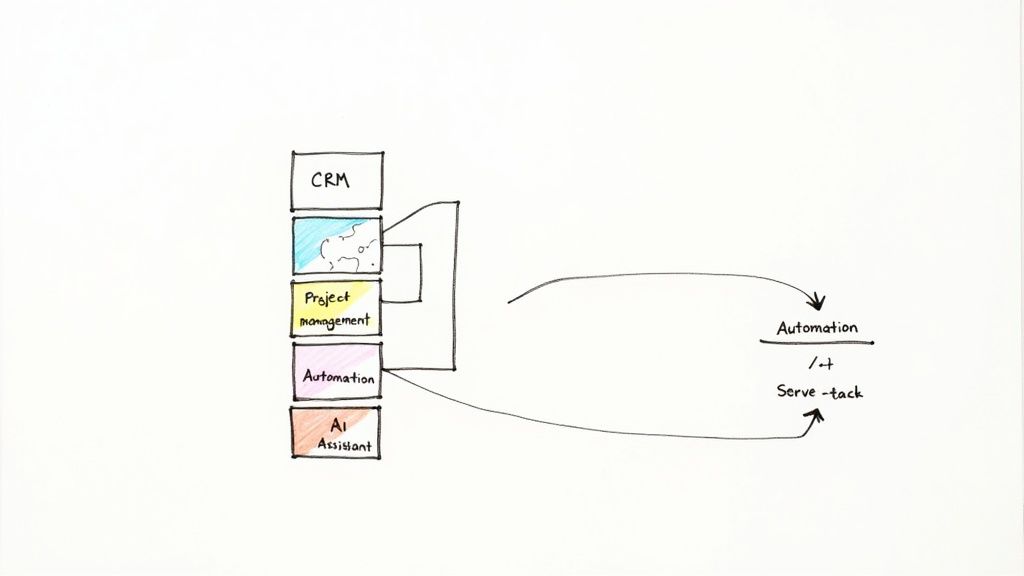
Before you start looking at fancy automation, you need to get the core pillars of your tech stack sorted. For most service businesses, it boils down to two key platforms that become your central source of truth.
-
Customer Relationship Management (CRM): This is your business's memory. It’s where every single client interaction lives, from that first phone call to the final invoice. For a real estate agent, the CRM holds buyer details, property history, and communication logs. For a tradie, it tracks every quote, job, and client phone number.
-
Project Management (PM) Tool: This is where the work actually gets done. Tools like Asana, Trello, or Monday.com let you turn your service delivery process into a repeatable template. A new client just signed on? Great, you spin up a new board, and all the steps, deadlines, and team members are already assigned.
Ideally, these two systems talk to each other. When a deal is marked 'won' in your CRM, it should automatically create a new project in your PM tool, pulling all the client data across seamlessly.
Layering On Intelligent Automation
Once your foundational tools are in place and organised, you can start chipping away at the high-volume, low-value tasks that eat up your team's day. This is where modern AI assistants and automation tools really shine.
Just think about all the repetitive communication in your business:
- Answering the phone just to qualify a new lead.
- The back-and-forth emails trying to schedule an appointment or a property viewing.
- Sending manual follow-up reminders for quotes.
- Answering the same five questions over and over again.
An AI call assistant, for example, can handle all your incoming calls when you’re on the tools or with a client. It can qualify the caller based on your specific criteria and even book appointments straight into your calendar. That one system alone stops leads from slipping through the cracks and saves you from constant phone interruptions. You can check out a heap of different small business automation tools designed to fix these exact headaches.
The goal of automation isn’t to replace the human touch. It’s to handle all the predictable, repetitive grunt work so your team can focus on the complex, high-value conversations that build relationships and actually close deals.
Investing in this kind of tech is quickly becoming standard practice for doing business in Australia. By 2025, total IT spending in the country is forecast to hit around AU$147 billion, with a huge chunk of that growth happening in IT services. It's a clear signal that smart businesses are prioritising systemisation through technology.
Choosing the right tech isn’t about finding one magical tool that does everything. It’s about building an integrated ecosystem where each piece of software solves a specific problem that you’ve already identified in your process maps. When you approach it that way, you’re guaranteed to get a real return on your investment instead of just adding more complexity to your day.
Getting Your Systems Off the Ground and Your Team on Board
You can design the most brilliant, efficient system in the world, but it’s completely useless if your team doesn't actually use it. This is where so many great plans fall over. Nailing this isn't just about fancy software and detailed documents; it's about people and how you bring them along for the ride.
First things first, you need to be crystal clear on the ‘why’ behind any new process. Your team has to see how this change makes their life easier, not just how it benefits the business. Frame it in terms of killing off their most hated tasks, cutting down on frustrating mistakes, or just making their day run a whole lot smoother.
Phased Rollout Beats a Big Bang Launch
It’s tempting to want to overhaul everything all at once, but trust me, that’s a recipe for chaos and resistance. A massive, disruptive launch just overwhelms people. A much smarter approach is a phased rollout, bringing in one new system or tool at a time.
My advice? Start with the process that causes the most collective headaches for your team.
If messy client onboarding is a constant source of pain, pour all your energy into systemising just that. Get it running like clockwork and show everyone how much better things are. That quick win builds trust and gets people excited for what's next, making them far more open to the next change you propose.
A great system doesn’t feel like a rigid set of rules forced upon your team. It feels like a shared tool they helped build to make their own jobs easier and more effective.
The real secret to getting buy-in is involving your team from the get-go. When they have a say in how a system is designed, they take ownership of it. They go from being reluctant followers to genuine champions of the new way of doing things. You can find some practical ideas for improving these workflows in our guide on streamlining administrative processes.
Measuring What Matters and Getting Better Over Time
So, how do you know if your new systems are actually working? You have to measure the impact. Introduce a few simple Key Performance Indicators (KPIs) that directly link back to the problem you wanted to solve in the first place. These numbers give you cold, hard proof that the changes are delivering real results.
Here are a few practical KPIs you could start tracking:
- Reduced Error Rates: A drop in the number of mistakes in client work or admin tasks.
- Faster Project Turnaround: The time it takes to get from the start of a job to final delivery.
- Improved Client Satisfaction Scores: Getting direct feedback that shows clients are happier with the consistency.
There’s a reason the adoption of automation and AI is surging across Australia. According to one study, the use of AI among surveyed businesses shot up from 69% in 2024 to 89% in 2025. Why? Because it demonstrably improves the bottom line and makes businesses more efficient. Companies are finally realising that a well-implemented system provides a measurable return. You can dig into the numbers and trends in this CPA Australia report.
At the end of the day, building great business systems isn't a one-and-done project. It’s about creating a culture where everyone is constantly looking for ways to improve. You need to review your processes regularly, celebrate the wins, and keep refining the playbook together.
Got Questions About Setting Up Business Systems?
Jumping into the world of business systems can feel a bit daunting. It’s totally normal to wonder where on earth to start, or how you’ll get your team to actually use the new processes you’ve spent ages building.
Let's walk through some of the questions I hear all the time. The good news is, the answers are usually much simpler than you think. It's all about taking practical steps, not trying to boil the ocean.
Where Should I Start When Creating Business Systems?
It’s so tempting to try and systemise every single thing at once, but trust me, that’s a one-way ticket to getting completely overwhelmed. The best place to start isn't with a fancy piece of software or some grand, fifty-page plan.
It's with your single biggest headache.
Think about it. What’s the one process in your business that causes the most stress, mistakes, or hold-ups? Is it the chaotic way you quote new jobs? Maybe it’s the clunky, inconsistent process for bringing on new clients.
Whatever it is, pour all your energy into mapping out and fixing that one workflow first.
A quick win builds incredible momentum. It proves the value of systems to you and your team, which makes getting buy-in for the next challenge a whole lot easier.
How Do I Get My Team To Follow The New Systems?
Ah, the million-dollar question. A perfectly designed system is completely useless if nobody follows it. Real adoption doesn't come from top-down orders; it comes from getting your team involved.
Bring the people who actually do the work into the documentation process. They’re the real experts on the ground, and when they help build the system, they take ownership of it.
You also need to show them what's in it for them. How does this new process make their job easier? Does it get rid of a tedious task they absolutely hate? Does it cut down on frustrating back-and-forth emails? When they see the personal upside, they’re far more likely to jump on board.
Finally, make the systems impossible to ignore by building them directly into the tools your team already uses every single day.
What Are The Most Important Systems For A Service Business?
While every business has its quirks, I've found there are three core systems that every service-based operation absolutely needs to get right if they want to scale. Nailing these gives you a rock-solid foundation for everything else.
-
Client Acquisition System: This is your repeatable, predictable process for attracting a steady stream of leads and turning them into paying clients. No guesswork allowed.
-
Service Delivery System: This is your playbook. It details the exact steps for doing the work you do, ensuring you deliver consistent quality, every single time. It's how you protect your reputation.
-
Financial Management System: You need a clean, simple process for invoicing, tracking expenses, and keeping a close eye on your cash flow. This one is non-negotiable for staying in business.
Getting these three areas dialled in is fundamental. They provide the structure you need to stop being a frantic operator and start thinking like a strategic business owner.
Ready to systemise your client communication and stop missing valuable leads? The OnSilent AI call assistant answers every call, qualifies enquiries, and books appointments automatically, giving you back hours in your day. Start your free trial.