

Nailing your AGM schedule is all about playing the long game. It's not something you can just whip together a few weeks out. This process starts months before the actual meeting, forcing you to work backwards from your financial year-end to make sure every legal deadline, notice period, and owner motion is handled by the book. Getting this foundation right is what separates a smooth, productive meeting from last-minute chaos.
Building the Foundation for a Flawless AGM
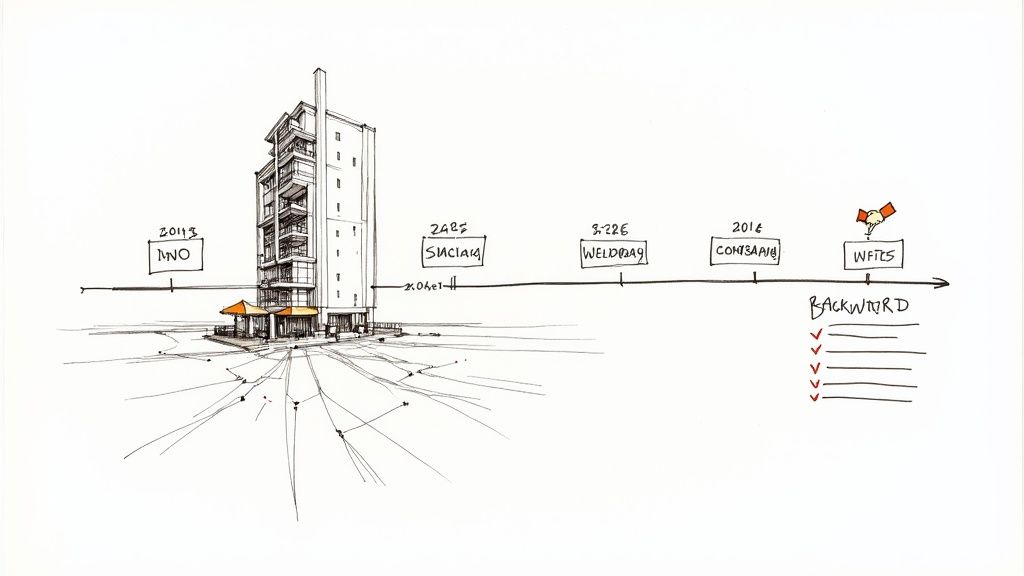
The secret to a seamless Annual General Meeting isn't some magic trick you pull off on the day. It's all in the strategic groundwork you lay in the weeks and months leading up to it. This isn't just about ticking boxes on a checklist; it's about building a solid operational blueprint for the whole shebang.
Think of it like reverse-engineering success. Pinpoint your scheme's financial year-end and start mapping out all the legislative deadlines backward from there. It's a simple move, but it instantly gives you a clear picture of when you need to hit key milestones, like calling for agenda items or sending out the official notice.
Setting Your Timeline and Budget
First things first, get on the same page with your strata manager to lock in those critical dates. A realistic timeline is your best defence against the last-minute scramble that so often leads to mistakes and frustrated owners. This is also the perfect time to hash out a practical budget for the meeting. You'll want to account for potential costs like hiring a venue, printing documents, or sorting out the tech for anyone joining virtually.
Another big piece of the puzzle is identifying major agenda items early on. Are there hefty capital works projects on the horizon? By-law changes that need to be proposed? These kinds of topics usually require detailed quotes or legal advice, and that stuff takes time to pull together. Tackling them early means owners get all the info they need with plenty of time to digest it.
Just to give you an idea of the sheer volume we're talking about, during the 2025 AGM season, corporate entities held over 51 AGMs and EGMs in January alone. That's a packed calendar, and it really highlights the administrative pressure on strata committees. When you're competing for owners' attention and professional resources, being organised isn't just nice—it's essential.
To help you visualise this, here’s a quick rundown of what a typical planning timeline looks like.
AGM Planning Timeline At-a-Glance
This table provides a high-level overview of the key phases for scheduling a strata AGM, based on typical legislative requirements across Australia.
| Phase | Timing (Relative to Financial Year End) | Key Actions |
|---|---|---|
| Initial Planning | 3-4 months prior | Set a tentative AGM date. Draft the budget for the upcoming financial year. Identify major projects or by-law changes for the agenda. |
| Call for Motions | At least 7 weeks prior | Issue a "pre-notice" inviting owners to submit motions for the AGM agenda. This is a critical step for owner engagement. |
| Agenda Finalisation | 4-6 weeks prior | The deadline for owner motions passes. The committee finalises the agenda, gathers quotes, and prepares all necessary reports and documentation. |
| Notice of Meeting | At least 21 days prior | Distribute the official AGM Notice, which includes the agenda, financial statements, budget, and all supporting documents for motions. |
| AGM Date | Within 3 months of FYE | Hold the Annual General Meeting, either in person, virtually, or as a hybrid event. |
Keep in mind that specific notice periods can vary slightly by state and territory, so always double-check your local legislation. This timeline is your roadmap to staying compliant and keeping things running smoothly.
The Value of Proactive Preparation
This proactive approach does way more than just keep you legally compliant. It drastically cuts down on the chances of owner disputes. When people feel informed and see a well-organised process, their trust in the committee skyrockets. A clear plan transforms the AGM from a procedural headache into a genuinely productive forum for making community decisions.
Of course, having the right tools makes a huge difference. Modern strata and body corporate management software can automate reminders and communication, making the entire scheduling process far more efficient. For committees needing a bit more horsepower, especially with complex admin and property oversight, looking into professional leasehold management services can bring invaluable expertise to the table and lighten the load on volunteers.
Getting to Grips with Legal Timelines and Notice Requirements
In the world of strata and body corporate management, timelines aren't just a friendly suggestion—they're a set of hard and fast legal rules. If you get them wrong, you risk invalidating every single decision made at your AGM. For any committee member or strata manager, mastering these deadlines is absolutely non-negotiable.
Following these procedures is about more than just ticking a compliance box. It’s about running a fair, transparent process that keeps the trust of all owners. The tricky part is that each state and territory has its own specific legislation, creating a patchwork of rules that demand your full attention.
Cracking the Code on State-Specific Notice Periods
While the exact number of days might differ from state to state, the core principle is always the same: give every owner enough time to review the agenda, think about the motions, and make arrangements to attend. One of the most common—and costly—mistakes is miscalculating the notice period, which can render the whole meeting void from the get-go.
Here’s a quick rundown of the minimum notice periods in key states:
- New South Wales (NSW): You’ll need to give lot owners at least 21 days' notice for an AGM. This has to be in writing and include the complete agenda.
- Victoria (VIC): For an owners corporation in Victoria, the requirement is a minimum of 14 days' notice. This ensures all members have a reasonable amount of time to prepare.
- Queensland (QLD): Queensland also requires at least 21 days' notice for an AGM. It’s crucial that this notice comes with all the required documents, like financial statements and the proposed budget.
Just remember, these are the minimums. It's always a good idea to give more notice, especially if you have a packed agenda with complex special resolutions. A little extra time can make a world of difference.
What’s a ‘clear day’ anyway? It’s a common point of confusion. It means you don’t count the day the notice is sent or the day of the meeting. So, if you send a notice on the 1st for a meeting on the 22nd, you have 20 clear days. That’s fine for a 14-day rule, but it falls short for a 21-day one. Always build in a buffer.
Committee Nominations and Owner Motions
It's not just about the main notice period. Other deadlines are just as critical, particularly the call for committee nominations and the submission of motions from owners. This step has to be officially started before you lock in the final agenda.
Typically, you'll send out a "pre-notice" or a call for agenda items several weeks before the official notice goes out. This gives owners a clear window to submit motions they want the scheme to vote on. In Queensland, for instance, the law says an AGM has to be called within three months of the scheme’s financial year-end. This creates a hard deadline for the entire process, from calling for motions right through to holding the meeting itself.
When an owner misses the cut-off for submitting a motion, it can't be legally considered at that AGM, which almost always leads to frustration and conflict. Making sure every owner is crystal clear on these deadlines is fundamental to scheduling a smooth, effective AGM.
If you’re looking for ways to get on top of these communication and scheduling challenges, exploring the benefits of strata management automation can be a game-changer. These tools are designed to streamline these exact workflows, ensuring nothing falls through the cracks.
Crafting a Compliant and Effective AGM Agenda
Let's be honest, a well-structured agenda is the absolute backbone of a productive AGM. It’s not just a list of things to talk about; it’s the official roadmap for the meeting. It keeps you legally compliant and gives every owner a clear picture of what’s on the table for a vote. Without a solid agenda, even the best-planned meetings can quickly go off the rails.
So, where do you start? With the non-negotiables. Every state's strata legislation has a list of mandatory items that must be included. Think presenting the financial reports, adopting the new administrative and capital works fund budgets, and, of course, electing the new committee. These are the core building blocks of your meeting.
This simple flowchart gives you a high-level view of how owner motions slot into the whole AGM scheduling process.
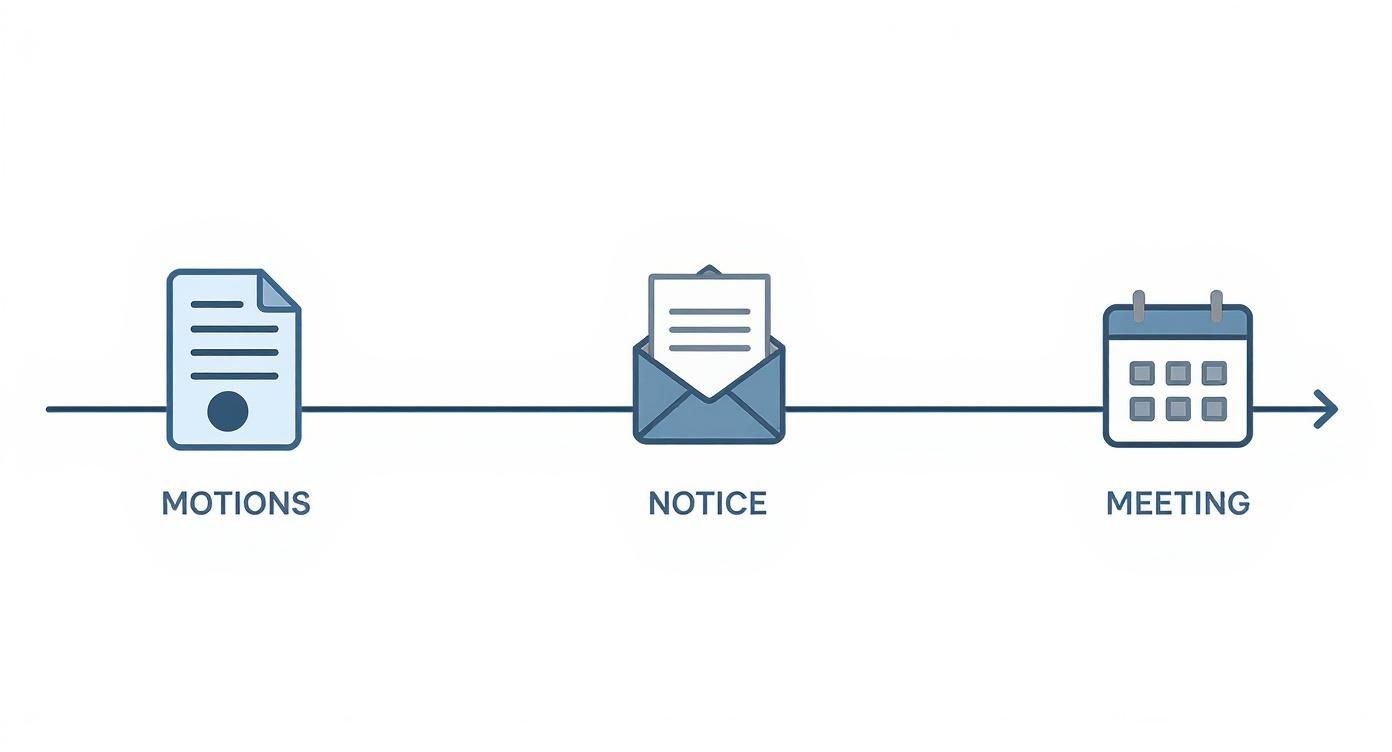
As you can see, leaving a clear window for owners to submit their motions before the official notice goes out is a critical step. It’s essential for both compliance and genuine owner engagement.
Drafting Clear and Actionable Motions
Beyond the must-have items, the real skill in crafting a great agenda is in how you write the motions. Ambiguity is your worst enemy here. A motion needs to be so crystal clear that a "yes" or "no" vote has an unmistakable outcome.
For instance, a vague motion like "Discuss the pool fence" is a recipe for a rambling, unproductive debate. A much better, actionable version would be:
"That the owners corporation accept the quote from XYZ Fencing for $5,500 to replace the swimming pool fence, with funds to be allocated from the Capital Works Fund."
See the difference? This one is specific, tells everyone what they’re voting on, and includes all the key details for an informed decision. The same principle applies whether you're dealing with an ordinary resolution (which just needs a simple majority) or a special resolution for big changes like amending by-laws, which has a much higher voting threshold.
Handling Owner-Submitted Motions Correctly
One of the most critical parts of AGM scheduling for strata and body corporate is how you manage motions submitted by owners. The committee has a legal duty to include any valid motion that’s submitted before the cut-off date. You can't just bin a motion because you don't agree with it.
The key is to communicate the deadline for submissions clearly and well ahead of time. This simple step can prevent a lot of frustration and stop owners from feeling like the committee is shutting them down. When you receive a valid motion, it must be added to the agenda exactly as the owner submitted it.
You also need to keep an eye on legislative changes, which can sneak in new mandatory agenda items. For example, some big reforms in New South Wales kicking off from 1 July 2025 will force all strata schemes to include sustainability as a permanent agenda item. These reforms also bring in tougher penalties for developers who don't get the first AGM right. You can read up on these upcoming strata changes on Strata Plus. Staying on top of updates like these is crucial to making sure your agenda is always compliant.
Getting Quorum, Proxies, and Voting Right
Let's be blunt: the decisions made at your AGM are only as solid as the procedures you follow. If you stumble on the rules for quorum, proxies, and voting, you’re not just making a small mistake—you’re risking having the entire meeting’s outcomes legally challenged. This is where a bit of careful management goes a long way.
It all kicks off with quorum. This is simply the minimum number of owners who need to be present (in person, online, or by proxy) for the meeting to even start. Think of it as the legal green light. Without it, the meeting is a non-starter, and no official business can happen.
Hitting Your Quorum Numbers
The exact number for a quorum can differ a bit depending on your state, but a common benchmark is that at least 25% of the people entitled to vote need to show up. For a small 12-lot scheme, that means you need at least three owners (or their proxies) in the room. In a larger building with 100 lots, you're looking for 25 people.
So, what happens if you don’t get the numbers? The meeting usually has to be adjourned for at least a week. You’ll have to send out a whole new notice for the rescheduled meeting. The silver lining is that at the second attempt, whoever shows up forms the quorum, even if it’s just a couple of people. But trust me, it’s an administrative headache you want to avoid if you can.
The best way to hit quorum is good old-fashioned communication. A few reminders in the lead-up to the AGM and making it dead simple for owners to appoint a proxy can make all the difference. You’ll dramatically boost your chances of getting it right the first time.
Making Sense of Proxy Votes
A proxy is just a formal piece of paper that lets an owner appoint someone else—a neighbour, a family member, or the chairperson—to attend and vote for them. Getting a handle on these is a massive part of a smooth AGM process.
You need to be meticulous here:
- Check Every Form: Make sure every proxy form is filled out properly, signed, and handed in before the meeting kicks off. Any incomplete forms are invalid, no exceptions.
- Know the Limits: Most states cap how many proxies one person can hold. This is a crucial rule to stop any single person from having too much sway over the votes.
- Directed vs. Open Proxies: An owner can either tell their proxy exactly how to vote on certain motions or give them the freedom to vote as they see fit.
Imagine an owner is travelling overseas. They could give their proxy to a neighbour with clear instructions: "Vote YES on motion 4 (the levy increase) but NO on motion 7 (the new by-law)." It falls to the chairperson to make sure these directed votes are recorded exactly as intended.
Picking the Right Way to Vote
Finally, we get to the actual voting. The method you use is just as important as the numbers. Typically, it comes down to two options: a show of hands or a formal poll vote.
A show of hands is the simplest approach: one owner, one vote. It’s perfect for routine, non-controversial decisions (ordinary resolutions) and keeps the meeting moving.
A poll vote, however, can be requested by any owner and is usually mandatory for the big stuff, like special resolutions. When a poll is called, votes are tallied based on each owner's unit entitlement or lot liability. This gives more weight to those who own larger or more valuable properties, reflecting their bigger financial stake. Getting this right is fundamental to a fair and legally sound outcome for everyone involved.
Executing the Meeting and Post-AGM Actions
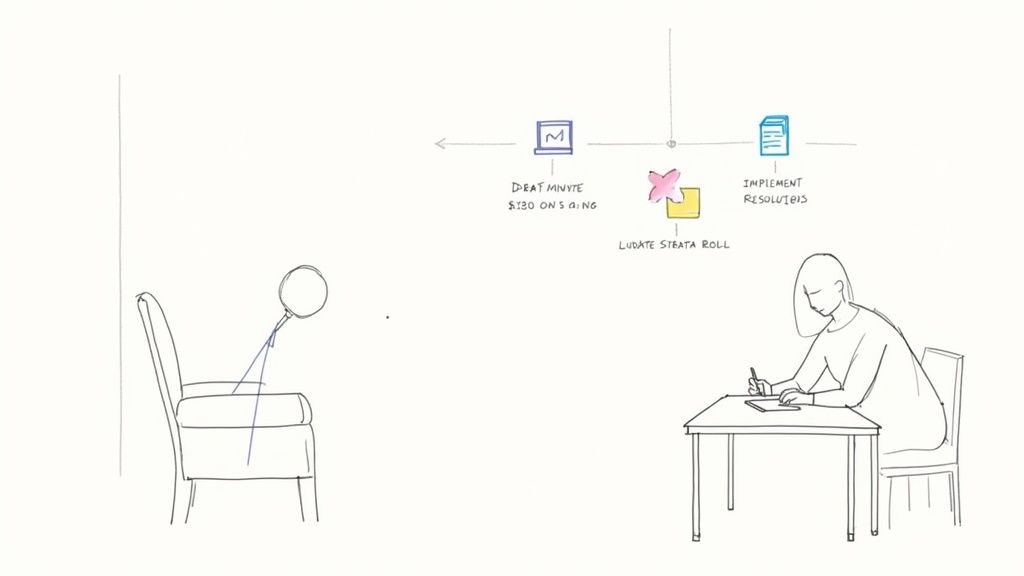
After months of careful planning, meeting day has finally arrived. But the job isn't over when the last vote is counted. How you run the AGM itself and what you do immediately afterwards are just as critical for good governance and ensuring every decision gets put into action.
Running a smooth, orderly meeting is an art. A good chairperson is worth their weight in gold, keeping discussions on track, respectful, and moving along. It’s their responsibility to make sure every owner gets a fair go at the microphone while politely reigning in conversations that stray off-topic and threaten to derail the whole agenda.
This isn't just about calling for votes; it's about actively managing the flow and energy of the room to get through everything on the agenda without the meeting dragging on for hours.
Capturing the Details Accurately
While the chairperson steers the ship, the secretary or strata manager is busy with the crucial job of taking the minutes. This isn't just a quick summary of who said what—it’s the official legal record of every single decision made by the owners corporation.
The minutes need to be precise. You must capture the exact wording of each motion and the result of the vote, noting who moved and seconded it, and whether it passed as an ordinary, special, or unanimous resolution. If a meeting is particularly complex or contentious, it might be worth using professional legal transcription services for meeting minutes to guarantee every detail is captured perfectly.
A classic mistake is writing vague minutes that say a motion was simply "discussed" or "agreed upon." For the minutes to hold up legally, they must explicitly state that a motion was resolved and detail the voting outcome.
The Critical Post-AGM Workflow
As soon as the meeting ends, a new clock starts ticking. The follow-up phase is where many committees unfortunately drop the ball, leading to lost momentum, confusion, and delays. Having a clear, action-oriented plan is non-negotiable.
Here’s a look at the essential tasks that need to happen promptly after the meeting wraps up.
This checklist outlines the key responsibilities and deadlines that your new committee and strata manager need to tackle straight away.
Post-AGM Action Checklist
| Task | Typical Deadline | Responsibility | Notes |
|---|---|---|---|
| Distribute Draft Minutes | Within 7-14 days | Strata Manager/Secretary | Check your state's legislation for the exact timeframe. |
| Action Resolutions | Immediately | Committee/Strata Manager | Begin implementing decisions, like signing contracts or issuing work orders. |
| Update Strata Roll | Within 14-28 days | Strata Manager | Formalise the new committee members' details. This is a legal requirement. |
| Notify Insurer | As soon as possible | Strata Manager | Inform the insurer of the new committee office bearers. |
| Update Bank Signatories | As soon as possible | Treasurer/Strata Manager | Ensure new committee members have authority for financial transactions. |
Getting these steps right isn’t just good practice; it's a legal necessity that builds trust and keeps the community running smoothly.
Reports show that committees using structured checklists for the whole AGM process see up to a 30% reduction in post-meeting conflicts. It’s a testament to how solid preparation and follow-through lead to better governance.
Juggling everything from the initial scheduling to all the post-AGM communication can feel overwhelming. This is exactly where dedicated tools can make a world of difference. Exploring specialised software for strata managers can show you how to automate these critical follow-up tasks, ensuring you stay compliant while freeing up your time for more important work.
Common Questions About AGM Scheduling
When it comes to strata meetings, a few common but critical questions always seem to pop up. Getting straight answers can help everyone, from owners to committee members, handle the AGM scheduling process confidently and sidestep those all-too-common pitfalls.
Let's dive into some of the questions we hear year after year.
What Happens if We Miss the Deadline for Our Strata AGM?
Missing the legal deadline for an AGM is a big deal. Your scheme will be in breach of state legislation, which can kick off a cascade of problems. A tribunal could step in and order the meeting to be held, and any decisions the committee made in the meantime could be questioned or even ruled invalid.
It also creates practical headaches. Things like approving annual levies get delayed, which can mess with the building's cash flow and put essential services at risk. If you see a delay on the horizon, get on the phone with your strata manager immediately. In some states, you might be able to get an extension, but you have to be proactive about it.
Can Our Body Corporate Hold an AGM Entirely Online?
Absolutely. In most Australian states, holding fully virtual or hybrid AGMs is now allowed by law. It’s a fantastic way to offer flexibility for owners who can't be there in person and often gives participation rates a healthy boost.
But first, you need to check your scheme's specific by-laws. Make sure there are no outdated rules that could get in the way. If you get the green light, the official Notice of Meeting must provide crystal-clear instructions on how to join electronically—everything from accessing the platform to voting and asking questions during the meeting.
Choosing a reliable and user-friendly platform is make-or-break for a successful virtual meeting. A clunky system will only lead to frustration and disenfranchise owners, completely defeating the purpose of going remote in the first place.
How Much Notice Is Required to Add a Motion to the Agenda?
The window for an owner to submit a motion for the AGM agenda varies by state, but the process is always the same: it has to be submitted in writing before the official Notice of AGM goes out.
As a general rule of thumb, owners should aim to get any proposed motions to the secretary or strata manager at least four to six weeks before the planned meeting date. This gives them enough time to make sure the motion is worded correctly and included in the agenda pack sent to all owners. Don't leave it to chance—always confirm the specific cut-off date with your strata manager to avoid being disappointed.
Who Can Chair the AGM if the Chairperson Is Unavailable?
If the elected chairperson can't make it to the meeting, don't worry—strata legislation has a simple and clear backup plan.
The very first order of business on the agenda becomes electing a temporary chairperson for that meeting. The owners present will first be asked to elect another committee member to take the reins. If no other committee members are available or willing, the owners can then elect any other eligible owner present to chair the AGM. The person elected steps into the chairperson's shoes with all their duties, but just for that meeting.
A smooth AGM process hinges on great communication. From sending reminders to managing follow-ups, OnSilent can handle your calls and messages, ensuring every owner stays in the loop without piling more onto your plate. Find out how an AI assistant can help you manage your strata communications.