

Think of a call answering service as your business’s professional front door. It’s a dedicated receptionist ensuring every single call gets handled quickly and professionally, even when you're flat out. This way, you never miss a lead or an opportunity just because you're on the tools or in a meeting.
What Are Call Answering Services and Why Should You Care?

At its heart, a call answering service is an external team or system that manages your incoming phone calls for you. Instead of your mobile or office phone ringing off the hook, calls are routed to this service. They then act on your behalf based on a set of instructions you’ve given them.
It sounds technical, but it’s actually pretty straightforward.
Imagine you're a plumber up a ladder in Brisbane or a real estate agent showing a property in Melbourne. A potential new client rings your business number. Instead of it going to your voicemail (which, let's be honest, many people just hang up on), the call is instantly forwarded to your chosen service.
How It All Works, Step-by-Step
This isn't just about picking up the phone; it's an intelligent process that you can tailor to how your business operates.
Here’s a typical look at how it unfolds:
- A Customer Calls: A new lead or an existing client dials your business number.
- The Service Jumps In: The call is answered immediately, either by a real person or a smart AI assistant, using a custom greeting you've set up for your company.
- They Get the Details: The receptionist gathers the crucial info—the caller's name, contact number, and what they're calling about.
- Action Is Taken: Based on your rules, the service might take a detailed message, book an appointment straight into your calendar, or patch the call through to you or a team member if it's an emergency.
- You Get the Memo: You receive an instant notification via SMS or email with all the details, so you can follow up when it suits you.
The beauty of this is that from your caller's perspective, they’ve received immediate and professional service. For you, it means no more missed opportunities and fewer interruptions when you're trying to get work done.
It's More Than Just Answering the Phone
Ultimately, a professional call answering service is a powerful tool for growth. It’s not just about managing calls; it's about improving your customer service and making your business run smoother. By providing a reliable and polished first point of contact, you build a credible image, no matter if you're a one-person show or a growing team.
This whole industry has become a massive part of the Australian business scene. The market for call centre operations in Australia is tipped to be worth around $1.9 billion in 2025, which shows just how vital this kind of support has become. Businesses are realising they need to meet customer expectations, and this is one of the best ways to do it. If you're curious, you can explore more data on the Australian call centre industry to see just how big it is.
Exploring the Types of Call Answering Services
Not all call answering services are built the same, and the right fit really depends on your business's specific needs and budget. Figuring out the main options is the first step to landing a perfect match. For Aussie businesses, the choice usually boils down to three models: live receptionists, big outsourced call centres, and the newer virtual or AI-powered assistants.
Each type brings a different mix of personality, power, and price to the table. A solo tradie might get exactly what they need from one model, while a national e-commerce brand will need the heavy-duty capacity of another. Let’s break down how each one works and who they’re best for.
The Personal Touch of Live Receptionists
A live receptionist service gives you a dedicated person or a small team of agents who actually get to know your business. Think of it as hiring a receptionist who just happens to work remotely. They’ll learn your preferred greetings, recognise your key clients, and can handle more complex conversations because they understand the context of what you do.
This model is a fantastic choice for businesses where building personal relationships is everything.
- Law Firms and Consultants: Where client confidentiality and a professional, reassuring voice are non-negotiable.
- High-End Service Providers: Like architects or boutique agencies, where every single interaction needs to reflect a premium brand image.
The big win here is the high level of personalisation and the quality of the customer interaction. The catch? This premium service usually comes with a higher price tag and might have limits on call volume or operating hours compared to the bigger players.
The Scalability of Outsourced Call Centres
Outsourced call centres are the heavy lifters of the call answering world. We’re talking large-scale operations with hundreds, sometimes thousands, of agents ready to handle a massive flood of inbound calls 24/7. They run on standardised scripts and are built for one thing: efficiency.
This option is a brilliant fit for businesses that get swamped with calls and need round-the-clock coverage without a single hiccup.
An outsourced call centre is like having an entire customer service department on standby, ready to scale up or down based on your latest marketing campaign or seasonal rush. This makes them perfect for product support lines, e-commerce stores, or any business running a major promotion.
While they’re incredibly scalable and often cost-effective for huge volumes, the conversations can sometimes feel a bit less personal. Agents are handling calls for heaps of different companies, so they stick strictly to the scripts you provide, leaving little room for spontaneous, detailed chats.
The Efficiency of Virtual and AI Assistants
The latest evolution in call answering is the virtual or AI-powered assistant. These systems use clever technology to manage calls with incredible efficiency, and they do it at a fraction of the cost of human agents. They can answer calls, take messages, book appointments, and even handle common customer questions instantly, any time of day or night.
For example, an AI answering service can juggle hundreds of calls at the same time without a single one ever hitting voicemail, making sure every potential lead is captured. This tech is perfect for small to medium-sized businesses, real estate agents, and tradies who need reliable after-hours coverage without the hefty overheads of a live agent. Many of these modern services also offer integrated tools like voicemail to text apps to make sure every customer message is logged and easy to review.
This approach offers unbeatable affordability and 24/7 availability. The main trade-off has always been the lack of a human touch, but today's conversational AI is making these interactions feel more natural than ever. Checking out an AI answering service for your mobile is a great way to see how this technology can slot right into your workflow.
To help you see the differences side-by-side, here’s a quick comparison of the three models.
Comparing Call Answering Service Models
| Feature | Live Receptionist | Outsourced Call Centre | Virtual/AI Assistant |
|---|---|---|---|
| Personalisation | High | Low to Medium | Low (but improving) |
| Cost | High | Medium (per call) | Very Low |
| Scalability | Low | Very High | Instantly Scalable |
| Availability | Business hours (24/7 optional) | Typically 24/7 | Always 24/7 |
| Best For | Relationship-focused businesses | High-volume, 24/7 operations | SMBs, tradies, cost-conscious businesses |
| Human Touch | Yes, very personal | Yes, but can be impersonal | No, AI-driven |
At the end of the day, the best call answering service comes down to balancing your need for a personal touch with your call volume, budget, and when you need to be available for your customers.
The Real-World Benefits for Your Business
Let’s move past the basic promise of "never missing a call" and get into the real, tangible ways a professional answering service can help you grow your business. This isn't just about having a safety net; it's a strategic move to boost your credibility, save a heap of cash, and get more done.
The positive effects really do ripple through your entire operation, turning a simple service into a powerful tool for success.
This diagram shows the typical ways calls get handled, from a live personal agent, to a bigger call centre, and finally to smart AI systems.
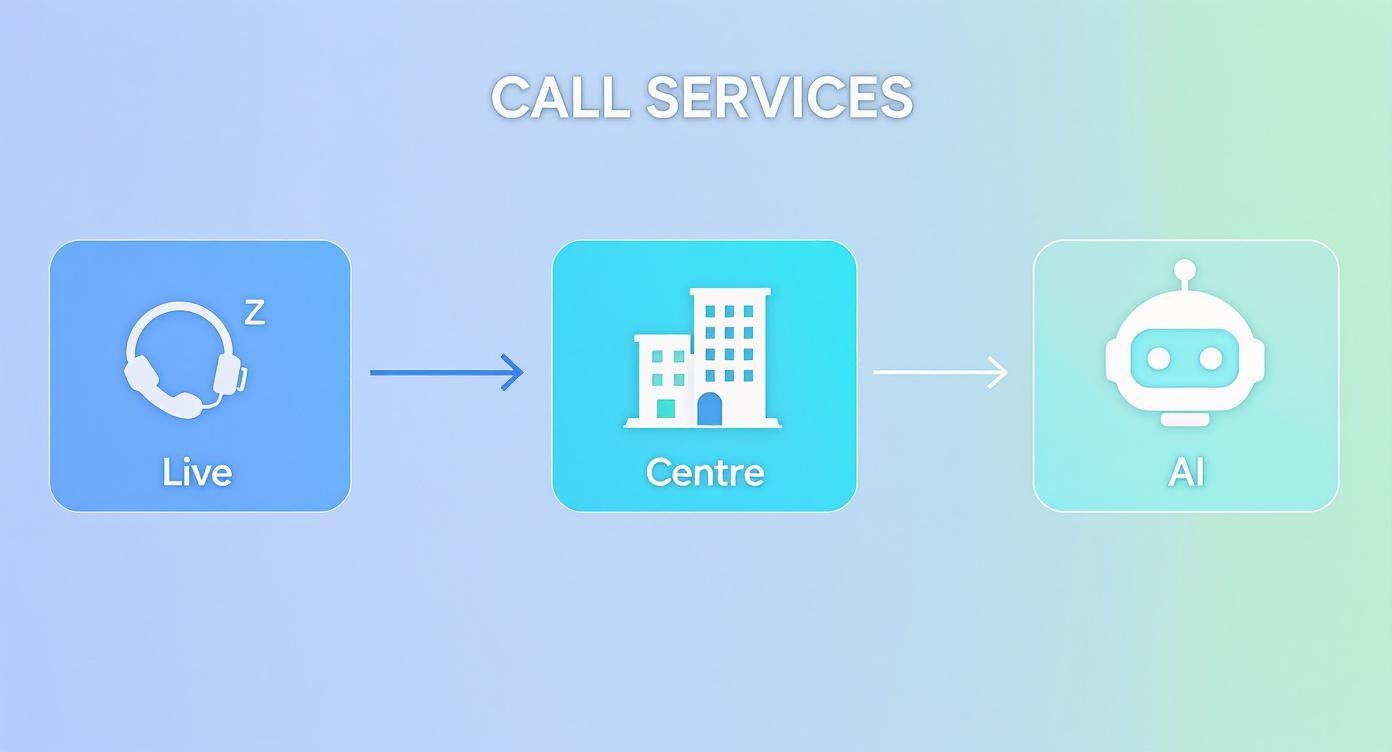
Each of these setups offers a different way of managing your communications, so you can pick the one that best suits your business style and what your customers need.
Project a Polished, Professional Image
You only get one chance to make a first impression. When a potential new customer rings you, how that call is answered instantly shapes how they see your business. A prompt, professional greeting builds immediate trust. It just does.
Picture this: you're a sole trader or run a small consultancy. A call answering service lets you give off the vibe of a much larger, more established outfit. Instead of a rushed "hello?" from a noisy job site, your callers are greeted by a calm, professional receptionist who sounds like they're part of your team.
That small detail can genuinely be the difference between a client choosing you or ringing your competitor next.
Realise Significant Cost Savings
Let's be honest, hiring a full-time, in-house receptionist is a massive financial commitment. Here in Australia, it’s not just about the salary. You’ve got to factor in superannuation, payroll tax, leave entitlements, plus all the overheads like office space and equipment.
This is where virtual answering services really shine. A traditional receptionist in a major Aussie city can easily set you back over AUD 55,000 a year. In stark contrast, a quality virtual answering service usually falls somewhere between AUD 200 to AUD 600 per month. The savings are huge, and you don't have to sacrifice on quality.
That's a serious amount of cash freed up to pump back into other parts of your business that actually make you money.
Boost Team Productivity and Focus
Constant phone interruptions are the ultimate productivity killer. Every single time you or someone on your team has to drop what they’re doing to answer the phone, it shatters concentration and pulls you away from the core tasks that drive revenue.
By handing off your call handling, you claw back countless hours every week. Your team can finally give their full attention to client work, strategic planning, or closing that next big deal, all while knowing that every incoming call is being managed properly in the background.
The result is a more focused, effective, and far less stressed-out workforce.
Improve Lead Capture and Customer Loyalty
In many service industries, the first business to answer the phone gets the job. It's that simple. Missed calls are missed opportunities. Take the legal sector, for example, where a whopping 62% of potential clients sign with the very first firm that gets back to them.
A call answering service makes sure every single lead is captured, documented, and sent straight to you for follow-up. That immediate, professional response doesn't just help you win new business; it also builds loyalty with your current clients, who feel like a priority. This system is a powerful addition to other strategies for generating business leads, as it ensures you never let a hard-won opportunity slip through the cracks.
How to Choose the Right Call Answering Service
Picking the right call answering service feels like a big commitment, but it doesn't have to be a headache. If you know what to look for, you can cut through the sales pitches and find a genuine partner for your business. Think of this as your no-nonsense checklist for making a smart, confident choice.
It all starts with a simple truth: not all services are the same. Your goal is to match a provider's strengths to your actual needs—from the kinds of calls you get to the software you use every day.
Assess the Essential Features
Before you even glance at a price tag, you need to know what a service can actually do for you. The features are the nuts and bolts of your new call management system, so focus on the ones that will make a real difference to your daily grind.
Here’s what you should be looking for:
- Custom Greetings and Scripts: The service needs to sound like you. They should answer with your business name and a tailored greeting, so your clients have no idea they’re talking to a third party.
- Call Forwarding and Routing: You need the power to send calls to the right person. That means having the flexibility to patch urgent calls through to you or route specific queries to different team members.
- Appointment Scheduling: A top-tier service can book appointments straight into your calendar. This saves you the endless back-and-forth and locks in new business on the spot.
- After-Hours and Overflow Support: What happens after 5 PM or when you’re swamped? Make sure the service can cover your back outside of business hours or during those crazy peak periods.
Choosing a service is like hiring a new team member. You wouldn't bring on a receptionist without making sure they have the right skills, and the same logic applies here. The right features are non-negotiable.
Demystify the Pricing Models
Pricing for these services can be all over the shop, so it’s vital to understand what you're actually paying for. Most providers use one of three main models, and each has its pros and cons depending on your call volume.
- Pay-Per-Call or Pay-Per-Minute: This is straightforward—you’re billed for exactly what you use. It can be a great budget-friendly option if your call volume is low or unpredictable.
- Monthly Flat-Rate Plans: These plans give you a set number of calls or minutes for a fixed monthly fee. The predictable billing is fantastic for budgeting, but you might end up paying for minutes you don’t use.
- Custom or Tiered Packages: Many services bundle features and call allowances into packages. This allows you to start small and scale up as your business grows.
Always, and I mean always, ask about hidden costs. Are there setup fees? Extra charges for public holidays? You’re looking for a transparent pricing structure that fits your call patterns, not one that’s full of nasty surprises.
Prioritise Seamless Integration
This one’s a big deal. A modern call answering service can’t be an island; it has to connect with the tools you already rely on. Good integration is what turns a basic answering service into a powerful part of your workflow.
Just imagine your service books a client meeting, and it instantly pops up in your Google Calendar. Or it logs a new lead directly into your CRM. That kind of connectivity saves you hours of mind-numbing data entry and makes sure nothing important falls through the cracks. For a deeper look, our guide on a professional phone call answering service shows just how much smoother your business can run with these connections in place.
Never Compromise on Security and Privacy
Finally, remember that you’re trusting a third party with sensitive client and business details. Data security and privacy aren't just buzzwords; they’re absolutely critical. Your chosen partner must comply with Australian privacy laws and show a real commitment to protecting your data.
Don’t be shy about asking potential providers about their security protocols. Where is their data stored? How do they ensure confidentiality? A reputable service will be completely open about its practices and have clear policies to back it up. Protecting your clients' information is just as important as answering their calls, so make it a deal-breaker in your evaluation.
Measuring the Return on Your Investment
So, how do you actually know if a call answering service is making you money? Beyond just feeling less stressed, you need to be able to measure the financial impact. The key is to stop seeing it as just another monthly expense and start treating it like a strategic investment—and for that, you need to understand its return on investment (ROI).
Don't worry, calculating the ROI doesn't need to be a complicated spreadsheet nightmare. It's really about balancing the real-world gains against the fixed monthly cost. Think of it as a simple equation: you take the value you've gained, subtract what the service cost, then divide that by the cost to see your return in black and white.
A Simple Formula for Calculating ROI
To get a proper sense of the numbers, you'll want to track a few key things. This helps you move from a gut feeling to a solid business case.
Here’s a straightforward formula to get you started:
(Value of Gains – Cost of Service) / Cost of Service = ROI
For this to actually work, you need to put a dollar value on the benefits. So, what do those "gains" really look like?
- Value of New Leads Captured: Let’s be blunt: how much is a new client or job worth to you? Every single call that gets answered instead of being dumped into voicemail is a potential sale you didn't have before.
- Value of Reclaimed Hours: What’s an hour of your time worth? Or your team’s? Tally up the hours you’re no longer wasting on the phone and multiply it by your billable rate. It adds up fast.
- Savings on In-House Staff: This one’s easy. Compare the service cost to what you’d pay a full-time receptionist, once you factor in salary, superannuation, and all the other overheads.
This little calculation completely changes the conversation from "How much does it cost?" to "How much is it making me?"
Bringing the Numbers to Life
Let’s see how this plays out for a couple of different businesses.
Case Study Example: A Law Firm
A small law firm pays $400 per month for a call answering service. In the first month, the service snags one new client enquiry after hours that would have absolutely been missed. That single client is worth $5,000 in legal fees. The ROI is massive. The service didn't just pay for itself; it generated a huge profit.
This is especially critical in competitive fields. For instance, some data shows a staggering 62% of potential clients will sign with the first law firm that gets back to them. Answering that one call can be the difference between winning and losing a massive piece of business.
The Hidden Costs of Doing It Yourself
Beyond just capturing new leads, there's the very real cost of managing call staff internally. Staff turnover is a huge, often invisible, expense that bleeds your bottom line through recruitment, hiring, and training. High attrition isn't just a headache; it's a major operational drain.
And this problem is all over Australia. The average staff attrition rate in Australian contact centres is around 29%, but for larger centres, it can rocket up to an eye-watering 43%. When you outsource your call handling to a dedicated service, you shield your business from these direct and indirect costs. If you want to dive deeper into these industry challenges, you can read the full report on Australian contact centre best practices.
By using a call answering service, you get consistent, professional coverage without the HR nightmares, making it a stable and predictable part of your operations. That stability lets you focus on actually growing your business, knowing that your front line of communication is always secure.
Getting Your Service Set Up for Success
A smooth launch is the secret to getting value from your new call answering service right away. Think of this guide as your action plan to cut out the guesswork and make sure your service is delivering results from the very first call.

Getting started isn't about being a tech whiz; it's all about clear communication. Your main goal is to arm your provider—whether it's a team of real people or a clever AI assistant—with everything they need to sound like a natural part of your business. A little effort upfront pays off big time, creating a polished, professional experience for every single caller.
Your Go-To Implementation Checklist
Flicking a switch and hoping for the best won't cut it. A solid setup needs a bit of thought about how you want your calls handled. Just work through these steps to build a rock-solid foundation.
-
Nail Down Your Call Handling Rules: This is the big one. You need to decide exactly what happens when the phone rings. Should the agent just take a message? Can they book an appointment directly? Or should they patch urgent calls straight through to your mobile?
-
Sort Out Your Scripts and Greetings: How do you want your phone answered? Give them a specific greeting—like, "Good morning, you've reached ABC Plumbing, how can I help?"—to keep your branding consistent. It's also a great idea to prep a short FAQ with answers to common questions about your services, hours, or pricing. For more pointers on this, check out our guide on call handling best practices.
-
Get Call Forwarding Right: This is the technical bit that makes it all work. You’ll need to set up your business number to automatically divert calls to the new number from your answering service. Most providers have simple, step-by-step instructions for all the major Australian carriers.
-
Connect It With Your Other Software: To really get things humming, link your new service to the tools you already use every day. Hook it up to your calendar for automatic appointment booking, and connect it to your CRM to make sure new lead info is logged without you lifting a finger.
The Final Check Before You Go Live
Before you tell the world about your new-and-improved availability, do a couple of test calls. This final check is crucial for ironing out any little wrinkles.
Call your own business number from a mate's phone. Go through the process just like a customer would. Does the greeting sound right? Is your information being captured correctly? This quick test run ensures everything is seamless when real customers start calling.
By following this structured approach, you can switch over to your new service with confidence. This prep work guarantees that from day one, your call answering service isn't just another bill, but a powerful asset that boosts your professional image and simplifies your day. You'll be set up to catch every opportunity, without adding more to your plate.
Common Questions About Call Answering Services
Committing to a new service always brings up a few last-minute questions. It’s smart to get the full picture before you jump in, so let's tackle the most common queries and concerns we hear from Australian business owners about professional call answering.
How Will a Remote Receptionist Sound Credible?
This is a top concern, and it's a good one. You don't want your clients talking to someone who sounds like a complete stranger to your business.
The secret is in the setup. A quality provider works with you to create detailed scripts, custom greetings, and a solid FAQ about your business. They learn your hours, your services, and even the names of your key staff.
From your caller's perspective, they’re just speaking with a well-informed assistant who’s part of your team—not some disconnected operator reading from a generic prompt. The whole point is to make them a seamless extension of your brand.
Can They Handle Complex Tasks Like Bookings?
Absolutely. Modern call answering services have moved way beyond just taking a message. Many can plug directly into your digital calendar—think Google Calendar or Calendly—to schedule appointments, book client consultations, or even line up property viewings in real-time.
This turns a simple phone call into a confirmed piece of business without you having to lift a finger. You set the rules and your available time slots, and the service handles the rest, firing off an instant confirmation to both you and your client.
The real value of a professional answering service isn't just that it answers calls, but that it performs valuable actions. It's the difference between a simple message-taker and a proactive administrative assistant who actively helps grow your business.
Is This Just a Glorified Voicemail?
Not even close. Voicemail is a passive system. It puts all the work on the caller to leave a message and then just sit there hoping for a callback. Let's be honest, how many actually wait? Studies show a massive 62% of callers in competitive fields like law simply hang up and dial the next business on the list.
A call answering service gives people what they want: an immediate, human interaction. It captures the lead's details, answers their basic questions, and provides a professional experience that builds trust from the get-go. It actively stops you from losing business, whereas voicemail practically hands customers over to your competitors.
How Is My Client Data Kept Secure?
In today's world, data security is non-negotiable, especially with Australia’s strict privacy laws. Any reputable provider will use secure systems and have tight protocols in place to protect your information. All your call logs, messages, and client details should be stored in encrypted environments.
When you’re vetting a service, always ask about their privacy policy and how they comply with Australian regulations. A trustworthy partner will be completely transparent about their security measures, making sure both your business and your clients' sensitive information are properly protected.
Ready to capture every lead and reclaim your time? OnSilent provides a powerful AI assistant that handles your calls 24/7, books appointments, and ensures no opportunity is ever missed. Discover how OnSilent can work for your business.