

Using AI as a body corporate manager isn't about bringing in some futuristic robot to run the show. It’s much simpler than that. It’s about making a smart shift from being constantly stuck in reactive, hands-on admin work to running a proactive, automated operation.
This technology is designed to take over the repetitive, time-sucking tasks—think sorting calls and scheduling routine maintenance. The goal? To free you up for the work that actually requires your expertise, like engaging with the community and strategic planning.
How AI Is Changing the Game for Strata Management Today

Picture the classic day for a body corporate manager: the phone rings off the hook, the email inbox is a mountain, and you're forever chasing up maintenance requests. It's a role that often feels like you're just juggling one admin task after another. This is where artificial intelligence steps in, not as some complex sci-fi concept, but as a seriously efficient digital assistant.
The real purpose of AI in strata isn't to replace managers but to give them a massive leg-up. It's brilliant at handling the high-volume, mind-numbing tasks that eat up your day. By automating these processes, AI pulls you out of the daily administrative grind, so you can focus on solving complex problems and building solid relationships within the communities you look after.
Shifting from Putting Out Fires to Preventing Them
One of the biggest wins with AI is moving from a purely reactive management style to a proactive one. Instead of waiting for a pipe to burst and dealing with the chaos, AI systems can look at historical data and predict when maintenance is actually needed. This heads off costly emergencies before they even happen.
This forward-thinking approach isn't just for physical assets, either. Here's a quick look at the transformation across the board.
Before we dive in, let's see how this shift looks in practice. This table breaks down the old-school methods versus what's possible with a bit of AI smarts.
AI Transformation in Body Corporate Management At a Glance
| Management Area | Traditional Method | AI-Powered Solution |
|---|---|---|
| Communication | Manually answering every call and email | Automated call/email triage; urgent issues flagged, routine queries get instant answers. |
| Administrative Tasks | Manual invoice processing and report generation | Automated data entry, levy notice distribution, and report creation. |
| Maintenance | Responding to failures and resident complaints | Predictive maintenance scheduling based on data analysis to prevent breakdowns. |
| Decision-Making | Relying on past experience and manual data review | Data-driven insights for budgets, capital works planning, and risk management. |
As you can see, it's about replacing tedious manual work with intelligent automation, giving managers the space to think strategically.
Key areas getting a complete overhaul include:
- Communication Overload: Smart systems can answer, sort, and direct incoming calls and emails. Urgent problems get flagged immediately, while everyday questions are handled automatically without you lifting a finger.
- The Admin Burden: Forget manual data entry. Tasks like processing invoices, sending levy notices, and pulling standard reports can all be automated, which means fewer mistakes and more time back in your day.
- Data-Driven Decisions: AI crunches the numbers from your operational data, giving you clear insights. This helps committees make smarter, more informed decisions on everything from budgets and maintenance schedules to long-term capital works planning.
This change is already picking up steam right across Australia. Artificial intelligence is reshaping property and strata management, delivering huge gains in efficiency and keeping residents happier. Reports show AI is being put to work for predictive maintenance, smoothing out tenant communications, and managing complex building systems.
Understanding the Real Change Here
At the end of the day, being a body corporate manager involves a massive list of duties, from keeping the books balanced to resolving disputes. To get a feel for the sheer scope of responsibilities that AI is designed to help with, check out this comprehensive guide to managing a building in NSW.
AI tools are built to handle the procedural side of these jobs, empowering you to use your expertise where it truly counts. For a closer look at how this all fits together, have a read of our article on strata management automation.
Five Practical AI Use Cases for Your Strata Portfolio

It’s one thing to talk about AI in broad strokes, but it’s another thing entirely to see how it can actually work for you day-to-day. For body corporate managers, AI isn't here to take over your job. It’s here to help you do it faster, smarter, and with a whole lot less stress.
So, let's ditch the theory and get practical. Here are five real-world examples of how AI can transform your strata portfolio from a chaotic juggling act into a well-oiled machine. Each one tackles a common headache and offers a genuine solution.
1. Automated Call and Voicemail Triage
You know the feeling—the phone is a double-edged sword. It’s your connection to residents and contractors, but it’s also a constant source of interruptions that can completely derail your day.
Imagine having an AI-powered assistant that acts as your frontline defence. It fields every single call and voicemail, instantly figuring out what’s what. It can tell the difference between a panicked "the basement is flooding!" call and a routine query about the next AGM. This means you only get alerted to the stuff that genuinely needs your immediate attention.
Suddenly, you’re free to focus on the big picture without the nagging fear that you’re missing a critical call. The AI handles the noise; you handle the important work.
2. Intelligent Email and Message Sorting
Just like the phone, your inbox is a battlefield. An endless stream of owner emails, contractor invoices, and random questions piles up, making it way too easy for something important to get buried.
AI tools can step in to automatically scan, categorise, and prioritise your emails based on what’s inside them. The system learns to spot keywords and patterns, sorting everything for you.
- Urgent Maintenance: Emails with phrases like "burst pipe," "no power," or "lift broken" are instantly flagged and shot straight to the top of your to-do list.
- Financial Queries: Anything mentioning "levies," "invoice," or "payment" gets automatically filed for your accounts team to handle.
- General Enquiries: Common questions about by-laws or meeting minutes can even trigger an auto-response with a link to the owners' portal.
This automated sorting makes sure nothing falls through the cracks and every message gets to the right person without you having to lift a finger. You can explore more on how an AI assistant for strata management can get these communication channels under control.
3. Proactive Resident Communications
Keeping everyone in the loop is essential for a happy strata scheme, but manually sending out reminders is a huge time-sink. Think about all the notices for window cleaning, AGM reminders, or alerts about a temporary water shut-off. That's a lot of admin.
AI can automate this whole process. By connecting with your strata software, it sends out scheduled, personalised messages to residents via email or SMS. This doesn’t just claw back hours of your time; it keeps residents happy and informed.
We’re seeing this approach work wonders in similar fields. For example, the use of AI chatbots for multifamily tenant engagement shows just how powerful instant, automated communication can be for building a better community vibe.
4. Predictive Maintenance Scheduling
Let’s be honest, reactive maintenance is one of the biggest budget killers in strata management. When a lift or HVAC system suddenly fails, you’re stuck with expensive emergency call-out fees and seriously unhappy residents.
AI flips the script from reactive to predictive. It crunches data from all sorts of sources—like the age of an asset, its repair history, and even data from smart building sensors—to predict when a piece of equipment is about to give up.
This gives you the power to schedule maintenance before a breakdown happens. Not only does this save a fortune on emergency repairs, but it also helps you budget for capital works with far more accuracy and makes your key assets last longer.
5. Automated Document and Invoice Processing
The mountain of paperwork in strata is just staggering. Manually processing contractor invoices, scanning notices, and filing everything away is a repetitive grind that’s begging for human error.
AI tools, especially those with Optical Character Recognition (OCR), can take this entire workflow off your plate. When an invoice lands in your inbox, the AI gets to work:
- It reads and pulls out the key info: supplier name, ABN, invoice number, and the total amount.
- It then checks these details against the approved work order in your system.
- Next, it codes the expense to the right budget line item.
- Finally, it tees up the invoice for your approval with a single click.
This kind of automation all but eliminates manual data entry, slashes errors, and gets your contractors paid faster. What was once a tedious administrative chore becomes a quick, digital task.
Here's how to get AI working in your strata management practice.
Bringing new tech into your business can feel like a massive job, but it doesn't have to be. The trick is to break it down into smaller, more manageable steps. You don't need to flip your entire operation on its head overnight. A gradual, well-thought-out approach is the key to a smooth transition and getting the best bang for your buck.
This guide will walk you through a simple roadmap, from figuring out your biggest needs to getting fully set up, complete with a handy checklist. Follow these steps, and you'll be able to introduce AI into your practice with confidence, making a real, positive difference to your workflow.
Start With Your Biggest Headaches
Before you even think about looking at software, take a minute to look at your day-to-day grind. The goal here is to pinpoint the real pain points—the stuff that eats up your time, causes the most stress, or where mistakes happen most often.
Is it the constant barrage of non-urgent phone calls that kill your concentration? Or maybe it's the administrative black hole of manually sifting through invoices and owner emails.
Jot down a list of these bottlenecks. It might look something like this:
- Communication Overload: Too many hours spent answering the same old questions about levy due dates or by-laws.
- Maintenance Delays: A real struggle to keep track of maintenance requests, leading to frustrated residents and expensive emergency call-outs.
- Administrative Drag: Wasting precious time on manual data entry, filing documents, and chasing up tradies.
Nailing down these specific issues is a game-changer. It gives you a clear target. You're not just buying "AI" for the sake of it; you're solving a genuine business problem.
Research and Choose the Right Tools
Once you know exactly what you're trying to fix, you can start hunting for the right tools. The key is to look for solutions built specifically for property or strata management. A generic AI assistant just won't get the unique language and workflows of a body corporate manager.
As you check out different platforms, keep your focus on features that directly tackle your pain points. Look into different types of software for strata managers that offer things like automated call handling, smart message sorting, or maintenance scheduling. Make a shortlist of two or three solid options and book in for a demo to see them in action.
Run a Small-Scale Pilot Program
Whatever you do, don't try to roll out a new system across your entire portfolio all at once. That's a recipe for chaos. A much smarter, safer approach is to run a small pilot program first. Pick one or two buildings, or even just one team member, to test-drive the new AI tool for a set time, say 30 or 60 days.
This approach has some huge advantages:
- Low Risk: It lets you find and fix any little issues without blowing up your entire operation.
- Valuable Feedback: You get real, on-the-ground feedback from your team about what’s working and what’s not.
- Proof of Concept: A successful pilot gives you a powerful case study to get the rest of your team and stakeholders on board.
During this trial period, make sure to track key metrics. Are response times getting faster? Is the person using it spending less time on admin?
Train Your Team and Measure Success
At the end of the day, new tech is only as good as the people using it. Proper training is absolutely non-negotiable. Make sure the software provider has a solid onboarding process and offers ongoing support. You want your staff to feel completely comfortable and confident with the new system.
Finally, you need to circle back and measure your success against those original pain points you identified. Set some clear Key Performance Indicators (KPIs) to see how you're tracking.
For instance, you could aim for a 30% reduction in time spent on phone calls or a 50% drop in manual email sorting within the first three months. Tracking these numbers is how you prove the value of your investment and make a case for bringing in more AI down the track.
While plenty of businesses are jumping on the AI bandwagon, having a structured plan is what separates the successful ones from the rest. A recent survey showed that while four in ten Aussie organisations are using AI, only 22% actually have a defined strategy. That's a big gap, especially when 53% of professionals using AI report a direct return on their investment, mostly from being more efficient. These AI adoption trends make it crystal clear: a solid implementation plan isn't just nice to have—it's essential.
Calculating the Real ROI of Adopting AI
Anytime you look at new tech, it always boils down to one simple question: is it actually worth the money? While the idea of AI for body corporate managers sounds great, you need to see a clear return on your investment (ROI). This isn't about fuzzy, feel-good benefits; it's about putting real numbers to the time and money you get back.
The value of AI really breaks down into two key areas: measurable time savings and direct financial wins. By looking at both, we can build a rock-solid case that shifts AI from a "nice-to-have" to a must-have for running a modern strata business.
Quantifying the Value of Reclaimed Time
Time is your most precious resource—you can't make more of it. For any body corporate manager, every hour sunk into repetitive admin is an hour you can't spend on high-value work like nurturing stakeholder relationships, strategic planning, or tackling complex problems. This is where AI delivers its first, and arguably biggest, payoff.
Just think about the daily grind for a moment. How much of your day is chewed up manually answering the same phone calls, sorting through a chaotic inbox, or chasing up routine maintenance jobs? An AI assistant can take a huge chunk of that off your plate.
- Automated Call Handling: Imagine an AI fielding dozens of calls at once, answering common questions instantly and only flagging the true emergencies for you. This could easily give you back 1-2 hours per day that you’d otherwise spend stuck on the phone.
- Intelligent Message Triage: Instead of manually sifting through hundreds of emails, an AI can categorise them, highlight what's urgent, and even suggest draft replies. That alone can free up another 5-10 hours per week.
Those reclaimed hours translate directly into more capacity without having to hire more people. Your team gets more done, feels less burnt out, and can finally focus on the work that actually needs a human touch.
This chart shows what’s happening with AI adoption in Australia right now, and it's telling. Over half the businesses already using AI are seeing a return on their investment.
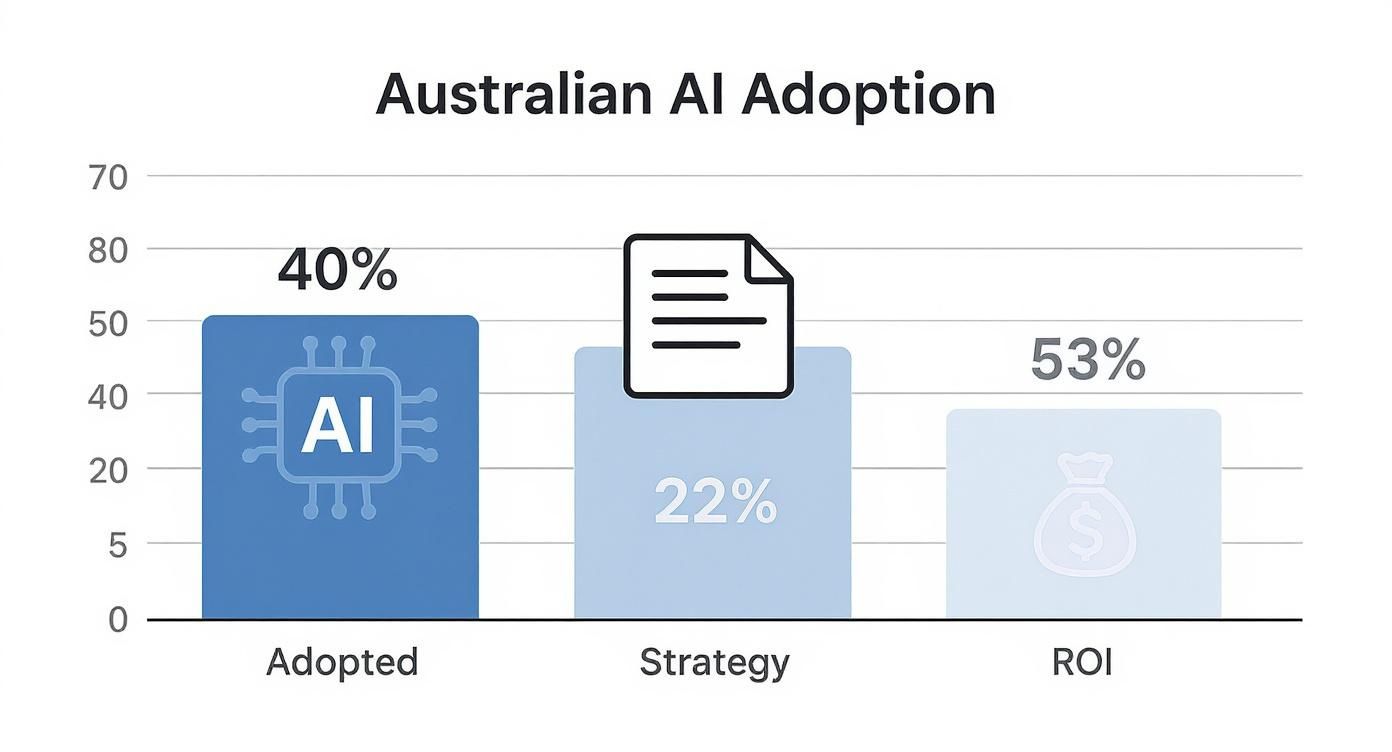
The data makes it pretty clear: while plenty of businesses are still figuring out their strategy, the early adopters are already reaping tangible financial rewards. That makes a powerful case for getting on board.
Pinpointing Direct Financial Savings
Beyond just saving time, AI brings direct financial savings that boost your bottom line and help the schemes you manage. These savings pop up from being more efficient and proactive, cutting down on both your operational costs and those nasty, unexpected expenses.
Predictive maintenance is a perfect example. Instead of reacting to a burst pipe or a failed lift—which means expensive emergency call-out fees and potential damage—an AI system can analyse asset data to schedule maintenance before things break. This forward-thinking approach can slash emergency repair costs by up to 40% a year.
The financial perks go beyond just maintenance. By automating things like levy reminders and meeting notices, you can dramatically cut down on physical costs like printing, postage, and the admin hours needed to manage it all.
To bring this to life, here’s a quick calculation showing the potential savings for a mid-sized strata portfolio.
Hypothetical Annual ROI of AI for a Mid-Sized Strata Portfolio
| Benefit Area | Estimated Annual Savings (Hours) | Estimated Annual Savings (AUD) |
|---|---|---|
| Reduced Admin Labour | 480 hours (at $40/hr) | $19,200 |
| Lower Emergency Repair Costs | – | $15,000 |
| Printing & Postage Reduction | – | $4,500 |
| Total Annual Savings | 480 Hours | $38,700 |
Once you put a dollar value on the reclaimed time and add in the direct cost reductions, the financial argument for implementing AI for body corporate managers is hard to ignore. It’s an investment that truly pays for itself through smarter operations, better cost control, and a higher level of service.
Navigating Compliance and Privacy with AI Tools

Bringing AI into your toolkit can unlock some incredible efficiencies, but it's vital to remember where the buck stops. The body corporate and its manager are legally accountable, so any tech you use has to operate within the strict boundaries of Australian law. AI is a powerful assistant, not a legal substitute.
This is a critical distinction to make. Think of an AI platform as a hyper-efficient paralegal. It can sift through mountains of data, draft documents, and flag potential issues with breathtaking speed. But just like a paralegal can’t give final legal advice, an AI can’t make legally binding decisions. That final judgement call always has to come from a qualified human.
Upholding the Australian Privacy Act
Whenever you introduce new technology into your workflow, data privacy has to be front and centre. For body corporate managers, this means strict adherence to the Australian Privacy Act 1988, which sets the rules for how personal information is handled.
AI systems often chew through huge amounts of sensitive data—from owner contact details to financial records and private correspondence. It's your job to make sure any AI provider you partner with has rock-solid security measures in place.
Before you sign on the dotted line, ask some direct questions about how they handle data:
- Data Sovereignty: Where is our data actually stored? For compliance peace of mind, you’ll want servers located right here in Australia.
- Encryption: Is all data encrypted both in transit (while it’s zipping across networks) and at rest (when it's sitting on a server)?
- Access Controls: Who has the keys to the kingdom? What systems are in place to stop unauthorised eyes from seeing sensitive information?
A failure to protect this information doesn't just erode trust; it can land you in serious legal and financial hot water. Your choice of an AI partner is a direct reflection of your commitment to privacy.
The Legal Status of AI-Generated Reports
AI can produce incredibly detailed reports, from maintenance forecasts to communication summaries. They’re fantastic for internal decision-making, but you need to be crystal clear on their legal limitations, especially when disputes arise.
Picture this: a maintenance report generated by an AI is presented as evidence in a tribunal like VCAT in Victoria or NCAT in New South Wales. The tribunal will almost certainly not accept it as standalone expert evidence. Why? You can't cross-examine an algorithm, it has no legal standing, and it can't provide the sworn testimony required of an expert witness.
The core responsibility for maintaining common property remains squarely with the body corporate under state legislation. An AI report can highlight a potential defect, but it cannot legally satisfy your statutory duties on its own.
This really hammers home a key point about AI for body corporate managers: the tech is there to augment your professional judgement, not replace it. Despite the rapid integration of AI, legal responsibilities haven't changed. As helpful as AI-powered detection can be, bodies corporate are still legally on the hook for common property, meaning AI reports alone just won't cut it as admissible expert evidence. You can read more about the legal risks of AI tools in strata maintenance to better understand these complexities.
Mitigating Risks with Human Oversight
The smartest way to leverage AI is to treat it as a powerful data analysis tool that feeds into your own decision-making process. The AI flags an issue, you investigate it, and then you make the final, informed call. This "human-in-the-loop" approach is your best defence against legal risk.
Here’s what that looks like in practice:
- AI Identifies: The system detects a pattern of moisture sensor alerts in a basement carpark.
- Manager Verifies: You send a trusted plumber to inspect the area in person.
- Expert Reports: The plumber provides a formal, written report confirming a waterproofing failure.
- Manager Acts: You use the plumber’s expert report—not the initial AI flag—to get quotes and seek committee approval for repairs.
Following a process like this ensures your actions are based on verifiable, expert human assessment. It keeps you compliant, protects the body corporate from liability, and proves that technology is there to enhance your duty of care, never to replace it.
Finding the Right AI Features for Your Strata Platform
Let's be honest, wading through tech options can feel like navigating a minefield of buzzwords. To find a platform that actually helps your business, you need to cut through the noise and zero in on features that solve real-world strata management problems. A genuinely useful AI tool should feel less like a novelty and more like a new, hyper-efficient member of your team.
When you're looking at different platforms, the real goal is to find practical functions that will genuinely cut down your admin load and make communication smoother. Think of this as your buyer's guide—a clear checklist to help you make a smart investment in AI for body corporate managers and get real value for your money.
Core Communication and Workflow Features
The best AI platforms get straight to the point, tackling your biggest daily headaches—especially that never-ending flood of calls and messages. You want to look for tools that don't just log communications, but actively help you manage them.
First up, an intelligent spam filter is non-negotiable. And I don't mean a generic one. You need a filter that’s been specifically trained on strata-related communications so it knows the difference between a genuine contractor invoice and junk mail. This simple feature keeps your inbox clean and ensures you never miss something critical.
Just as important is a business caller ID. This feature is a game-changer, giving you instant context on who's calling. Before you even pick up, you'll see the caller's name, which building they're calling about, and any recent messages they've sent. No more scrambling for information while the phone is ringing.
For managers who are always on the move, a mobile-first design is key. Look for things like ‘swipe-to-action’ workflows. Apps like OnSilent, for example, let you manage tasks, delegate calls, or fire off a reply right from your phone with a simple swipe. It’s about making your workflow seamless, wherever you are.
Integration and Customisation Capabilities
An AI tool that can't talk to your other systems is just another silo, creating more work than it saves. For any platform to be truly effective, it has to plug straight into the software you're already using every single day.
- CRM and Strata Software Integration: Check that the AI can connect directly with your existing strata management software. This is crucial for automatically syncing contacts, properties, and communication logs, which means no more tedious double data entry.
- Customisable Workflows: Every agency has its own way of doing things. The ability to tweak the tool to fit your specific processes is vital. You should be able to set your own rules for how messages are triaged or what actions get triggered by certain keywords.
At the end of the day, the right AI platform should bend to your business needs, not force you to change your processes. By focusing on these specific, high-impact features, you can confidently pick a solution that delivers a genuine return—saving you time, cutting down on stress, and freeing you up to focus on the work that really matters.
Got Questions About AI in Body Corporate Management?
Bringing any new tech into the mix is bound to raise a few eyebrows and a bunch of good questions. When it comes to AI for body corporate managers, it’s smart to cut through the noise, figure out what’s real, and see how it actually impacts your work, your data, and your committees.
Here are some straight-up answers to the questions we hear most often.
Will AI Take My Job?
Short answer: no. The whole point of AI in strata isn't to replace you, but to give you a serious leg-up. Think of it as a super-efficient assistant that takes on all the high-volume, mind-numbing tasks that clog up your day—like filtering endless non-urgent calls or sorting through a mountain of emails.
This frees you up to knuckle down on the complex, high-value stuff that actually requires your brainpower and expertise. Things like mediating disputes, planning for the future, and building solid relationships within the community. In a nutshell, AI for body corporate managers handles the grunt work so you can focus on what really counts.
Do I Need to Be a Tech Whiz to Use It?
Not at all. The last thing you need is another complicated system to learn. Modern AI platforms are built for busy people, not IT gurus. The best ones have simple, clean interfaces that make sense from the moment you log in.
Honestly, if you can use a smartphone, you’ve got all the tech skills you need. Good AI tools slot right into how you already work, usually through a simple app, without causing any headaches.
Is My Owners' Data Safe?
This is a big one, and rightly so. Data security is non-negotiable, and any vendor worth their salt takes it extremely seriously. When you're looking at different platforms, make sure they're up to scratch with Australian privacy laws and are transparent about how they protect your data.
Don't be shy about asking the hard questions:
- Where is our data actually stored? (You want to hear "in Australia".)
- What kind of encryption do you use to keep information locked down?
- Who can access the data, and under what specific rules?
How Do I Get the Committee on Board with the Cost?
To get the green light from your committee, you need to show them it's not just another expense—it's a smart investment. Build a clear business case that focuses on the real-world wins.
Frame it around these three key benefits:
- Giving You Time Back: Work out roughly how many hours your team will get back each week by not having to do repetitive admin.
- Saving Money: Point to direct savings from things like smarter, predictive maintenance and simply needing less time for admin overflow.
- Happier Owners: Talk up the value of faster response times and smoother, more professional communication for everyone in the building.
When they see that AI pays for itself in efficiency and better service, it becomes a much easier conversation.
Ready to see how an AI assistant can free up your time and streamline your communications? OnSilent is designed specifically for busy professionals like you. See how it works and start your free trial today.