

Strata management automation is all about using smart software to take care of the repetitive, time-consuming admin tasks that bog managers down. Think of it as an intelligent assistant that automatically handles routine jobs like processing invoices, sending out levy notices, and logging maintenance requests. The result? A smoother, more efficient strata scheme and managers who are free to focus on the bigger picture.
Unlocking Efficiency in Modern Strata Communities
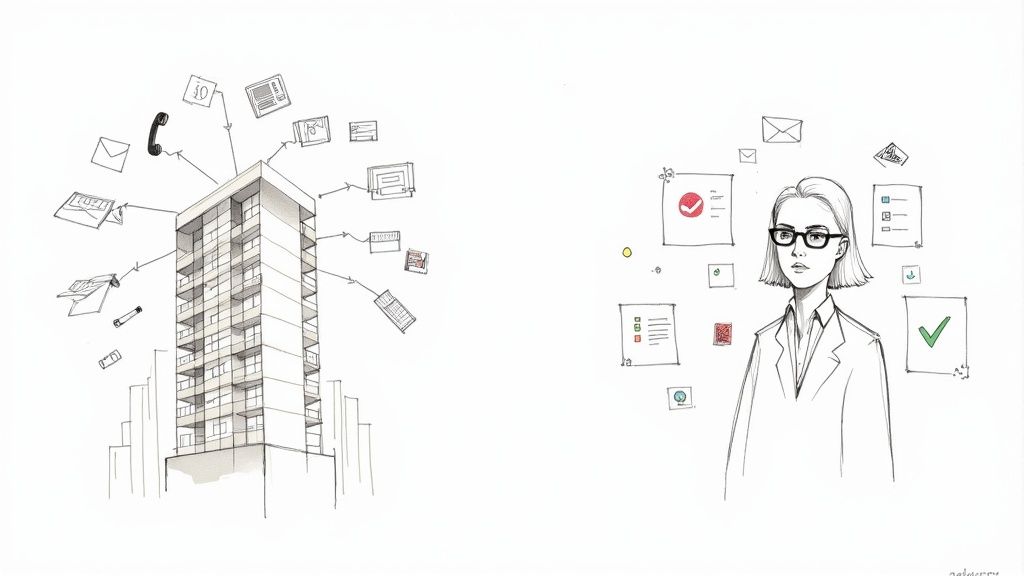
Picture a strata manager trying to run things with an old-school telephone switchboard. Every call, email, and maintenance request is a wire they have to manually plug into the right port. As the building gets busier, calls get dropped, messages get lost, and the operator is completely overwhelmed. For too many, this is the reality of traditional strata management.
Strata management automation swaps out that clunky switchboard for a sleek, digital system. It doesn't replace the manager; it empowers them. It takes over the high-volume, mind-numbing tasks that eat up most of their day, freeing them up to deal with what really matters.
The Driving Forces Behind Automation
So, what's pushing strata communities to make the switch? For starters, the administrative load on managers has ballooned, thanks to stricter compliance rules and the constant communication needed to keep everyone in the loop. At the same time, residents' expectations have skyrocketed—they want instant answers and total transparency, just like they get from every other digital service they use.
Automation isn't just a nice-to-have anymore; it's a must-have for running an efficient and compliant strata scheme. It shifts the manager's role from a reactive administrator putting out fires to a proactive community leader focused on strategy and relationships.
The scale of this challenge is massive. Australia is home to over 368,000 strata schemes, which adds up to more than 3.19 million individual lots. We're already seeing the impact of automation in the field. Platforms that automate work orders and maintenance have been shown to cut response times by up to 40% and improve communication efficiency by 35%. It's a game-changer.
Core Principles of Automated Workflows
At its heart, strata automation isn't some futuristic concept; it's a practical application of proven business principles. For anyone keen to dig deeper, understanding what workflow automation is all about provides a great foundation. The central idea is simple: create predefined rules that trigger actions automatically. This ensures everything runs smoothly and reliably, time after time.
This systematic approach directly tackles some of the biggest operational headaches:
- Minimising Human Error: When a process is automated, it follows the exact same steps every single time. This drastically cuts down on mistakes in things like financial data entry or sending out official notices.
- Improving Response Times: An urgent maintenance request can be instantly flagged and sent to the right contractor, without having to wait for a manager to manually forward it.
- Enhancing Financial Oversight: Automatic levy reminders and arrears tracking are a lifesaver. They improve cash flow and reduce the need for those awkward follow-up calls.
By building a system for these essential functions, strata management automation gives managers a solid foundation to build a thriving, well-run community.
Manual vs Automated Strata Tasks: A Quick Comparison
To really see the difference automation makes, it helps to put the old way and the new way side-by-side. The contrast is pretty stark.
| Strata Task | Manual Approach (The Old Way) | Automated Approach (The New Way) |
|---|---|---|
| Levy Notices | Manually creating and posting individual notices. Chasing late payments with phone calls. | Automatically generating and emailing notices. Sending scheduled reminders for overdue fees. |
| Maintenance Requests | Receiving a phone call, creating a work order, calling contractors for quotes, and following up. | Residents log requests via a portal. The system automatically notifies pre-approved contractors. |
| Meeting Minutes | Manually typing up notes from a meeting, formatting them, and emailing them out to all owners. | Using software to record, transcribe, and distribute minutes and action items almost instantly. |
| Document Management | Filing physical copies of invoices, reports, and correspondence. Searching through cabinets to find info. | Storing all documents in a secure, searchable cloud-based system accessible 24/7. |
| Communication | Sending out individual emails or posting notices in common areas. Hope everyone sees them. | Sending targeted mass communications via email or SMS. Centralised portal for all updates. |
It's clear that automation doesn't just speed things up; it fundamentally changes how work gets done, making the entire process more reliable, transparent, and less prone to error.
The Core Pillars of an Automated Platform

To really get what strata management automation can do, it’s helpful to stop thinking about it as just a list of features. Instead, picture a solid structure built on three core pillars. Each one supports a critical part of your operations, and they all work together to create a management system that's stable, efficient, and reliable.
Just like the foundations of a building, if one of these pillars is weak, the whole thing gets wobbly. So let’s break down what they are and what they actually do for you.
The Financial Engine
First up is the Financial Engine, and it's arguably the most critical. This pillar is all about keeping the strata scheme financially healthy. Cash flow is the lifeblood of any community, and this is the digital treasurer that works 24/7 to keep it moving smoothly.
It handles all the key financial jobs that can become a real headache:
- Automated Levy Collection: Forget manually generating and posting hundreds of notices. The system sends them out automatically by email on a set schedule. Simple, consistent, and always on time.
- Arrears Management: The platform tracks overdue payments and sends out scheduled reminders to residents. This gets rid of awkward follow-up calls and seriously improves collection rates.
- Invoice Processing: When a contractor's invoice lands in your inbox, the system can digitise it, send it to the right committee member for a tick of approval, and schedule the payment. It's a clean, traceable workflow.
By automating these tasks, the Financial Engine cuts down on human error, creates a crystal-clear audit trail, and gives everyone a real-time snapshot of the scheme’s finances. That kind of oversight is gold for good governance.
The Communication Hub
Next, we have the Communication Hub—the central nervous system of your strata community. We all know that good communication stops disputes before they start, builds trust, and keeps everyone in the loop. This pillar is designed to automate the flow of information between managers, committees, and residents.
It moves communication beyond messy email chains and notices stuck in the lift, creating clear channels for everyone involved. It turns communication chaos into an organised, efficient process.
Here’s what the Communication Hub takes care of:
- Centralised Resident Portals: A secure online spot where residents can find documents, check financial statements, and see important updates whenever they want.
- Automated Alerts and Notices: Need to let everyone know about a water shutdown or lift maintenance? Send out an instant SMS or email alert.
- Streamlined Meeting Coordination: Automatically send out meeting agendas, collect electronic proxies, and distribute the minutes after the meeting wraps up.
This pillar makes sure information gets to the right people at the right time, every time. It fosters a genuine sense of community and transparency, which goes a long way toward keeping residents happy.
One of the biggest communication bottlenecks has always been the endless stream of phone calls and voicemails. But modern strata automation uses AI to turn this weakness into a major strength, transforming missed calls into tasks that get done.
An AI call assistant can handle incoming calls, transcribe voicemails into text, and even create a task directly in the management system. For instance, a resident's voicemail about a broken garage door can be automatically turned into a maintenance request and assigned straight to the right contractor. No more lost messages.
The Compliance Guardian
The final pillar is the Compliance Guardian. Think of it as the scheme’s automated risk manager. Strata management is tangled in complex legislation, and dropping the ball on compliance can lead to some hefty penalties.
This pillar is built to keep an eye on critical dates, track regulatory requirements, and maintain perfect records. It helps strata managers navigate the maze of by-laws and state legislation without breaking a sweat.
It handles the crucial jobs that mitigate risk:
- By-Law Enforcement Tracking: Automates the whole process for managing breaches, from sending the first warning to issuing a formal notice, all while keeping a complete digital record.
- Critical Date Monitoring: Tracks deadlines for things like insurance renewals, fire safety inspections, and AGMs, sending automated alerts so nothing ever gets missed.
- Report Generation: Creates detailed compliance reports for committee meetings with just a few clicks, proving that all the necessary regulations are being met.
Together, these three pillars—the Financial Engine, Communication Hub, and Compliance Guardian—form the foundation of a truly robust strata management automation platform. They work together to slash administrative work, improve financial health, build better communication, and lock down compliance.
Calculating the ROI of Strata Automation
So, beyond all the talk about benefits, how does strata management automation actually boost your bottom line? The return on investment (ROI) isn’t just about trimming a few expenses here and there. It’s a powerful mix of direct cost cuts, recovered time, and real opportunities to grow your business. Getting a handle on this value is the key to building a solid case for owners and committees.
The easiest place to start is with the tangible, direct savings. Think about all the costs tied up in old-school, manual admin. We’re talking about printing mountains of paper for meeting notices, the postage for hundreds of levy letters, and the endless hours your staff sink into data entry. These are all direct hits to your budget that automation can drastically shrink or get rid of completely.
Quantifying Direct Cost Savings
Let's break down where you'll see the immediate financial wins. Of course, every strata scheme is different, but the savings in these key areas tend to add up fast, giving you a clear and immediate return.
- Reduced Administrative Labour: Automation steps in to handle the grind of repetitive tasks, like processing invoices and chasing up arrears. This frees up your admin team to focus on work that actually adds value, instead of just plugging away at manual data entry.
- Lower Material Costs: Going digital with your communications means a huge drop in what you spend on paper, ink, envelopes, and stamps. For a bigger scheme, these costs can easily run into the thousands each year.
- Faster Levy Collection: Automated reminders and simple online payment options mean levies get paid on time, more often. This directly improves the body corporate's cash flow, reducing the need for expensive financing or putting off important maintenance.
These direct savings are the foundation of your ROI calculation. They're the simplest numbers to track and make a straightforward financial argument for bringing in new tech.
Unpacking the Indirect Returns
But the real gold in strata management automation often lies in the indirect returns. These benefits might be a bit trickier to nail down on a spreadsheet, but their long-term impact on your profitability and sustainability is massive.
One of the biggest indirect wins is better manager retention. Burnout is a huge problem in the strata industry, fuelled by crushing admin loads and constant pressure. By automating the most tedious parts of the job, managers feel less stressed and have more headspace for strategic planning and building stronger community relationships. This leads to better job satisfaction and less staff turnover—which is a massive cost saving in itself.
The real game-changer is unlocking your growth potential. An automated system lets a management company take on more buildings without needing to hire more admin staff. That’s a direct boost to profitability.
Then there’s the crucial idea of opportunity cost. This is all about the value you're missing out on by sticking with clunky, manual processes. Every hour a manager spends chasing an invoice is an hour they could have spent negotiating a better maintenance contract or advising a committee on a major capital works project. Automation hands that valuable time right back to you.
The Financial Impact of Efficient Operations
Running a tight ship with automation creates a positive financial ripple effect. Take an automated maintenance workflow, for instance. It doesn't just save admin time; it can slash long-term repair costs. When residents can easily log issues through a portal, problems get spotted and fixed faster, stopping small leaks from turning into major, expensive water damage.
The industry data backs this up big time. Over 60% of strata managers in major Aussie cities are now using digital platforms, reporting a 30% reduction in administrative workload and a 25% jump in resident satisfaction. Systems that let residents log maintenance requests on their phones have been shown to cut response times by up to 50%. If you want to see how technology is reshaping the game, you can read more about future property management trends. This isn't just about convenience—it's about driving financial performance and delivering better service.
Your Roadmap for Implementing Automation
Bringing a new automation system into your strata management practice can feel like a massive project, but breaking it down into a clear, step-by-step roadmap makes the whole process manageable. Think of it as a guide to get you from planning to a successful launch without the usual headaches.
Following a solid plan helps you sidestep common traps and really get the most bang for your buck. The journey doesn't start with picking software; it starts with a good, hard look at your own operations. This first step is the foundation for everything that follows, making sure the tech you choose actually solves your real-world problems.
Phase 1: Assessment and Goal Setting
Before you even think about watching a software demo, you need to pinpoint your biggest operational headaches. Are your managers drowning in manual invoice processing? Is chasing up levy arrears eating up half their week? Or is messy communication with residents causing unnecessary friction?
Get it all down on paper. Make a list of these challenges and then set some clear, measurable goals for what you want strata management automation to fix. For example, a great goal would be to "cut down time spent on arrears management by 50% within six months." Another could be to "get a 90% resident sign-up rate for the new communication portal in the first quarter."
These goals will act as your north star, guiding every single decision you make from here on out.
Phase 2: Choosing the Right Software Partner
Once your goals are crystal clear, it’s time to start checking out potential software partners. This is about more than just ticking off features on a list; it’s about finding a provider who genuinely gets the ins and outs of the Australian strata industry. As you map out your implementation, it's a good idea to compare various property management software options to find the perfect fit for your business.
Pull together a checklist to size up potential vendors, zeroing in on a few key things:
- Local Support: Is their support team actually based in Australia and available when you are?
- Data Security: How do they handle your community's sensitive data, and are they up to scratch with Australian privacy laws?
- Integration Capabilities: Can the platform easily connect with your accounting software or other tools you already rely on?
- User Experience: Is the interface straightforward and easy for both your managers and residents to pick up and use?
The right partner won't feel like just another vendor; they'll feel like a collaborator who's as invested in your success as you are.
Phase 3: Data Migration and System Setup
After you've picked your partner, the next job is to get all your existing information into the new system. This part, called data migration, can sound a bit daunting, but a good provider will walk you through it. They should have a clear, secure process for transferring everything—owner details, financial records, and all your property info.
During this phase, you’ll also work with them to tweak the system to fit your specific workflows. This is when you set up the cool stuff, like automated rules for levy reminders, how maintenance requests get routed, and communication templates. You're basically tailoring the platform to run the way you do.
A well-planned data migration is non-negotiable. Think of it like packing and labelling boxes before a big house move—a bit of organisation upfront saves you from total chaos later and makes sure everything ends up exactly where it should be in your new digital home.
Phase 4: Team Training and Change Management
Let’s be honest, technology is only useful if your team knows how to use it. Proper training is an absolute must. Your software partner should offer structured training sessions for everyone on your team, covering the daily tasks as well as the more advanced reporting features.
But success isn't just about training; it's about managing the change. Start talking to your team about the benefits of the new system early and often. Don't frame it as a replacement for their expertise. Instead, show them how it’s a tool that will get rid of the boring, repetitive tasks and free them up to focus on more valuable work. Getting your team genuinely excited about the possibilities is the secret to a smooth rollout.
This flow is pretty simple but powerful. The initial savings lead to more time, which lets your team deliver higher value.
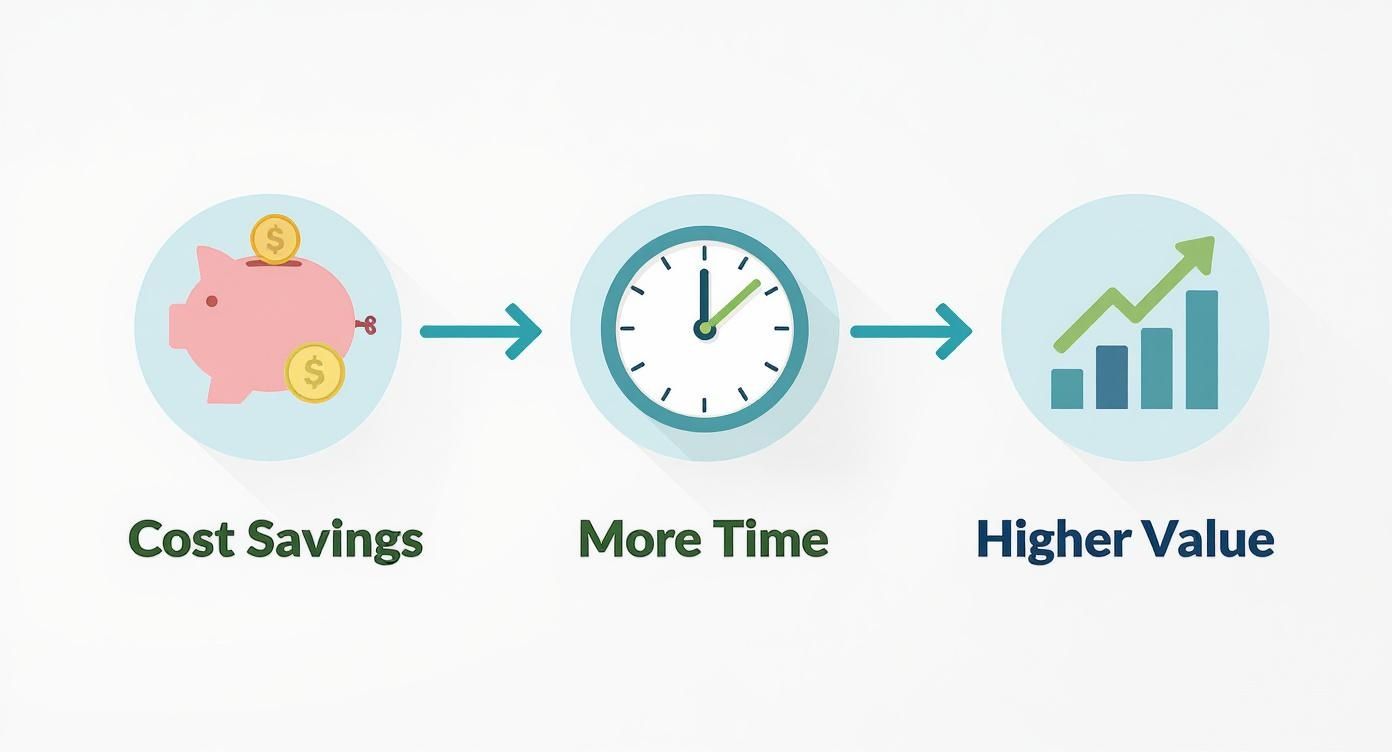
As the visual shows, direct cost savings free up time, which managers can then reinvest into strategic work that brings greater value to your communities.
Phase 5: Launch and Continuous Improvement
The final phase is the go-live! This is when you officially introduce the system to your residents and committee members. Kick things off with clear communication, providing simple guides and support to help everyone log into the new portal. A staggered launch, maybe starting with just one or two buildings, is a smart way to iron out any kinks on a smaller scale.
But the work doesn't stop once you've launched. Make sure to ask for feedback from both your staff and residents to see what’s working and where you can make things even better. Use the system's analytics to check your progress against the goals you set way back in Phase 1. Strata management automation isn't a "set and forget" thing; it's a platform that helps you keep getting better and evolves right alongside your community's needs.
Real-World Strata Automation in Action
The theory is great, but seeing strata management automation actually work is where the lightbulb really goes on. Let's step away from the concepts and look at a few real-world situations where automated workflows solve the very problems that chew up a manager's time and energy.
These stories show how a smart system can tackle complex, multi-step processes on its own, turning potential chaos into a perfectly executed sequence of events. Once you see it in action, you get a real feel for the impact on efficiency, communication, and keeping risks in check.
The After-Hours Emergency
It’s 2:00 AM on a Saturday. A pipe bursts in a top-floor apartment. The old way? A panicked resident leaves a garbled voicemail, hoping the on-call manager happens to check it before the whole building has a water feature. The manager then has to wake up, hunt for the emergency plumber's number, and start dialling.
With automation, the story plays out very differently.
- The Call Comes In: The resident calls the after-hours number and leaves a message. An AI assistant instantly transcribes it, picking up keywords like "burst pipe" and "urgent water leak."
- The Workflow Kicks Off: The system flags the urgency and triggers an emergency maintenance workflow. No human intervention needed.
- Instant Alerts Go Out: It automatically sends an SMS to the pre-approved on-call plumber with the resident's details and the problem. At the same time, an email pings the strata committee, letting them know what’s happened and that it's being handled.
- A Perfect Paper Trail: Every single step—from the initial call to the final notification—is logged in the system, creating a flawless, time-stamped record.
The whole thing happens in minutes, not hours. The leak is contained faster, damage is minimised, and the manager can sleep soundly, knowing the system is on the job.
This isn't just about making life easier; it's about protecting the building's assets and mitigating risk. An automated emergency response can save thousands of dollars in potential damages and insurance claims by guaranteeing immediate action is taken, every single time.
The Annual General Meeting
Pulling together an Annual General Meeting (AGM) is a massive administrative headache. It involves dozens of steps that can take weeks to get right. Honestly, it’s a prime candidate for strata management automation, turning a logistical nightmare into a smooth, straightforward process.
An automated system can manage the entire AGM lifecycle from start to finish:
- Sending Notices: It automatically generates and emails the official meeting notice, agenda, and financial statements to all owners on the legally required date. No more mail merges or missed deadlines.
- Collecting Proxies: Owners can submit their proxy votes electronically through a secure portal. This gets rid of the hassle of collecting and counting paper forms.
- Generating Minutes: During the meeting, software can help create draft minutes in real-time. Afterwards, it can distribute the finalised minutes and action items to every attendee with a single click.
This level of automation frees up an incredible amount of admin time, slashes the risk of human error, and just makes it easier for all owners to participate.
Managing a By-Law Breach
Dealing with by-law breaches, like a recurring noise complaint, can be a sensitive and drawn-out affair. Automation brings consistency and fairness to the table, all while creating a bulletproof record of every conversation.
Here’s how it works. A resident submits a noise complaint through the online portal, which kicks off an automated by-law management workflow.
- Initial Log: The complaint is logged with a time-stamp, and an automatic acknowledgement is sent straight back to the person who reported it.
- First Notice: The system generates a polite, pre-approved initial warning notice and emails it to the owner of the unit in question.
- Escalation Path: If another complaint is logged after a set period, the system automatically escalates things, sending a formal breach notice as required by legislation.
This workflow makes sure by-laws are enforced consistently every time. It removes the emotional element from the initial stages and builds a clear, documented history that’s invaluable if the issue ever needs to go to formal mediation or legal action. It makes compliance management both fair and efficient.
Getting Over the Hurdles: Common Automation Challenges and Best Practices
Let's be real—bringing in a new strata management automation system isn't just a technical upgrade; it's a cultural one. And while the payoff is huge, getting there means navigating a few potential bumps in the road. If you're prepared for these challenges with a few proven strategies, your new platform will feel like a long-term asset, not a short-term headache.
You’ll find the most common roadblocks often have more to do with people and processes than the software itself. Things like getting residents on board with new tech, convincing a cautious committee about the initial spend, and making sure everyone's data is locked down tight can stop a great idea in its tracks.
Overcoming Implementation Hurdles
The trick is to tackle these issues head-on. Every single one has a practical solution that can make the transition smoother for managers, committees, and residents. A bit of foresight here goes a long way in building confidence and getting everyone to actually use the new system.
Here are a few common tripwires and how to sidestep them:
- Resident Pushback: Some residents just aren't keen on new technology. The best way to handle this is with clear, consistent communication that spells out the benefits for them—like 24/7 access to documents and getting their maintenance requests sorted faster. It's a good idea to run a few training sessions and keep the old-school communication channels open for those who aren't so tech-savvy.
- Justifying the Investment: That initial cost can make a committee nervous. Your best bet is to build a rock-solid business case that focuses on the long-term ROI. Don't just talk about the direct savings from less printing and postage; highlight the massive win of clawing back administrative hours and improving your building's cash flow.
- Data Security Concerns: Protecting community data is absolutely non-negotiable. Make sure you partner with a vendor who is compliant with Australian privacy laws and can show you their security creds, like solid data encryption and secure cloud hosting.
Best Practices for Long-Term Success
Just installing the software and calling it a day won't cut it. The real goal is to create a culture of continuous improvement, where your automation platform grows and adapts right alongside your community. This means you need to commit to regular check-ins and strategic oversight.
This forward-thinking approach is especially critical as rules and regulations change. For instance, recent government reforms in New South Wales have put a much tighter rein on strata governance, making automated systems almost essential for staying compliant. In fact, these reforms, combined with automation, have already led to a 20% drop in compliance-related disputes. On top of that, 70% of strata managers now report using specific cybersecurity measures to protect their data. To get a better sense of how managers are navigating this new world, you can read the full webinar summary on adapting to the new strata environment.
A successful automation strategy is never "set and forget." It requires regular review, data-driven adjustments, and a commitment to using the platform's insights to make smarter operational decisions for the future.
Got Questions About Automation? We’ve Got Answers.
Jumping into new technology always brings up a few questions. To give you a clear picture of how strata management automation works in the real world, we've put together answers to the queries we hear most often from managers and committee members. These are straight-up, no-nonsense answers to help you feel confident about making the switch.
Moving to an automated system is a big step, so it’s totally normal to wonder about the costs, how it'll affect your staff, and whether your community will get on board with it. Let's get right into it.
Isn't Strata Management Automation Expensive to Set Up?
While there’s an initial cost, it’s much better to look at it as an investment that pays you back over time. Most modern platforms run on a subscription basis, so you can forget about massive, one-off capital expenses. The real win comes from the huge savings on admin hours, printing, postage, and better cash flow from getting levies paid faster.
When you actually sit down and add up the cost of doing things the old way—all those hours chasing arrears, the paper and ink for printing hundreds of documents—you'll find that automation often pays for itself surprisingly fast. It’s an investment in a smoother operation that delivers real, measurable financial returns.
Will Automation Make Our Strata Manager Redundant?
Absolutely not. The whole point of automation is to empower your strata manager, not replace them. By taking all the repetitive, soul-destroying admin work off their plate, it frees them up to focus on the high-value stuff that actually needs a human touch.
Think of it like this: automation handles the predictable, routine tasks so your manager can tackle complex problem-solving, build genuine relationships within the community, and offer strategic advice to the committee. It lets them be proactive leaders, not just reactive administrators.
How Do We Get Less Tech-Savvy Residents Onboard?
The key here is a gentle rollout and clear communication across a few different channels. Start by picking a platform with a simple, clean interface that doesn't look like a spaceship's control panel. You can introduce new features one by one, maybe starting with automated email notices before you even mention a full resident portal.
Give people simple, easy-to-follow instructions in a few different ways:
- Printed Guides: A simple one-pager dropped in mailboxes can work wonders.
- Info Sessions: Host a quick, casual drop-in session to walk residents through how it all works.
- One-on-One Help: Offer to help residents get set up over the phone.
The most important thing is to keep the old ways of doing things—like phone calls and paper notices—available for those who can't or don't want to switch. That way, nobody in the community gets left behind.
How Secure Is Our Strata Community's Data?
Data security is non-negotiable for any decent provider. When you're looking at different platforms, make sure they comply with Australian privacy laws and use solid security measures like data encryption and secure, onshore cloud hosting. Your data should always belong to your strata scheme, period.
A trustworthy vendor will be upfront about their policies on data ownership, who can access what, and how they back everything up. This gives you total peace of mind that your community’s sensitive information is locked down tight and protected from anyone who shouldn't see it.
Stop letting missed calls turn into missed opportunities. OnSilent acts as your AI assistant, ensuring every call is answered and every lead is captured, giving you back hours every week. Start your free 2-week trial today and see how effortless communication can be.